Review: Girl from the North Country at Belk Theater
By Perry Tannenbaum

When it premiered in 2017 at The Old Vic in London, Girl from the North Country must have seemed like the fruition of a musical theatre dream team. The original book would be by acclaimed Irish playwright Conor McPherson, who would freely roam amidst the vast catalogue of music and lyrics by Bob Dylan, the 2016 Nobel Prize Laureate, to choose his songlist. By most surviving accounts and reviews, Girl from the North Country was must-see theatre in two successive London productions, Off-Broadway in 2018, and on Broadway in 2020.
Previous peeps at the show on the road, chronicled in regional sections of BWW, have only been slightly less enthusiastic. So opening night at Belk Theater earlier this week was a massive shock when the national tour touched down here for the 28th of its 30 scheduled stops.
The first stunner was the sparsity of the crowd. Often sold out on opening night for brand-name shows, the Belk was less than half-filled for the Charlotte premiere. Traffic to the Uptown was no lighter than usual, and blackouts had already been a non-factor for previous events I had covered in Plaza Midwood and Davidson. Were fervid Dylan fanatics, among the most loyal anywhere, diverted by the WNBA Playoffs? Were they glued to their TV sets, watching the Walz-Vance debate?
Whatever reason the stay-aways may have had, the biggest shocker was that the no-shows were so right. The dream team is merely a mirage on the road, though the esteemed playwright is still listed as the stage director.
As much as we both love Dylan – my wife Sue and I held hands when the mighty “Hurricane” was sung – Girl from the North Country never fully connected with us. The boxer and escaped convict in McPherson’s script is Joe Scott, we’re in 1934 Duluth (three years before Rubin “Hurricane” Carter was born), and when Warren Nolan Jr.* plunges into the song, he must segue into “All Along the Watchtower” long before the tale of the framed boxer reaches its epic, cumulative power and intensity.

This is not the story of the Hurricane. Yet the connection of this suddenly anachronistic song, unlike the decisively irrelevant “Watchtower” or “Idiot Wind” that complete the medley, is stronger than nearly all the others we hear. At its worst, the beginning of Act 2 at Nick Laine’s dingy Duluth boarding house devolves into a chaotic Dylan concert with no forward-moving drama at all, the most inert and aimless musical theatre I’ve seen since Cats purred back from its intermission.
Action revolves around the innkeeper, his bipolar wife Elizabeth Laine, his alcoholic and artistic son Gene, and his adopted black daughter Marianne, five months pregnant. Curiously, Nick is the musical eye of this stormy family, the only member who never gets a solo to sing. John Schiappa is devoted to his demented wife, whom he dutifully feeds though she might slap the plate out of his hands, but he cares more for his longtime boarder, Carla Woods as Mrs. Neilsen, a possible financial lifeline if her late husband’s ever gets out of probate.

As Elizabeth, Jennifer Blood gets the most outré actions from McPherson – even when she’s brooding at an upright piano – and a royal gem from the Dylan songbook at the end of each act, “Like a Rolling Stone” followed “Forever Young.” These briefly sounded like echoes from the days of Janis Joplin reign as rock’s blues queen. Days of mad incense and love. Elizabeth has more reasons to be jealous of her admirably stable and ruggedly handsome husband than justifications for her relentless resentfulness and orneriness.
Yet even this most powerful of McPherson’s roles never quite bridges the gap between the footlights and our hearts. My most generous theories for why this was so on opening night are the sheer size of the Belk, double the seating capacities of the houses where North Country played London and New York, and the wretchedness of the sound, a chronic Blumenthal ailment.
Come back to us, MJ! – or at least send your sound crew.
Sharaé Moultrie gives a velvety smooth voice to Marianne and, despite her precarious position as an unwed mother-to-be, enough serenity for us to occasionally suspect that her conception was immaculate. She gets her share of solos, if not the choicest harvest. Dramatically, Marianne is the calm center of a vortex, with love and affection swirling around her from at least three different men.
Concerned about her future, Nick seeks to wed her to the financially secure – but elderly – Mr. Perry, portrayed by Jay Russell with humility, gentleness, and heart. Manuel as Joe is almost immediately smitten by Marianne, no doubt imagining himself as her redemption and she as his. She has reason to be impressed, for when he was challenged to a fight by her drunken brother Gene, Joe reluctantly yielded to the challenge and floored Gene with a single blow.
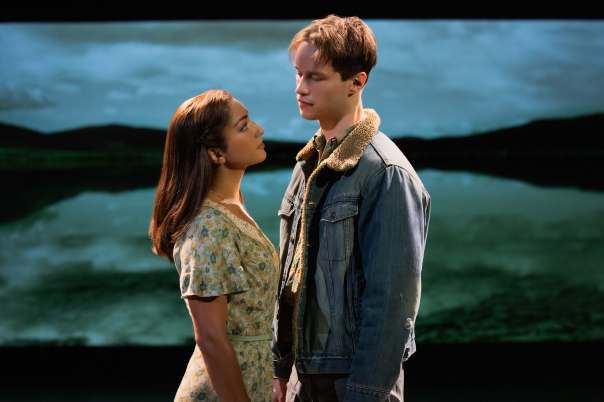
Prodded by Nick to get a job to help steady the Laines’ finances and avert foreclosure on the guesthouse, Aidan Wharton* as Gene sees his hopes of becoming a writer fading away. More sorrows to drown in drink are triggered by his ladylove, Chiara Trentalange as Kate Draper, when she announces that she is already engaged to be more pragmatically married. The ensuing Wharton-Trentalange duet on “I Want You” was probably the most dramatically apt of the evening.
Might have been more impactful in a smaller house with cleaner sound.
McPherson puts plenty of life onstage that never quite projects to Belk’s empty upper balconies. Aside from Mr. Perry; a wild bible salesman with a frayed clerical collar arrives with Joe, Jeremy Webb as Reverend Marlowe; and our sometime narrator, Alan Ariano as Dr. Walker, pops up periodically at the boarding house, making his rounds. Of the two, Webb as Marlowe is far more dangerous – almost dramatic – for his fugitive status and his poverty make his sales pitches aggressively hard-sell and his fingers tend to get sticky when he thinks nobody is looking.
With so many plots already brewing in Duluth, McPherson thoughtfully adds a family from the outside world that tends to add variety to the inbred local atmosphere of seediness and decay. The well-dressed Burkes are a fallen uppercrust family, as iconic during the Great Depression as the downtrodden wanderers crossing the Dust Bowl to sunny California.

Both Mr. Burke, who lost his business during the Great Crash, and Mrs. Burke, who lost a chunk of her patrician trust and self-confidence as a result, are on the lookout for new opportunities, not necessarily with each other. Both David Benoit and Jill Van Velzer, playing the elder Burkes, also sit down occasionally to play the drums, adding a new musical level to the evening while expanding the social context of North Country. Benoit gets to be more decadent, proposing to manage a ring comeback for Joe.
The couple’s son Elias has some sort of learning problem, so D’Marreon Alexander* gets a breakout moment in Act 2 – parallel to Blood’s with “Rolling Stone” in Act 1 – when Elias suddenly emerges from his cognitive cocoon with “Duquesne Whistle.” Doubly surprising for me, for “Duquesne” hurtles forward with the drive of Dylan’s best work and because I’d never heard the 2012 composition before. Wow.
I wish I could praise any of McPherson’s dramatic moments as highly. We’re not likely to experience a theatre week such as the current one for ages to come. Two living playwrights who have translated works by Anton Chekhov – and do not hesitate to use his methods – have pieces running simultaneously in Metrolina. Arguably, McPherson’s book, repeatedly stressing the consequences of inaction, has more of the Russian master’s most distinctive flavor.
But Stephen Karam’s The Humans, set in post-9/11 and post-Hurricane-Sandy Chinatown, will rock your world. Anyone torn between the two would be best-advised to bypass the Broadway Lights production at the Belk and head up Interstate 77 to Davidson, where Karam’s masterwork is playing at the Armour Street Theatre.
*Note: On opening night, Wharton, who normally portrays Elias, replaced Ben Biggers (sick all week ) as Gene. Alexander replaced Wharton as Elias and Nolan Jr. subbed for Matt Manuel.


 Art on My Sleeve