Review: Jazz @ Theatree Bechtler with Nicolas Bearde
By Perry Tannenbaum
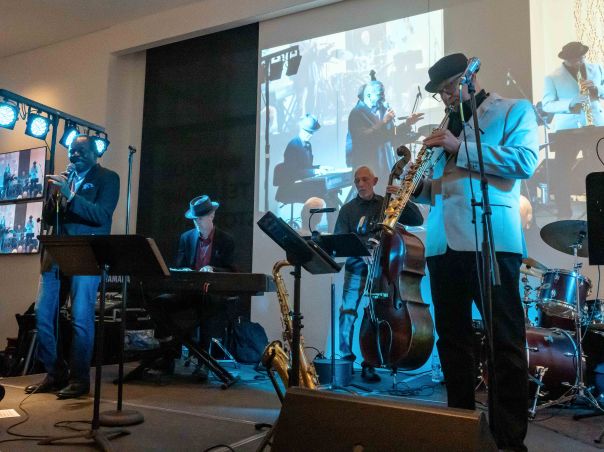
October 4, 2024, Charlotte, NC – As a listener and a sometime vocalist, my feeling is that a jazz singer backed by a piano trio can only verge on the sublime. Until a horn is added – saxophone, trumpet, or clarinet parlaying and intertwining with the vocalist – the divine nectar never quite sparkles with maximum effervescence. So it’s always a joy when the Jazz at the Bechtler series hosts a guest vocalist, for the leader of the house band, Ziad Rabie, always carries a tenor and soprano sax with him to fortify the artillery. Before Nicolas Bearde’s appearance on Friday, I hadn’t been to one of these bacchanals since Nnenna Freelon guested in May 2022, so I was behind the curve in terms of how the experience in the Bechtler Museum of Modern Arts lobby has been enhanced.
Perhaps influenced by Middle C Jazz over on Brevard Street, the Bechtler bandstand is now framed by large video monitors displaying a live feed of the concert – that is also projected as a larger-then-life backdrop upstage of the players. The effect of the live pastel projections is electrifying, especially if your sightline differs radically from the camera’s, and the projected images are helpful if your view of one of the musicians is obscured. A music stand downstage blocked my view of drummer Rick Dior sitting behind Rabie, but when I stood up briefly to snap a photo of him, I discovered that a second music stand right at his drum kit was still blocking my view. Luckily, the live feed up above him was available to us when he took a solo.

Bearde last sang in Charlotte at the tenth anniversary celebration of the Bechtler series staged at the adjoining Knight Theater in January 2022. That was my gateway to his discography, which certainly reinforced my notion that he agreed with me on jamming with a horn. There were plenty of Nat King Cole tracks online that were delightful to discover from his recent album on Spotify, along with a few Johnny Hartman gems on past recordings. He’s been around long enough, since before the turn of the millennium, to have accumulated two Spotify artist listings that do not overlap – and he still sounded like he’s at the top of his game. The two saxophonists who have played on Bearde’s last two albums, Eric Alexander and Vincent Herring, are both self-recommending – and they both supplied a sheaf of candidates for seamless transport to the Bechtler lobby and Ziad’s capable hands.
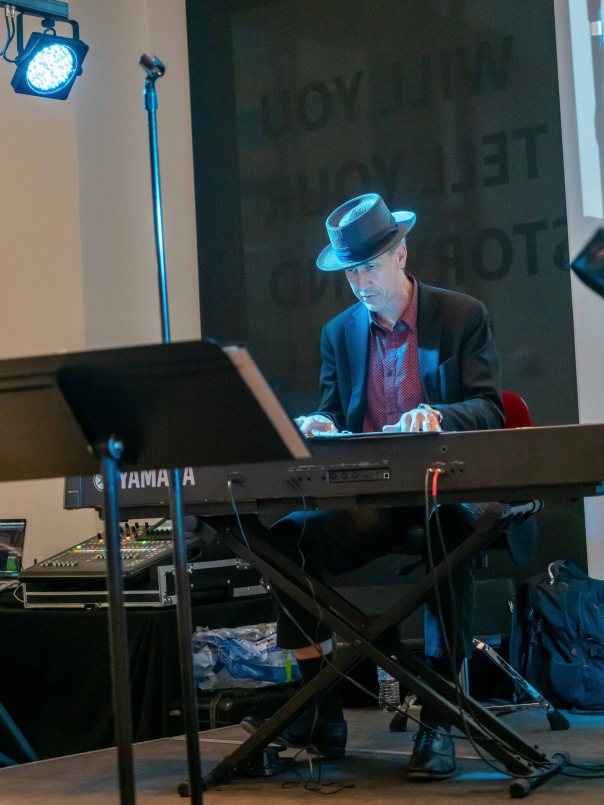
So did two of the songs Bearde sang in 2022, his own “Falling in Love Again” and Abbey Lincoln’s “Living Room,” both of which were reprised in more extended versions. The baritone began his set with the same song that began his 2016 album, Invitation,Burton Lane and Alan Jay Lerner’s “Come Back to Me.” Where Herring had inserted his alto, Ziad now blazed with his soprano sax, with extra space in the arrangement set aside for pianist Noel Freidline’s ruminations – all with the speed and verve of the lyric’s “turn the highway to dust, break the law if you must” spirit.
With “That Sunday, That Summer,” Bearde brought us the first of two tracks selected from his Nat Cole tribute album, both of which, not at all coincidentally, featuring Alexander on tenor sax. Bearde’s way with the song is jazzier than Cole’s 1963 saccharine hit – with its lush strings, full chorus, and glinting triangle – but I can’t say I like all the added syncopation he brings to the table. Best of the covers, to me, is a Sarah Vaughan version not to be found on Spotify. That revelation is online exclusively at Apple Music on her Jimmy Rowles Quintet album from 1974.
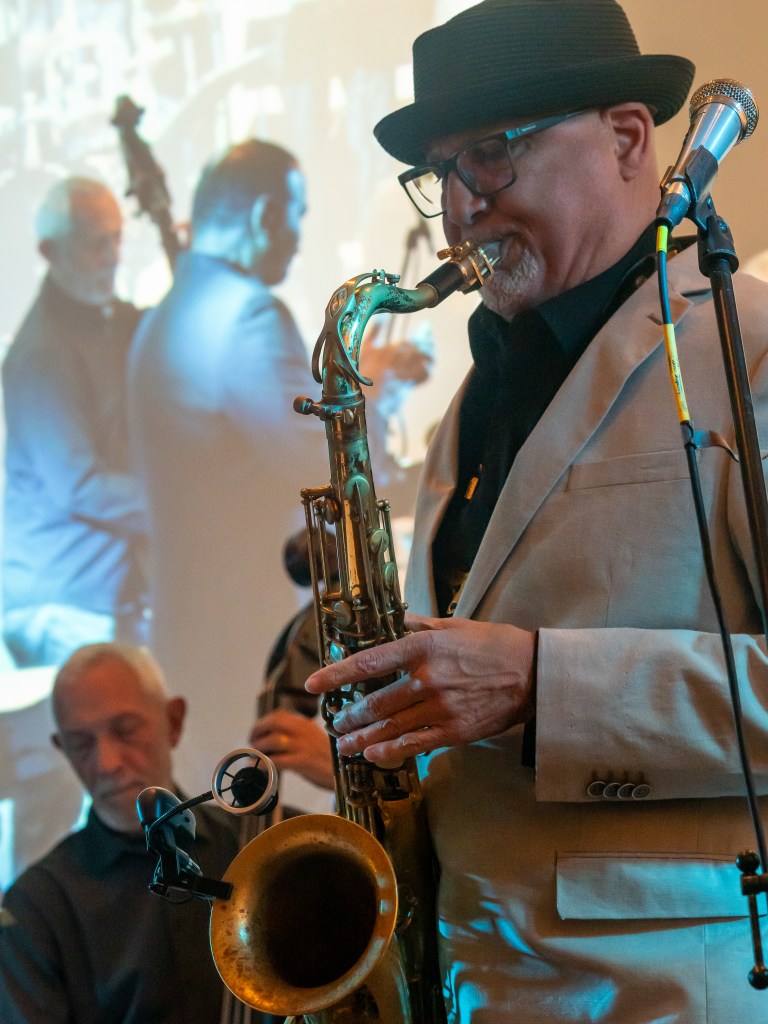
Bearde was entirely in his groove thereafter, beginning with his cha-cha inflected Burt Bacharach hit, “Close to You,” with some fine solos by both Ziad and Freidline – and a wonderful breakaway into 4/4 tempo in the middle of the vocal reprise – with some extra Beard/Ziad jamming afterwards. Lincoln’s “Living Room” was beautifully embroidered the second time around with an introductory Freidline fantasia intro from his electric keyboard and a regal solo from bassist Ron Brendle after Ziad’s tenor sax proclamation. Most unexpected and exciting was a new song, “Si Vous Saviez,” written by Rabie with Jennifer Shea. If you’ve heard John Coltrane’s Ballads album, you can begin to imagine the lovely sound of Ziad’s creamy, buttery intro on tenor sax, and Bearde took to the longish tune like he was seriously considering recording it on his next album.
The rest of the set included songs that Bearde has already taken to the studio, starting with the moody title tune from the Invitation release, which saw a fine intro and later solo from Ziad and, notwithstanding the comparatively mellow mood, a fine chunk of work from Dior on the solo I screened. Plucked from his Nat Cole tribute, “Thou Swell” actually began life as part of Rodgers & Hart’s A Connecticut Yankee in 1927, where its archaic language was perfectly apt. Both Ziad and Freidline contributed zippy, palate cleansing solos that readied us for the finale.
Once again it was “Falling in Love Again,” with Bearde elucidating on his composition at greater length before performing it this time. Further engaging us, he encouraged us in the audience to clap out the rhythm as Freidline, chided all through concert for his snazzy (and Sinatra-like) chapeau, pounded out a genial piano intro. Everybody was in great spirits by this point, and Ziad gave us one more reason to applaud with his screaming tenor sax.
Photos by Perry Tannenbaum


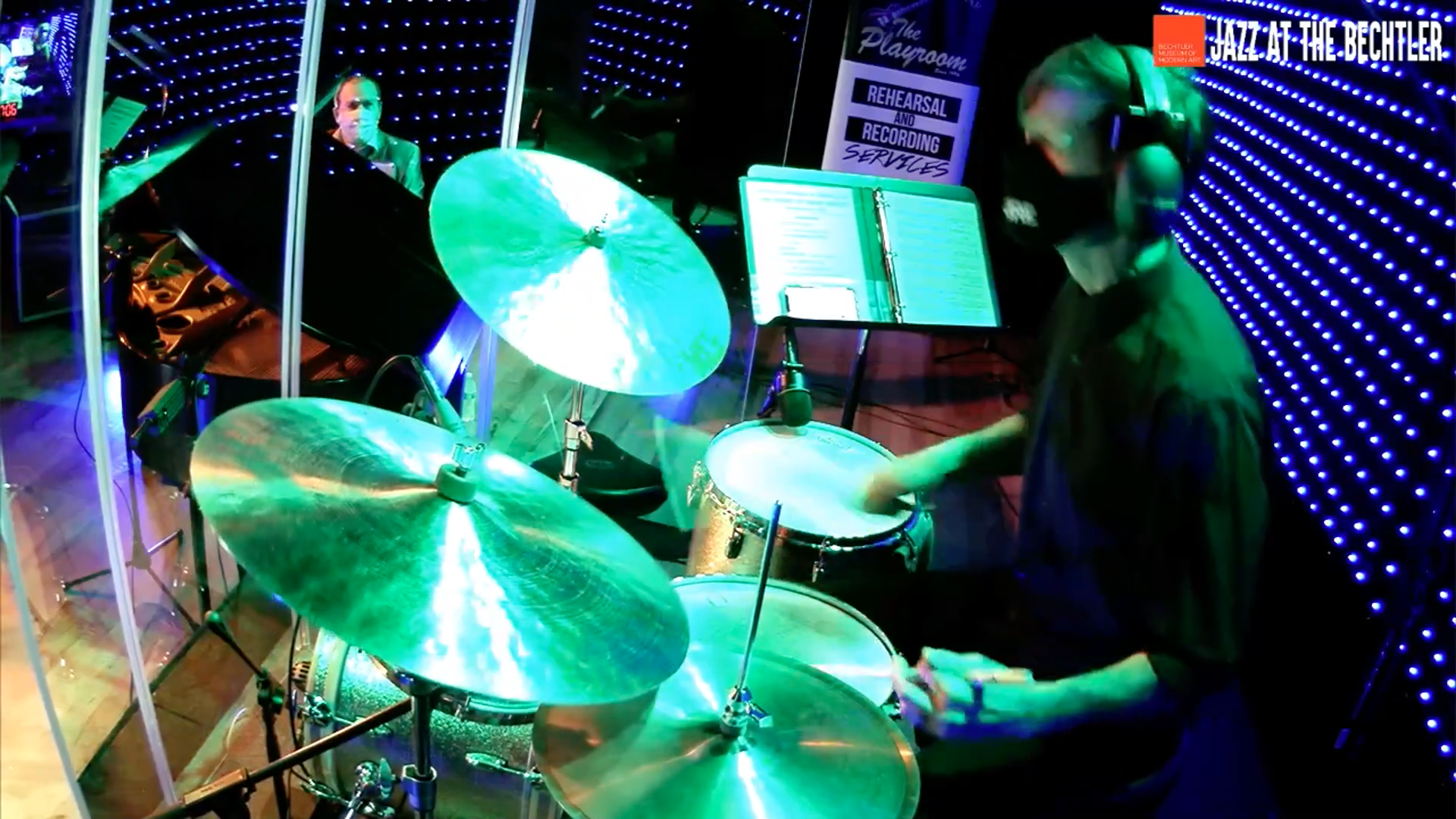
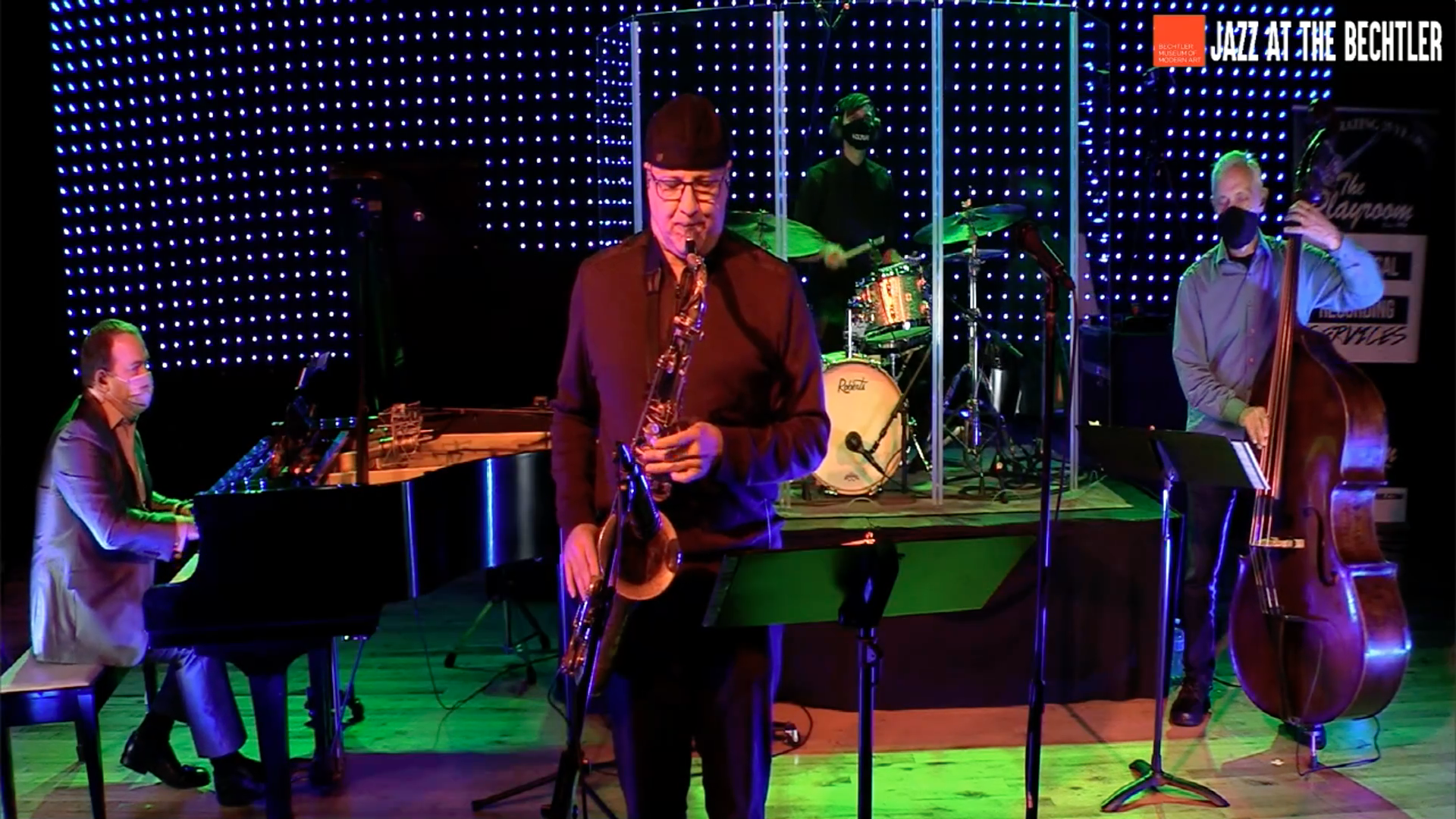 Rabie’s final three selections were his most predictable, culled from two of Mobley’s most acclaimed Blue Note recordings, Soul Station (1960) and Workout (1961). “This I Dig of You,” from the earlier album, bopped more than “High and Flighty,” but the creativity flowed richly from the quartet as all the players had a chance to solo. Sergel took up his sticks to launch the merriment, pounding on his rims as well as his toms, and Rabie handed things over quickly to Higgins, who swung his first chorus on the keyboard and offered fresh new angles on each ensuing variation. Rabie was deceptively tame at first, almost cool with his bopping triplets, before he whipped up a harder sound up in the treble, getting a second wind. Brendle had a crisp, swinging take on the tune before Sergel crafted a hybrid solo at the drums, beginning with brushes in Brendle’s wake and then turning the heat back up with his drumsticks.
 Art on My Sleeve