Review: Theatre Charlotte’s Smoke on the Mountain
By Perry Tannenbaum
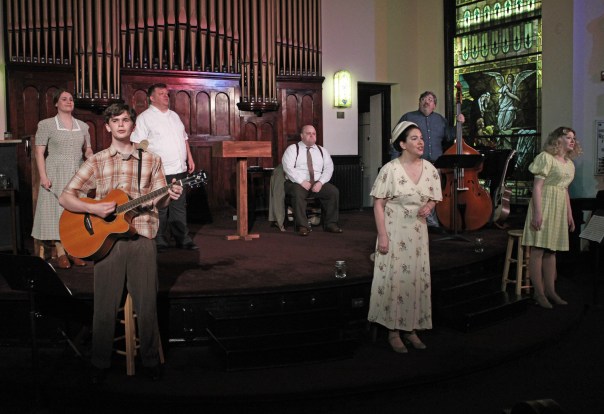
February 24, 2022, Charlotte, NC – There’s a bit of a Tar Heel tug-of-war going on between two small towns east of Charlotte, Mount Pleasant and Mount Olive, for the honor of having the best claim on being the site of Smoke on the Mountain, a homegrown musical that has maintained its popularity since 1988. Geographically, Mount Pleasant has the far stronger claim, due to its closer proximity to Charlotte, which is explicitly mentioned numerous times in the script, and because the Mount Pleasant Baptist Church is officially ordained as our setting in Connie Ray’s book.
Yet in terms of flavor, smell, and story in Alan Bailey’s original concept, Mount Olive and its famed pickle factory cannot be dismissed, for there are twin accidents near the pickle works that figure prominently in the opening scenario. Gawking at the gherkin spillage from the plant, the Sanders Family has tipped over its van and is therefore late in arriving to the church, where they are scheduled to lead a sing-along before a music-and-dance-averse congregation. Original musical arrangements were by Mark Craver, longtime member of the Red Clay Ramblers, and Mark Hardwick. Since both Craver and Ray hail from North Carolina, those roots run deep in the story and in the music.
Pastor Mervin Oglethorpe has invited the Sanders Family to sing at the Church in June 1938, part of his stealth campaign to lighten up – and modernize – his congregation, and the songs were chosen to evoke that era. “No Tears in Heaven” by Robert S. Arnold, for example, was written in 1935, and Albert E. Brumley’s “I’ll Fly Away” was penned in 1929. When Theatre Charlotte last presented this musical in 2010, they were able to build better scenery at their Queens Road than I had seen three years earlier at a Pineville Dinner Theater production. A fire at that barn in December 2020, however, has turned Theatre Charlotte’s 94th season into an extended road trip, stopping at various locations around the city.
If the company’s mid-December production of A Christmas Carol seemed more than a little dwarfed by Halton Theater on the campus of Central Piedmont Community College, the current location at The Great Aunt Stella Center could hardly be more ideal. With a full set of organ pipes upstage to frame the Sanderses and Pastor Oglethorpe, and with cushioned pews for the audience to sit in, The Great Aunt Stella hardly needs to pretend at all to be accepted as a church. In fact, we’re entitled to think that Auntie Stella determined the choice of Smoke on the Mountain rather than the other way around.
As stage director and music director, Kristin Graf Sakamoto has done a fine job in taking advantage of the venue – and of the cast, since she reports prevailing on members to pick up instruments they had never seen before. That certainly tamps down the bustle onstage I’ve seen in previous productions that were burdened with a house band and adds to the homespun authenticity of this Mountain. We may be a little confused and disoriented when the Sanders Family hurriedly makes their belated arrival, for all of their instruments are already onstage – guitars, bass, mandolin, and assorted percussion instruments.
June Sanders is the first to arrive as Pastor Oglethorpe stalls for time. Emily Nageotte does a fine job in giving us the comical pickle catastrophe backstory, explaining her parents’ and siblings’ delay while portraying herself as the odd duck in the family. Instead of singing with them, she will sign for the deaf – whether or not there are hearing-impaired people in the audience. Eventually, June will sometimes make more noise than other members of the family as, one by one, she removes a wacky assortment of percussion instruments – including washboard, spoons, and cowbells – from their hiding places during the course of the concert.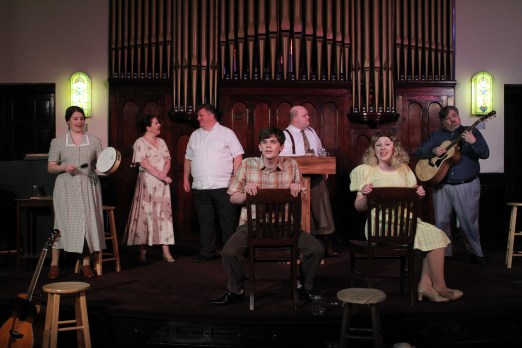
We’re in a church, so the evening’s program turns out to be a mix of homespun musicmaking and spontaneous testifying. As you might suspect, the Sanderses are a rusticated bunch, so a backwoods Mayberry shyness befits them all – with the exception of Liz Waller as Vera, the mama, affecting something close to a Minnie Pearl effervescence. Now there was also a proud and ornery side to Vera when her views didn’t coincide with Pastor Oglethorpe’s. Instead of coming to blows, they hurled Bible quotes at each other, citing chapter and verse for extra emphasis. Fretting with all kinds of picayune worries, Stuart Spencer as Oglethorpe keeps a perpetual crackle of tension in the air, heightened when his scriptural erudition is disputed, released only when he yields to the music. At first, he merely sings along at the top of his lungs, but when the spirit truly hits, he runs back to a cloakroom and fetches a harmonica.
The friction between the pastor and the Sanders Family (his singing contributions aren’t received enthusiastically), especially Vera, make for a needed dramatic undercurrent to spice up the singing and testifying until the hubbub that brings on our intermission. Burl, the genial patriarch of the family, seemed to be the peacemaker in Mike Cheek’s papa-bear portrayal, loyal to his wife Vera and all their cubs. It’s his brother Stanley, the black sheep of the family, who stomps out of the hall in a huff, and it’s Burl who must coax him to return.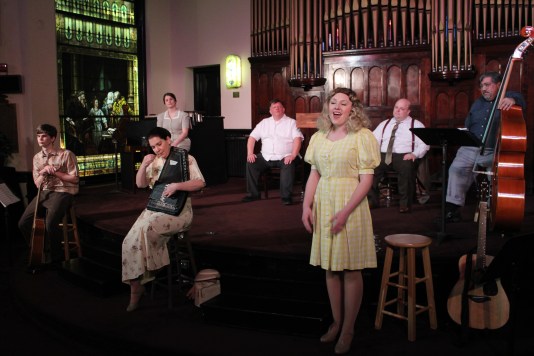
After this kerfuffle, while Pastor O is having a couple of words with the Sanders girls, the stage is set for the most dramatic testimony of the night, when the wayward Stanley returns. Apparently the only Sanders to have tasted the fermented fruit of the vine or the distillery, Jake Yara is wonderfully quiet and penitent in Stanley’s testimony, humbled yet not shamed. His earnest confessional seemed to spur Molly Neal as Denise, the younger Sanders twin, to unburden her heart and reveal that she had once run away from home – to Charlotte! – in a poignant tale of teen heartbreak. Neal upstaged her younger twin with her abortive foray into showbiz, but Gray Ryan as Dennis had a simpler, more comical testimony, aspiring to fulfill the calling of a preacher despite his terror of public speaking.
The acoustics at Great Aunt Stella are better for music than theatre, so it’s fortunate that Sakamoto placed such a high premium on the voices in her cast delivering the two dozen songs we hear. Backup vocals are as meticulously rehearsed as harmonies, and the instrumental performances are quite serviceable. Some might prefer the weepy and morbid repertoire like “Meet Mother in the Skies,” “Everyone Home but Me,” and “Whispering Hope.” Among these Christian hits, I’ll take the quirky and the upbeat any day. Give me more like “Christian Cowboy,” “I Wouldn’t Take Nothing for My Journey Now,” “Angel Band,” “I’ll Fly Away,” and “I’m Using My Bible for a Roadmap.”




 Art on My Sleeve