Tag Archives: Jackie Fishman

Grit and Endurance at Birkenau – and Urgency Today

Review: Protective Custody: Prisoner 34042

By Perry Tannenbaum

ProtectiveCustody5

For those of us who didn’t endure or survive it, talking about the Holocaust can be awkward, uncomfortable, and disturbing. I should know: Invited to a 1991 production of I Never Saw Another Butterfly by Children’s Theatre, my own uncle – brought to Charlotte as a pre-eminent authority on gifted children – turned down the opportunity to see a fine Teen Ensemble in action. Very likely, the I in the title was the biggest red flag for Uncle Abe – the threat of hearing a first-hand account of the horrors, the inhumanity, and the suffering. Even from teens.

Ah, but what if you weren’t the child of Jewish American immigrants, safe from the Nazi killing machine and the misfortunes of growing up Jewish inside the Third Reich? If you had grown up Jewish in Berlin and Vienna, if you had seen the belly of the beast as a concentration camp prisoner at Auschwitz and Birkenau, smelled the smoke of the crematorium from the moment you arrived, dreaded every morning roll call, and reverted to your animal instincts just to survive – even then, after surviving this unfathomable ordeal, you’re unlikely to feel comfortable talking about it.

Come to Duke Energy Theater and you’ll see why.

The screening of Surviving Birkenau at the Charlotte Jewish Film Festival late last month was a preliminary reminder. Like Three Bone Theatre’s world premiere of Protective Custody: Prisoner 34042, now at Spirit Square through Sunday, Ron Small’s documentary was all about the early life of Dr. Susan Cerynak-Spatz and how she managed to outlast her brutal captors – ultimately escaping Adolph Hitler’s infamous “final solution.”
ProtectiveCustody2

After the film, there was a panel discussion and time set aside for audience questions. Among those on the panel were Three Bone Theatre artistic director Robin Tynes-Miller, Charles LaBorde, the actor-playwright-educator who adapted Cernyak-Spatz’s memoir, and Dennis Delamar, who is directing it. Joining the panel was Jackie Fishman, Cernyak-Spatz’s daughter, who had appeared briefly during the film and was instrumental in greenlighting the new play.

It was Fishman who inadvertently delineated the key difference between the Cernyak-Spatz we had just seen onscreen at the Levine Jewish Community Center and the one who I would see portrayed at Duke Energy the following week. Asked about how her mom had discussed the Holocaust in their home while she was growing up, Fishman recalled that the subject was rarely mentioned. Avoided.

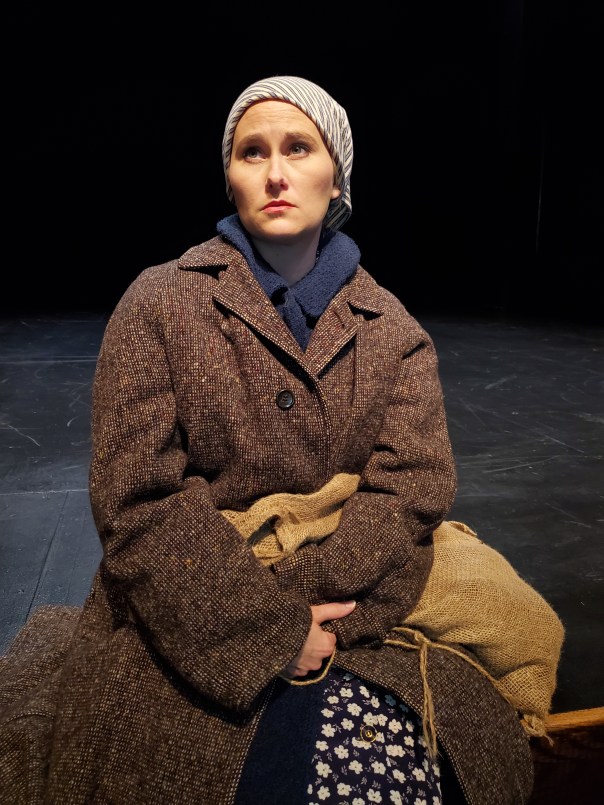
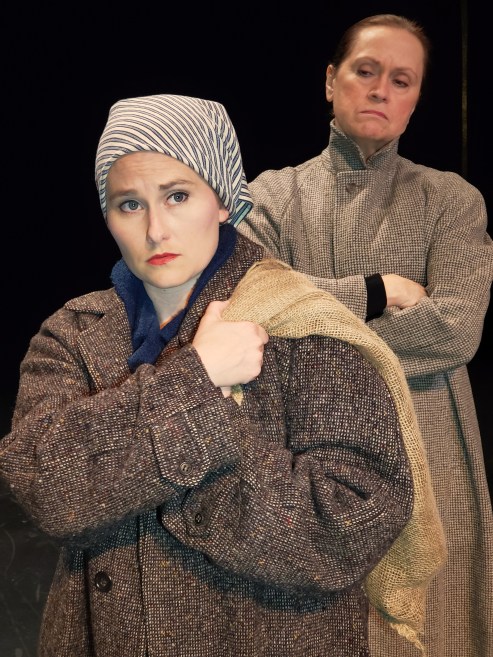
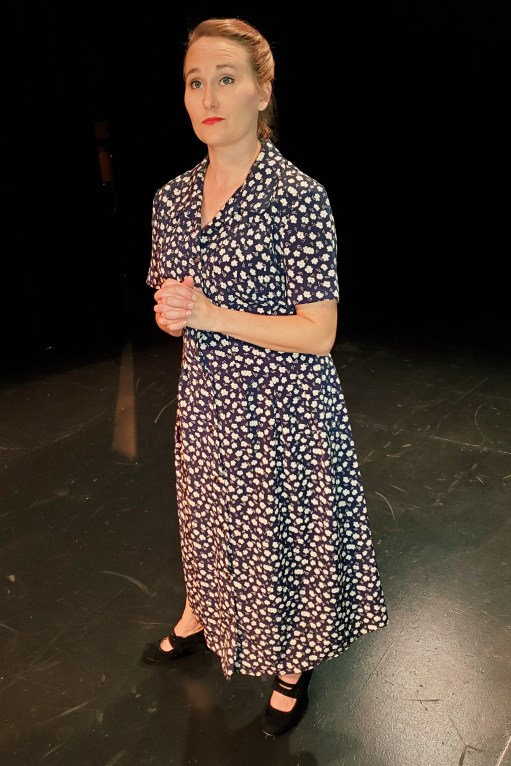
We had just watched a woman who, already well into her 90’s when Surviving Birkenau was filmed, had spoken – and as a UNC Charlotte professor, lectured – all over the US and around the world for decades about her Holocaust experiences and studies. She hadn’t been at all uncomfortable about doing so once again for the cameras. The woman that LaBorde would have us meet, Leslie Giles playing the role, is 40-something according to the script, about the same age Cernyak-Spatz was when she and Fishman attended the same Midwest college together.

[Getting an actress who could replicate the 97-year-old today is borderline impossible. Recently felled by a stroke, Cernyak-Spatz willed herself out of her sickbed and attended last Sunday evening’s performance. Brava, Susan!]

What LaBorde has done, taking the author who published her memoir in 2005 and making her some 40 years younger, isn’t exactly unusual for adaptations we see onstage, in movies, or in opera. But when you’re dealing with Holocaust material, the discomfort factor needs to be part of your calculus.

For LaBorde, audience discomfort is definitely a consideration. You can see it and hear it as the play begins. But what LaBorde, Giles, and Delamar didn’t calibrate – or consider – was Susan’s discomfort four decades earlier.

ProtectiveCustody4

Instead of immediately plunging us into the Kristallnacht pogrom of 1938 and all that she and millions of other Jews experienced after that, in a gradual crescendo of horrific inhumanity, Susan introduces us to a rack of clothes that – with a Dresser, portrayed by Paula Baldwin – will help her to guide us through all the major transformations that befell her from the days of her relatively idyllic childhood in Vienna onwards. It was during the lighter pleasantries opening the show that Giles faced what nobody had anticipated.

Whether it was because so many theatrefolk were in the audience on opening night or because of the grim subject, this wasn’t the kind of crowd that shouted back a greeting if you started off with a “Good evening!” or a hearty hello, Nothing came out of us in response to Susan’s welcome. Not even enough for Giles to come back with the obligatory, “Aw, you can do better than that!”

It was an awkward moment – but also a momentary glimpse of what we would see if we were being addressed by a Susan who had real trepidations about broaching a story that might be uncomfortable or disturbing for us to hear. Or for her to relive. Giles proceeded to tell Susan’s story with all the confidence that’s on the pages of the original Protective Custody memoir, in a voice that, benefiting from fruitful time spent with Cernyak-Spatz’s audiobook, occasionally replicated Susan’s with chilling accuracy.

And what a story it was, a powerful no-bull account of what life was like in the showcase Theresienstadt camp and the more harrowing living conditions at Auschwitz and Birkenau. Nor was there any sugarcoating of what it took from Susan to survive. Actually, the show is pretty amazing when you consider that Three Bone Theatre skipped the preliminary processes of a full staged reading or an intermediate workshop version. The entire production team was learning for the first time how an audience would react to the full script.

All that I saw on opening night was at a surprisingly advanced state of development. LaBorde, Giles, and Delamar have delivered far more than a mere chronology of a descent into hell. There are a couple of times when the highly detailed narrative is paused. One happens when Susan ponders how a bad decision by her mom changed the course of both their lives – and poisoned Susan’s attitude towards her to this day. Another recounts how Susan lost her faith in God.

Giles makes these into moments that challenge us – and LaBorde gives her another at the end of the evening when Susan turns her unflinching gaze on today’s world and the question of whether we have learned anything from the history she has devoted her life to preserving. She frames the Never again question in a way calculated to make us uncomfortable one last time.

ProtectiveCustody1

More moments such as these, with Susan speaking her heart, voicing her sense of urgency, or simply engaging us directly would help in fleshing out Prisoner 34042, which now has a somewhat boney 80-minute runtime. I’ll be surer of whether LaBorde has mined all the details from the memoir to give his drama maximum power when I finish the ebook, but what I’ve already read convinces me that the task of distilling the book was as daunting as he has said.

Paying more attention to the drama inherent in becoming comfortable with the Holocaust conversation – or at least usefully informed by it – might also turn up the temperature, but there were also times that I felt more dialogue between the two women onstage could spark more tension, light and warmth. Even though she rarely spoke, Baldwin brought me some of the most touching drama of the evening. Curiously enough, her most affecting moments came at the end, when she ditched her Euro accents and became a couple of Americans who welcomed Susan to freedom. Choked me up.

Of course, we can credit much of Baldwin’s liberating impact to the vivid narrative Cernyak-Spatz had written, LaBorde had adapted, and Giles had so deeply immersed herself in, taking her audience along with her on her journey. Already portraying Susan’s mom and various Nazi jackboots, Baldwin could be helping to make Giles’ journey even more intense along the way. But I won’t disagree with anyone who emerges from Spirit Square feeling that Protective Custody: Prisoner 34042 is informative, intense, and impactful enough as it stands.

Disturbing? I hope so.

Charlotte’s Witness to Genocide

Preview: Protective Custody: Prisoner 34042, a Three Bone Theatre Production

By Perry Tannenbaum

ProtectiveCustody1 

At age 97, Dr. Susan Cernyak-Spatz can look back on a life well-lived – and a life well-told. Neither outcome seemed possible on May 7, 1942, when Cernyak-Spatz and her mom responded to an invitation from the Nazi invaders who had occupied Czechoslovakia. It was an invitation that Jews could not refuse. They assembled at a large public square, where they were marched across the city of Prague in broad daylight, herded to a freight station, loaded onto trains, and transported to the Theresienstadt concentration camps.

Survival was already against the odds. Those odds grew slimmer on January 31, 1943, when Cernyak-Spatz was transported from Theresienstadt, the “showplace” camp built to deceive International Red Cross inspectors, to Birkenau, the belly of the beast in Adolph Hitler’s genocide machine.

Yet Cernyak-Spatz did survive. She survived a transfer deeper into the belly, to Auschwitz, and an attack of typhus fever brought on by the toxic living conditions there. Even after the Russians began “liberating” Eastern Europe, Cernyak-Spatz survived a grueling death march in the custody of her captors.

And oh baby, since arriving in the US nearly three-quarters of a century ago, Cernyak-Spatz has told her story – well and often. New generations have heard it at Jewish Sunday schools and at UNC Charlotte, where she is still a professor emerita in German literature. In classrooms, in lecture halls, and in synagogues across America and Europe – including Germany – she has opened fresh eyes to Nazi atrocities. In books she has authored about her life, the Holocaust, and Theresienstadt, Cernyak-Spatz has chronicled the unthinkable horrors she survived – horrors that millions of other Jews did not survive.

ProtectiveCustody2

The story keeps getting told. At the upcoming Charlotte Jewish Film Festival, filmmaker Ron Small’s documentary biopic, Surviving Birkenau, will be screened on October 26. And next week at Spirit Square, a project initiated by Cernyak-Spatz’s daughter, Jackie Fishman, and notables of the QC’s theatre community comes to fruition. Charles LaBorde’s adaptation of Cernyak-Spatz’s memoirs, Protective Custody: Prisoner 34042, opens on November 1 in a Three Bone Theatre production directed by Dennis Delamar.

The idea for presenting a one-woman show focused on his longtime friend Susan’s life had been moldering in Delamar’s mind since 2005 when he directed the Charlotte premiere of Doug Wright’s Pulitzer Prize-winning I Am My Own Wife, an adaptation of transvestite Charlotte von Mahlsdorf’s autobiography.

“That survivor’s story carried us through the Holocaust and also the fall of the Berlin Wall and made me start visualizing something similarly possible about another person’s unique Holocaust story. Someone I actually knew and cared for very much – Susan! Since then, I thought the idea was a really good one, but it stayed in the back of mind, dormant. Cut to eleven years later.”

Pieces began falling into place when Fishman, education coordinator at the Stan Greenspon Center for Peace and Social Justice, brought Delamar and LaBorde to Queens University for a reading of Address Unknown in April 2017, reviving one of multiple Holocaust plays LaBorde had already written. Almost inevitably, Delamar broached his long-gestating idea with Fishman during rehearsals.

“Jackie was immediately ecstatic over the idea,” he recalls, “as if I had said some magic words. ‘Let’s do it! Mom has already written her story down, the book she published in 2005. Have you read it? I’ll get you a copy.’ At that moment, Jackie became a key driving force behind this play getting done, a mission she has continued to energize as a daughter’s gift to her mother.”

Though Fishman had been one of his most valued teachers back when LaBorde was principal of Northwest School of the Arts, he didn’t see a natural transition of Protective Custody from page to stage: “too many people, too complex a story to pare down enough for an audience to follow.” LaBorde was prepared to walk away – until he came face-to-face with Fishman’s enthusiasm for the project. So he gave the book a second look.

With Three Bone Theatre aboard – and Cernyak-Spatz greenlighting the project – Delamar and LaBorde returned to Queens University, where the Greenspon Center hosted an even more exciting event last December than they had the year before. For Cernyak-Spatz was seated in the front row of a packed house at a reading-stage performance of a new LaBorde play, doubly honored at the occasion.

Nor did Cernyak-Spatz sit idly by as the latest incarnation of her life story took shape. She and her daughters, Jackie and Wendy Fishman, have been intensively involved in the process, checking facts, suggesting enhancements, correcting pronunciations, and fine-tuning the voice of the Susan we will see onstage.

“My favorite bit of research,” LaBorde reveals, “was to ask Wendy and Jackie if their mother would say the line I had written early in the play, ‘Somebody fucked up.’ Their reaction was to look at each other and then say simultaneously, ‘Oh, yeah.’”

My own research for this momentous Three Bone premiere took me to Prague last month – and from there to the fortress site of the Theresienstadt camps, the town of Terezín, and the Museum of the Ghetto. In Prague, my wife Sue and I stood in one of the squares where Cernyak-Spatz may have been marched to the transport awaiting her at the freight yards. Our guide told us that we were standing on pavement made from the shattered gravestones from a demolished Jewish cemetery.

At Theresienstadt we saw the barracks where Jews were warehoused in hall-length beds three and four levels high, no toilets provided. We saw a washroom built to hoodwink the Red Cross, lined with sinks where no water has ever flowed. We saw cemeteries near Theresienstadt and Terzín larger than football fields – with marked graves, unmarked graves, and mass graves. We were guided to the Secret Synagogue where I read the most heartbreaking plea to God that I’ve ever seen in a house of worship, written in Hebrew:

“PLEASE RETURN FROM YOUR WRATH.”

And outside Terezín, adjoining one of the burial grounds, we saw the crematoriums, restored by the Luski Family, a name familiar throughout Charlotte’s Jewish community. Maybe the most chilling and revelatory things I saw were the records displayed at the Ghetto Museum of the transports, punctiliously kept by the Nazis: dates, points of origin, and numbers of Protective Custody prisoners brought into Theresienstadt via the transports. Of the hundreds, sometimes thousands who were loaded into the cattle cars, I never saw that even 100 survived any of these horrific transports. More than once, the number was zero.

Clearly, Cernyak-Spatz bucked prodigious odds to arrive at Theresienstadt, to survive her journey to Birkenau, and finally reach Ravensbrueck, the destination of her January 1945 death march. Susan does use the word “miracle” in LaBorde’s script to account for her eluding “the gas.” Once.

ProtectiveCustody4

Benefiting from the guidance of the Fishmans – and the sound of the real Cernyak-Spatz’s voice (yes, there’s a Prisoner 34042 audiobook!) – Leslie Giles takes on the daunting challenge of being Susan at Duke Energy Theater, assisted by Paula Baldwin as The Dresser.

“Oh my gosh, daunting doesn’t even begin to describe how it feels to take on this very special project about this incredible person,” says Giles. “The amount of lines would be enough to scare some actors away, and then to top it off with the very real and gritty details makes it overwhelming at times. That said, it is absolutely worth it, probably the most important piece of work I’ve ever performed in my entire career. It is one thing to read about these events in a book. It is another thing to watch the story coming alive in front of you.”

Reflecting on the wonder of her survival, Cernyak-Spatz scoffs at the notion that she had any special wisdom. “Our entire day was taken up with thinking of survival,” she declares. “We had to be alert like wild animals. Wild animals don’t do much thinking. They survive. We ate anything that wouldn’t eat us. There was no time to dwell on faith or God; you had to give up your expectations of a normal universe. Perhaps my naivete allowed me to take great risks that paid off.”

If it weren’t for the war, Cernyak-Spatz says she would have likely become a dancer or an actress. Indeed, she has occasionally performed onstage here in the QC, most recently when I called her one the “islands in a stream of ineptitude” in my review of Theatre Charlotte’s production of A Little Night Music in 2006. No wonder she treasures the gift of a new drama dedicated to her in her twilight years.

There’s also a twinkle of artistry in the title of her memoirs. The Nazis didn’t simply record your prisoner number in a ledger or stitch it into your prison clothes – it was tattooed into your forearm. They fancied themselves the master race, so they could house Jews and brand Jews and liquidate Jews like cattle. The 34042 that endures in Cernyak-Spatz’s title does not signify their triumph.

“The title serves my purpose of explaining the steps and the de-humanization of a group of human beings. When one is ultimately reduced to no more than a number, the extrapolation is that there’s no worth to this life and it can be easily disposed of. I have outlived the Third Reich, triumphed over them, with a successful and productive life – raised a Jewish family and have told my story all over the world. Anyone who sees the tattooed number on my arm becomes a witness to this history.”

Jewish Playwriting Contest Dramatically Involves Charlotte Audience in Selecting a New Play for a New York Production

Review: The Jewish Plays Project

By:  Perry Tannenbaum

The Jewish Plays Project, currently in its ninth season, seeks to recognize and develop new plays that freshly address contemporary Jewish life. In their annual Jewish Playwriting Contest, plays that peddle stock Jewish humor or deal directly with the Shoah are graciously discouraged. Like other playwriting contests, it solicits scripts that haven’t received professional productions and welcomes playwrights of all ethnicities. Of course, an expert panel is part of the selection process, but unlike the Pulitzers, the Tonys, or the Steinberg Awards, the JPP panel only screens the hundreds of entries and winnows them down to a group of finalists.

Cunningly, JPP invites theatre communities around the country to engage with the scripts, winnow them down to a Top 3, perform the Top 3 publicly in abbreviated staged readings, and have the live audience vote for their winner. In the 2019 cycle, Charlotte is the first of seven cities to complete its participation in the process, so the ultimate winner won’t be announced until after the Palo Alto readings on May 1 – moving on to a full production in New York this September.

The seven finalist scripts were emailed to us back in November, and I can proudly say that our reading panel in Charlotte had the most listed members, edging out Houston and New York, sharing the honor for the most populous panel with Chicago. Our panelists met at the Levine Jewish Center for a dinner powwow during the last week in January. After spirited discussions of each script, we wound up choosing In Every Generation by Ali Viterbi, The Shabbos Goy by Cary Gitter, and Dox Modern Middle by Megan Pope for the public event at Gorelick Hall, the J’s theater facility.

Last year’s national winner, Summer Night with Unicorn by David Rush, had been produced by the Levine Cultural Arts department’s JStage at the Gorelick in November, so there were people in the audience – and onstage – who had experienced last year’s playoffs and/or seen its fruit. This was the third year that Charlotte had participated in the annual contest, my second year of participating on the community panel, and my first time at the competitive readings. I was a bit taken aback by the robust turnout. Word has gotten around.

Unlike the staged reading festivals presented in the past by Actor’s Theatre of Charlotte and the defunct Charlotte Rep, the Levine’s Jewish Playwriting Contest maintained its professionalism without stuffiness or excessive formality. If you were an actor, you weren’t warned against the impropriety of wearing a color or dressing for your part, but you did lay your script on a lectern as you performed. If you bought a ticket, you could grab a free nosh at the back of the hall and schmooze with your fellow cognoscenti before David Winitsky, the founder and director of JPP, moved up front to issue welcomes and thanks. Then he explained the JPP and the Contest before testing the technology that would be used for the individual playwright intros and the voting. Directing all three entries, he also read the stage directions during the readings.

Old schoolers could vote on paper ballots as God intended, or if you had a smart phone, you could text your vote to a prescribed number. My first two test votes, before and after the first play reading, were for macaroons and Bernie (who lost to Midge). While writing this review, I texted “LEAVE” to the number we had been given and received an answer, my first real assurance that my votes had counted. So the technology worked, the format for the evening had been exhilarating, and theoretically, my vote may have been decisive. Yet I did not drive home feeling that the format had been completely fair.

Gitter’s The Shabbos Goy led off the readings, probably the easiest of the three to summarize. Seth, a divorced Orthodox Jew, has a crisis of faith because he has fallen in love with Angie, an Italian-American art gallery curator who recently moved into an apartment down the hall. Not knowing she had moved in, Seth had knocked on her door, thinking he would call on his Shabbos goy to do something for him that Orthodox Jews are forbidden to do on the Sabbath – like turning on a lamp or an oven. Angie readily agrees to help this nerdy knish maker. He’s such an unlikely candidate for her affections that, when he asks her out, she doesn’t immediately grasp what he’s doing, by which time he’s apologizing.

Seth’s sister Rachel, his partner in the Lower East Side knish store, is more devoutly opposed to her brother’s wishes – she’s not Jewish! – but Sophia, Angie’s folksy grandmother, has an open mind. In the scenes excerpted for the reading, Seth (Jordan Ellis) told Angie (Karina Caporino) about his spiritual crisis. His confession went better than Fitzwilliam Darcy’s, acting as an aphrodisiac. Afterwards, Angie had a couple of heart-to-hearts with Sophia (Jackie Fishman) and Rachel (Susan Cherin Gundersheim).


If the allusion strikes home, you’ll already know that Viterbi’s In Every Generation has something to do with Passover. Not only is the Passover seder the instrument of fulfilling the biblical commandment of telling your children about the exodus from slavery in Egypt, it is the gateway for fulfilling man’s obligation “to see himself as if he personally went out of Egypt.” Viterbi divides her play into four parts, a very apt number for Passover, and links three generations of a family across three seders, beginning with 2018 in LA, then flashing back 65 years to 1953, and then zipping forward to 2048. After three seders with this family, Viterbi thinks we’re ready to visualize her family in 1416 BCE after leaving Egypt, celebrating Passover and yearning for the Promised Land.

In the first excerpted scene, we saw all three generations gathered at the 2018 seder. Drawing most of our attention were two squabbling siblings, Yael Katz (Caporino) and her adopted Chinese older sister, Devorah (Vivian Howell Tong), who is studying to be a rabbi. It is she, therefore, who expounded on the number four in the Passover Haggadah. Their mom, Valeria (Stephanie DiPaolo), tried to keep order, but her difficulties were compounded by her octogenarian parents, Davide Levi (David Catenazzo), who coukd no longer speak due to ALS, and Paola (Fishman), who kept lapsing into Italian. Our second excerpt took us to 1953, shortly after Davide and Paola had immigrated to America. Davide could talk at that seder – smoothly enough to convince Paola that Passover might be a great time to start their squabbling unborn family.

Reduced to a bare-bones 20-minute sampling, In Every Generation had to shed its last two parts – and the English subtitles that are supposed to help us understand Paola’s Italian when she arrived in LA back in 1953. Shabbos Goy suffered to a lesser extent from Winitsky’s radical abridgement, losing one of its characters, a dashing young artist whose work Angie would love to display at her gallery. Young and sexy Blake, Angie’s arrogant quarry, expected to combine business with pleasure. Pope’s Dox Modern Middle was perhaps the most disadvantaged by Winitsky’s excerpting. It would have been helpful, for starters, if the playwright, the director, or the reading had explained what the title meant.

Amid some healing chanting and a spectral appearance of Fathermother, representing her parents and her Orthodox Jewish heritage, the excerpt began with 17-year-old Raphaela (Arella Flur) arriving in Israel. She was greeted by her Aunt Caroline (DiPaolo), a longtime Israeli who knew more about Raphaela than the girl thought. Caroline already knew, for instance, that her upfront 16-year-old neighbor Gil (Rixey Terry) would be the perfect companion to show Raphaela around – because he is gay, she is lesbian, and that’s why she was sent away from Brooklyn by her “Dox” parents. In later excerpts, we learned that there’s an LGBTQ nightclub in Jerusalem that will welcome both Gil and Raphaela, with queerness to burn. A quartet of glittery queens emerged from the audience, voguing and preening. More seriously, the club’s bartender, Pop Tart Girl, took an interest in Raphi, evoking memories of Ani (Caporino in both roles), her previous paramour back in Brooklyn.

When the votes were tallied, Winitsky announced that The Shabbos Goy had been our audience favorite. Audience members who have become attached to Seth and Angie, rooting for their romance, can go to JewishPlaysProject.org and see how Gitter’s romantic comedy is doing in the standings. With the two points that Shabbos Goy earned at the Charlotte playoffs, it is now tied with In Every Generation for first place. Next in the standings, trailing the leaders by two points, is Dox Modern Middle. As exciting as the contest was, I’d be more comfortable if the readings were extended to 40-45 minutes each. Lacking that, audiences should get a full summary of each contestant. That’s what I’m voting for.