Tag Archives: Hilary Powell

“Bright Star” Shines Zestfully in Matthews

Review: Bright Star at Matthews Playhouse

By Perry Tannenbaum

Though it never settles down here in the QC, it’s nice to know that Steve Martin’s beautifully crafted Bright Star, while tracing its graceful decades-longstory, carves a North Carolina oval around Charlotte. Crisscrossing between Asheville and Raleigh with stopovers in Hayes Creek and Zebulon. Martin’s music leans pleasantly westward, delivering bluegrass and mountain flavors, brightly flecked with sounds of the comedy polymath’s signature banjo. Nor in transporting the original “Iron Mountain Baby” story to the Blue Ridge Mountains, does Martin neglect the rhythm of the rails, for a train traveling over a river is pivotal to the plotline.

So of course, this genial musical, which stopped at Belk Theater on its national tour in 2018, is a perfect match for Matthews Playhouse (and its nearby depots) as it arrives for a richly deserved revival. Newly crowned last month with the 2024 North Carolina Theatre Conference Community Theatre Award, headquartered at the Matthews Community Center, this company is perfectly poised to deliver the authentic vibe.

Under the meticulous direction of Paula Baldwin, it does. Her design team, also leaning mountainward, delivers a rusticated look overall, with Yvette Moten’s varied costume designs pushing gently back against the drift of scenic designer Marty Wolff’s driftwood-and-tree-trunk set. Even when we’re at the Asheville Southern Journal, where Alice Murphy passes judgment on manuscripts by Carl Sandburg and Tennessee Williams, the fancy signage over the office is painted on wood. This buttoned-up office is no less rusticated than Jimmy Ray Dobbs’ porch at the mayoral mansion in Zebulon, way over past Raleigh.

And the music! Nestled in an upstage shed framed by the timbers, musical director Ellen Robinson leads a zesty septet from the keyboard, with Nelson Frazier on the banjo. Edie Brickell’s lyrics ain’t no great shakes, but he had a hand in composing the music, so we’ll give him a pass.

Shuttling across the Tarheel State, we also shuttle between 1923 and 1946, when Alice decides to tell us her story. Although I loved the tale when I first set sight on it over six years ago, it wasn’t until I revisited it last week that I experienced its full power. Part of the revelation came from the alchemy of gradually remembering the Bright Star story as it unfolded anew inside Fullwood Theater – knowing what was coming a few minutes before it happened – and part of it came from Baldwin and her company simply doing a better job.

It seemed like the director of the touring production, whose name I didn’t mention in my review, cast his Alice solely on the basis of how well she personified the spinster-like stickler editor of 1946 rather than how well she evoked the vivacious and vulnerable underage victim of 1923. But Hilary Powell is consistently flesh-and-blood in spanning the wide gap between her prim present and her more primal past.

Powell decisively makes these Alices different people when we finally get to see the lass who captivated Jimmy Ray, the mayor’s son. Her smiles are like a sudden outpouring of sunshine on a previously rainy day. When we first saw her as a formidable editor, still aggrieved by her ancient breakup, we could hardly guess how it all had ended. As open and joyous as she once was, the prestigious editor is now largely inscrutable. Was her dear Jimmy Ray cruel and alive or devoted and dead?

Turns out there’s another possibility when we delve into Alice’s past, meet Jimmy Ray, and revisit their illicit romance. Lit up by Powell, Nick Culp as her beau brings us more radiance, eclipsing the touring portrayal we saw in 2018 as charismatically as his paramour does.

While we’re time-traveling out in Asheville and over in Zebulon, the story in Hayes Creek moves steadily forward from 1945, when Billy Cane returns from WW2, apparently unscathed, undecorated, and unkissed. He’s an aspiring writer with many stories to tell about his hometown, so it’s natural that the owner of Margot’s Bookstore is the first to greet him – clearly more chastely than she’d like. Billy’s heart is set on Asheville, where he hopes to publish his first works in the Southern Journal.

Not above a little subterfuge, Billy pens a letter of recommendation from Thomas Wolfe to bring along with his manuscripts to the Journal office. Gatekeepers Lucy and Daryl find Billy’s presumptions ludicrous, blithely tossing the unknown’s precious manuscript in the trash before his eyes. Fortunately, Alice happens by and, knowing that Wolfe has been dead these seven years, finds herself impressed by Billy’s duplicitous audacity.

We can presume that Billy knew enough about Wolfe’s connection to Asheville to accurately gauge how a recommendation from him would resonate there. Conveniently enough for Martin’s purposes, Wolfe’s Asheville home – a boarding house really, if you remember Look Homeward Angel – wasn’t turned into a memorial landmark until 1949. Sandburg’s home in Flat Rock, as you may know, is also a National Historic Site.

Billy sheepishly realizes that he’s been busted by the person he most wishes to impress, which only enhances his naïve charm. Alice keeps one of the manuscripts, not to publish but because she sees promise. Subsequently, she puts Billy under Daryl’s tutelage as his personal editor and sounding board. Robert Allen isn’t too swishy as Daryl but gay enough, and he provides a cosmopolitan contrast to Joshua Brand’s wide-eyed innocence as Billy.

I’m willing to entertain the idea that Brand is fulfilling the role of a drop-dead dreamboat, but it’s Hannah Daniels as Lucy who cements his magnetism, coming on to Billy after his first tastes of alcohol. Brand is hit-and-miss in rendering Billy’s reactions, overacting more than once, but I’ll admit that made him more unpolished and adorable for me.

Truth is, the augmented professionalism of Theatre Charlotte and Matthews Playhouse – in the absence of big Equity companies across the Metrolina region – makes me miss community theatre. Yet I also found the exaggerated greenhorn aspects of this Billy to be very complementary to the dark, melodramatic side of Martin’s yarn. Softened only by his contrite drunkenness deep in Act 2, Darren Spencer was absolutely fiendish as Mayor Josiah Dobbs, more like the ketchup Trump we’ve never seen than the eating-cats debater who is merely hilarious TV.

Jimmy Ray’s dad was a man who could stuff a newborn baby in a satchel, board a train, toss his grandson in a river, and inspire a lurid folksong. Spencer revels in the moment and Baldwin makes a point of triple underlining it. She also makes sure that Culp and Murphy don’t mute their reactions to the loss of their child and the atrocity.

Of course, in this retelling, the satchel dropping doesn’t become notorious. Alice keeps seeking to discover the whereabouts of her adopted son and her parents nurse their regrets, dad for signing the papers and mom for letting him. Compared to Mayor Dobbs, John West as Daddy Murphy and Liz Waller as Mama are benign, eventually earning our empathy with their years of suffering, estrangement from their daughter, and remorse. Even at his worst, West contrasts meaningfully with the diabolical mayor, rejecting his grandson out of wrongheaded righteousness rather than self-interest.

Back in Hayes Creek, Daddy Cane and Margot eagerly follow Billy’s progress over in Asheville. Looking at Todd Basinger as the dad, you can easily see where Billy’s simplicity and goodness came from. And if Gabriella Gonzalez as Margo seems conspicuously more experienced as an actress than Brand, that also plays beautifully. Remember, she’s a successful bookstore owner. Like Alice, she knows good writing when she sees it.

Daddy Cane has a big secret, but in a moment that reverberates back to Ulysses’ scar in The Odyssey, the secret gives itself up without him. Aristotle himself would have been delighted to see how Baldwin brought his concept of anagnorisis – the moment of recognition – to life. That heart-stopping revelation brought me close to tears, mostly because I saw it coming.

Normality Attacks a Serial Killer in Catch the Butcher

Review: Catch the Butcher with Post Mortem Players @ CATCh

By Perry Tannenbaum

Serial killers, wherever they prey on young defenseless women and girls, are universally detested, even by fellow criminals. Yet these monsters, vying with vampires in wickedness and cunning, surely have a captive audience that greatly outnumbers their victims. Identify one and he’s frontpage news, sure to draw breathless airtime on local and national TV. Invent one who is truly special and you may spawn a bestseller and even an Oscar winner.

Yes, the guilty pleasures of sopping up the gory conquests of killers at-large and thrilling in the hunt to stop and avenge their rampages are perverse addictions shared by millions. Our susceptibility to the lurid scent of butchery was more than enough license for playwright Adam Seidel to bring us Nancy, his sacrificial lamb in the grimly satirical Catch the Butcher.

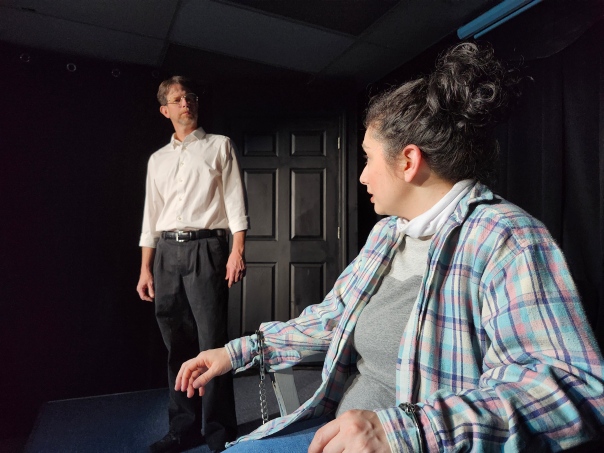
Nancy doubles down on the audience’s unspoken perversion: she wants to be abducted by “the butcher of Harbor Park.” Night after night, she sits alone on a park bench deep in the darkness of that dreaded landmark, fearing that she will be stalked and longing for it. As directed by Heather Wilson-Bowlby in the current Post Mortem Players production at CATCh, the company’s first sally into the QC, Nancy is almost advertising her yearning.

She’s reading The Stranger Beside Me, Ann Rule’s account of her friendship with serial killer Ted Bundy, a classic in the true crime genre. Heather-Bowlby’s mischievous touch, we will learn, is especially apt because the Harbor Park butcher dabbles a little in literature, dedicating a poem to each of his victims. Nancy’s fandom runs deep, admiring the fiend’s verse and feeling an unspoken kinship.

Parallel to this literary thread, the action of the early scenes is dark, silent, and animal until the Butcher pulls off his abduction. The silence of this lamb, as her killer circles ever more closely around her, is not merely evocative of a silent movie creepshow, begging for organ music in the background. We come to realize that it was also like a National Geographic documentary depicting a mating ritual in the wild.

Throughout Nancy’s bizarre captivity, Seidel has his fun juxtaposing the sophisticated with the primal and the drudgery of domesticity with our natural savagery – to shocking or comical effect. Numerous twists are in store as this butcher-victim pas-de-deux develops, including at least one complete flip-flop. And why not, seeing that Nancy and the butcher of Harbor Park were actually stalking each other?

If you don’t scan the QR code on Post Mortem’s flyer before the lights go down, gaining access to the full digital “Slaybill,” you won’t have any idea of where the silent opening scenes are happening, who we’re watching, or when the action takes place. That heightens our suspense and delays the onset of humor we’d expect at CATCh (Comedy Arts Theater of Charlotte). You’ll know most of the details if you’ve read the script beforehand, but Wilson-Bowlby flouts the playwright’s insistence that we’re in the present day, giving her star headphones instead of earbuds and a boombox instead of an iPhone.

We’re no further back than 1980, when The Stranger Beside Me was first published, but the copy that Jackie Obando Carter is clutching shows considerable wear and age. Costume designs by Carter were no more decisive to my eyes in designating the decade. More impressive were the design and execution of special effects that Carter and Hilary Powell collaborated on: one stabbing was particularly impressive since, at CATCh, my wife Sue and I were seated as close to the action as we would be watching a card trick.

Carter’s chemistry with her abductor, Chuck Riordan as the Butcher, is deliciously volatile. The vibe is more spiced with sensuality on Carter’s end as Nancy tries to divert and charm Bill – revealing his name bares the first chink in the Butcher’s armor – as her survival instincts kick in. While Nancy is dazed and disoriented when she first awakens in the Butcher’s soundproofed dungeon, this is what she quested for during her previous vigils in the dark.

She is not like us. She needs prodding to scream her loudest and confirm Bill’s soundproofing. A knife at her throat as she sits helplessly handcuffed to a chair? Carter must calibrate the mortal terror that Nancy is experiencing with her fantasy fulfillment and delight. The more we realize how diligently Nancy has worked to be here, the more we appreciate the complexity of Carter’s performance.

Since she candidly lets out that the Butcher and his technique aren’t what she expected, Bill is also a bit disoriented as he realizes what he has stepped into. Being measured against the glamor and terror of Nancy’s dream serial killer begins to tilt his attitude toward defensiveness and appreciation. While maintaining his dominator role, he finds he must prove himself as a ruthless butcher and sustain the admiration his victim has professed toward his poetry.

Riordan, like Carter, is making his QC debut in a role that requires deft and sudden navigation. But he has significantly more leeway in how he portrays this monster as his vulnerabilities are exposed. He doesn’t get to be quite so sure of himself as the adventurous nothing-to-lose Nancy – deviations from glamor, savoir faire, and fearsome menace all redound in his favor as we see more beneath his façade. He’s an anti-villain, in a sense.

Riordon can thus roll with the moment and seem authentic so long as he doesn’t fumble his lines or visibly stumble in his actions. Especially in Bill’s domesticated scenes, Riordon can mute his paranoia and be altogether humdrum. There are key moments when Riordon is suddenly called upon to show a killer’s steel or a lover’s grace. He masters these with aplomb, and he’s strong on Bill’s telling trait: he wants to make his mark with his murders and his poetry, desperate for both notoriety and acclaim.

It would be heartless to give an even sketchy summary of how the story unfolds with Seidel’s unfailing logic. So let’s concentrate on a sequence that was pivotal for me.

To gain precious time, Nancy has convinced Bill that she wishes to hear the poem that was written about her. Bill not only picks up on the ploy, he notices that, compared with previous victims, Nancy isn’t as terrified when a knife is at her throat. She is not what he expected. He must consider the possibility that Nancy is a cop or an FBI agent, particularly after she escapes her handcuffs to use the toilet.

Fast forward a bit past some juicy action, one of them with French toast, and Bill has finished his new poem. We haven’t sampled the Butcher’s literary craft before, so we presumably know less about what we can expect than Nancy. “A Single Rose,” as Bill titles it, is recognizably dreadful – so dreadful that I initially suspected that the serial killer was laying a fiendish trap for our lady in distress, testing whether her esteem was worth having.

Asked for her reaction, Nancy comes back with an utterly hilarious, magnificently audacious response: “It’s not your best work.”

At this point, we had reached a realm of dark humor that was unfamiliar to me. In perfect style. From here, Seidel could take us wherever he wished – even upstairs, out of the Butcher’s dungeon, to a new household.

In the aftermath, we get to know the couple’s next-door neighbor, Joanne – a bubbling busybody portrayed by Jennifer Briere, yet another talented Post Mortem newcomer. She enters through the front door with a bundt cake, then a vase filled with freshly cut roses, seemingly well-acquainted with the welcoming-new-neighbors drill. Briere is especially precious when Joanne learns how Milwaukee, wherever that is, differs from Texas. You will see that all the audacity Nancy has shown us before is eclipsed the moment she dares to open the front door for Joanne, defying Bill’s stern commandment.

Reviews of Catching the Butcher sometimes cite Silence of the Lambs as an inspiration and inevitably Dexter, because the original Nancy in the 2015 Off-Broadway production, Lauren Luna Vélez, was a fixture in that series. If you’ll permit a more classical viewpoint, Seidel’s macabre comedy reminded me more of John Fowles’ The Collector, may favorite horror novel alongside Dracula. Bill is more of a scientist than Hannibal, less of a gourmand.

The household idyll we see blossoming after intermission, with its undercurrent of doom, took me back to prelapsarian Adam and Eve, with snoopy vivacious Joanne subtly installed as our Serpent. Wilson-Bowlby may have been feeling similar vibes as she staged the ending, giving it more of a wedding or honeymoon tang than Seidel could have imagined. Quite wonderful.