Tag Archives: Emerson Dayton

Charlotte Ballet Takes Us Back to the Future in Rousing and Meaningful “Innovative 1970”

Review: Innovative 1970 at Center for Dance

By Perry Tannenbaum

Innov1970 gypsy moths photo by Jeff Cravotta

February 4, 2022, Charlotte, NC – Distorted by delay, the title of Charlotte Ballet’s latest program sounds more like an oxymoron than ever. Innovative 1970 was originally designed to celebrate the company’s 50th anniversary, but COVID intervened in all our lives so that the official celebration couldn’t be staged until October 2021, already 51 years after the original troupe was formed in Winston-Salem as the North Carolina Dance Theatre. That commemoration included an electrifying revival of The Rite of Spring by Salvatore Aiello, who brought NCDT to Charlotte in 1990. Following that program, the company more predictably reprised The Nutcracker for the holidays, choreographed by Jean-Pierre Bonnefoux, who succeeded Aiello as NCDT’s artistic director in 1996 and rebranded the troupe in 2014.

The durably titled Innovative 1970 is thus the first program of all-new pieces since Charlotte Ballet returned to live performances this season and the first to return dancers and subscribers to the Patricia McBride and Jean-Pierre Bonnefoux Center for Dance, doubly appropriate because 1970 was adopted as the creative trigger for all three newly commissioned pieces on the program, choreographed by Andrés Trezevant, Rena Butler, and Ja’ Malik.
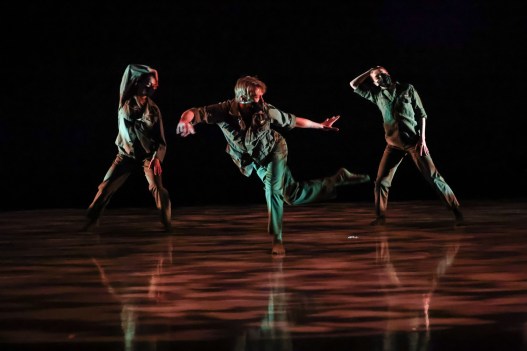
Innov1970 What was it for Photo by Jeff CravottaAppropriate to its Vietnam War theming, Trezevant’s “What Was It For?” arrived for its premiere as a partial amputee, for the beginning of the scenario in the printed program, where war protesters make houses out of draft cards, is MIA – along with the conspicuous absence of Elton John’s “Bennie and the Jets (1974).” What remained thrust us into middle of warfare, Julie Ballard’s lighting design turning the floor of the Center for Dance’s black box into camo splotches of green and gray, while a house of cards lingered downstage, now a cryptic relic of the original concept. A quaint portable radio was spotlit near the opposite wing, likely another leftover, but it remained functional, emitting only white noise as five male dancers, dressed as soldiers, populated the stage, simulating scenes of combat, capture, escape, and rescue.

We were clearly – and perhaps angrily – back home, when Maurice Mouzon Jr. subsequently performed a dashing solo to Nina Simone’s “Backlash Blues (1967).” The two women in this piece, Sarah Lapointe and Anna Mains, arrived onstage as healers while the scene brightened somewhat. Now the returning soldiers – Colby Foss, Ben Ingel, James Kopecky, and Rees Launer – were presumably in hospitals and rehab, dealing with mental and physical trauma in the grim aftermath of a futile war. I suspect that the house of draft cards was intended to fall at the end, but it remained standing.
Innov1970 Subliminal Tsunami photo by Jeff Cravotta

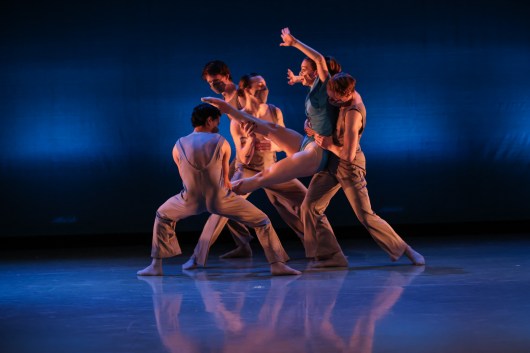
Subliminal Tsunami by Rena Butler, with original music by Daniel J. Hoffman, was a more acerbic and satirical piece that took 1970 as a checkpoint on the state of women’s rights and horizons, compared with where they are today. Recorded voices of Gloria Steinem, Nikki Giovanni, and ABC News anchor Marlene Sanders were in the colloquium, intermingled with recorded voices of seven Charlotte Ballet dancers delivering their own personal accounts. Sharply contrasting with this dignified discussion was what we saw onstage, five women dancers coldly confined by Ballard’s lighting into five squares. The stiffness of Lapointe, Raven Barkley, Isabella Franco, Sarah Hayes Harkins, and Amelia Sturt-Dilley, dressed in matching costumes by Kerri Martinsen, clearly identified them as a collection of Barbie dolls, handled dutifully by four men – Foss, Ingel, Launer, and David Preciado.

Only occasionally did the voices compete with the dancers for attention as the piece proceeded, giving the dancers more latitude for movement. No doubting that the black box’s sound system sorely needs an overhaul, OK for rehearsals but not suitable for prime time. It was still a bit stinging to listen to the cautions against following your impulses issued to young girls contemplating a future of homemaking. Lamentably, the pace of progress for women has been mostly subliminal, not at all a tsunami, though cumulatively we have evolved substantially since 1970, and more progress can be perceived if we look back to when women gained the right to vote 50 years earlier. While I was bothered to see the dancers still masked in 2022, Butler had an ingenious way of coping with the situation: Big smiley, lipsticked mouths on Martinsen’s matching flesh-colored masks were clearly and effectively part of the women’s design.Innov1970 gypsy moths 2 photo by Jeff Cravotta

After the traumas of war and the indignities of gender inequality, it was refreshing to return after a second intermission to gypsy moths, Ja’ Malik’s joyous celebration of funk rockers LaBelle and their frequent collaborator Laura Nyro. A teeming cast of five men and five women, all in spangled masks, converged on the floor for “Met Him on a Sunday,” Nyro’s 1971 cover of a song introduced by The Shirelles thirteen years earlier, and “Come Into My Life,” introduced on LaBelle’s Chameleon album in 1976. “Gypsy Moths,” introduced on the same LaBelle album, paired the company into five couples Emily Porter with Kopecky, Harkins with Humberto Ramazinna, Shaina Wire with Josh Hall, Emerson Dayton with Preciado, and Barkley with Mouzon.

It wasn’t until the ensuing three songs that it became clear that Barkley and Mouzon were the alpha couple of Malik’s piece, for Barkley was obviously the lead in “The Wind” and Mouzon was unquestionably the alpha male in “Going on a Holiday,” both backed by the full cast. Neither of these ensemble segments was as special or memorable as Malik’s seething setting of “Been on a Train,” the whole stage cleared for a slithering Barkley-Mouzon pas de deux. “Desiree,” taken from Nyro’s 1971 Gonna Take a Miracle album was only slightly anticlimactic, a glittery showcase for the other four women, and “What Can I Do for You” was a stirring finale for the entire cast, so infectious that it roused rounds of rhythmic clapping from the audience. The ovation when the spectacularly dressed Malik joined the dancers onstage was even more raucous.

Originally published on 2/5 at CVNC.org

Charlotte Ballet’s 50th Is Luxuriously Long and Varied, Culminating in a Sizzling “Rite of Spring”

Review: Charlotte Ballet’s 50th Anniversary Celebration

By Perry Tannenbaum

ROS Rehearsal Photo

Sitting next to an audience member I’d never met before and conversing with her, thanks to the COVID vaccines and to our vaccination cards that had been scrupulously checked in the Belk Theater lobby, I could share her excitement in being back to see the Charlotte Ballet, out in public without pods or social distancing, and enjoying live performance in a real audience for the first time in nearly 19 months. Even though we were all masked – discarding social distancing seems to increase our tendency to take this precaution seriously – my wife Sue and I felt a distinct residue of wariness.

Yet my trepidations must be an infinitesimal fraction of the wariness anti-vaxxers maintain toward getting vaccinated and an infinitesimal fraction of the daily risks they’re willing to take. Trusting that the people sitting next to you and the people checking them are trustworthy was a calculated leap of faith, my first occasion of sitting next to a stranger since March 2020, so I could understand why the upper tiers at Belk Theater were empty for Charlotte Ballet’s 50th Anniversary Celebration, and why the orchestra and Grand Tiers weren’t teeming to capacity.

Gathering us together for their big celebration after two postponements, Ballet didn’t shrink from keeping us together, offering us a longer and more varied program than we’ve seen in many a season. More than that, they welcomed Christopher Warren-Green and the Charlotte Symphony to the pit (have we ever seen him down there before?) to perform a Philip Glass piece and brought four masked Symphony principals onstage to fuel a performance of Antonin Dvořák’s Piano Quintet. With the exception of Salvatore Aiello’s electrifying setting for Igor Stravinsky’s The Rite of Spring, the program didn’t find Charlotte Ballet in a retrospective mood.

Christopher Stuart, the new Charlotte Ballet II program director, jumped into the fray first with a new piece, “Then, Now, Forever,” set to the live Glass. Canadian choreographer Crystal Pite, whose work has been featured at Spoleto Festival USA on a couple of occasions dating back to 2009, made an edgier Charlotte debut with “A Picture of You Falling,” paired with the Stuart piece before the first of two intermissions. Framed by the two intervals, Val Caniparoli appeared in Charlotte for the first time with Ibsen’s House, interestingly set to the Dvořák. All of these choreographers were present for the celebration – except for Aiello, the former North Carolina Dance Theatre artistic director who died in 1995 at the age of 51.

TROS Young Warrior

The company itself, launching season 51, looked no less fresh and new, especially with etoile Sarah Hayes Harkins happily sidelined on maternity leave. No less than five dancers were taking their first steps as new members of Charlotte Ballet and Charlotte Ballet II, including two Isabellas, Franco and Bertellotti, who are time-sharing a role in the three performances of Ibsen’s House through Saturday. Meanwhile, a trio of seven-year veterans of the troupe; Sarah Lapointe, Raven Barkley, and Amelia Sturt-Dilley; are striding more to the forefront. Lapointe and Barkley struck me as the most arresting presences in Section 1 of the “Then, Now, Forever” suite. Tempo quickened noticeably for Section 2, with newcomers Franco and Emerson Dayton paired with Ben Ingel and Davis Preciado. Easing back to a languid midtempo Section 3, Lapointe poured out her newfound imperious confidence opposite Rees Launer, which made the fast pace of Section 4 that much celebratory, teeming with 10 dancers. Stuart’s choreographic style didn’t startlingly depart from classical models, so his costume design collaboration with Katherine Zywczyk, as well as the dancers, somewhat upstaged him. Backlighting and dramatically silhouetting the famously inert Belk Theater organ pipes, lighting designer Jeff Emory made them useful for the first time in their ignominious history.

Standing spotlights were the scenery for Pite’s “A Picture of You Falling,” surrounding Sturt-Dilley and Andrés Trezevant in a semi-circular formation as the tenuously connected couple performed to Owen Belton’s original 2008 music and Pite’s cold, emotion-free text. We are perhaps invited, without any cordiality, to identify with this brief deconstructed romance, first from Trezevant’s point of view as he faced himself and the repetitive emptiness of his life. Eventually, we escape from this spiral as Pite takes us to the moment where he literally bumps into Sturt-Dilley.

Flirtation and courtship do not figure on this island of light in Pite’s pitch-black universe, so when Trezevant is shown falling, the effect is from gravity rather than love – “This is you falling,” “This is you collapsing” – and his heart literally hits the floor rather than filling with passion. Sturt-Dilley seemed to take over the lead, drawing our empathy for a while, as the little chronicle climaxed at “The Place,” with a light hint that what’s happening, as the two are engaged in their pas de deux, isn’t happening to him. “This is how it happens” transitioned swiftly, without the luxury of regret, “to this is how it ends” after repeated, obsessive descriptions of the room, something like a Last Year in Marienbad video loop or some classically gloomy Ingmar Bergman. Repeated collapses followed, and the falling featured some slo-mo and freeze-frame touches reminiscent of The Matrix.

We haven’t seen any Ibsen from our local theatre companies in Charlotte since a lackluster production of A Doll’s House in 1999, so Caniparoli’s Ibsen’s House figured to be a bad mismatch with the Queen City’s theatre tastes, theatre history, and local theatre professionals outside UNC Charlotte, where they presumably remember that the Norwegian is revered as the father of modern drama. Caniparoli showcased five oppressed Victorian women, including the heroines from Ghosts, Lady from the Sea, Rosmersholm, and the title character of Hedda Gabler. Yet it would be irresponsible for me to recommend catching up with these scripts, for there was little from Dayton and Ingel that reminded me of feminist icon Nora Helmer, insensitive ingrate husband Torvald, and A Doll’s House – or anything at all from Lapointe as Hedda, Josh Hall as George Tesman, Sturt-Dilley as Mrs Alving, and Peter Mazuroski as her son Oswald that awakened memories of Gabler or Ghosts, the other Ibsen staples in Caniparoli’s gallery that I’ve seen. Dayton captured Nora’s early timidity beautifully and Lapointe had a steely resoluteness that was almost intimidating, yet we never found ourselves in the vicinity of the notorious endings of their dramas. Scenic and costume designer Sandra Woodall is best in evoking this strait-laced and corseted era, and Caniparoli excels brilliantly in choreographing the Dvořák, whose 1887 quintet was completed between the times that Ghosts and Hedda Gabler premiered.

Sarah Lapointe in TROS

Having already previewed The Rite of Spring, we need not dwell on the fire and fury of Lapointe as The Chosen One – other than to say that Lapointe didn’t disappoint and completely owned the sacrificial maiden’s every move (Sturt-Dilley dances the role on Friday and Lapointe returns Saturday). Lapointe upstaged and literally towered over everyone else in sight, but the clash between Ingel as the Old Chieftain and James Kopecky as the Young Warrior was primal, intensely physical, and thrilling. Presiding over everything with a shamanistic presence as the curtain went up was Nadine Barton as the Earth Figure, a grand coming out for her in her third year. About the only clear reminder we had all evening of concessions we’re still making to COVID was the absence of live winds, brass, and percussion blaring forth and flailing away at Stravinsky’s score in the orchestra pit. Representing the Salvatore Aiello Trust, curator Jerri Kumery brought the spirit of the choreographer into the hall, and the 17 dancers onstage kept the temperature of his work white-hot.