Review: Sex, Lies, and a Sycamore Tree
By Perry Tannenbaum

Away somewhere in Sycamore Grove, a subdivision in the burbs of a certain fast-growing New South city in the Carolinas, there’s a diversity problem. For the McLeans and the McDaniels, lily-white next-door neighbors in playwright Elaine Alexander’s new comedy, Sex, Lies, and a Sycamore Tree, there’s still too much of it.
Owners of an ostentatious year-old McMansion that the pushy missus already plans to expand, the McLeans project an image of wealth that clearly intimidates Tracy McDaniels as she enters her neighbor’s posh patio for the first time. She’s an English teacher who has lived in Sycamore Grove with her carpenter husband, Rick, since long before Hugh and Ali arrived next door, refugees from California’s wildfires, mudslides, and property taxes.
They don’t fit in.
The McDaniels can remember when the subdivision actually resembled its name, with more modest ranch houses like theirs and many more trees. On one memorable occasion, Tracy cussed out the greedy real estate developers who were heartlessly bulldozing the signature sycamores at a city council meeting. Now their sycamore is the only one left.
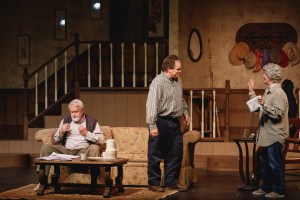
Alexander herself is directing the world premiere of her new script at The VAPA Center in the Charlotte’s Off-Broadway black box – a perfect vantage point for the playwright to gauge what’s working and what isn’t. She also designed the set. On opening night, Alexander could be seen among us in the front row, scrutinizing her brainchild. Likely, she discerned some needed touchups, but she could hardly have been dissatisfied with her sharp cast.
I’m not sure we had ever seen Elyse Williams in a role as declassee as Tracy before, so I was instantly wary. Her slacks and her wig, the flamboyant antitheses of down-to-earth, were not going to help me overcome my qualms. Keith Hopkins as the rugged and grizzled Rick, on the other hand, instantly clicked with his apt attire and Alexander’s crafty characterization.
For Rick, the McLeans’ invite is a bit of a godsend, a chance to visit one of these neighborhood McMansions as a guest rather than as a laborer or a handyman. Yet he comes armed with defenses against his hosts’ possible pretensions, carrying with him a six-pack of craft beer and a bag of Doritos – in case he is offered anything he can’t pronounce.
As we can quickly divine from the stemmed glassware and the spigot-less bar on Alexander’s set, Rick is right on-target with his premonitions. After a year in the neighborhood and their recent trip to Portugal, the McLeans will ply their dear neighbors with Portuguese wine, gazpacho, and a sprinkling of Portuguese idioms. The gallant Hugh has even saved a pocket-sized book of Portuguese poetry for the occasion.
Hugh’s gallantry and savoir-faire are driven by a fairly active libido, so Tom Schrachta has quite a juicy role in counterbalancing Rick’s savvy, crafty vulgarity. In addition to his newly acquired Portuguese, Hugh can hurl some choice Freudian jargon at Mr. Six Pack. Yet Hopkins can parry with choice verses from the King James Bible and the occasional Shakespearean quote on loan from his wife’s teaching curriculum.
The collision between California and the Carolinas – Old and New South – is sharply delineated in the men’s lifestyles. Yet Alexander has crosswired their presumed political leanings.
It’s that lone sycamore lurking behind the scenes that triggers the plot and unveils the main conflict.

Fran Kravitz gets to drive the plot as the fiendishly scheming Ali. She hasn’t belatedly invited her neighbors over to make friends, but rather to make amends for their tree’s trespasses. Nor does she wait until the first bottle of Alvarinho is emptied or the first beer can is crushed. Instinctively, both of the McDaniels come to the defense of their innocent centuries-old sycamore – earning Ali’s patrician scorn and the stigma of liberals.
Yeah, we get to hate Kravitz quickly, and the hits keep coming. Her initial hospitality at the beginning of her opening night performance was too big and loud for the room, so I had misgivings, but her subsequent belligerence and deceit were nicely calibrated, on par with Williams’ righteousness and occasional moral lapses. Kravitz meshed well in the Lies and Sycamore components of Alexander’s plot.
Plausibly motivated and ruthless, Kravitz was also the most convincing in the Sex sector. But Alexander layers on more sex, and it’s here where she is less artful than in the more compelling legal and moral struggles. It looks very early like Hugh and Tracy have a prior history – and that both are taken aback at encountering each other so close to home.

How this is possible after living as neighbors for a year is just the first thing we ought to have explained. By not fleshing out the details, Alexander allows these elements of the comedy and drama to remain noticeably slapdash. Although the playwright does contrive to set aside quality time for Hugh and Tracy, most of the meatiest time they have alone together happens during intermission.
When Hugh’s gallantries and jovial deflections ignite Rick’s jealousy, opening the gates to his choicest Scripture and Shakespeare, the sexual chemistry layered onto the conflict really does turn up the heat in a delightful way. As soon as we see Hopkins stalking in with the axe that Rick has discovered in the McLeans’ backyard, we can see comedy and drama beginning to teeter on the tip of the blade.
Furthermore, Hugh’s roving eye gives some common cause for Rick and Ali, providing extra leverage when she litigates and negotiates a mutually beneficial resolution to the matter of the McDaniels’ pesky sycamore. With so much lying, scheming, and betrayal going on around him, will Rick be the last to succumb?
No less suspenseful, we wonder if the two families can become good neighbors and if the two couples can remain intact. Slapdash or not, this is complicated.
Alexander’s instincts seem to tell her not to get too bogged down in the moral, political, economic, and environmental issues she brings up – no to be too dogmatic or preachy. That allows her drama, her comedy, and her audience to breathe more easily. It allows her to favor dramatic and comic impact over message and allows her plot and her characters to have more sway.
All to the good, especially with this cast in Alexander’s directorial hands. Yet I still wish for more eloquence and passion from both sides of the Sycamore controversy. I’m never sure that the playwright quite realizes the magnitude of what she has accomplished here.

She has greatly levelled the playing field in a debate that usually pits big business, real estate developers, grasping politicians, and banks in a one-sided battle against private homeowners and brainy conservationists. Here we have two families with these conflicting interests – with the McLeans retaining enough monetary advantage to keep it real. Let’s have Tracy, Rick, and Ali all fervently pleading their cases as if their futures depended on it, OK? And keep the sex (plus backstory) intact.
It’s hard to deny that if George S. Kaufman were working this material, now or 90 years ago, his slant would have ultimately been more progressive. Why should we be more cautious and regressive now?
Yes, we are in purple North Carolina rather than blue California, but who are we convening in these seats at this world premiere? Overwhelmingly, we are progressives and liberals who still get the gist of the US Constitution, the Bill of Rights, and settled science. That is the reality now and that will be the reality in the foreseeable future: whether or not PBS, NEA, CBS, and Stephen Colbert survive this disgusting decade.



 Art on My Sleeve