Tag Archives: David Fisk

Listen! Charlotte Symphony Has Launched Its 94th Season With a Truly Musical Logo

Review: Charlotte Symphony Plays Shostakovich Symphony No. 5

By Perry Tannenbaum
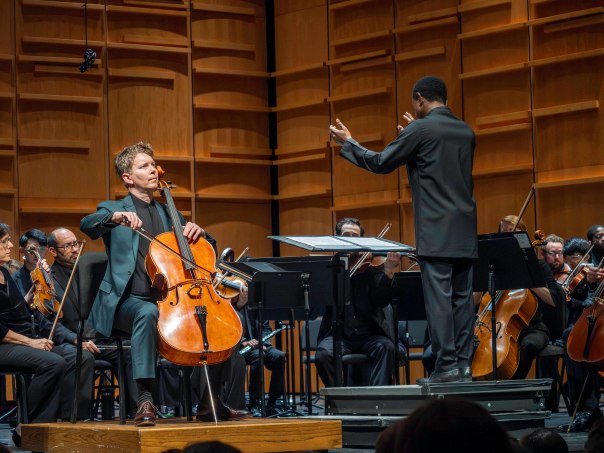
October 10, 2025, Charlotte, NC – It’s a bit of a mind-bending concept, so after launching Charlotte Symphony’s 94th season by leading his orchestra and audience in the National Anthem, music director Kwamé Ryan needed to take a couple of minutes to explain what exactly a musical logo is. Symphony also has a new conventional logo, a graphic see-through C with a top seraph that reminds one of a bass clef. But Symphony’s musical or sonic logo, Ryan explained, is akin to the six notes you hear on your iPad when you get a fresh sports bulletin from ESPN or the sonic boom that blasts you off your couch when you sign in to Netflix.

Ryan joked that Symphony had gone to John Williams to write the new theme but he wasn’t available. So he settled for Mason Bates, the second most-performed living composer (by American orchestras), who accepted the commission. The timing was auspicious, for Bates’s acclaimed new opera, The Adventures of Kavalier & Clay, opened at the Met less than a month ago.

Ryan proceeded to lead his orchestra in two versions of the new logo, the world premiere of an extended concert version followed by the abbreviated five-second version concertgoers could expect to hear in the Knight Theater lobby, summoning us back from intermission. Tell me I’m wrong, but Bates also seemed to have Williams in mind, in a heraldic vein, when he fulfilled his commission. And if musical or sonic logos become a thing among orchestras, Bates, Ryan, Symphony, and its subscribers can all claim to have been on the ground floor at the Knight.

Bates also took honors for composing the first piece to appear on our printed programs for the new season, Attack Decay Sustain Release. Premiered 12 years ago on the Left Coast, this lively five-minute appetizer was written, Ryan revealed, in 7/4-time. Bates’s title was likely onomatopoetic, describing the flow of his primary melody, for the seven beats often ended with a sustained crescendo. In its multiple episodes, the five-minute piece also boasted plenty of space for highlighting Symphony’s strings and brass section, sprinkled with an assortment of woody and frond-y percussion.

The remainder of the evening would be devoted to Dmitri Shostakovich, if our printed programs were to be trusted. In greeting us, however, Symphony president David Fisk told us to expect an extra musical moment after intermission. Surprises galore! Maybe the biggest went unmentioned by Fisk and Ryan: the turnout at the Knight. Compared with the “disappointing” turnout I reported last November for Shostakovich’s Ninth, the first and only previous occasion that Shostakovich topped the bill of a Symphony program, our 2025 crowd for the composer’s Fifth was robust, few empty seats across the orchestra section and seats sold in the balcony to the uppermost row.

Guest soloist Joshua Roman may not have been apprised of the surprisingly enthusiastic crowd awaiting him, appearing slightly wary as he seated himself for Shosty’s Cello Concerto No. 1. With good reason. The piece, written for Mstislav Rostropovich in 1959 is bold and daring from the brash onset of its opening Allegretto movement, not at all a timid or apprentice composition. Roman’s part in the Allegretto was precociously modern; so driving, repetitive, and mechanical that it seems to antedate the minimalism of Philip Glass and John Adams. The comical interjections from brass and clarinet upstaged the soloist somewhat in my first live audition of this piece.

Roman could have told himself to be patient about winning us over, for his role became more complex and impressive after the only pause in the piece, when he tackled the cluster of three final movements, delivered without further pause. At the heart of this cluster, between a soulful Moderato and a joyous Allegro con moto, Ryan and his orchestra observed a reverential silence as Roman played the Rostropovich-worthy third movement cadenza. There were bowed sections featuring a melody and a bassline simultaneously and, deeper into the virtuosic display, interludes of counterpoint where he bowed with his right arm on open strings while plucking a second melody line with his left hand. You couldn’t miss the difficulties here even if you closed your eyes. Nor was the final movement anticlimactic, featuring the return of the orchestra and a more decorative and colorful return of the march motif from the opening movement.

Undoubtedly, the audience perceived the military triumph they had witnessed, rising for a lusty standing ovation. This triggered a final pre-intermission surprise, for after being cheered back onstage a couple of times, Roman sat himself down for an encore and, before the tumult died down, launched into the Prelude to J.S. Bach’s Cello Suite No. 1, maybe the most familiar solo he could possibly offer.

Pure negligence prevented me from sampling the sounding of the musical logo prompting our return after intermission for our most touching surprise, played in tribute to three dearly departed members of the Charlotte Symphony family. Thankfully, it wasn’t Samuel Barber’s Adagio but rather a piece that necessitated some fresh sculpting and rehearsal, Arvo Pärt’s Cantus in memoriam Benjamin Britten. Beautiful!

We’ve heard a lot from Ryan in recent years, though many Symphony subscribers might say we should have heard much more. In preparing what Shostakovich subtitled “A Soviet Artist’s Practical Creative Reply to Just Criticism” – from renowned music critic Josef Stalin – Ryan trampled on the notion that Symphony No. 5 was in any way servile, apologetic, or conciliatory. All the true moods of Shosty’s 1937 portrait of Soviet Russia were vividly rendered, beginning with the bleak, haunting, and ultimately aching qualities of the epic opening Moderato. This battlefield desolation was not altogether relieved by the comical marching of the ensuing Allegretto, which combined sourness with merriment, along with a delicious dancing interlude from concertmaster Calin Ovidiu Lupanu. The Largo reverted to the weepy and misty grumblings and dyspepsia of the opening movement. Then we transitioned wonderfully – especially in ghoulish October – to the surreal, manic phantasmagoria of the concluding Allegro non troppo. My happy memories of Christopher Warren-Green conducting this work have faded since 2013, so I offer no comparisons. But this was no doubt the finest performance I

Charlotte Symphony’s New Maestro, Kwamé Ryan, Thrills a Packed House

Review: Tchaikovsky & Brahms at Belk Theater

By Perry Tannenbaum

April 5, 2024, Charlotte, NC – The audience at Belk Theater didn’t rise and sing the National Anthem as we do at the start of every new Charlotte Symphony season, but the occasion – Tchaikovsky & Brahms – was auspicious enough for Symphony president David Fisk to take the stage, notes in hand, and introduce the Orchestra’s newly designated music director, Kwamé Ryan. On the heels of CSO’s announcement that they were already at over 80% in reaching its $50 million fundraising campaign goal, ensuring Symphony’s financial stability, Classics subscribers had multiple reasons to express their enthusiasm – as Fisk spoke and when Ryan made his entrance. Both events had been sufficiently ballyhooed in the press. Fisk could wait a leisurely eight minutes after the normal starting time to make his appearance, so the usual curtain-up helter-skelter of late arrivals had subsided. Unless Ryan raised his eyes to the uppermost balcony, he saw a packed house ready to erupt.

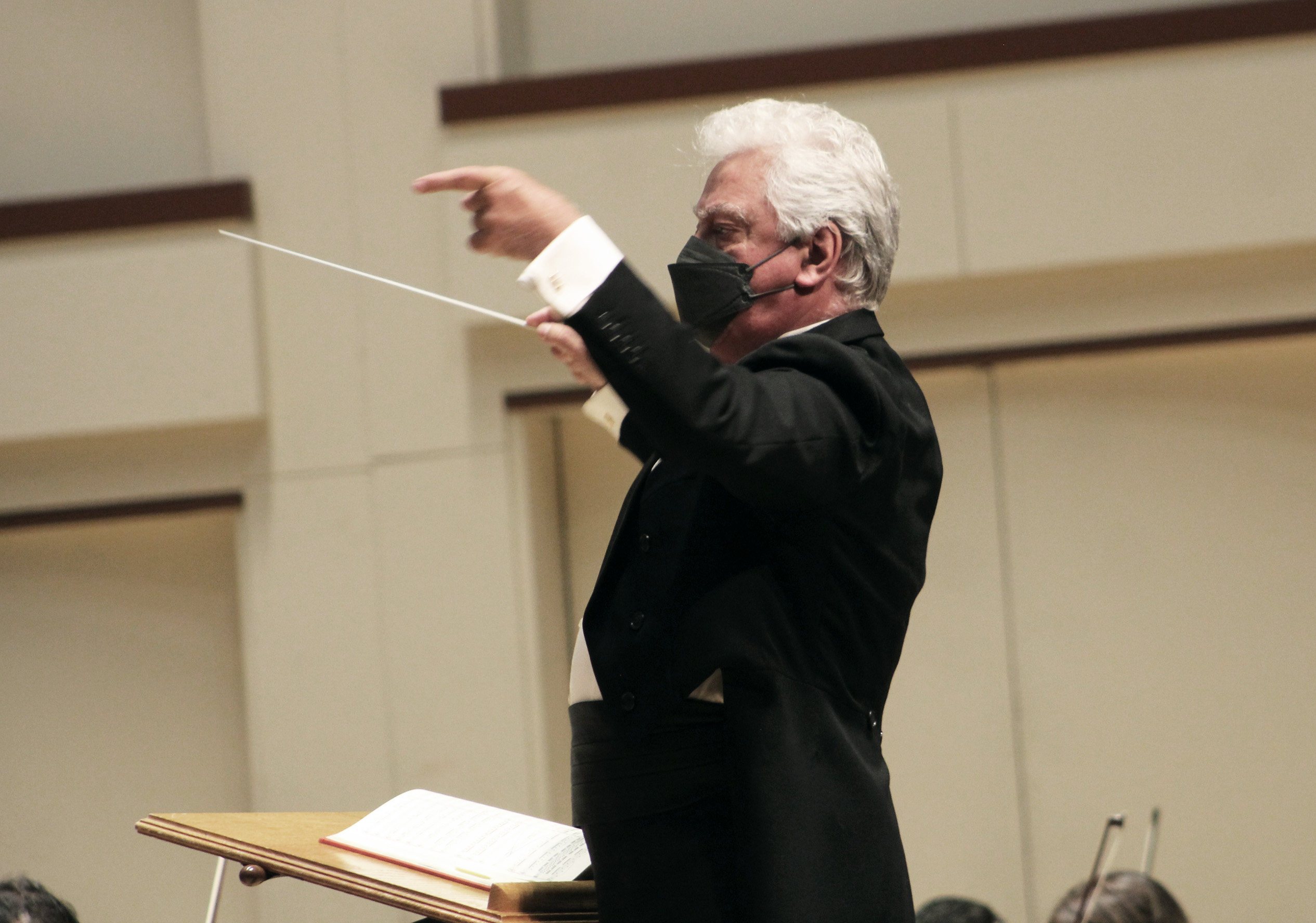
Ryan’s greeting was even more personable than Fisk’s intro, so audience adoration actually rose a couple of notches before quiet prevailed and he could put his baton to use. This really was the beginning of a new Kwamé Ryan era, and the director designate did not fail to take advantage of that vibe. Instead of the “Star-Spangled Banner,” Ryan began his reign with what felt like the next best thing. With the composer seated in the orchestra, poised to receive more audience adulation, Ryan and Symphony performed Wang Jie’s Symphonic Overture “America, the Beautiful.” A self-professed “lover of adventure on mountains and cliffs,” Wie was thrilled when the Colorado Springs Philharmonic asked her to create a work inspired by nearby landmark Pikes Peak and the song written by Katherine Lee Bates in 1895 to a melody composed more than a decade earlier by Samuel A. Ward.

The commission was not at all outré, since Bates’s original poem was inspired by her first trip to the summit of Pikes Peak. You might say, however, that Jie’s music was inspired by America in 2016, since her description of this work stresses the unifying effect of the song amid political turbulence. She aimed for a piece that acknowledges how “fractured” we are while expressing the hope that a “re-harmonized” take on the anthemic song could still have healing and unifying powers. Fractured episodes alternate with Jie’s re-orchestrated presentations of Ward’s melody, presented in chunks of eight bars each until all of “America, the Beautiful” is reprised with brassy grandeur, followed by a frantically accelerated coda. Curiously, the piece probably does sound a lot more hopeful today, eight years after it was premiered barely two weeks before Election Day. A revision today might not contain the same wan, ruminating passage from the French horns or the silvery wistfulness from concertmaster Calin Ovidiu Lupanu. Wie’s energetic balancing act was almost nostalgic.

Although cellist Joshua Roman performed Tchaikovsky’s Variations on a Rococo Theme in Charlotte as recently as 2012 during an All-Tchaikovsky concert led by Christopher Warren-Green, the piece didn’t skyrocket to mountaintop status for me until Gautier Capuçon played it at the glorious Dvořák Hall during the Prague International Festival of 2019. Reaching that stratosphere would be difficult for both guest soloist Sterling Elliott and Ryan, navigating Pyotr’s score before the vivid memory of Semyon Bychkov’s exploits with the Czech Philharmonic had fully faded. Indeed, the delight and perfection of the Prague experience drifted beyond reach by the time Elliott and the CSO had traversed the mid-tempo prelude, the rococo theme modeled on Mozart, and the first two variations at a friskier pace. Ominously, it dawned on me that this was the first piece I was hearing Ryan conduct with Symphony that wasn’t composed by an American citizen.

With the onset of the dreamy Variation III, Elliott and Ryan found their footing, bringing forth the full sublimity of the Andante sostenuto. At that point, knowing that some bodacious virtuosity lay ahead in the final four Variations and the crowdpleasing coda, I resolved to try and watch Elliott from the perspective of those in the audience who were experiencing the Rococo for the first time. Wiping the slate clean not only enhanced my own experience, it plugged me into the excitement and wonder of the Belk Theater crowd as the buoyed Elliott slashed through the pyrotechnics in the latter half of Tchaikovsky’s concerto and shredded his bowstrings. If you factor in opening night jitters, Elliott’s encore figures to be even more awesome.

The Brahms Symphony No. 1 built to a similarly walloping climax after intermission. Limited rehearsal time – or simply the limited time Ryan and the Orchestra have had to become acquainted with each other – may have accounted for the somewhat listless and shapeless reading of the opening Un poco sostenuto and its subsequent transitions back and forth from Allegro. It was in the ensuing Andante sostenuto, where acting principal oboist Erica Cice had multiple chances to shine bookending principal clarinetist Taylor Marino’s eloquence, that the ensemble seemed to discover its voice, capped by some subtle soloing from Lupanu.

Marino spun a little more magic, in league with principal flutist Victor Wang, at the start of the third movement Allegretto as the ensemble ramped up for the grand finale, where Brahms First echoes Beethoven’s last. Here was where we could find the most encouraging examples of the pacing, sculpting, and exhilaration we can expect as Ryan settles in with Symphony for seasons to come. Repeatedly, principal French hornist Byron Johns was impressive, first as he hovered above the brass and later in concert with the other horns. There was admirable warmth from the strings in the big tune, with effective spotlights from Wang, Cice, and the four trombones. Everything was clicking during this finale, which crested with thunder, and the audience called Ryan back from the wings again and again with a standing ovation.

Warren-Green Bids Farewell With a Rousing Beethoven “Ode to Joy”

Review: Charlotte Symphony Plays Beethoven’s Ninth

 By Perry Tannenbaum

IMG_6604_dcoston

May 20, 2022, Charlotte, NC – Even back in the early ‘90s, when Charlotte Symphony struggled to sustain respectable mediocrity, the valedictory concert led by Leo Driehuys in 1993 proved that the orchestra could always rise to the occasion when called upon to perform Beethoven’s thrilling Ninth Symphony. Having heard the same ensemble bludgeon Beethoven’s “Eroica” to blandness just months earlier, it was hard for me to believe that the inspiration came solely from the composer. I struggled with the answer to this anomaly until I interviewed Driehuys’s successor, Peter McCoppin, shortly before his final season at the end of the millennium.

Not referencing Beethoven at all, but explaining why he enjoyed his years in Charlotte so thoroughly, McCoppin observed that the Queen City is incredibly fertile ground for choristers and choruses. You just had to count the churches around town to see his point. Not only had the Oratorio Singers of Charlotte brought extra spark to Beethoven’s “Choral Symphony,” they had also arguably sparked the Charlotte Symphony musicians they were partnering with.

The Oratorios have undergone numerous metamorphoses during the past three decades, at discreet intervals absorbed into Symphony, renamed the Charlotte Symphony Chorus, and eventually set free to seek their own gigs, rebranded once again as the Charlotte Master Chorale. Yet each time it was necessary to muster the instrumental and vocal artillery needed for Beethoven’s masterwork – indeed, classical music’s masterwork – the Chorale has admirably answered the call.

In a recent interview prefacing his valedictory concert as Symphony’s music director after 12 fruitful seasons, Christopher Warren-Green revealed that the chorus had been “one of the big incentives for me to come to Charlotte because of the great repertoire that was written for orchestra and chorus.” Little wonder, then, that Maestro Warren-Green has chosen to conclude his tenure by including the Master Chorale in his final “Ode to Joy” concert – or that he has already announced that, when he returns this coming December as Symphony’s music adviser and conductor laureate, the choir will be in the mix once more as he conducts Handel’s Messiah at Knight Theater.

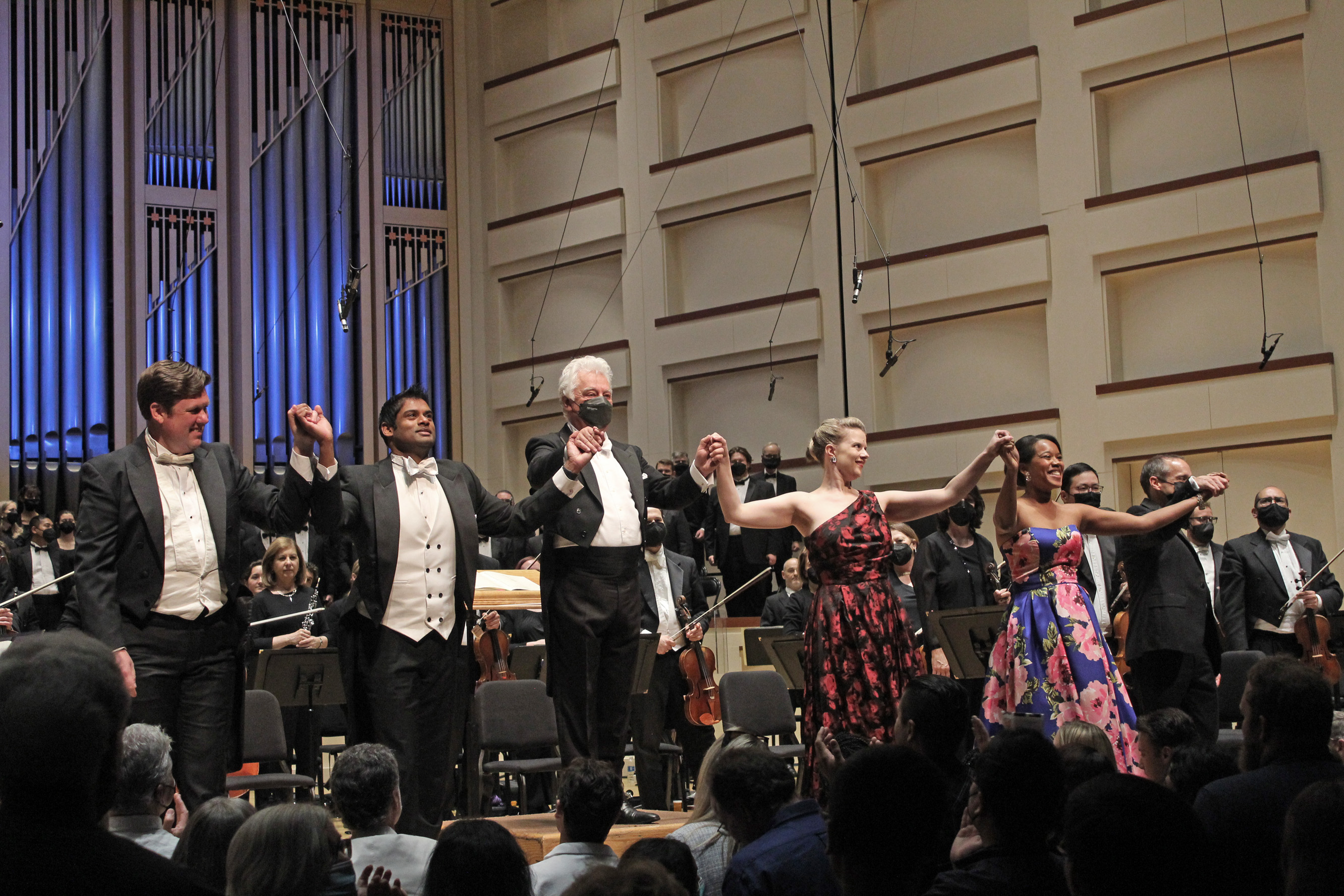
There always seem to be extra layers of drama and excitement when the “Choral Symphony” returns to Belk Theater, never more than when Christof Perick made his 2001 debut as music director just 10 days after 9/11. Fast forward to the fourth Ninth that Symphony has programmed since then, and there was still a palpable sense of a special occasion in the hall. Symphony president and CEO David Fisk saluted Warren-Green before he made his grand entrance, greeted with a lusty standing ovation. Maestro then pooh-poohed all of Fisk’s accolades, paid tribute to four newly retired Symphony musicians, and – prior to a nifty and brief exit – exhorted the audience to keep supporting the CSO “or I’ll never forgive you.”

That was the last laugh of the evening as Warren-Green returned to the podium, signaled the Chorale to be seated, and presided over the Symphony as Beethoven brought them to a boil, quicker than a microwave oven, in his opening Allegro ma non troppo. Warren-Green’s Ninth would by a turbulent one, far more timely than timeless, discarding many chances for liquid lyricism in favor of alert and spirited rigor – almost militant but never quite lapsing into rigidity with the onset of its rousing quicker tempos. The incisiveness of Jacob Lipham’s timpani came upon us quickly, never allowing us to rest for long, while the affecting woodwinds and the lively strings offered eloquent counterweights.

When we reached the Molto vivace second movement, with its industrious bustle and perpetual overlapping, Warren-Green enabled us to hear early foreshadowings of the teeming humanity we’ll find in the epic fourth movement, struggling toward togetherness and brotherhood. Excitement in the overlaps between various sections of the orchestra was increased dramatically by spasmodic boosts in dynamics and the sharp whacks of the timpani. Also pushing against the flow of the violins and the warmth of the cellos were the percolating winds and the moaning French horns.

IMG_6891_dcoston

Between the second and third movements, the last true pause in this symphony, the guest soloists entered and took their seats at center stage: bass baritone Jordan Bisch, tenor Sean Panikkar, soprano Alicia Russell Tagert, and (substituting for Briana Hunter) mezzo-soprano Sarah Larson. The two little girls seated in front of my mom and me perked up expectantly at this point, only to be let down by the relatively tranquil Adagio molto e cantabile. The little girls weren’t as restless or fidgety during this lovely movement as you might expect little boys to be, but their attentiveness waned noticeably – despite the sweetness of the first violins, the affecting violas and second violins, and the mellifluous woodwinds and horns. Their adorable decorum was threatened most by the beautiful confluence between clarinet, horn, and flute as the penultimate movement faded into the concluding Presto.

IMG_6511_dcoston

Having this glorious score in front of you, with its magnificent build-up to the signature fireworks waiting to explode, must be so gratifying and fulfilling as a musical conductor stands on the podium, heading into the homestretch of his 12-year tenure. Surely, the musicians and choristers sensed the excitement and shared an eagerness to deliver. The first violins were certainly ardent and rich over the churning violas and second violins as the build-up began, yet as the gradual gravitation toward the brotherhood theme was beginning, I noticed that Warren-Green was doing something different and new. Instead of seating his cellos and double basses to our right, they were now spread in a long row, starting in front of the podium and reaching to the left edge of the stage in nearly a straight line.

So there was a little more than the usual edge as the journey to the brotherhood theme launched, continuing with dogged inevitability after the woodwinds mischievously flashed back to the agitations of the second movement. Violas layered onto the cellos and basses, adding to the smoldering sensation, and the violins accelerated the familiar strains until the brass made them soar. The little girls in front of us were completely re-engaged ahead of the next magnificent build. Bisch sounded stronger and more robust in his opening declaration, “O Freunde, nicht diese Töne! (Oh friends, not these sounds!),” culminating in the announcement of his Joy agenda (“Freude!”), than he did reprising the brotherhood refrain as he plunged into Friedrich Schiller’s “An die Freude (Ode to Joy).” More than a couple of bass baritones who have recorded these passages have fared the same. Perhaps that was Beethoven’s design, for ample reinforcements will emphatically arrive on the scene, first the soloists and then the phalanxes of choristers who were elevated over everyone upstage, ably representing Schiller’s millions.

At least a couple of regatherings follow, as all of us who love the Ninth well know. There’s a grand, brassy military march while the vocalists inhale for awhile and hold their fire, and then there are those sublime audible inhalations as Schiller’s lyrics, helpfully translated in supertitles above the Belk stage, took us “above the canopy of stars” in an ethereally protracted chord. When the Master Chorale reached peak tempo in the concluding Allegro assai vivace, like a herd of horses urged by Warren-Green to full gallop, one of the little girls turned to the other with an OMG expression on her face that her mom would have treasured until her dying day if she had seen it. At this moment, the greatest pleasure in watching kids experience this magnificent storm of sound for the first time is being able to say to yourself. “You ain’t heard nuthin’ yet!”

Originally published on 5/22 at CVNC.org

Ukraine’s Colors Shine Through Charlotte Symphony Celebration

Review: Dona Nobis Pacem at Belk Theater

 By Perry Tannenbaum

2022~Dona Nobis Pacem-31

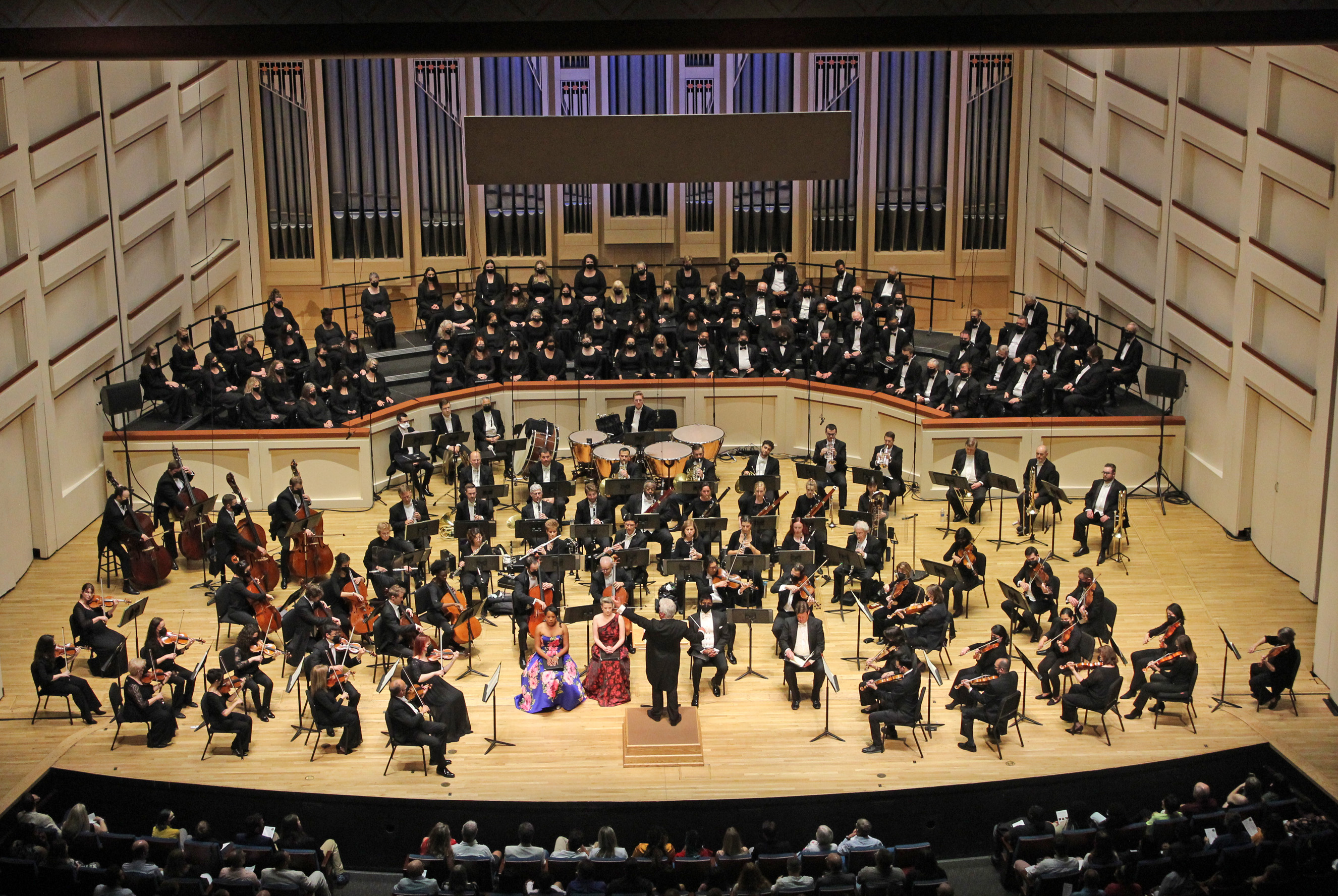
March 12, 2022, Charlotte, NC – When 57 musicians gathered at the Carolina Theatre on Tryon Street to present the inaugural Charlotte Symphony concert on March 20, 1932, none of them could have possibly predicted how the orchestra’s 90th anniversary would be celebrated in 2022. Three of the five pieces that Christopher Warren-Green conducted, nearing the end of his distinguished tenure as Symphony’s music director, hadn’t been written yet, and one of the composers hadn’t been born. Even last May, when CSO’s 2021-22 season was announced, Warren-Green himself couldn’t have predicted how grimly appropriate Ralph Vaughan Williams’ Dona Nobis Pacem would be for the occasion. As originally conceived, the program was an olive branch from England to America, three British composers conducted by one of the Crown’s finest, two of the pieces paying homage to Walt Whitman, our greatest poet.

A small dent in the all-English lineup turned up when Symphony’s Australian second trombone, Thomas Burge, finished enough of his to-be-continued “Charlotte Symphony Fanfare” for it to serve as a preamble to the orchestra’s celebration. What truly turned the tone of the anniversary festivities upside-down was Vladimir Putin’s horrific invasion of Ukraine, lending Dona Nobis Pacem – “Grant us peace” – unforeseen pertinence and meaning. With St. Patrick’s Day weekend revelers teeming along the sidewalks and spilling over onto Tryon and Fifth Streets, there was a dramatic contrast for concertgoers who became pedestrians shortly after hearing Williams’ Fantasia on a Theme by Thomas Tallis and the Dona Nobis at Belk Theater on Saturday night. The most festive of the night’s festivities were outside the hall.

Burge’s new composition will no doubt impress more when it takes its intended place at the launch of a future Symphony’s classics season and the composer’s showy post-pandemic staging can be realized: three brass choirs spread out across the Belk balcony. For the 90th, the brass battalion was confined behind the masked string sections, but the peep we had into the work-in-progress was sunny and glorious. Gustav Holst’s Walt Whitman Overture, a youthful piece completed in 1899 when the composer would turn 25, was arguably the most sustained celebration of the evening, though it might be somewhat deflating to learn that Holst had been dead for over 48 years when the piece was first performed in 1982. The transparent violins at the beginning, hovering over churning basses and cellos before flutes and brass peeped in, struck me more like Schubert than any American or British music. When the brass first broke through, however, there may have been a glint of Sousa, and the final swell of the piece was in a grand Victorian vein.

The Four Scottish Dances by Malcolm Arnold (1921-2006), premiered in 1957, were clearly the most winsome offering of the evening, shuttling between slow and fast tempos – not only between dances but sometimes within them. Inspired by Louis Armstrong more strongly than by Whitman, Arnold’s music displayed a more American élan, geniality, and broad humor than the other Brits’. If your head wasn’t spinning from the abrupt acceleration that Warren-Green called forth in the opening “Strathspey Pesante,” which ended with a pedestrian “shave and a haircut” phrase, then the slowdown in the ensuing Vivace (Reel), initiated by Joshua Hood galumphing on his bassoon, would certainly have caught your ear. And if that weren’t sufficient mischief, Warren-Green’s hambone slacking and slouching at the podium added a visual cue. Perish the thought that Maestro Warren-Green’s predecessor, Christof Perick, would ever have tainted himself with such levity.

After these pranks, which reminded me of the Western merriment in Copland’s folksier pieces, the work of principal harpist Andrea Mumm Trammell, principal flutist Victor Wang, and oboist Erica Cice was sublime in the penultimate “Hebridean Song,” shining through the shimmer of the strings. The concluding “Highland Fling” had as much Scottish flavor as the “Pesante,” rushing at us unabated with sudden shifts in volume, the tweedling of the high woodwinds answered by onrushes of orchestra colored with fiery alarms from the trombones.

If the customary programming conventions for galas were being observed, I’d strongly question the wisdom of delaying the comparatively solemn and serene Tallis Fantasia until after Arnold’s suite, which would have sent us off to intermission in a lighter mood. But Symphony president David Fisk had already solemnized the occasion by dedicating the concert “to Ukraine and the courage, strength, and resilience of its people,” a theme that would subsequently be echoed in the digital program and by Warren-Green, when he prefaced his performance of the Dona Nobis. By coincidence surely, Vaughan-Williams composed his 1910 Fantasia very similarly to Burge’s spanking new “Fanfare,” dividing his aggregation of strings into three parts, two string orchestras with a string quartet within the larger orchestra. Concertmaster Calin Ovidiu Lupanu had the last and most eloquent solo among those doled out to the four principal string players, but kudos should also go to principal violist Benjamin Geller, whose solo launched the memorable quartet episode.

What will stand out for me, however, was the extraordinary alchemy of this performance. Whether it has always been baked into Vaughan-Williams’ orchestration, maybe something special that Warren-Green was able to elicit from his musicians, or whether it was the unprecedented high placement of the small string orchestra on the platform where the Charlotte Master Chorale would soon sing, flush against the upstage vestigial pipes at the Belk… I could have sworn that there was a softly playing organ in the orchestral mix. Needless to say: amazing.2022~Dona Nobis Pacem-27

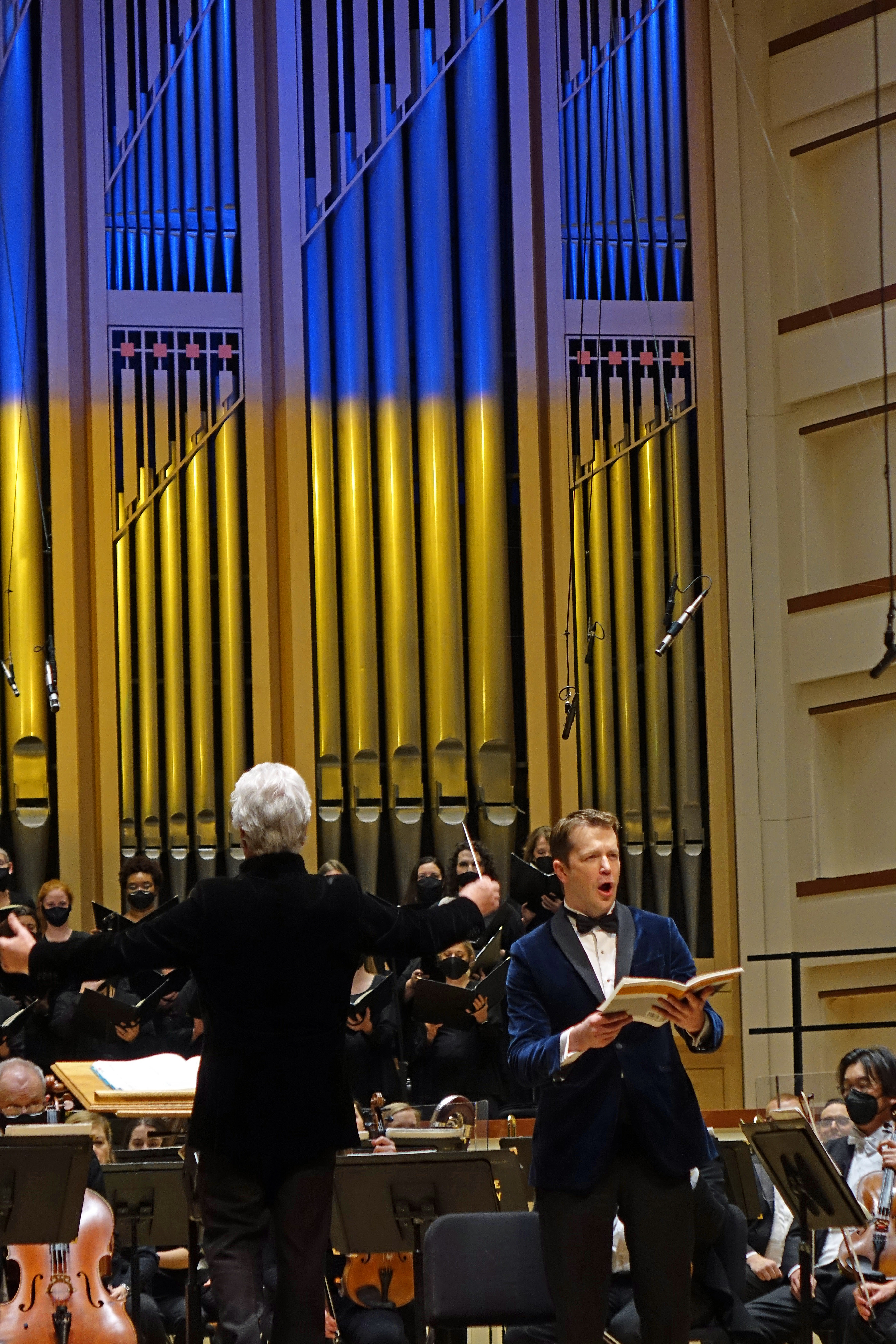
Those organ pipes were more verifiably involved in the culminating performance of the Dona Nobis Pacem, after more than 40 Master choristers filed in, followed by our two guest soloists: soprano Christina Pier and, in his Charlotte debut, bass-baritone Daniel Okulitch. It was then that Warren-Green dedicated this piece to the valiant, freedom-loving people of Ukraine. Between the moment that the maestro turned away from us and Symphony began to play, those silvery pipes, illuminated until then entirely in blue light, suddenly became halved into stripes of gleaming blue and yellow gold, the colors of the Ukrainian flag. A proud moment for us all.

Whether prescribed by COVID protocols, Warren-Green’s decree, or the unmasked singers’ personal preferences, Pier and Okulitch sat further apart than the vocal soloists we usually encounter at Symphony concerts. With Pier mostly singing the “Agnus Dei” refrain that contains the Latin title, and Okulitch confining himself in the middle movements in Walt Whitman’s English – and Old Testament translations in the Finale – the separation between the singers wasn’t awkward at all.

2022~Dona Nobis Pacem-24

Pier tended to sing with the orchestra and the choir, but there was an extended stretch where Okulitch, standing to Warren-Green’s right, was accompanied solely by Lupanu, seated to his left. So the tableau enhanced the intimacy of their duet. What was really unfortunate and compromising for us were the vast stretches of incomprehensible text from the chorus that Vaughan-Williams had scored so splendidly. If there had been supertitles above the stage or printed programs in our hands, the experience would have been even more powerful. Those of us who were able to download the digital program were adequately equipped, but the Blumenthal Performing Arts Center has had repeated problems with transmitting these copious, colorful, and informative materials.

In future performances where we’re expecting to follow along at the Belk, I will try to download the digital materials before I leave home. Clearest of all was the chorus’s mighty “Beat! Beat! Drums!” refrain from one of Whitman’s most metrical Civil War compositions. Even when we might be lost in the less familiar words of other war poems by the Good Gray Poet (“Reconciliation” and “Dirge for Two Veterans”), the music, the voices, and the colors of the fighting Ukrainians’ flag landed on us forcefully. It was thrilling.

Originally published on 3/14 at CVNC.org