Tag Archives: David Catenazzo

Off-Broadway Star Shines in Three Bones’ Andy and the Orphans

Review: Andy and the Orphans at The Arts Factory

By Perry Tannenbaum
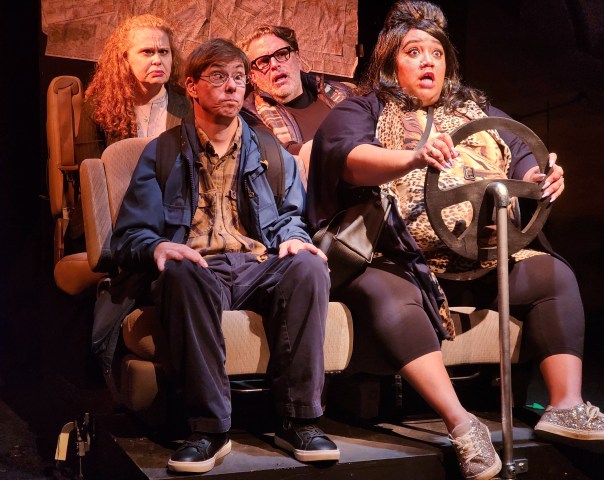
Eddie Barbanell, Susan Cherin, David Canetazzo and Vanessa Robinson (1)

When playwright Lindsey Ferrentino wrote Amy and the Orphans about her Down Syndrome aunt Amy, she convincingly demonstrated that she didn’t need to write its fraternal twin, Andy and the Orphans. But the demonstration happened too slowly. Ferrentino and director Todd Haimes needed a second Down Syndrome actor to play the title role at matinee performances when the show opened for the Roundabout Theatre Company in 2018.

Presumably, Ferrentino thought that pickin’s would be slim after finding Jamie Brewer at a New York fashion runway, the first DS person to participate in Fashion Week, through a talent agency that specialized in performers with disabilities. So the playwright didn’t specify what gender her second DS actor should be. Along came Eddie Barbanell to step onstage as the matinee understudy, and along came Andy and the Orphans, the custom-tailored male version of Ferrentino’s tribute to her Aunt Amy.Eddie Barbanell as Andy_1

Five years later – and five years closer to Andy’s real age – Barbanell is here in Charlotte, wowing audiences at The Arts Factory in Three Bone Theatre’s production of Andy and the Orphans through February 25. Meanwhile, Ferrentino has learned, through versions of her work staged in London and Spain, that you can reliably find DS actors to play DS people onstage anywhere. The real stumbling block for DS performers is the lack of roles for them.

Three Bone was actually early to the Ferrentino party, bringing the playwright’s previous work, Ugly to the Bone, to Spirit Square’s Duke Energy Theater two years ago. It was another script that showed Ferrentino’s empathy with female castaways in our society and how they are treated. Then it was Jess, an Afghanistan War vet returning to her Florida home, disfigured and disabled physically while inwardly suffering from PTSD.

While the content of Amy/Andy is more autobiographical, the location moves away from the playwright’s native Florida to New York. Precise locations shift during the action, and Ferrentino is rather circumspect about where we are or when. Without the script in my hands, I guessed that at various times we were in Staten Island, outside LaGuardia or Kennedy Airport, at a group home in Queens or Long Island, on the road, and – quite memorably – at a Burger King. Andy, his elder siblings, and Kathy, the caretaker who must accompany Andy, are on a road trip to Dad’s funeral, past the end of the fabled Long Island Expressway (and Sunrise Highway afterwards) to Montauk, the eastern tip of New York.David Catenazzo and Susan Cherin_2
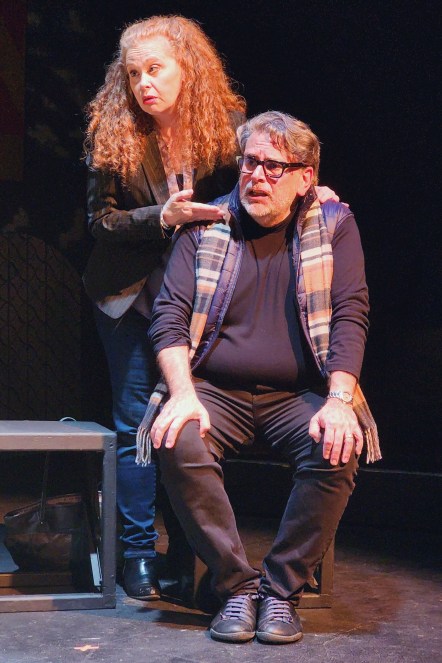
Maggie and Jacob, when they aren’t bickering over whether their yearly meet-ups are Christmas or Chanukah visits, are worried over how they will break the news that Dad has died – and that Mom has already died awhile ago. This is the right comedy varnish to apply to a story that has a rather horrific dramatic core. Likewise, being overdue on telling their DS little brother that Mom and Dad are dead is a rather innocuous patina to apply to the family trait the characterizes Andy’s sibs and parents, a shocking abdication of their responsibilities toward him.

As this shabby trait becomes more and more exposed, the sideshow dinginess of Chip Davis’s traffic-themed set design becomes more and more apt for this story. It’s hard to escape the conclusion that director Danielle Melendez lucked out when Susan Cherin and David Catenazzo showed up for auditions. Cherin comes off as the kookier, more neurotic sib as Maggie, far more likely to be a fretful helicopter parent than her shambling brother. As Jacob, Catenazzo has the more Jewish name and delivers a more Jewish demeanor – compounding the comedy, since he’s the bible-toting convert who celebrates Christmas.

It’s really hard for us to be disgusted with either Cherin or Catenazzo until Maggie and Jacob are shown why they should be deeply disgusted with themselves. That’s why this key moment is such a gut punch for us.

Barbanell is extraordinary, giving us all that Ferrentino wrote into Andy and more. As an actor myself, I marveled at his cue pickup and his timing. We don’t need to be in his presence long for us to believe how he and Brewer blew away the playwright’s expectations for what a DS actor can do, or that they were the first Off-Broadway cast members to go off-book. Nor was I surprised by the end of the evening to read that Barbanell had burst into Shakespearean monologues by Romeo, Julius Caesar, and Puck the first time he met up with Ferrentino at a roadside diner, turning his interview into an audition and a theatre event. Each performance was “word perfect” by the playwright’s account.

Tacitly, then, she has admitted that she might have filled out Amy/Andy’s role more amply if she had known, going in, the full capability of DS actors. Critics who have faulted Ferrentino for not fleshing out her title character and letting us get to know him better may have overlooked just how pioneering this script is. Getting buffeted by myopic critics was the price she had to pay.

Nice thing is, Ferrentino has been asked by Netflix to adapt and direct a film version of Amy and the Orphans. That will allow her to reframe her story knowing her DS actors’ capabilities beforehand. Both Brewer and Barbanell have been tapped to be in the remake, so it’s probable we’ll get first look inside Amy and Andy’s group home. Maybe Andy’s unseen girlfriend, Tina Turner, will get thrown overboard in favor of Amy!

Sarah Molloy and Nathan Morris (1)Sarah Malloy and Nathan Morris are Sarah and Bobby – and the key reason why Ferrentino has moved her tale to the Staten Island vicinity. They are the parents of the title character, but it may take awhile before audiences catch on. My wife Sue, who taught special needs children for decades, got it the second time Sarah and Bobby locked horns. It didn’t come together for me, merely a special needs child’s elder brother, until maybe a half hour later.

Even then, notwithstanding the fine work from Malloy and Morris, I wondered why the playwright felt these dead parents needed to be onstage, in the story. There was something unsavory about both of them, that I can say, before the big reveal. Then the Staten Island connect became crucial.

[[Spoiler Alert: In the run-up to the upcoming Netflix film, it’s hard for me to predict whether the Willowbrook State School will remain a spoiler. Back in his day, Senator Robert F. Kennedy visited the facility. Not too long afterward, Geraldo Rivera dropped by with a TV crew, coming away with similar impressions. Decide for yourself by googling Willowbrook – or delaying that search – whether you wish to know about it before or after you see Andy and the Orphans. Will Netflix insist on showing us the place? Stay tuned.]]Vanessa Robinson (1)
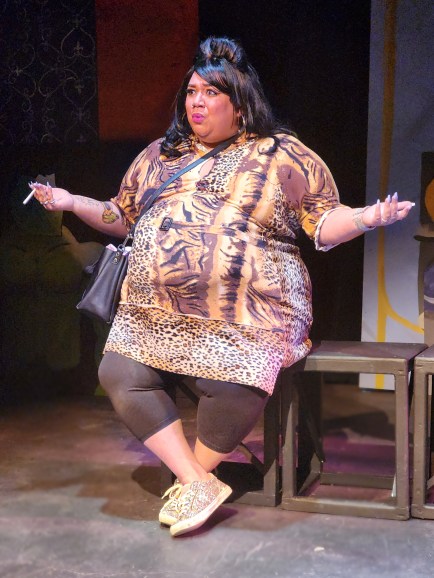
Finally, it must be said that Vanessa Robinson’s sensational Charlotte debut as Kate has absolutely nothing to do with luck on Melendez’s part. She went way against script, where Kathy is described as Italian-American, in casting Andy’s pregnant social worker. With a down-to-earth quality that masks her admirable ability to tolerate all the Maggies and Jacobs she has dealt with over the years – and the Andys – Robinson shows us a different way to be “the walking embodiment of Long Island, New York.”

When they perform their big monologues, both Barbanell and Robinson hit it out of the park.

One of the things I had to ponder on our drive home was whether Ferrentino had been dealing from the bottom of the deck when she showed us how normal and everyday Maggie and Jacob were – not to mention Sarah and Bobby before them – in their interactions with Andy and each other. It’s only when you factor in how many hundreds and thousands of parents and siblings behaved the same way, for over four decades, that the monstrousness of such normality becomes clear.

Ferrentino is slowly, cautiously, and carefully cushioning us for a hard truth. All the time we’re thinking that we’re in on the big reveal Maggie and Jacob have in store for Andy, we are being set up with devastating circumspection.

The tables are turned suddenly. Jarringly.

Theatre Charlotte’s “The Producers” Is More Politically Incorrect Than Ever

Review:  The Producers

By Perry Tannenbaum

IMG_0681

When I first saw Mel Brooks’ The Producers on Broadway in 2001, my disappointment in not seeing Nathan Lane in the role of Max Bialystock was assuaged by the realization that the show was still so damn good with last-minute replacement Brad Oscar filling the megastar’s shoes. Each of the successive versions I’ve seen in Charlotte – the national tour at Ovens Auditorium in 2004 and the CPCC Summer Theatre production at Halton Theater in 2009 – has only strengthened my conviction that Lane was not an essential ingredient in the show’s success.

But isn’t it too much to expect a smashing Producers at Theatre Charlotte, where they don’t have a Broadway-sized budget – or even a spacious orchestra pit like the Halton’s? Make a couple of allowances and then prepare to be astonished.

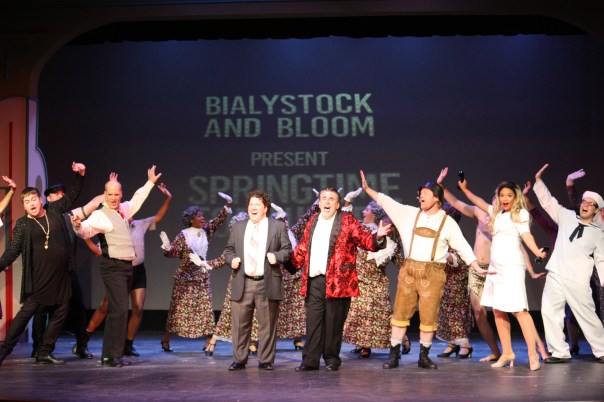
Scenic design by Chris Timmons is cheesy, even by community theatre standards, and there are no live musicians in sight – or out of sight – at the Queens Road barn. Once you get past those visible and audible austerities, you can revel in the costume designs by Rachel Engstrom, so crucial to the big “Springtime for Hitler” climax, and in the deep cast, so necessary in putting over Brooks’ comedy and his schlocky score.

Benefitting from the embarrassment of riches that showed up at auditions, director Caroline Bower hasn’t squandered her good fortune. In David Catenazzo as Max, she has found a leading man who is as seedy as Timmons’ scenery. Mostly a secret kept in recent years by JStage at the Levine Jewish Community Center, where he has starred in A Year With Frog and Toad and Fiddler on the Roof, Catenazzo proves to have a strong singing voice to go along with his comedic gifts. He absolutely oozes corruption, eager to enlist humdrum accountant Leo Bloom to cook his books, eager to bilk show investors in a surefire flop, and rabid to shtup Ulla, the voluptuous Swedish actress who turns up early for auditions.

A second solid gold debut comes from Landon Sutton as the diffident Leo, more than nerdy enough for a numbers crusher who discovers how to pocket a shady profit from a Broadway flop. There’s pallid innocence to Sutton’s manner as Leo, plus a little endearing pudginess, that works well when he’s too timid to plunge into the crooked scheme he has inspired. But there’s a surprisingly strong and smooth singing voice when Leo jumps aboard on the reprise of “We Can Do It,” and hormonal heat in “That Face,” his serenade to Ulla.

Brooks’ book and lyrics are so politically incorrect that they still seem to draw a pass from the audience – apparently willing to overlook the sexist attitude toward Ulla and the mockery directed at Franz Liebkind, the pigeon-keeping diehard Nazi who has penned the worst musical script that Max has ever read, Springtime for Hitler. Bower makes the right choices in casting the very un-Swedish Hailey Thomas as Ulla, draping her curves with a modicum of modesty, and limiting her flirtatiousness in comparison with Max’s leering. The Sveedish accent is ba-a-a-d, which is paradoxically good, and she’s positively smashing in her Nazi eagle outfit.

Neo-Nazis are less of a laughing matter than they were 18 years ago, so it’s also wise to have Chip Bradley tone down Franz’s achtung authoritarian qualities and pile on some extra daffiness. The result is the best performance I’ve seen from Bradley, particularly when he shows us all how Hitler should be sung at Springtime auditions. Bradley’s eccentric excellence is sustained when we encounter the Greenwich Village artistes who will direct Franz’s stinker, Roger De Bris and his loyal assistant Carmen Ghia, handpicked for their inabilities.

Here we are blessed with the gay flamboyance of Matt Kenyon as Carmen and the Ethel Merman regality of Paul Reeves Leopard as Roger. It takes a professional-grade queen to pull off Carmen’s arrogant servility and Roger’s ornate Chrysler Building party dress. Kenyon and Leopard have the goods. Leopard is certainly a different kind of Hitler than Bradley when Roger must sub for Franz on opening night.

On my fourth go-round with The Producers, I wasn’t laughing out loud until the Springtime for Hitler auditions, where I found myself enjoying the outrageousness as much as the newbies in the audience. I suspect their expectations were surpassed as much as mine were 18 years ago when Lane’s absence was announced as I stood in line outside the St. James Theatre. Enthusiasm for the Little Old Ladies and their tap-dancing walkers crackled like I remembered it even if the shtick has gone a little stale for me.

Iesha Nyree as Lick-me Bite-me and Layla Sutton as Hold-me Touch-me rounded out the named characters in the cast, which lists another 14 ensemble members who make choreographer Lauren “Loz” Gibbs look good. So what ever happened to the biddie named Kiss-me Feel-me? A victim of downsizing, we must presume.

Jewish Playwriting Contest Dramatically Involves Charlotte Audience in Selecting a New Play for a New York Production

Review: The Jewish Plays Project

By:  Perry Tannenbaum

The Jewish Plays Project, currently in its ninth season, seeks to recognize and develop new plays that freshly address contemporary Jewish life. In their annual Jewish Playwriting Contest, plays that peddle stock Jewish humor or deal directly with the Shoah are graciously discouraged. Like other playwriting contests, it solicits scripts that haven’t received professional productions and welcomes playwrights of all ethnicities. Of course, an expert panel is part of the selection process, but unlike the Pulitzers, the Tonys, or the Steinberg Awards, the JPP panel only screens the hundreds of entries and winnows them down to a group of finalists.

Cunningly, JPP invites theatre communities around the country to engage with the scripts, winnow them down to a Top 3, perform the Top 3 publicly in abbreviated staged readings, and have the live audience vote for their winner. In the 2019 cycle, Charlotte is the first of seven cities to complete its participation in the process, so the ultimate winner won’t be announced until after the Palo Alto readings on May 1 – moving on to a full production in New York this September.

The seven finalist scripts were emailed to us back in November, and I can proudly say that our reading panel in Charlotte had the most listed members, edging out Houston and New York, sharing the honor for the most populous panel with Chicago. Our panelists met at the Levine Jewish Center for a dinner powwow during the last week in January. After spirited discussions of each script, we wound up choosing In Every Generation by Ali Viterbi, The Shabbos Goy by Cary Gitter, and Dox Modern Middle by Megan Pope for the public event at Gorelick Hall, the J’s theater facility.

Last year’s national winner, Summer Night with Unicorn by David Rush, had been produced by the Levine Cultural Arts department’s JStage at the Gorelick in November, so there were people in the audience – and onstage – who had experienced last year’s playoffs and/or seen its fruit. This was the third year that Charlotte had participated in the annual contest, my second year of participating on the community panel, and my first time at the competitive readings. I was a bit taken aback by the robust turnout. Word has gotten around.

Unlike the staged reading festivals presented in the past by Actor’s Theatre of Charlotte and the defunct Charlotte Rep, the Levine’s Jewish Playwriting Contest maintained its professionalism without stuffiness or excessive formality. If you were an actor, you weren’t warned against the impropriety of wearing a color or dressing for your part, but you did lay your script on a lectern as you performed. If you bought a ticket, you could grab a free nosh at the back of the hall and schmooze with your fellow cognoscenti before David Winitsky, the founder and director of JPP, moved up front to issue welcomes and thanks. Then he explained the JPP and the Contest before testing the technology that would be used for the individual playwright intros and the voting. Directing all three entries, he also read the stage directions during the readings.

Old schoolers could vote on paper ballots as God intended, or if you had a smart phone, you could text your vote to a prescribed number. My first two test votes, before and after the first play reading, were for macaroons and Bernie (who lost to Midge). While writing this review, I texted “LEAVE” to the number we had been given and received an answer, my first real assurance that my votes had counted. So the technology worked, the format for the evening had been exhilarating, and theoretically, my vote may have been decisive. Yet I did not drive home feeling that the format had been completely fair.

Gitter’s The Shabbos Goy led off the readings, probably the easiest of the three to summarize. Seth, a divorced Orthodox Jew, has a crisis of faith because he has fallen in love with Angie, an Italian-American art gallery curator who recently moved into an apartment down the hall. Not knowing she had moved in, Seth had knocked on her door, thinking he would call on his Shabbos goy to do something for him that Orthodox Jews are forbidden to do on the Sabbath – like turning on a lamp or an oven. Angie readily agrees to help this nerdy knish maker. He’s such an unlikely candidate for her affections that, when he asks her out, she doesn’t immediately grasp what he’s doing, by which time he’s apologizing.

Seth’s sister Rachel, his partner in the Lower East Side knish store, is more devoutly opposed to her brother’s wishes – she’s not Jewish! – but Sophia, Angie’s folksy grandmother, has an open mind. In the scenes excerpted for the reading, Seth (Jordan Ellis) told Angie (Karina Caporino) about his spiritual crisis. His confession went better than Fitzwilliam Darcy’s, acting as an aphrodisiac. Afterwards, Angie had a couple of heart-to-hearts with Sophia (Jackie Fishman) and Rachel (Susan Cherin Gundersheim).


If the allusion strikes home, you’ll already know that Viterbi’s In Every Generation has something to do with Passover. Not only is the Passover seder the instrument of fulfilling the biblical commandment of telling your children about the exodus from slavery in Egypt, it is the gateway for fulfilling man’s obligation “to see himself as if he personally went out of Egypt.” Viterbi divides her play into four parts, a very apt number for Passover, and links three generations of a family across three seders, beginning with 2018 in LA, then flashing back 65 years to 1953, and then zipping forward to 2048. After three seders with this family, Viterbi thinks we’re ready to visualize her family in 1416 BCE after leaving Egypt, celebrating Passover and yearning for the Promised Land.

In the first excerpted scene, we saw all three generations gathered at the 2018 seder. Drawing most of our attention were two squabbling siblings, Yael Katz (Caporino) and her adopted Chinese older sister, Devorah (Vivian Howell Tong), who is studying to be a rabbi. It is she, therefore, who expounded on the number four in the Passover Haggadah. Their mom, Valeria (Stephanie DiPaolo), tried to keep order, but her difficulties were compounded by her octogenarian parents, Davide Levi (David Catenazzo), who coukd no longer speak due to ALS, and Paola (Fishman), who kept lapsing into Italian. Our second excerpt took us to 1953, shortly after Davide and Paola had immigrated to America. Davide could talk at that seder – smoothly enough to convince Paola that Passover might be a great time to start their squabbling unborn family.

Reduced to a bare-bones 20-minute sampling, In Every Generation had to shed its last two parts – and the English subtitles that are supposed to help us understand Paola’s Italian when she arrived in LA back in 1953. Shabbos Goy suffered to a lesser extent from Winitsky’s radical abridgement, losing one of its characters, a dashing young artist whose work Angie would love to display at her gallery. Young and sexy Blake, Angie’s arrogant quarry, expected to combine business with pleasure. Pope’s Dox Modern Middle was perhaps the most disadvantaged by Winitsky’s excerpting. It would have been helpful, for starters, if the playwright, the director, or the reading had explained what the title meant.

Amid some healing chanting and a spectral appearance of Fathermother, representing her parents and her Orthodox Jewish heritage, the excerpt began with 17-year-old Raphaela (Arella Flur) arriving in Israel. She was greeted by her Aunt Caroline (DiPaolo), a longtime Israeli who knew more about Raphaela than the girl thought. Caroline already knew, for instance, that her upfront 16-year-old neighbor Gil (Rixey Terry) would be the perfect companion to show Raphaela around – because he is gay, she is lesbian, and that’s why she was sent away from Brooklyn by her “Dox” parents. In later excerpts, we learned that there’s an LGBTQ nightclub in Jerusalem that will welcome both Gil and Raphaela, with queerness to burn. A quartet of glittery queens emerged from the audience, voguing and preening. More seriously, the club’s bartender, Pop Tart Girl, took an interest in Raphi, evoking memories of Ani (Caporino in both roles), her previous paramour back in Brooklyn.

When the votes were tallied, Winitsky announced that The Shabbos Goy had been our audience favorite. Audience members who have become attached to Seth and Angie, rooting for their romance, can go to JewishPlaysProject.org and see how Gitter’s romantic comedy is doing in the standings. With the two points that Shabbos Goy earned at the Charlotte playoffs, it is now tied with In Every Generation for first place. Next in the standings, trailing the leaders by two points, is Dox Modern Middle. As exciting as the contest was, I’d be more comfortable if the readings were extended to 40-45 minutes each. Lacking that, audiences should get a full summary of each contestant. That’s what I’m voting for.

“Summer Night, With Unicorn” Plants the Seed for Professional Jewish Theatre at Shalom Park

Review:  Summer Night, With Unicorn

By Perry Tannenbaum

In a cycle that begins in November, The Levine Jewish Community Center jumped aboard the Jewish Plays Project two years ago as Charlotte became one of 12 cities adjudicating JPP’s annual Jewish Playwriting Contest. Charlotte has already assembled 21 readers for the judging process, tied with Chicago for the most among participating cities, in deciding the three scripts that are publicly presented in the spring at Gorelick Hall. That’s where the Shalom Park audience takes over, choosing the winner and also-rans for our region. From those results, a consensus national winner is chosen – not only for presentation at an annual Jewish play festival up in New York but also for full professional productions in all the cities where the Project has taken root. Last year’s contest was different from those that preceded, pitting all winners from previous contests against each other, so that an all-time winner from 2012 to 2017 would emerge. Decided by an objective points system, the 2018 contest actually produced two winners, Estelle Singerman by David Rush, winner of the 2013 prize, and Belfast Kind by Margot Connolly, the 2015 winner.

Among the co-winners, Charlotte chose Rush’s bittersweet comedy-fantasy. We had been told at the readers’ committee meeting back in January that Rush’s title was in flux. By the time it was presented at The Festival of Jewish Theater in June, Estelle had been renamed Summer Night, With Unicorn. That’s the title that JStage brought to Gorelick, sporting poster and playbill artwork with a Marc Chagall flavor that marvelously reflected the spirit and the magical realism of Rush’s play. The main figures in Kayla Piscatelli’s artwork are a crescent moon over the head and neck of a unicorn. Within that white unicorn, there is a silhouetted cityscape of skyscrapers with space enough above them for the Hebrew letters of the first four words of the traditional mourner’s kaddish. Estelle is a gregarious elderly Jew, not devoutly religious, since we meet her a little after 10pm at a lonely McDonald’s in Chicago. There’s nobody else to pester but Warren Spencer, an obvious Cubs fan busily clogging his arteries with a burger and a large order of fries.

Estelle would like this sullen, downcast, and brooding widower to believe she’s doing him a favor by sharing his fries and perhaps hoping to cheer him up as she invites him on a late-night odyssey. She will take him to a park, the Lake Michigan shore, a Christian Science reading room, a synagogue, and – inevitably – a zoo. Where else would Estelle and Warren converse with Seymour, a reincarnated giraffe? Rush proves to be very ecumenical in his ramblings around Chicago. The depressed and anorexic Hannah Kipper reads tarot cards on her lakeside blanket, the reading room is managed by a kindly Sister Rose, and the dark synagogue is haunted by a rabbi who’s unsure whether he’s alive or dead, a thickly bearded gent with Wandering Jew earmarks who has his visitors wondering who’s dreaming whom. Nor are the characteristics that Hannah and Rush assign to the Unicorn gleaned from the Encyclopedia Judaica, where there is no entry for the mythological beast.

Long before intermission arrives, we realize that Warren is a stubbornly lapsed Jew who is stewing in bitterness over the circumstances surrounding his wife Doris’s death. Estelle is a widow herself, habitually wandering the city at night because she’s afraid to go to sleep, promising Warren the glory of a sunrise over the lake at the end of their journey. We join Warren in wondering what Estelle’s ulterior motive is, getting hints that he isn’t the first to join her on her midnight rambles. As the lights go down for intermission, it becomes suddenly clear that Estelle is looking somebody to say kaddish over her. What we didn’t know was whether Estelle was alive, with a wisp of matrimonial motives triggering her quest, or dead, needing Warren’s prayers to bring an end to her ghostly wanderings. The other big question was whether Warren would ever say kaddish over his own beloved Doris, let alone this strange and mystifying Estelle.

My estimate is that I haven’t reviewed a theatre performance at Gorelick in almost 16 years, during which time the J has sprouted multiple new wings, one of them two stories high, along with a new entrance and dazzling new facilities – all of which make the Gorelick, now shunted from the front to the back of the complex, look old and drab by comparison. The stage and the dusty chairs we sat in could sorely use a refresh, for starters. JStage producer Susan Cherin Gundersheim, the cultural arts director at the Levine JCC (and a theatre professional in her own right), is clearly facing an uphill climb in convincing people to make a serious investment in the J’s theatre program. Gundersheim has managed to bring professional-grade theatre to the site regardless.

To check off all the design and directorial boxes, Gundersheim has brought in Piscatelli and Mark Sutton to don multiple hats, which they do admirably on their shoestring budget. Sutton’s set design, little more than three wooden frames after we exited McD’s, meshed well with his directorial concept, calling upon his audience to mostly imagine the scenes for themselves. Piscatelli’s costumes and lighting were no less complimentary, the raggedy cerements for the ghostly Doris and the gleaming silk cape for the Unicorn contrasting effectively with the garish attire of our earthbound protagonists.

There are plenty of Hebrew and Yiddish expressions studding this script like landmines. Fortunately, Sheila Snow Proctor navigated the treacherous terrain almost perfectly as Estelle, certainly better than Sutton, who allows Devin Clark to mangle his Yiddish mercilessly as the ageless Rabbi. Portraying a lapsed Jew, David Catenazzo probably earned a pass as Warren on his trespasses with the Hebrew blessing for putting on a tallit – I’ve heard worse during torah readings at my Conservative synagogue. Proctor not only clops around like a pensioner, slightly stooped, slightly squinting, she gets the essence of Jewish soul and humor, the impulse of kvetching leavened with a pinch of self-mockery. She even carries her late husband’s tallit bag and tefillin with a touch of reverence. Perhaps Proctor would have had an easier time of it if Catenazzo had similarly leavened his anger and impatience with hints of the Jewish soul that had loved and indulgently persevered with Doris when she wasn’t angelic. To some extent, Warren needed to be charmed by Estelle. Judging this role is a little like living the journey of Ebenezer Scrooge.

With two major cameos, the Rabbi and the giraffe, Clark had the most opportunities to shine among the supporting players. He was especially entertaining as Seymour sparring with Warren, who probed into the question of why he had been demoted to giraffe in his present incarnation. Yet Clark was curiously endearing as the bewildered Rabbi, notwithstanding the butchered vay iz meers. Liora Tal likely sparked some objections for how she delivered Hannah Kipper, a little underpowered and maybe a little too serene for a young fortune teller looking forward to death – but Estelle persisted in feeding her, and I didn’t think we were supposed to believe her, either. I’m afraid that Mariana Bracciale didn’t get much of a chance to shine as Sister Rose, but at least she got to glow in the denouement as the Unicorn, making her entrance and exit from the margins of the audience.

No cameo better encapsulated what Summer Night, With Unicorn was all about than Stephanie DiPaolo’s visit from the beyond as the ghost of Doris. Even more befuddled and uncomprehending than the Rabbi, DiPaolo only flickeringly registered what Warren was asking of her, but although she haltingly spoke, she never responded. That was very much the dynamic in Rush’s magical journey. Multiple possibilities presented themselves to Estelle when she posed the question we all have about what lies ahead, but through the night, there was no clearer answer than that death will surely come. With richer lighting, sound design, and a sprinkle of special effects, DiPaolo’s clarifying moment of confusion might have reached a finer pinnacle. Hopefully, when more people at the Levine JCC appreciate the gems these professionals are creating, they will also realize that the artists and their audience deserve a finer setting.