Tag Archives: Darren Spencer

“Bright Star” Shines Zestfully in Matthews

Review: Bright Star at Matthews Playhouse

By Perry Tannenbaum

Though it never settles down here in the QC, it’s nice to know that Steve Martin’s beautifully crafted Bright Star, while tracing its graceful decades-longstory, carves a North Carolina oval around Charlotte. Crisscrossing between Asheville and Raleigh with stopovers in Hayes Creek and Zebulon. Martin’s music leans pleasantly westward, delivering bluegrass and mountain flavors, brightly flecked with sounds of the comedy polymath’s signature banjo. Nor in transporting the original “Iron Mountain Baby” story to the Blue Ridge Mountains, does Martin neglect the rhythm of the rails, for a train traveling over a river is pivotal to the plotline.

So of course, this genial musical, which stopped at Belk Theater on its national tour in 2018, is a perfect match for Matthews Playhouse (and its nearby depots) as it arrives for a richly deserved revival. Newly crowned last month with the 2024 North Carolina Theatre Conference Community Theatre Award, headquartered at the Matthews Community Center, this company is perfectly poised to deliver the authentic vibe.

Under the meticulous direction of Paula Baldwin, it does. Her design team, also leaning mountainward, delivers a rusticated look overall, with Yvette Moten’s varied costume designs pushing gently back against the drift of scenic designer Marty Wolff’s driftwood-and-tree-trunk set. Even when we’re at the Asheville Southern Journal, where Alice Murphy passes judgment on manuscripts by Carl Sandburg and Tennessee Williams, the fancy signage over the office is painted on wood. This buttoned-up office is no less rusticated than Jimmy Ray Dobbs’ porch at the mayoral mansion in Zebulon, way over past Raleigh.

And the music! Nestled in an upstage shed framed by the timbers, musical director Ellen Robinson leads a zesty septet from the keyboard, with Nelson Frazier on the banjo. Edie Brickell’s lyrics ain’t no great shakes, but he had a hand in composing the music, so we’ll give him a pass.

Shuttling across the Tarheel State, we also shuttle between 1923 and 1946, when Alice decides to tell us her story. Although I loved the tale when I first set sight on it over six years ago, it wasn’t until I revisited it last week that I experienced its full power. Part of the revelation came from the alchemy of gradually remembering the Bright Star story as it unfolded anew inside Fullwood Theater – knowing what was coming a few minutes before it happened – and part of it came from Baldwin and her company simply doing a better job.

It seemed like the director of the touring production, whose name I didn’t mention in my review, cast his Alice solely on the basis of how well she personified the spinster-like stickler editor of 1946 rather than how well she evoked the vivacious and vulnerable underage victim of 1923. But Hilary Powell is consistently flesh-and-blood in spanning the wide gap between her prim present and her more primal past.
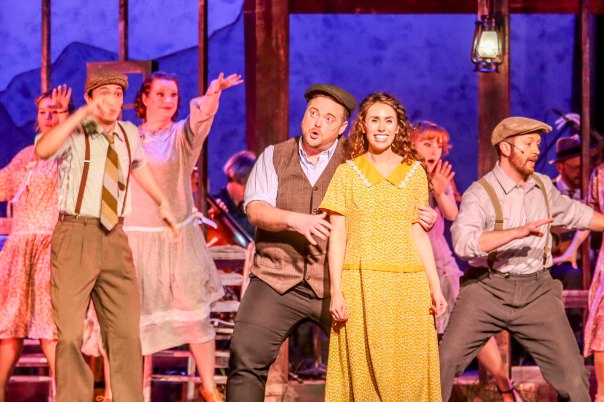
Powell decisively makes these Alices different people when we finally get to see the lass who captivated Jimmy Ray, the mayor’s son. Her smiles are like a sudden outpouring of sunshine on a previously rainy day. When we first saw her as a formidable editor, still aggrieved by her ancient breakup, we could hardly guess how it all had ended. As open and joyous as she once was, the prestigious editor is now largely inscrutable. Was her dear Jimmy Ray cruel and alive or devoted and dead?

Turns out there’s another possibility when we delve into Alice’s past, meet Jimmy Ray, and revisit their illicit romance. Lit up by Powell, Nick Culp as her beau brings us more radiance, eclipsing the touring portrayal we saw in 2018 as charismatically as his paramour does.

While we’re time-traveling out in Asheville and over in Zebulon, the story in Hayes Creek moves steadily forward from 1945, when Billy Cane returns from WW2, apparently unscathed, undecorated, and unkissed. He’s an aspiring writer with many stories to tell about his hometown, so it’s natural that the owner of Margot’s Bookstore is the first to greet him – clearly more chastely than she’d like. Billy’s heart is set on Asheville, where he hopes to publish his first works in the Southern Journal.

Not above a little subterfuge, Billy pens a letter of recommendation from Thomas Wolfe to bring along with his manuscripts to the Journal office. Gatekeepers Lucy and Daryl find Billy’s presumptions ludicrous, blithely tossing the unknown’s precious manuscript in the trash before his eyes. Fortunately, Alice happens by and, knowing that Wolfe has been dead these seven years, finds herself impressed by Billy’s duplicitous audacity.

We can presume that Billy knew enough about Wolfe’s connection to Asheville to accurately gauge how a recommendation from him would resonate there. Conveniently enough for Martin’s purposes, Wolfe’s Asheville home – a boarding house really, if you remember Look Homeward Angel – wasn’t turned into a memorial landmark until 1949. Sandburg’s home in Flat Rock, as you may know, is also a National Historic Site.

Billy sheepishly realizes that he’s been busted by the person he most wishes to impress, which only enhances his naïve charm. Alice keeps one of the manuscripts, not to publish but because she sees promise. Subsequently, she puts Billy under Daryl’s tutelage as his personal editor and sounding board. Robert Allen isn’t too swishy as Daryl but gay enough, and he provides a cosmopolitan contrast to Joshua Brand’s wide-eyed innocence as Billy.

I’m willing to entertain the idea that Brand is fulfilling the role of a drop-dead dreamboat, but it’s Hannah Daniels as Lucy who cements his magnetism, coming on to Billy after his first tastes of alcohol. Brand is hit-and-miss in rendering Billy’s reactions, overacting more than once, but I’ll admit that made him more unpolished and adorable for me.

Truth is, the augmented professionalism of Theatre Charlotte and Matthews Playhouse – in the absence of big Equity companies across the Metrolina region – makes me miss community theatre. Yet I also found the exaggerated greenhorn aspects of this Billy to be very complementary to the dark, melodramatic side of Martin’s yarn. Softened only by his contrite drunkenness deep in Act 2, Darren Spencer was absolutely fiendish as Mayor Josiah Dobbs, more like the ketchup Trump we’ve never seen than the eating-cats debater who is merely hilarious TV.

Jimmy Ray’s dad was a man who could stuff a newborn baby in a satchel, board a train, toss his grandson in a river, and inspire a lurid folksong. Spencer revels in the moment and Baldwin makes a point of triple underlining it. She also makes sure that Culp and Murphy don’t mute their reactions to the loss of their child and the atrocity.

Of course, in this retelling, the satchel dropping doesn’t become notorious. Alice keeps seeking to discover the whereabouts of her adopted son and her parents nurse their regrets, dad for signing the papers and mom for letting him. Compared to Mayor Dobbs, John West as Daddy Murphy and Liz Waller as Mama are benign, eventually earning our empathy with their years of suffering, estrangement from their daughter, and remorse. Even at his worst, West contrasts meaningfully with the diabolical mayor, rejecting his grandson out of wrongheaded righteousness rather than self-interest.

Back in Hayes Creek, Daddy Cane and Margot eagerly follow Billy’s progress over in Asheville. Looking at Todd Basinger as the dad, you can easily see where Billy’s simplicity and goodness came from. And if Gabriella Gonzalez as Margo seems conspicuously more experienced as an actress than Brand, that also plays beautifully. Remember, she’s a successful bookstore owner. Like Alice, she knows good writing when she sees it.

Daddy Cane has a big secret, but in a moment that reverberates back to Ulysses’ scar in The Odyssey, the secret gives itself up without him. Aristotle himself would have been delighted to see how Baldwin brought his concept of anagnorisis – the moment of recognition – to life. That heart-stopping revelation brought me close to tears, mostly because I saw it coming.

Let “The Drowsy Chaperone” Hypnotize You

Review: The Drowsy Chaperone at Theatre Charlotte

By Perry Tannenbaum

My advice for best enjoying The Drowsy Chaperone at Theatre Charlotte is to listen to the Man in the Chair – and yield to his pitch-dark hypnosis. Yes, before the lights even go up at the old Queens Road barn, he’s in his chair speaking to his audience and conjuring up what we should hope and pray for: “I just want to be entertained. Isn’t that the point?”

As the show unfolded, brilliantly directed by Billy Ensley with what must be the local cast of his dreams, I realized that, as a critic, I shou

ld heed that hypnotic suggestion devoutly. Discard my usual pointy critical and analytical tools. What’s more, I came to believe more and more strongly that, if actors and directors of previous Drowsy Chaperones I’d seen had followed that simple mantra, I would have fallen in love with the show long before last Friday night.

When the lights came up a few minutes deeper into the Man in Chair’s monologue, we saw him locking the front door of his humdrum apartment with four or five assorted deadbolts and chains. It’s a bit of an abrupt swerve, but we’re suddenly aware that this Broadway musical devotee is a recluse and a bit paranoid. Each time the phone rings, we’ll see that the Man in Chair fails to answer, yet another confirmation of these traits.

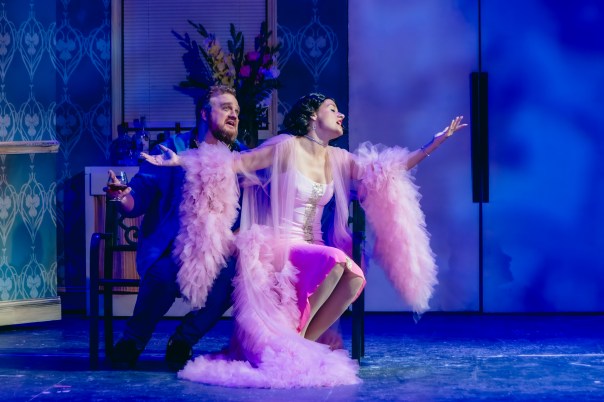
By the time the title character of the fictional “Drowsy Chaperone” is a few wobbly notes into her showstopping “As We Stumble Along,” we already should know that the Man in Chair is gay, which accounts for Lisa Smith Bradley delivering the song as a living fetishization of Ethel Merman and Judy Garland – Merman’s vibrato wedded to Garland’s glitter, slacks, and drug dependency.

Yet when we’re watching Kyle J. Britt as our genial host, we need not attribute his reclusiveness or paranoia to being a gay man. As a Broadway musical fanatic, this Man in Chair identifies more readily as a New Yorker with Innerborough hangups. Meanwhile, Bradley is sufficiently over-the-top as both gay icons – especially Merman – to be accused of impersonating a female impersonator.

We might say that Ensley & Co. have decided that being gay in 2024 isn’t nearly the leaden weight it was in 2006 when Drowsy Chaperone premiered in the Big Apple or in 1996 when Angels in America tore the QC apart and made us a laughingstock. Pretentiousness, solemnity, and subtlety really are inimical to this delicate relic. Britt handles it with audiophile care as removes the vinyl disc – a rare original cast recording of his favorite 1928 musical – from its LP sleeve and gives both sides a loving once-over with a Discwasher brush before lowering his treasure onto a turntable.

The same can be said of size and scale, which may also have muffled my enjoyment of productions at Belk Theater in 2007 and Halton Theater. There’s something so right about our little séance in the dark at the Old Barn on Queens Road that it cannot attain in a more modern and spacious hall where the Man in Chair must project his spell into a distant balcony. The homeliness of the Man’s urban dwelling also sits better on Queens Road than in the bowels of a bank building on Tryon Street.

To be honest, it’s Broadway Lights and the late CP Summer Theatre that should apologize for not matching the unpretentiousness of Josh Webb’s scenic design. Of course, it would be nice if Webb’s scenery could transform spectacularly into Broadway splendor when the stylus of our host’s turntable comes down – with its signature thump – onto the vinyl and the mythical “Drowsy Chaperone” comes to life. In the less-is-more world on Queens Road these days, these shortcomings are comedy assets, part of the overall charm.

On the other hand, our time travels to 1928 get a softer landing thanks to the costumes by Beth Killion, notable for their flair, their formality, and their discreet dashes of color. We’re awaiting the wedding of Robert Martin and Janet van de Graaf, so there are actually multiple levels of time travel here, for Bob Martin actually co-wrote the Drowsy Chaperone book with Don McKellar – and starred in the original Broadway production as Man in Chair – while he was married to the real-life Van de Graaf.

In fact, this originally Canadian work, which eventually layered on music and lyrics by Lisa Lambert and Greg Morrison, was gestated at Martin’s stag party in 1997, nearly 70 years after these fictional nuptials. More reasons not to view this lark as a gay cri de cœur.

Rare as his vinyl treasure may be, Britt comes across less as a scholar or a critic than as a fanboy, occasionally panting like an eager puppy as he presumes to approach his fantasy idols more and more closely. More than once, the principals will obligingly freeze for him. Nor does this Man in Chair seem to favor the men over the ladies with his adoration, only tipping the scales just before the final bows. Charmingly enough, there are overtones of scholar and critic as he dishes tasty trivia about the fictitious “Drowsy” cast members or advises us to be on the lookout for some truly dreadful lyrics.

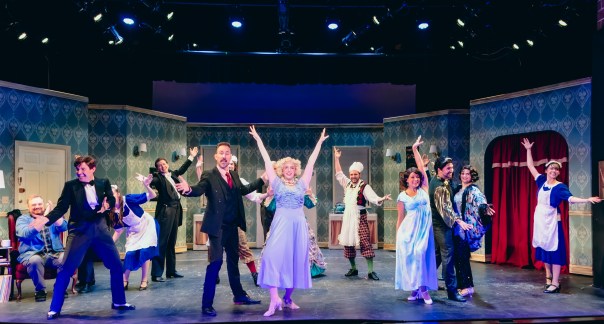
These glamorous, theatrical, servile, and criminal characters are all blissfully ignorant of the nerd who has conjured them up, preoccupied with their conflicting efforts to carry off the planned wedding or ruin it. The bride herself, Lindsey Schroeder as Janet, seems to be grandly ambivalent about becoming Robert’s wife, sacrificing her glittery stage career and the adoration of millions, while suppressing her basic instinct to “Show Off.” Love is at comical war with vanity. Carried away by the swiftness of this whirlwind romance, Andy Faulkenberry as Robert also has his doubts.

Aside from Janet’s drunken chaperone, politely labelled as Drowsy, there are a butler Underling, an eccentric Mrs. Tottendale, and Robert’s best man George shepherding the loving lambkins to the altar. Only Zach Linick as George seems to be afflicted with any degree of competence or reliability. More importantly, he and Faulkenberry make up a formidable tapdancing duo. (Thank-yous to choreographer Lisa Blanton.) Allison Rhinehart as a frilly, bustling Tottenham and Darren Spencer as the gray and starchy Underling are no less inevitably channeled toward blithe entertainment.

Counterbalancing the fragile determination of the bride and groom, compounded by the flimsy protection of their good friends, we have an exquisite mix of bumbling baddies trying to sabotage the wedding. These are led by Joe McCourt as Broadway producer Mr. Feldzeig (Feldzeig Follies ring a bell?), under pressure from his mobster backers, who consider Janet to be the cash cow of the Feldzeig franchise. The sneering McCourt is bedeviled by Gangster 1 and Gangster 2, armed emissaries – Titus Quinn and Taylor Minich – masquerading as hired chefs to ensure a catastrophe.

Ah, but it isn’t simply muscle aimed at swaying the maiden and returning her to showbiz. Somehow, a predatory Lothario is among the wedding guests – although he has never met anyone else there. Mitchell Dudas is this egotistical Adolpho, far more arrogant than Feldzeig, a mixture of Erroll Flynn and Bela Lugosi with a thick Iberian accent. Feldzeig has no trouble at all convincing Adolpho that he was born to seduce the bride-to-be.

Equally dumb, Autumn Cravens as Kitty is a ditzy chorine, constantly nagging her boss and wedding escort Feldzeig to let her fill Janet’s shoes in his next Follies. Effortlessly, Dudas will outperform Cravens in thwarting Feldzeig’s schemes. Love conquers all, but it would be a huge spoiler to say how many times when we reach this very happy ending.

Just one more wild card is needed to tie up all the festivities. Be on the watch for Trinity Taylor as Trix the Aviatrix, who descends from the skies at just the right moment with a voice of thunder. For a few moments, she even upstages Britt and Schroeder who are so fabulous.

It would be a mistake to miss the craftmanship lavished on this plot with its stock characters by Martin and McKellar, brought out so brilliantly by Ensley and his dream cast. For instance, think how perfectly 1928 was chosen: between Lindbergh’s transatlantic flight, Babe Ruth’s 60 homers, The Jazz Singer of 1927 and the Wall Street Crash of 1929. A brief last window of bliss before global misery. In the real world, the parade of yearly Ziegfeld Follies revues would be halted after 1927 – until 1931.

Follow the Yellow Brick Road to the Queens Road Barn

Review: The Wizard of Oz at Theatre Charlotte

By Perry Tannenbaum

With her rustic picnic basket, her toy dog Toto, her beribboned pigtails, and her iconic gingham dress, the 1939 movie version of L. Frank Baum’s imperishable heroine, Kansas-born Dorothy Gale, was designed to closely echo the Dorothy found on the pages of Baum’s 1900 novel. She was conceived in the lineage of Little Red Riding Hood and Lewis Carroll’s Alice as a little girl – credulous, easily surprised or disappointed.

Judy Garland was 16 years old when she began shooting The Wizard of Oz at MGM Studios. Her sub-5-foot stature bridged some of the age gap, but director Victor Fleming and the MGM braintrust didn’t stop there, trussing Garland up to hide her curves. All of this subterfuge (some would call it barbarity) was logical only because Hollywood, suspicious of fantasy and children’s fiction, wanted to reassure us that Oz, The Wizard, the Witches, the Winkies, and the ruby slippers were all nothing more than a little girl’s dream.

Noel Langley’s screenplay, revised chiefly by Florence Ryerson and Edgar Allan Woolf, went to extraordinary lengths to frame Dorothy’s adventures as a dream. The celluloid version supplied the Scarecrow, the Tin Man, the Cowardly Lion, Glinda, the Wicked Witch, and The Wizard with Kansas counterparts she will transform into Ozians. Baum never created a Miss Gulch or a Professor Marvel. In fact, when he adapted The Wonderful Wizard of Oz for the stage in 1902, Baum actually expelled Toto and the Wicked Witch from his cast – and did not permit the Lion to speak.

Langley obviously hasn’t gotten enough credit for his contributions to Oz mythology. The whole preamble to the cyclone and Oz is his, along with the wholesome welcome home to Kansas that crowds the screen with patronizing adults. Aunt Em is the only person who greets Dorothy in the book, where the ending is dispatched in less than 75 words. Dorothy finds a new farmhouse that Uncle Henry has built to replace the old one that killed the Wicked Witch of the East. No question in Baum’s mind: Dorothy has been away to a real place in real time.

When John Kane adapted The Wizard of Oz for the Royal Shakespeare Company in 1987, he went with Langley’s version of the story. Not only were the songs by Harold Arlen and the lyrics by Edgar “Yip” Harburg brought along for the ride, so was “The Jitterbug,” an Arlen-Harburg song that didn’t make the film’s final cut. If anything, Kane’s additions to the screenplay served to underscore the idea that Oz was a dream, dropping more key words and phrases that linked the magical land to Kansas. Auntie Em and Uncle Henry were added to the roster of Kansans who change costumes and join Dorothy in Oz.

That’s the version we have now as Theatre Charlotte kicks off its 96th season with a rousing trek down the familiar Yellow Brick Road. After her TC debut in 2022 at Camp North End during the company’s vagabond season, Allison Modafferi Brewster directs for the first time at the Queens Road barn. Leaning heavily on projection designs by Alison Nicole Fuehrer to navigate the geographies of Kansas and Oz, Modafferi and her cast of 40 (plus nine “Ruby” Munchkins who timeshare with the “Emerald Cast” that performed on opening night) heartily buy into the notion that Oz is a dreamland.

But in choosing Winthrop University senior Cameron Vipperman as the lead, Modafferri and costume designer Rachel Engstrom are pushing back against the idea that Dorothy must be a child. Or, to cite the range prescribed for auditions in 2006, when Central Piedmont presented this Wizard as their first summer extravaganza at the newly-built Halton Theater, between the ages of 14 and 17.

Gone are the ribbons, the pigtails, and the gingham dress, though Vipperman’s do does sport a couple of fairly subtle weaves. Nor does this energetic production go along with the notion that Miss Gulch and the Wicked Witch of the West must be gnarly old crones. Wielding her broomstick in a rather gladiatorial black outfit, Mary Lynn Bain was quite the action figure as the Wicked One. No corny cone hat for her!

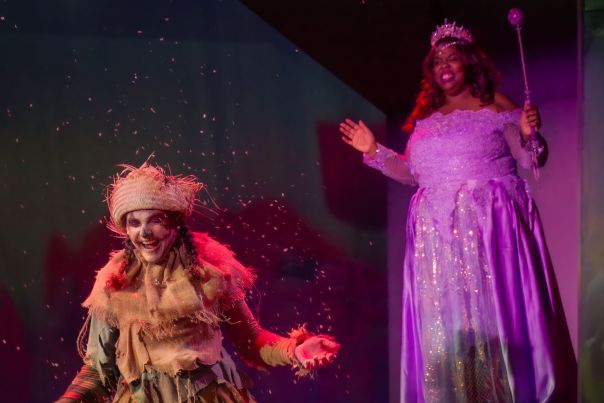
Unless you’ve scouted productions down at Winthrop and Matthews Playhouse, neither of these antagonists will be a familiar name. Casting is no less adventurous for Dorothy’s Yellow Brick pickups. As the Scarecrow, Devon Ovall comes to the Queens Road barn by way of Northwest School of the Arts. Ashley Benjamin, the first female Tin Man we’ve ever seen in Charlotte, seems to be freshly arrived from Georgia in her digital bio. Only Kyle J. Britt can boast previous Queen City exploits prior to his present turn as the Cowardly Lion, having appeared at the barn in last year’s Christmas Carol as the Ghost of Christmas Present.

Noticeably younger than any Oz supplicants you’ll ever see again in an adult production – so close to Dorothy’s age that they seem to be her pals and never her protectors – this youthful trio is remarkably appealing. Ovall flops around and collapses with infectious glee as Scarecrow. Aided by strategic sound effects, Benjamin brought plenty of creaky stiffness to the Tin Man, but she often needed stronger miking.

Rachel Engstrom’s costume designs for these two weirdos are masterworks of simplicity, but her greatest triumph may be her Lion, little more than a wig gone wild and a couple of fringed sleeves. This is sufficient armament for Britt to make delicious meals of both his Cowardly highlights, blustering his “top-to-bottomous” bravado with gusto and regally rolling his r’s on “King of the Forest” – with an extra-chesty baritone.

Modafferri’s infusions of diversity and gender switching don’t stop with Benjamin. Brandie Hill brings a righteous gospel flavor to Aunt Em and especially to Glinda the Good, while D. Laverne Woods brings out the gypsy in Professor Marvel and the sass in the Wizard. Darren Spencer as Uncle Henry is a softer, more indulgent contrast to Aunt Em’s law-abiding rigor, making him the obvious choice to play the softy old Guard at Oz’s palace.

Mostly at the service of Fuehrer’s projection designs, set designer Chris Timmons’ neutral-toned slabs don’t quite allow the colors to pop until we first espy the poppy field and Emerald City beyond. The cityscape lingered a few seconds too long as we transitioned from Oz to the wicked West, my first inkling that there was more than one projector in play. The more concerning miscue on opening night was the stage crew’s failure to secure the flight of stairs leading up to the platform where the Wicked Witch makes her immortal “What a world!” exit.

Poor Bain took a nasty little tumble trying to get up there, nearly breaking her neck before she had a chance to melt, prompting Vipperman to be very careful when she climbed up after her. The wonderful reversal was still effective.

That climactic scene cannot be withheld from an adoring public, so Timmons had to choose between the complexities of using a trapdoor in the middle of his stage or building a platform. The latter solution is likely simpler, but its hazards were frightfully exposed last Friday. No doubt all the furniture moving and fastening will go better this week as the run resumes.

Technically, the Theatre Charlotte version of The Wizard is nowhere near as dazzling as the CP version of 2006, when the Witches, the Wizard, Dorothy, the Scarecrow, Miss Gulch, and a cow all flew, and Glinda floated gloriously in a bubble. Such lavishness is probably the main reason why CP shitcanned its Summer Theater programming this season – after four decades of serving as the best launching pad for emerging professional talent that Charlotte has ever seen.

Musically, the lack of a live orchestra dulls the brilliance of Herbert Stothart’s scoring, but music director Matt Primm and his talented cast rescue things nicely. After a shaky start, when Vipperman was too studiously on the beat, “Over the Rainbow” came to full bloom. Surrounded by the loosey-goosey shenanigans of Ovall and Britt, she blossomed even more in Oz. Pepper Alpern as Toto remained a wild card. Nobody knew what the mutt would do next, behaving, barking, or otherwise stealing focus.

Engstrom and choreographer Vanessa Zabari held a deck full of winning cards to counteract this earthbound production’s lack of aerial aces. Dance numbers greatly enlivened the arrivals in Oz and the Emerald City when a bevy of Munchkins, a Youth Ensemble, and an Adult Ensemble strutted their stuff, captained by Aidan Conway. Punctuating the action at key moments with assorted tumbles, somersaults, and splits, Conway was also a pro-grade soloist when he wasn’t fronting the ensembles.

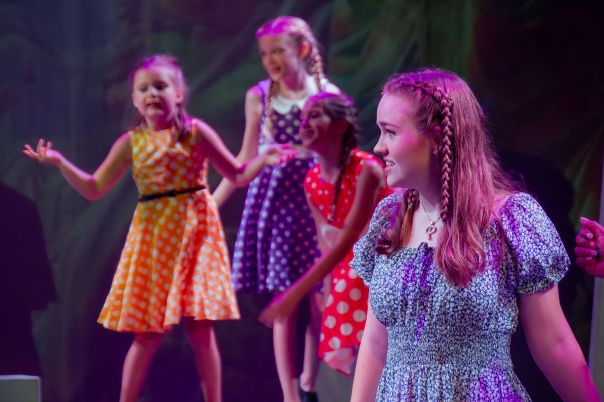
Thanks to Engstrom, Emerald City was a sea of multitudinous greens, and the changes of dresses for the adorable Munchkins were more than enough to convince me anew that Oz truly is a merry old land. But for the next two months, I’d be quite content if I didn’t see another damn polka dot.

“Pippin” Is Mostly Magical at Theatre Charlotte

Review: Pippin at Theatre Charlotte

By Perry Tannenbaum

TC95-Pippin-018

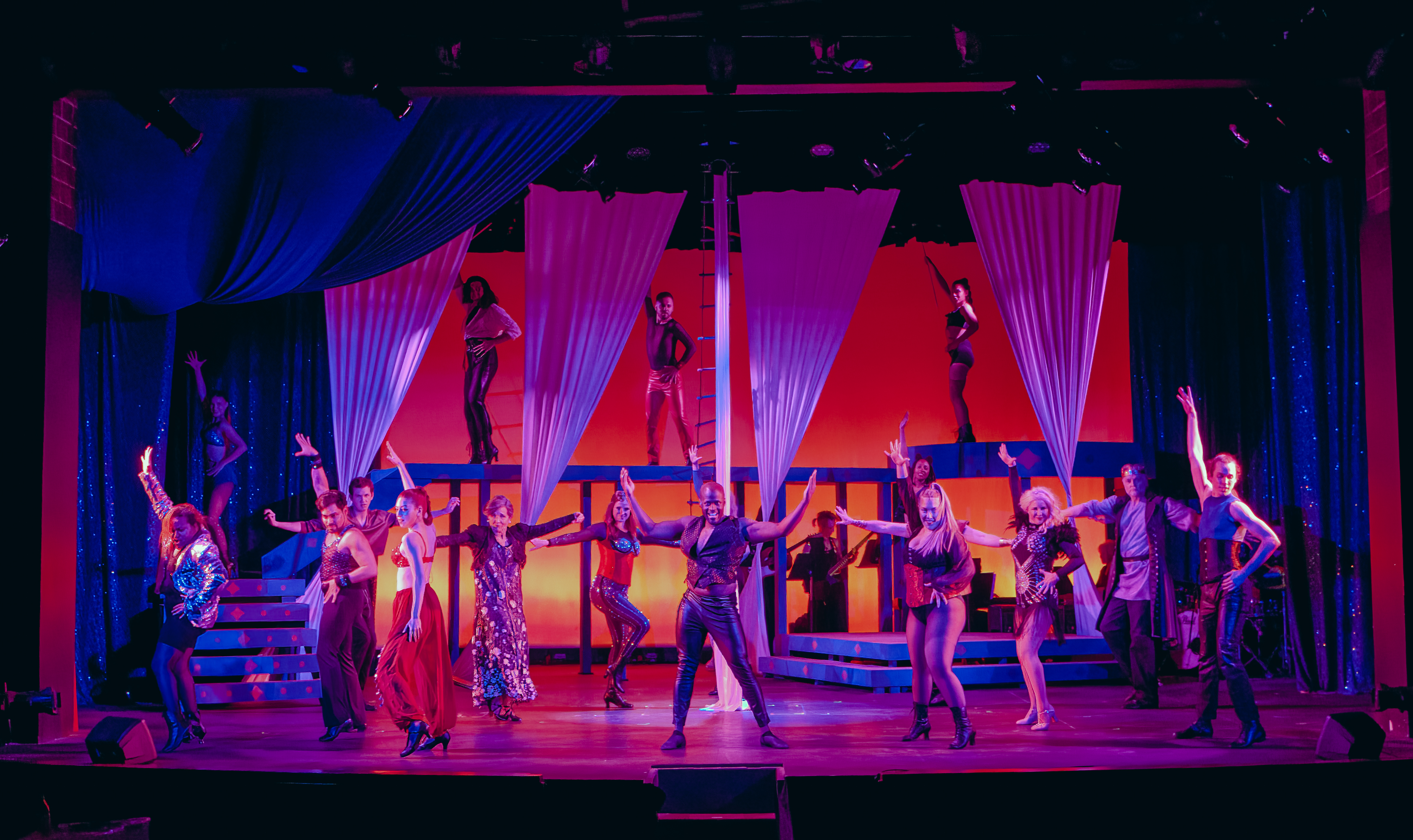
There was plenty of magic to do last Friday night as Theatre Charlotte opened their new production of Pippin at the Queens Road barn. Opening night was happening in the wake of a dazzling Broadway Lights reveal at Belk Theater of a star-studded touring version of Into the Woods just three nights earlier. That compounded the new challenges already added by the 2013 Broadway revival of Stephen Schwartz’s 1972 hit, layering on new illusions, flying effects, circus acrobatics, and fire.

Behind the scenes, budgets and available talent are also stressed and stretched. Theatre Charlotte is embarking on an unprecedented series of four consecutive shows, hosting performances of Detroit ’67 (opening May 26) and I and You (June 16) at the old barn through June 25, after an excursion to the Uptown Mint Museum, where Picasso at the Lapin Agile will pay a visit beginning on May 5, the weekend after Pippin shutters. At home and on the road, TC’s running crews are booked for the next 10 weekends.

At first blush, it was tough for me to escape the notion that Woods witch Montego Glover’s wardrobe alone – not to mention her paycheck – was more expensive than this entire pipsqueak Pippin production. But the five-piece stage band directed by Lindsey Schroeder is tight, the ensemble directed by director/choreographer Lisa Blanton is brash and teeming with pro-grade talent, and the dance stylings by Sterling Masters-Deeney (home from a 12-year stint with the Broadway company of Wicked) are besprinkled with Fosse hands and pizzazz.

Before he composed Wicked, Schwartz wasn’t exactly sold on serious storytelling, so it isn’t difficult to swap out the narrative frameworks of Godspell and Pippin. Not for directors and most of the design team, anyway. For the acting troupe, most of whom are billed as Players; and for those designing the new Pippin effects and teaching performers how to execute them; it’s a different story. A granny on a trapeze? The original Javert from Les Miz learning parlor tricks? Tall orders.

Community theatres have scaled-down prep schedules as well as Slimfast budgets, so there were a few times – particularly when fire is involved – when you’ll need to brace yourself for disappointment. Otherwise, the acrobatics, the sawed woman, and the levitation stunt overachieved magnificently. Who knows, maybe by the second weekend, the kinks will be ironed out of the flame-throwings.TC95-Pippin-275

With Nehemiah Lawson as the Leading Player and Bart Copeland in the title role, both emerging from the ensemble of Theatre Charlotte’s Something Rotten, the bulk of Schwartz’s music and lyrics is in good hands. Lawson is a powerful presence and an excellent dancer, and the costume Beth Killion has designed for him strongly suggests black magic wizardry. Yet Lawson sometimes undercuts his own authority when he appears to be striving to precisely execute the choreography instead of taking over his moves, manhandling them, and making them his own.

The flimsy book by Roger O. Hirson is already lax in reminding us that the Leading Player is in charge of all the other players and their storytelling, so Lawson’s occasional spasms of fidelity don’t help. Yet his scenes with Sophie Lanser as the flawed and recalcitrant Catherine, Pippin’s true love, are beautifully calibrated in their give-and-take, and his climactic tantrum when Pippin rejects martyrdom is fairly breathtaking.

As Prince Pippin, Holy Roman Emperor Charlemagne’s son, Copeland is disarmingly wholesome, earnest, and at ease. His dancing prowess seems to improve before our eyes as he ages and becomes more worldly-wise, with an added grace that may stem from Copeland’s not taking himself seriously as a dancer. That kind of modesty works well for the major Pippin role that hasn’t won two Tony Awards (Ben Vereen in 1973 and Patina Miller in 2014), particularly when you’re a protagonist who finds himself beaten down in life no matter which path he follows toward fulfillment, his ”Corner of the Sky.”TC95-Pippin-154

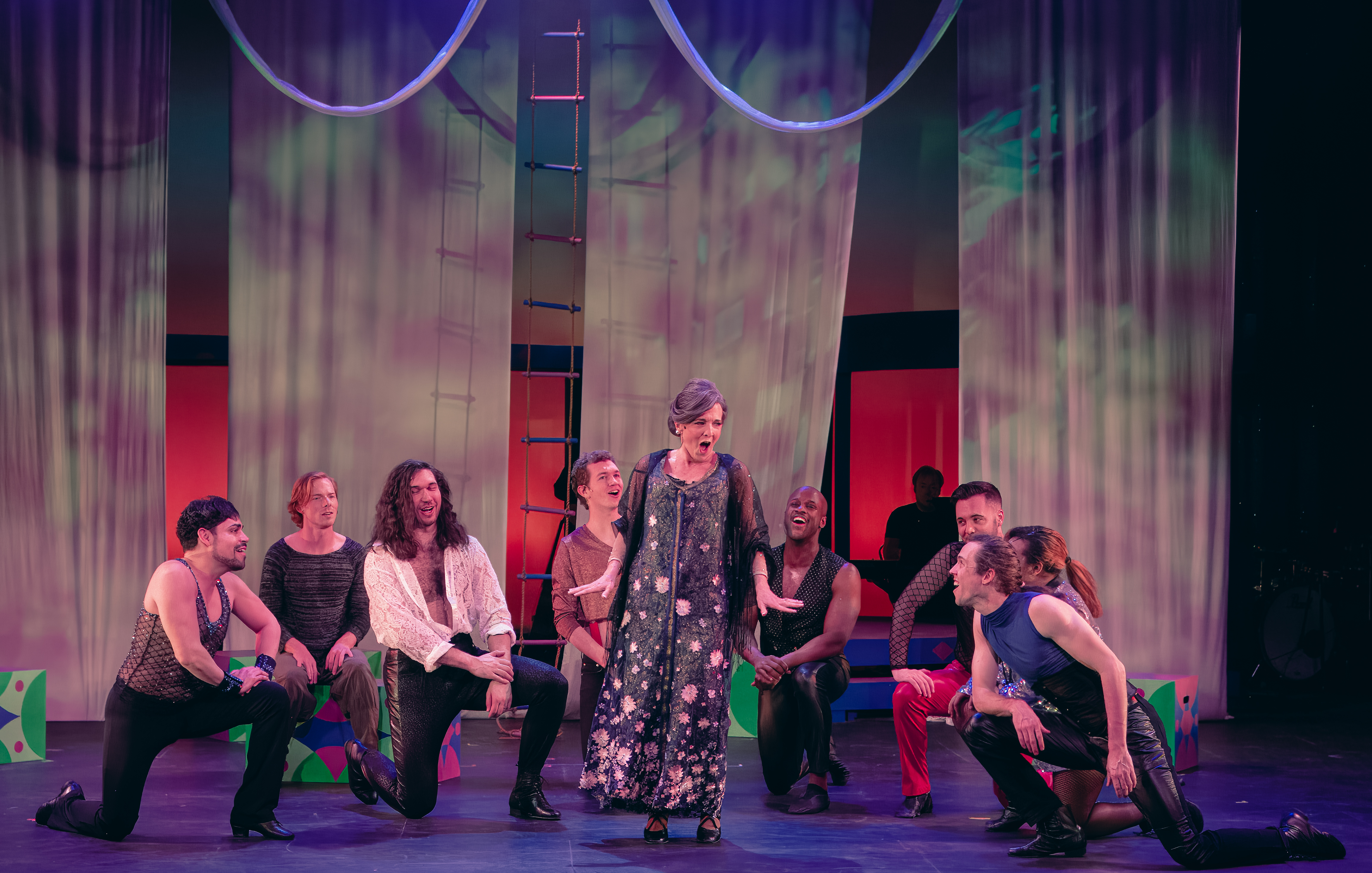
While we savor the blithe amorality of Darren Spencer as Charlemagne, more aristocratic zest emanates from two female royals. Reveling in her corruption as Fastrada, Charlemagne’s current wife, Alyson Lowe gets to scheme against both her Emperor husband and her stepson Pippin, slyly maneuvering to install her valorous dimwitted son Lewis on the throne. Louann Vaughan draws the sunnier role as Charlemagne’s mom, exiled from court by the conniving Fastrada.

Her sunnier song, “No Time at All,” is the catchiest, a carpe diem song from Granny that espouses hedonism to Pippin as a better path than ambition. It also draws some of the most surprising staging as Berthe proves she hasn’t sunk into stagnant retirement. She’s as much of an opposite of Catherine as the cold-blooded Fastrada, for Lanser quickly forms a domesticated trio with Copeland and Logan Campbell as the widow’s son Theo, bonding together in the precious “Prayer for a Duck.”

Common farmer she may be – and maybe, according to Leading Player, the lowliest actor in the troupe – but Lanser reminds us she isn’t a doormat, aggressively seeking out a replacement husband when she’s on script in the Leading Player’s story and then pugnaciously inserting a song that he has not approved. Catherine needs Pippin and her “I Guess I’ll Miss the Man” is a long way from worshipful.

Matt Howie is the only other cast member who speaks, giving Pippin’s half-brother Lewis a surprisingly sweet tinge. After seeing him in numerous productions, most recently in Something Rotten, I’m not sure he can help it. Among the dozen dancers in unnamed roles, captains Georgie DeCosmo and Mitchell Dudas consistently excelled. Charlton Alicia Tapp also stood out as a slick ballroom lizard, and lithe Riley Gray breathtakingly took acrobatic honors ascending and descending the silks.