Tag Archives: Danielle Melendez

Small Sizing Yields Big Rewards in DCP’s Fun Home

Review: Fun Home at Armour Street Theater

By Perry Tannenbaum

Across the way from the Gershwin Theatre, where Wicked has been running for over 20 years, you can find my favorite Broadway theater, Circle in the Square. At the other end of an underpass that connects the two venues – and two or three flights of stairs underground – you and 800+ plus patrons (less than half the Gershwin’s capacity) can have a theater-in-the-round experience in a space that’s like a wee oval basketball court or a hockey rink.

I’ve seen seven different productions at this underground stadium since 1999, most unforgettably the world premiere of Tennessee Williams’ Not About Nightingales that year and the visionary waterworld of Mary Zimmerman’s Metamorphoses in 2003. Right now, two other Circle gems are playing in Metrolina revivals, Lombardi at the Lee Street Theater in Salisbury and five-time Tony Award winner Fun Home at the Armour Street Theater in Davidson.

A couple of admirable versions of Jeanine Tesori’s musical have already run in the QC, a Broadway tour at Knight Theater and an Actor’s Theatre reprise on the Queens U campus, so the current Davidson Community Players production, directed by Danielle Melendez, has big shoes to fill. What strikes me most positively about DCP’s effort, however, is how small it is. If you’re sitting in the front row, as my wife Sue and I were last Saturday evening, some of the action will be right next to you. Or behind you.

From that vantage point, DCP is better than even the 2019 Actor’s Theatre production at Queens’s Hadley Theater in replicating the intimacy of the Circle in the Square experience. Set designer Chip Decker, who stage directed the Hadley production during his years at the helm of ATC, retains his bright visual concept – a departure from the more funereal Broadway and touring versions – in depicting the Bechdel Funeral Home, allowing Alison Bechdel’s cartoons free play on the translucent windows of the parlor.

Often, they’re animated, with Bechdel’s words and drawings blooming before our eyes.

As we watch Lisa Kron’s adaptation of Bechdel’s graphic novel unfold, there’s a nice little studio perch set aside at stage right for the full-grown Alison to narrate. Sometimes as Alison, Kel Wright insinuates herself into the action, lurking in the main playing space, sketchbook in hand, as Small Allison and Middle Allison act out her vivid memories of growing up at a Pennsylvania funeral home and coming out as a lesbian at Oberlin College.

The bright visual concept tracks better with Kron’s book, because darkness only gradually seeps into the story. Alison’s dad, Bruce, seems like a bookish, excessively neat and proper mortician at first, mainly because he and his dutiful wife Helen conspire to hush up his big secrets. When Small Alison and her brothers sing “Come to the Fun Home,” a faux commercial jingle for the funeral home, the childish glee is as contagious as an early Jackson 5 hit or something fresh from little Donny Osmond and his backups.

Bruce may discourage these boisterous outbursts, but he cannot suppress them. Similarly, when Small Alison wants to go to her school party in jeans and sweater, Bruce can temporarily impose his will by shaming his daughter into wearing a dress. It’s only in retrospect that we and the full-grown Alison realize that Bruce was mostly protecting himself, shielding the truth of his own sexuality rather than upholding propriety.

Ironically, the fulcrum begins to shift for Middle Alison at Oberlin College, where she discovers her own gayness. This is jubilantly proclaimed in “Changing My Major (to Joan),” a song that equals the joy of “Fun Home” and surpasses it in exuberant sensual comedy. Tesori is at her best in these chamber sized songs with their pop flavorings and their Avenue Q spice. Even at her peak in Caroline, or Change and Kimberly Akimbo, Tesori’s other acclaimed shows, there’s a little bit of Sesame Street mischief going on.

Having coped with Bruce’s escapades for decades, Helen understandably freaks out when her daughter informs her that she has come out. Alison can only see her mom’s distress through a haze of misperception. Yet we always like Alison because she not only observes herself and her family with her sketchbook, she perseveres on her path and eventually, if still hesitantly, confronts her problems.

Despite Dad’s disdain, she continues to opt for cartooning instead of “serious” art, continues to wears jeans instead of dresses. Faced with Joan’s advances, Middle Alison retreats… temporarily. She seems to hibernate and marinate after writing home about her gay epiphany, processing Dad’s puzzling evasiveness and Mom’s distress, but she elects to bring Joan home with her when she returns from Ohio on winter break.

Darkness falls gradually, but it falls hard.

Mortician, English teacher, preservationist, and molester of underage boys – there’s a lot to unpack, even for adults in the audience, as we try to understand and judge Bruce in the context of his times. Coming off his outré antics in Vampire Lesbians of Sodom,Ashby Blakely is as varied, complex, and nuanced as we’ve ever seen him as Bruce. At times, he roars in his tyrannical moments, overpowering the small house. Like all the other players, he’s miked, but thanks to Kathryn Harding’s exemplary sound design, there’s never any distortion, clipping, or dropouts to mar the show or its music.

The one major sacrifice for theatergoing purists is the lack of a live orchestra at Armour Street. Nevertheless, Harding contrives a surround effect by channeling the prerecorded soundtrack and the amplified voices from the rear speakers. It was a pretty unique front-row experience for me, rather enjoyable.

After her exploits at Booth Playhouse as Norma Desmond in Sunset Boulevard, Alison Rhinehardt had already convinced me that she could overpower Armour without a mic. As Helen, she predictably knocks her showpiece, “Days and Days,” out of the park with diva aplomb. Until then, she’s rather wholesome and humdrum, accentuating Mom’s breakout.

Nor is there any perceptible cratering when we scrutinize the less familiar names in this cast. Recently unveiling her directing chops in the Queen City Concerts premiere of Local Singles,Wright brings an exacting intensity to Alison that always captures the drama, even when she sings. “Caption,” she keeps barking in Kron’s script, so her valuation of le mot juste always seems foremost as her castmates take care of the graphics.

As the Bechdel brothers, Aiden Honeycutt as John and Grayson Flowers as Christian help turn Small Allison’s “Fun Home” promo into an exhilarating panorama. Bailey Fischer takes flight almost from the first moment we see her as Small Alison – goodness, energy, and precocity personified until her last “Flying Away” moment. That energy is formidable when Ann Schnabel must take over as Middle Alison, especially in the intimidating context of a matriculating college freshman. In a sense, then, her “Changing My Major” is as much a rebirth as it is an affirmation.

It’s the needed embrace of the real world that will ultimately help her in coming to terms with the truth about Dad.

Criminal law is far more confident than my feelings in determining who the forbidden fruit is among the remaining cast. As the revelatory Joan, Sierra Key seems healthy enough, her seductiveness sufficiently muted for a Midwest coed. At school and visiting the funeral home, Key hits all the notes that emphasize Joan’s savoir-faire and discretion without pounding them. As the Bechdels’ handyman, Bart Copeland struts and preens enough to convince us that he’s also a consenting adult.

When he switches roles and becomes a former student that Bruce picks up on his nocturnal rambles, Copeland calls upon the naivete that made his star turn as Pippin so compelling last spring at Theatre Charlotte. Topped with a mop-top wig, you’ll see he’s also a perfect fit for Tesori’s retro pop music.

Doubling the Fun

Okay, so maybe you weren’t duly impressed that two shows are now running in Metrolina that premiered at the same Broadway theater. We can do better. Weirder. This coming weekend boasts two different shows set at a funeral parlor! Yes, as Fun Home continues for two more weekends up in Davidson, down here at Booth Playhouse, Charlotte Conservatory Theatre is bringing us the world premiere of Nan-Lynn Nelson’s Leaving Watermaine, directed by the playwright.

It opens on leap day this Thursday, at the tail-end of Black History Month, for a four-day run. By the end of Act 1, we’re greeted with a busy weave of plot threads involving undertaker Werly Mainlodge, his three daughters, and their beaus – both beloved or unwanted. Which of the three young ladies will be leaving first? Elopement or honeymoon? Will the Klan intervene on the eve of the planned departure?

Has there been a KKK lynching or a passionate murder? Or is the presumed victim still alive? Mystery, racism, colorism, and comedy peep into what seems like a tragedy, so you’ll need to stick around after intermission to learn how the dangling threads sort out. Nelson seemed to have it all calculated, incorporating her own musical soundtrack into her sound design.

Off-Broadway Star Shines in Three Bones’ Andy and the Orphans

Review: Andy and the Orphans at The Arts Factory

By Perry Tannenbaum

Eddie Barbanell, Susan Cherin, David Canetazzo and Vanessa Robinson (1)

When playwright Lindsey Ferrentino wrote Amy and the Orphans about her Down Syndrome aunt Amy, she convincingly demonstrated that she didn’t need to write its fraternal twin, Andy and the Orphans. But the demonstration happened too slowly. Ferrentino and director Todd Haimes needed a second Down Syndrome actor to play the title role at matinee performances when the show opened for the Roundabout Theatre Company in 2018.

Presumably, Ferrentino thought that pickin’s would be slim after finding Jamie Brewer at a New York fashion runway, the first DS person to participate in Fashion Week, through a talent agency that specialized in performers with disabilities. So the playwright didn’t specify what gender her second DS actor should be. Along came Eddie Barbanell to step onstage as the matinee understudy, and along came Andy and the Orphans, the custom-tailored male version of Ferrentino’s tribute to her Aunt Amy.Eddie Barbanell as Andy_1

Five years later – and five years closer to Andy’s real age – Barbanell is here in Charlotte, wowing audiences at The Arts Factory in Three Bone Theatre’s production of Andy and the Orphans through February 25. Meanwhile, Ferrentino has learned, through versions of her work staged in London and Spain, that you can reliably find DS actors to play DS people onstage anywhere. The real stumbling block for DS performers is the lack of roles for them.

Three Bone was actually early to the Ferrentino party, bringing the playwright’s previous work, Ugly to the Bone, to Spirit Square’s Duke Energy Theater two years ago. It was another script that showed Ferrentino’s empathy with female castaways in our society and how they are treated. Then it was Jess, an Afghanistan War vet returning to her Florida home, disfigured and disabled physically while inwardly suffering from PTSD.

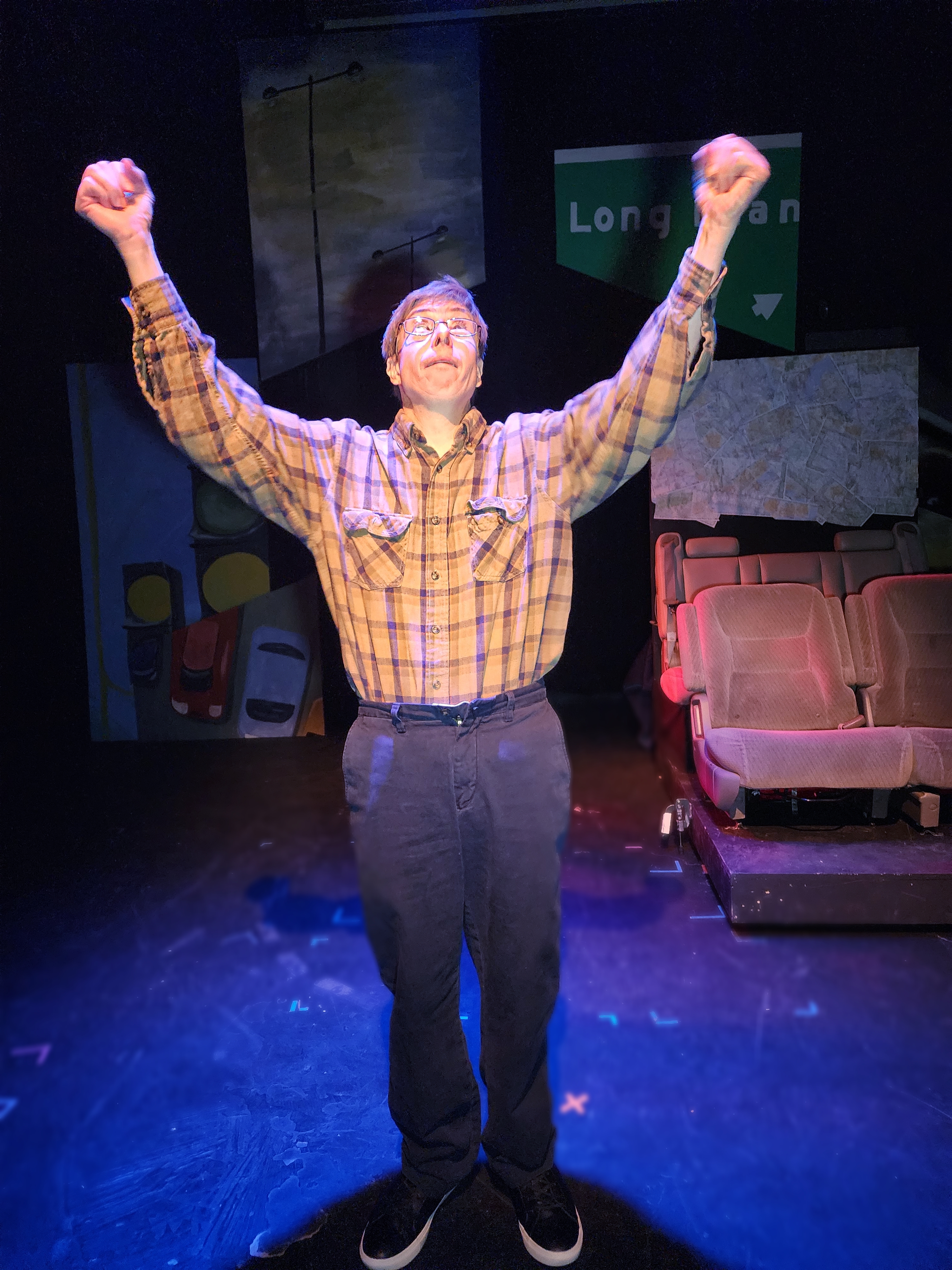
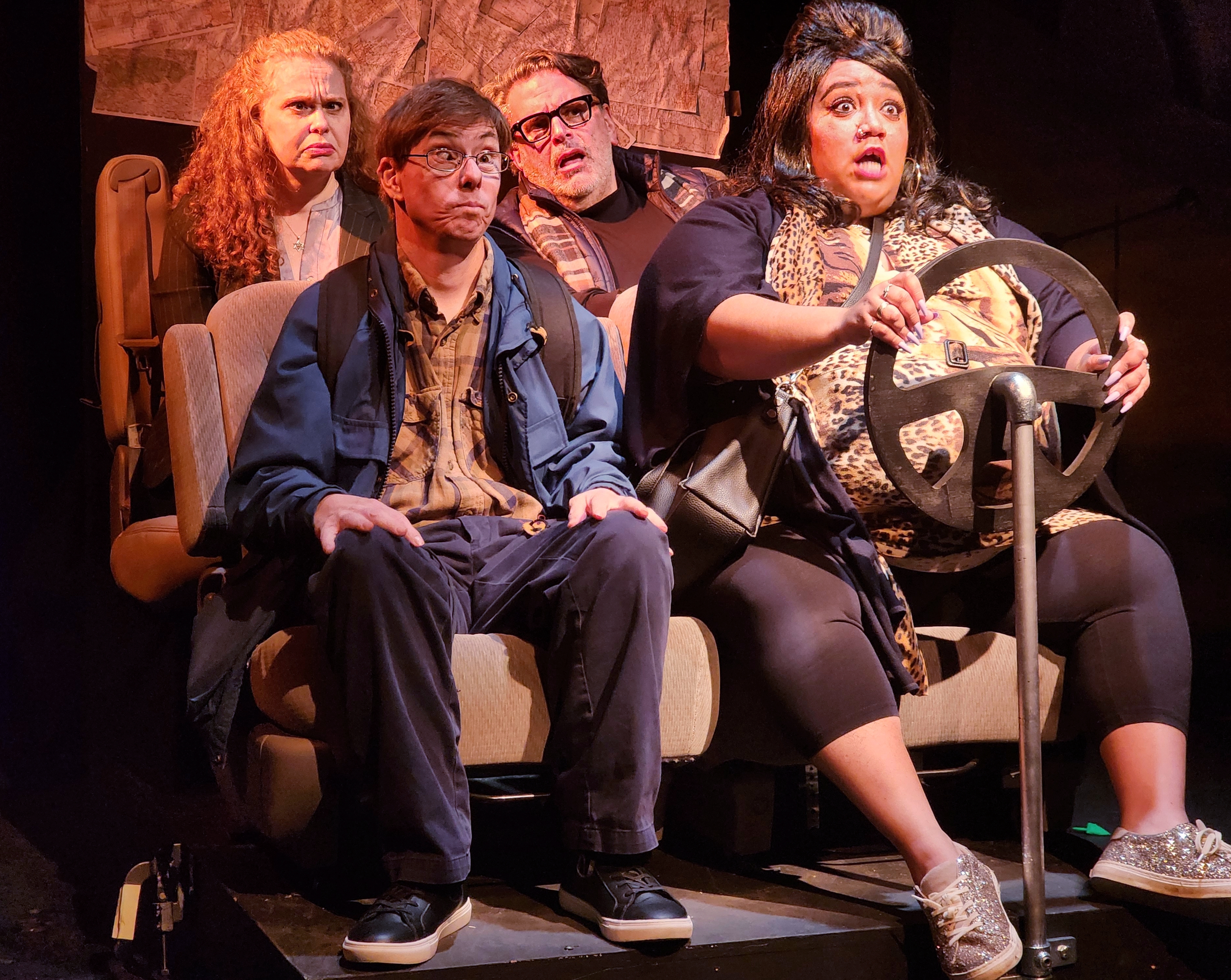
While the content of Amy/Andy is more autobiographical, the location moves away from the playwright’s native Florida to New York. Precise locations shift during the action, and Ferrentino is rather circumspect about where we are or when. Without the script in my hands, I guessed that at various times we were in Staten Island, outside LaGuardia or Kennedy Airport, at a group home in Queens or Long Island, on the road, and – quite memorably – at a Burger King. Andy, his elder siblings, and Kathy, the caretaker who must accompany Andy, are on a road trip to Dad’s funeral, past the end of the fabled Long Island Expressway (and Sunrise Highway afterwards) to Montauk, the eastern tip of New York.David Catenazzo and Susan Cherin_2

Maggie and Jacob, when they aren’t bickering over whether their yearly meet-ups are Christmas or Chanukah visits, are worried over how they will break the news that Dad has died – and that Mom has already died awhile ago. This is the right comedy varnish to apply to a story that has a rather horrific dramatic core. Likewise, being overdue on telling their DS little brother that Mom and Dad are dead is a rather innocuous patina to apply to the family trait the characterizes Andy’s sibs and parents, a shocking abdication of their responsibilities toward him.

As this shabby trait becomes more and more exposed, the sideshow dinginess of Chip Davis’s traffic-themed set design becomes more and more apt for this story. It’s hard to escape the conclusion that director Danielle Melendez lucked out when Susan Cherin and David Catenazzo showed up for auditions. Cherin comes off as the kookier, more neurotic sib as Maggie, far more likely to be a fretful helicopter parent than her shambling brother. As Jacob, Catenazzo has the more Jewish name and delivers a more Jewish demeanor – compounding the comedy, since he’s the bible-toting convert who celebrates Christmas.

It’s really hard for us to be disgusted with either Cherin or Catenazzo until Maggie and Jacob are shown why they should be deeply disgusted with themselves. That’s why this key moment is such a gut punch for us.

Barbanell is extraordinary, giving us all that Ferrentino wrote into Andy and more. As an actor myself, I marveled at his cue pickup and his timing. We don’t need to be in his presence long for us to believe how he and Brewer blew away the playwright’s expectations for what a DS actor can do, or that they were the first Off-Broadway cast members to go off-book. Nor was I surprised by the end of the evening to read that Barbanell had burst into Shakespearean monologues by Romeo, Julius Caesar, and Puck the first time he met up with Ferrentino at a roadside diner, turning his interview into an audition and a theatre event. Each performance was “word perfect” by the playwright’s account.

Tacitly, then, she has admitted that she might have filled out Amy/Andy’s role more amply if she had known, going in, the full capability of DS actors. Critics who have faulted Ferrentino for not fleshing out her title character and letting us get to know him better may have overlooked just how pioneering this script is. Getting buffeted by myopic critics was the price she had to pay.

Nice thing is, Ferrentino has been asked by Netflix to adapt and direct a film version of Amy and the Orphans. That will allow her to reframe her story knowing her DS actors’ capabilities beforehand. Both Brewer and Barbanell have been tapped to be in the remake, so it’s probable we’ll get first look inside Amy and Andy’s group home. Maybe Andy’s unseen girlfriend, Tina Turner, will get thrown overboard in favor of Amy!

Sarah Molloy and Nathan Morris (1)Sarah Malloy and Nathan Morris are Sarah and Bobby – and the key reason why Ferrentino has moved her tale to the Staten Island vicinity. They are the parents of the title character, but it may take awhile before audiences catch on. My wife Sue, who taught special needs children for decades, got it the second time Sarah and Bobby locked horns. It didn’t come together for me, merely a special needs child’s elder brother, until maybe a half hour later.

Even then, notwithstanding the fine work from Malloy and Morris, I wondered why the playwright felt these dead parents needed to be onstage, in the story. There was something unsavory about both of them, that I can say, before the big reveal. Then the Staten Island connect became crucial.

[[Spoiler Alert: In the run-up to the upcoming Netflix film, it’s hard for me to predict whether the Willowbrook State School will remain a spoiler. Back in his day, Senator Robert F. Kennedy visited the facility. Not too long afterward, Geraldo Rivera dropped by with a TV crew, coming away with similar impressions. Decide for yourself by googling Willowbrook – or delaying that search – whether you wish to know about it before or after you see Andy and the Orphans. Will Netflix insist on showing us the place? Stay tuned.]]Vanessa Robinson (1)

Finally, it must be said that Vanessa Robinson’s sensational Charlotte debut as Kate has absolutely nothing to do with luck on Melendez’s part. She went way against script, where Kathy is described as Italian-American, in casting Andy’s pregnant social worker. With a down-to-earth quality that masks her admirable ability to tolerate all the Maggies and Jacobs she has dealt with over the years – and the Andys – Robinson shows us a different way to be “the walking embodiment of Long Island, New York.”

When they perform their big monologues, both Barbanell and Robinson hit it out of the park.

One of the things I had to ponder on our drive home was whether Ferrentino had been dealing from the bottom of the deck when she showed us how normal and everyday Maggie and Jacob were – not to mention Sarah and Bobby before them – in their interactions with Andy and each other. It’s only when you factor in how many hundreds and thousands of parents and siblings behaved the same way, for over four decades, that the monstrousness of such normality becomes clear.

Ferrentino is slowly, cautiously, and carefully cushioning us for a hard truth. All the time we’re thinking that we’re in on the big reveal Maggie and Jacob have in store for Andy, we are being set up with devastating circumspection.

The tables are turned suddenly. Jarringly.

Charlotte’s Ace Comedienne Takes on a Touchy-Feely Challenge

Preview:  Every Brilliant Thing

By Perry Tannenbaum

Written by two Brits, Duncan Macmillan with Jonny Donahoe, Every Brilliant Thing began life in 2013 in a little English town and didn’t achieve any kind of renown until Donahoe brought the one-man show across the pond in an off-Broadway production the following year. An HBO movie in 2016, a coveted engagement at Spoleto Festival USA last season, and numerous productions across the country have spread the word.

To an uncommon degree, this one-man show relies on audience participation to tell the story. When a vet comes by to put down the young narrator’s dog, Sherlock Bones, a person from the audience is picked to play the vet. When Mum is taken “to hospital,” an audience member helps deliver the scene where Dad explains that the boy’s mother has made her first suicide attempt.

And when the boy draws up his list of “everything brilliant in the world. Everything worth living for,” in a lifelong effort to cheer Mum up and keep her alive, audience members who are given hand-written scraps of paper before the show call out items on the epic list. #1, Ice cream, #2, Water fights, and so on.

But Every Brilliant Thing doesn’t have to be a one-man show. Or British. At Spirit Square, where the Three Bone Theatre production opens next week, it won’t be.

“One of the exciting things about the script is that the playwright has specified that this story can be told by any actor, any gender identity, any race, any age,” says Three Bone artistic director Robin Tynes.

Rehearsals started back in December. There were no auditions. With so much emceeing, audience interaction, and stand-up comedy skill required, your garden-variety audition wouldn’t help a director to make her choice. Tynes just handed the script to Tania Kelly.

Tynes needed someone who could draw an audience to Duke Energy Theater, somebody with proven improv chops. “Tania was an obvious choice to me. She has extensive emcee experience, comedy experience through Robot Johnson and other shows, and people love watching her on stage. We worked with Tania in our production of Five Women Wearing the Same Dress, so I knew she had the dramatic chops for the piece. I think she’s an excellent actress who often times gets pigeonholed into solely comedic roles.”

Kelly offers a slightly different account of getting the script from Tynes. “I read it,” she recalls, “and then immediately sent her a message that said, ‘WHAT DO I NEED TO DO TO BE IN THIS?’ We had a meeting and then I got to do the best thing ever. I wanted to do this show so bad because I immediately related to the story. But then on top of that, the writer also gave a lot of freedom in the casting of the Narrator with all those really interesting footnotes. So, I don’t think anything super drastic needed to be changed.”

Recently named the recipient of A Seat at the Table’s inaugural “She Is Dope” Award, Kelly is best known for how smart, brainy, snarky, and caustic her performances have been. She was the worst psychiatrist ever in Beyond Therapy in 2011 and a prodigiously misinformed humanities professor last year in Women Playing Hamlet. But Kelly’s dopiest exploit remains her stint as both Dromios in the 2016 Chickspeare presentation of The Comedy of Errors.

Tynes plans to give Kelly a more intimate and clubby atmosphere to work in at Duke Energy Theater, reducing seating capacity to around 100 people and putting her star to work before the action begins, working and engaging the crowd. Kelly agrees that her unique résumé has been invaluable.

“Robot Johnson has definitely been a master class in ‘Just roll with it, trust your friends, and man these drunks are loud,’” Kelly quips. “Also I was a DJ/Emcee for tweens for Radio Disney for like five years, and I feel like that skill has really helped lately. But also yes, this is still, for real, absolutely terrifying.”

With all the unpredictable audience participation that Kelly is called upon to cope with, the rehearsal process had to be re-engineered. It wasn’t altogether private, one-on-one, or hush-hush.

“Danielle Melendez, our stage manager, and Robin have worked really hard to organize a series of test audiences for me to interact with for just those scenes. Which has made this such a fun and unique process for all of us. We’ve been essentially running a series of experiments. It’s been pretty cool.”

Kelly doesn’t mention that a recent performance at Catawba College earned her a standing ovation, but Tynes does. There’s still some polishing going on behind the scenes as opening night approaches. Yet the object has never been to make the Three Bone version anything like the off-Broadway production that won Every Brilliant Thing its acclaim. Tynes has devoutly avoided watching any other version of the show, including the HBO special.

“It was also thrilling for us,” says Tynes, “to interpret and mold this script that was crafted by a white British man to fit an African-American woman. While casting Tania was not intentionally political – she was hands-down the best person for the job – it has inherently changed how I view the script. We’re discussing and diving into mental health, and the demographic in the United States with the least access to mental health care is women of color. I love that by having Tania play this role, a woman of color is at the forefront of this discussion about mental health care and support systems.”

Davidson’s pudgy cuddliness will vanish when Kelly takes over his role, but the heavy moments – and the touchy-feely ones – will be part of the challenge that she’s embracing. Kelly dismisses any talk of the larger significance of the event. “This is a really funny show about depression,” she insists. “I’m just telling a really gorgeously written story.”

Fair warning: you might feel otherwise. With all its shtick and spontaneity, Every Brilliant Thing becomes something of a ritual when different audience voices chime in, a ritual of empathy, celebration, and healing.

“Actually, we are all telling this story together,” Kelly agrees. “The audience is creating this with me every night. I have never done anything like this before. I can’t wait for y’all to see it!”

Oh, and don’t be surprised if Sherlock Bones is renamed Chuck Barkley. He’s Kelly’s dog now, and it’s Kelly’s show.