Review: Austen’s Pride at Knight Theater
By Perry Tannenbaum

Depending on how well you adapt Jane Austen’s most beloved novel, Pride and Prejudice,the result on stage or screen can range from Hallmark saccharine to comedy grandeur. At their best, adaptations of recognized classics revel in their new media, rivaling Fiddler on the Roof onstage, High Society onscreen, or Mozart’s Marriage of Figaro at the opera house.
Results with P&P largely reflect how deeply a screenwriter or a playwright savors the perfections and delights of Austen’s narrative, dialogue, and wit… and how well he or she channels and tweaks the author’s temperament. What’s most daunting in 2025, more than two centuries after Pride and Prejudice was first published, is the sheer number of adaptations, good and bad, that already exist.
Back in the world of books, a welter of variants and sequels to Pride and Prejudice flourishes, from Austen copycats to audacious apostates who lavish fresh condiments, such as vampires and zombies, onto the original. Onstage and in musicals, the onslaught hasn’t been so fierce, but new acolytes have plenty of TV versions – around 25 – strewn onto their path to Broadway, which most recently had a musical based on the Austen classic, First Impressions, in 1959.
To their credit, Lindsay Warren Baker and Amanda Jacobs took a different path to retelling Pride and Prejudice in their new musical, AUSTEN’S PRIDE. Their visionary concept has Austen, prodded by her sister Cassandra, rewriting an earlier draft from years before, titled First Impressions, and turning it into her beloved chef d’oeuvre right before our eyes.
Recast into a theatrical idiom, with Austen’s characters also offering their input, the musical plays like the rehearsals and development of a new stage work. Austen, vivaciously played by Olivia Hernandez at the Knight Theater in Charlotte, becomes an active, sometimes hyperactive collaborator with characters onstage, like a director or a playwright with her players.
Since Baker & Jacobs have ordained that Austen herself evolves and develops during the process as much as the story itself, Austen supplants her sassy and superb Elizabeth Bennet as our protagonist. Or does she? Behind the scenes, director Igor Goldin decides how much time Hernandez spends onstage in close proximity with Delphi Borich as Elizabeth – and how often she will upstage her by reacting.
Hernandez gets a vast catalog of reactions to call upon: various smiles, gasps, and interactions with Austen’s manuscript, whether it’s jotting things down, feverishly crossing things out, or just pondering, hesitating, and deciding. It’s easy to become captivated with Hernandez’s full repertoire – and to welcome reprises of her greatest hits – but, churlish as it might be to say it, Goldin should be holding her back more than he is.

If you happen to love Austen’s masterwork, Hernandez’s presence infuses her creators’ concept with surprising magic. Example: as she stalked the big proposal scene in Act 1, where Darcy and Elizabeth approach each other from opposite wings, I found myself sobbing before their impassioned dialogue even began. Somebody on the Knight Theater stage seemed to be sharing my reverence for what was about to happen.
While Hernandez becomes a wee bit repetitious, we could definitely benefit from seeing a more fine-grained development of Borich’s evolution as Elizabeth from wit to wisdom. That would push back a little on Baker & Jacobs’ intentions, true enough, but it would also narrow the gap between the ceilings they have placed on Borich’s and Hernandez’s performances. Fine as Borich is in navigating Elizabeth’s misperceptions and epiphanies, Hernandez is diva class, exactly right for a midlife Austen seeing herself as a brilliant young Elizabeth in her rearview mirror, more beguiling but less mature.
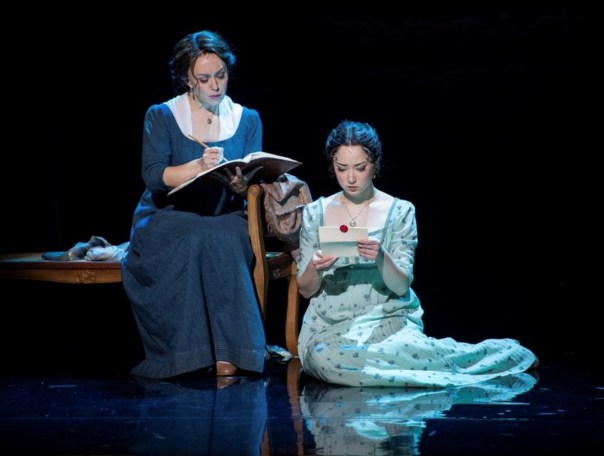
Without pedantry, Elizabeth is teaching Austen while the author does the hard work: crafting Elizabeth and her world. Austen’s yearnings, worries, and epiphanies all get more urgency from Baker & Jacobs and more power from Hernadez’s glorious larynx. Her best notes pierce our hearts more than our ears.
Some of Pride’s impact derives directly from Austen’s text: the language of Elizabeth’s letters, the dialogue of Mr. Darcy’s first and second marriage proposals, and the most memorable snippets from Mom and Dad. But some of the deftness that Baker & Jacobs bring to the task of distilling the triple plot of P&P for the stage is discernible in the music they make together.
They bring out Kevyn Morrow as Mr. Bennet more than we expect in a musical with “Silly Girls,” a conspicuously Tevye-the-Dairyman moment, and they give Dan Hoy extended play as Fitzwilliam Darcy at precisely the right moments. Hoy not only finds the nuances of the nobleman’s arrogance and humanity with admirable exactitude, he reminds us that this role – and that of Heathcliffe – were deemed by Hollywood to be the rightful property of Laurence Olivier.

Yet there are elements of Austen’s Pride that are laudably free of pretension, leaning away from Broadway glitz toward chamber-music decorum and perfection. The pit band at this Knight Theatre production numbers only nine players, including music director Kerianne Brennan at one of the keyboards.
Scenery by Josh Zangen is equally elegant and spare. Windows in Austen’s study, accented simply with glowing potted flowers, fly upwards when we transition to her novel-in-progress. When we need to conjure up the splendor of Bingley’s Netherfield estate, a chandelier drops down to simulate his glittery ballroom.

Emily Rebholz not only makes Darcy and the dudes manly with her costume designs, she also distinguishes beautifully between the decorous Bennet sisters and the more matronly/professional Austens. When Kate Fahey, as the frivolous and flirtatious Lydia Bennet, attempts to tempt Darcy’s longtime acquaintance, dashing militiaman George Wickham, only four more redcoats need to be sewn to conjure up his regiment for “I Can’t Resist a Redcoat.”
The frilliest Rebholz creations are reserved for Austen’s most high-strung women, Elizabeth’s irrepressibly vulgar and mercenary mom and Lady Catherine de Bough, Mr. Darcy’s imperious aunt. Sally Wilfert makes a hearty meal of both of these delicious witches, as marmoreal and severe as Lady C as she is fidgety and flighty as Mrs. B., singing “My Poor Nerves” in her dopier chores.

Three other players fend off idleness by playing multiple roles, helping Rebholz to put further limits on her fittings. When not overshadowed by Lydia as her sister Kitty, Cali Noack transforms into Georgiana, Darcy’s younger sib. After shining as the hilariously awkward and pretentious Mr. Collins – whose marriage proposal to Lizzy must be declined without laughing in his clergyman’s face – Paul Castree radiates the dignity and urbanity of Mr. Gardiner.
Before strutting beside Castree as the decorous Mrs. Gardiner, Sarah Ellis has a couple of more provocative turns, first as Mary Bennet, the most bookish and moralizing of Lizzy’s sisters, and then as Caroline Bingley, notable for her three “My Dearest Jane” cameos to Elizabeth’s long-suffering elder sister – and the eye-popping color of that dress.
Jane isn’t the easiest or plumiest role to play, asking Addie Morales to be both modestly discreet and passionately adoring when Charles Bingley pays her his attentions. Morales tips the balance between these two postures so obviously that her amorousness can no doubt be seen from the balcony. While that does compromise the quality of Darcy’s perceptions on behalf of his friend, Cole Thompson endows Bingley with such wholesome and abundant cluelessness – and such lanky Ichabod Crane ungainliness – that their comedy works nicely.
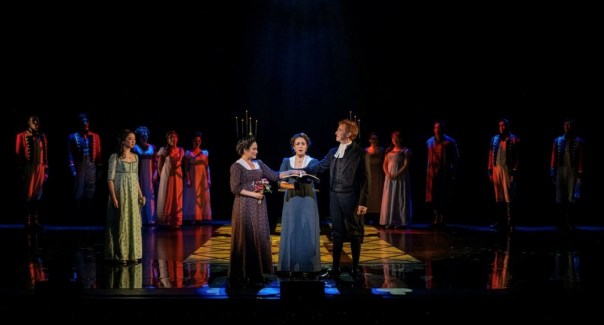
Although the role is not included on the cast list or the who’s-who bios, Dianica Phelan gives us a fine, albeit brief, portrayal of the pragmatic Charlotte Lucas, who accepts her friend Lizzy’s discard, Mr. Collins, for her husband. Mostly, Phelan portrays Austen’s sister Cassandra. So after joining with Hernandez in “Choices,” the opening duet concerned with how to exhume First Impressions and follow up on the success of Sense and Sensibility, she’s there on two fronts to consider women’s choices in Austen’s life and in her signature novel.
The feminist tang so easy to overlook in Austen’s work gracefully surfaces as these circumscribed choices are doubly aired. While Charlotte and Elizabeth are discussing the merits of marrying for love against marrying for security, their author and her sister, Cassandra, are debating the matter with a little more heat and real-life experience.
That’s one of the reasons Austen’s Pride delivers extra boosts of relevance and drama in Baker & Jacobs’ adaptation, along with its tuneful novelty. This fresh take on Pride and Prejudice, deftly balancing comedy and romance, is ready for primetime and its Broadway aspirations, with room left over for further developing its scenic dimensions and tech adornments.




 Art on My Sleeve