Review: Some Like It Hot at Belk Theater
By Perry Tannenbaum
More than a decade before Cabaret, Tootsie, Victor Victoria, The Birdcage, and Kinky Boots pushed harder and harder against Hollywood’s crossdressing taboo, Billy Wilder’s SOME LIKE IT HOT smashed through in 1959. This was a deliciously adult film, and with Marilyn Monroe and Tony Curtis as the leads, deliriously appealing to hordes of teens who cherished the stars as their heartthrobs and hormone stirrers. Because of the sleeping cars and backstage dressing rooms tightly woven into singer Sugar Kane’s roving lifestyle, there was an extra edge of voyeurism for Marilyn to innocently exploit in close quarters.
True to its outlaw spirit, the story yanked us back to the days of Prohibition, legendary mobsters, and big band jazz – the speakeasy trinity. Any other kind of music in a musical adaptation of this comedy would be a turn-off for me. Listening to the sound of violins in the overture of Sugar, the first Broadway musical adaptation of Wilder’s screenplay, with music by Jule Styne and orchestrations by Phil Lang, my ears recoiled and my gorge rose as soon as the strings got involved with tremolos and sugary transitions.
No cocktails, please. Even Sugar drank hard liquor in the film. From a flask she stashed in her stocking.
Though many will question the liberties Matthew Lopez and Amber Ruffin take with Wilder’s storyline, they follow a more natural path with Marc Shaiman’s jazzier 2022 score than their 1972 predecessors. Predictably, as the current touring version confirms, they choose a more progressive PC path as well.
As soon as Sugar follows her boss, Sweet Sue, into the spotlight at Belk Theater, movie mavens and dilettantes will surely notice her radical Lopez/Ruffin makeover: Sugar isn’t lily white like the players in Wilder’s cast. Or dumb. Or objectified.

Now Marilyn wasn’t so dumb that she would pass up the chance to seduce a millionaire (it’s in the background checking that she faltered), but director/choreographer Casey Nicholaw has his leading lady, Leandra Ellis-Gaston, easing off a little when she presses that pedal. There are plenty of other places in this yarn where the comedy can be broadened.
The guys that Wilder’s risqué trailer called Marilyn’s “bosom buddies” get some subtler remodeling. Jerry still plays bass like Jack Lemmon, but he and bandleader Sue are now Black musicians. No less important, Tavis Kordell is going to take more readily to drag than his ‘50s counterpart, with a more profound and nuanced appreciation of womanhood than even Dustin Hoffman achieved as the more cerebral Tootsie. After a while, Jerry feels like he is Daphne, a transition that Kordell, a non-binary Raeford native and a UNC-Greensboro grad, is pleasingly at home with.
As Curtis did, Joe still blows the saxophone before and after he crossdresses, transforms into Josephine, and joins Sweet Sue and her Society Syncopators Band. But since Christian Borle was nearly 50 when he opened on Broadway in the role, the former Black Stache (Peter and the Starcatcher)and rockstar Shakespeare (Something Rotten!) was repeatedly chided for being old. So unlike the suave matinee idol of the film, when Matt Loehr whips off his blonde wig and reverts from Josephine to Joe, his hair is more salt than pepper.

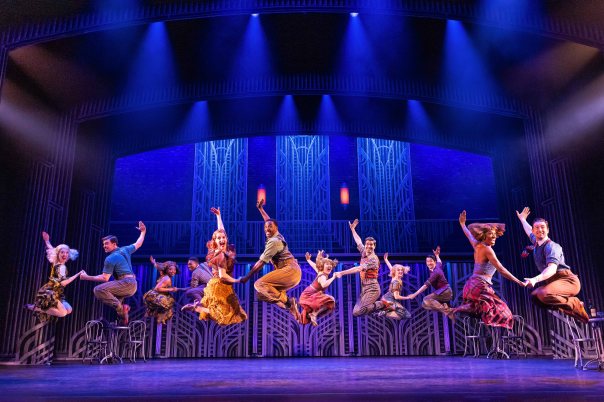
Ranging further from the original, both Josephine and Daphne double their showbiz talents as an amazing tapdance duo – so the oldster has drawn a high-energy role. If Loehr is at pains to keep in step with Kordell and Ellis-Gaston, his huffing and puffing can only augment the comedy. Somewhat fiendishly, Nicholaw delights in giving all three leads a workout, even embracing the absurdity that all the Syncopators can become ace tapdancers – along with the waiters and bellmen they meet on the way.
Of course, when the tap duo is in disguise, they dance in high heels.
Momentum for the story – and the guys’ motivation to sequester themselves in drag – pushes from Chicago, where mobster Spats Columbo initially hires Jerry and Joe to perform. The production saves on scenery and props by keeping Spats’s killings indoors while arming him and his henchmen with pistols instead of machine guns. But Scott Pask’s scenery economies go too far.
Evidently, Pask never received the memo that all touring shows playing the Belk must be able to hit audiences in the eye with the production logo from a distance of 50 yards. Some Like It Hot not only lacks a logo on its faux curtain and proscenium, it’s missing any trace of color! Worse, the stage-filling motif is recycled over and over in various scenes, occasionally acquiring the hues of purple and turquoise. With the aid of smart bulbs, a quartet of chandeliers also reappears over and over during the band’s odyssey, as if they are stowaways on their voyage.
Hotel rooms, ballrooms, Spats’s office, and Osgood’s millionaire yacht are even more cheaply evoked. They do succeed in making Gregg Barnes’s costume designs look even more resplendent in relief, enhancing their Tony Award-winning aura.
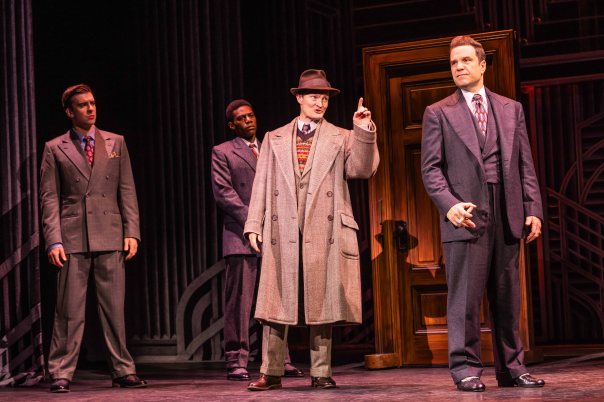
Pity poor Devon Goffman as Spats – too resplendent! If the gangleader could only be more raffish and déclassé, Lopez and Ruffin might have armed him with a larger gang and Shaiman might have begrudged him a song. Goffman draws a disappointingly clean-shaven and corporate image, too seldom onstage to tighten the dramatic tension.
Nicholaw doesn’t seem to mind the void at all. Instead, he feasts on the show’s two big chases, choreographing them for their comedic flavor while evoking one of the most beloved trademarks of silent film. Ironically, we witness much of the touring Some Like It Hot as if it were a silent film because the sound at the Belk is as muffled and foggy as ever. We’d love Tarra Conner Jones as the irascible and ebullient Sweet Sue so much more if we could decipher what she’s belting so lustily. We can be thankful, too, when Ellis-Gaston gets to vamping, for her body communicates to us more completely than her larynx.

Only Edward Juvier consistently pierces through the sonic fog as the millionaire Osgood in his screwball pursuit of Daphne. Gather round him, fellow cast members, and let him preach unto ye the gospel of enunciation.
Ultimately, Lopez and Ruffin succeed in elevating the resolution between Joe and Jerry, diversifying the love match between Joe and Sugar, and crafting a more evolved relationship between Jerry and Osgood. Shaiman had the more formidable task in concocting his score, which is probably why his Some Like It Hot often feels so effortful onstage. They’re all striving so hard to create what the film so naturally was in the first place: a road musical with cherrypicked hits for Marilyn Monroe to croon, including “Runnin’ Wild,” “I Wanna Be Loved by You,” and “I’m Thru With Love.”
You can stream the original soundtrack online and judge for yourself. With a little extra diligence, you can search out Marilyn’s rare single recording of “Some Like It Hot” and see how it measures up to Shaiman’s title song, written with lyricist Scott Wittman. Pretty well, I’d say.



 Art on My Sleeve