Review: Back to the Future The Musical at Belk Theater
By Perry Tannenbaum

The stars aligned – and Hollywood’s star system functioned flawlessly – when Michael J. Fox and Christopher Lloyd, both proven TV commodities, came together in 1985 to star in the year’s top-grossing blockbuster, Back to the Future. You could easily “see” Fox as Marty McFly if you tuned into Family Ties, where the diminutive 23-year-old was already starring as a son who was more grounded, pragmatic, and strait-laced than his hippy dad. Likewise, the lean and bony Lloyd was perpetually disheveled and long-haired enough on Taxi to ace an audition for the pivotal role of Doc Brown, the eccentric nuclear physicist who unlocks the secret of time travel.
Doc and Marty live in Hill Valley, a town that is perfectly rigged to enable time travel back-and-forth from 1985 to 1955, according to the unique formula concocted by screenwriters Robert Zemeckis and Bob Gale The writing/directing team clearly liked wheels: they put Marty on a skateboard and put wheels into time travel – in a customized DeLorean that was as fuel hungry as a space rocket. No less than the force of an atomic bomb was required to achieve lift-off at the magical speed of 88mph.
Anybody remember Oldsmobiles?
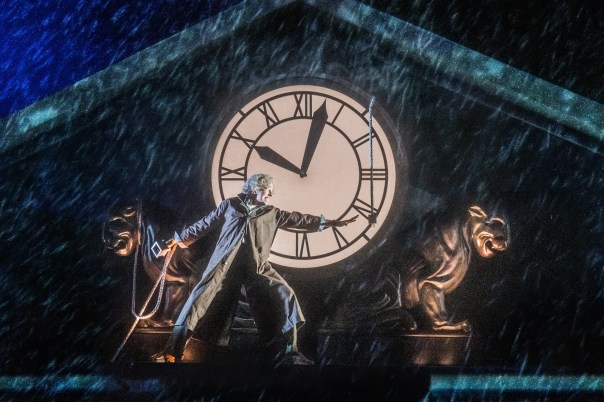
Stolen plutonium fuels the DeLorean in its maiden flight to 1985, but if you don’t already know, it’s Hill Valley and its highest, most visible landmark that powers the kooky, suspenseful journey back. More than 30 years after the box office smash – and a franchise that includes two film sequels, video games, amusement park rides, and a lunchbox – Gale wasn’t going to hand over his story to anyone else when the time was ripe for Back to the Future The Musical.
As fans of the film will soon discover at Belk Theater, Gale’s parental care for his brainchild hasn’t prevented him from tinkering extensively with its workings. Doc’s DeLorean is now equipped with voice recognition, with a smart-ass voice that tells McFly he can no longer change its settings. In other vehicular news, Marty’s grandpa will no longer run into him with his jalopy and the lad’s skateboard usage will be seriously curtailed. Nor is there any traffic onstage from Libyan terrorists, so Marty’s letter to Doc, to be acted upon 30 years later, now has a different safety warning.

The magical family snapshot that Marty carries along with him to 1955, providing useful updates on whether he and his sibs still exist in 1985, is gracefully finessed. No, we can’t see closeups of the photo at the Belk like we could on a big screen, but Doc’s lab is thoughtfully outfitted with an overhead projector so we can track changes on a smaller pulldown screen.
While the telltale snapshot is upscaled, so is the buffoonery of Marty’s dad, George McFly. A conspicuous loser in both time slots, carrying over a Jerry Lewis gawkiness into each, Burke Swanson feasts on George’s timid nerdiness, threatening to steal the show whenever he appears. Next to her clownish husband, Zan Berube suffers some shrinkage in 1985 as Lorraine, Marty’s long-suffering mom, but she conspicuously flowers as the younger teen in 1955, evidently the queen bee of Hill Valley High.
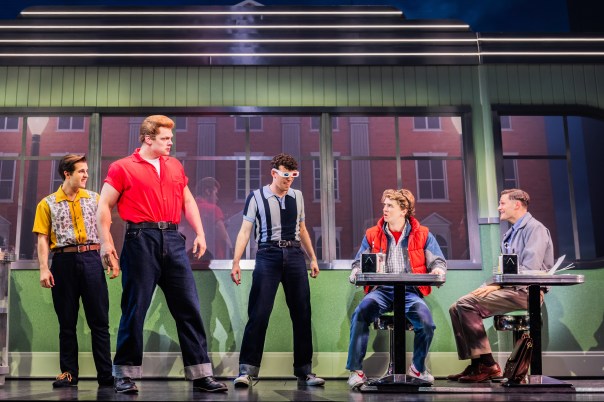
There she is glamorous as the ideal of both George and his nemesis, Biff Tannen*, the town bully – and she is dangerous because she fancies Marty, a mortal threat to the space-time continuum and his existence. Aided by a bodacious Campbell Young Associates wig, Ethan Rogers makes for wonderfully cartoonish Biff, looking like a monstrously morphed Archie Andrews, with flecks of Bluto, Curly from Oklahoma, and The Donald. This Biff ought to be the toast of the town in New York.
With so many delicious distractions – and so many, many, many songs by Alan Silvestri and Glen Ballard – Don Stephenson as Doc and Caden Brauch as Marty struggle to stay at the forefront throughout Act 1, where pacing reaches cruising speed but never really sustains it. We pine, we ache for the DeLorean whenever it’s parked out of sight.
But the payoff for the increased development of Mom and Dad, before and after marriage, lands nicely as Act 2 accelerates to its finale. We’re not assailed with frantic jumpcuts or chases, but so many difficulties and complications remain to be resolved as 10:04pm inches closer at the fateful courthouse clock tower. Before the lightning strikes, hopefully lavishing its gigawatts on the DeLorean at its magical speed, Biff must be thwarted, Mom and Dad – with nothing to build on yet in their relationship – must consummate their first kiss, and Marty must take fond leave of all the key people in his life.
Preferably, with his own survival assured. Then all he needs to do, in the dark of night in a high wind driving his DeLorean at 88mph, is thread a needle at precisely the right moment. Piece of cake.
It’s easy to forget the emotional weight of the film’s relationships and time-traveling farewells 35 or more years after savoring its pulsating adventure, so they all came back forcefully for me on opening night. Although they aren’t Rodgers & Hammerstein, the songs by Silvestri & Ballard mystically magnified that weight – even if I sometimes wished the revving-up sounds of the DeLorean might drown them out.
While his headgear and goggles still brand him as a mad scientist, Stephenson as Doc veers more toward personifying the physicist as a visionary. His vision of the “21st Century” impacts comically as cockeyed optimism rather than eccentricity, and his “For the Dreamers,” an anthem for losers, resonates rather poignantly with the sorry loser futures faced by George and his present-but-unborn son.
Fox’s fidgety acting style, his three little jumps before making an exit – or simply moving – have become avatars for seemingly every leading man on tour or on Broadway in a musical. Those hiccups are intact in Brauch’s embodiment of Marty McFly, punctuated with all his skateboard and DeLorean business, but he also recaptures Michael J’s anguish and urgency as he counsels his own dad on how to be a man. Yes, that’s the knack that Fox brought to movies from his stint on Family Ties, but here the stakes are immensely higher – as high as they can be – in a cosmic comedy!

At times, the time traveling intervention with Dad is cringeworthy. Marty is basically telling Dad how to bed his mom so he can be born. But with music, Brauch can heighten his role from advisor to motivator. Brauch’s powers of inspiration are magnified when he plants idea of running for mayor in the mind of the kid sweeping the floor at the diner where Marty first encounters his dad-to-be (a fine “Gotta Start Somewhere” cameo for Cartreze Tucker as Goldie Wilson).
When he sings “Put Your Mind to It” to Dad in Act 2, Marty must skirt the Scylla and Charybdis of phoniness or peppiness. We don’t want him sounding like huckster Max Bialystock singing “We Can Do It” in The Producers or evoking a Richard Simmons workout session.
So yeah, besides those hops, Brauch also needs to have that youthful brashness we associate with Fox and McFly. Elevating a shallow and tepid rock song into a motivating “We Can Do It” mantra, Brauch pours on all the energy and earnestness needed to make Marty take flight.
Nor does it hurt when the DeLorean levitates.
*No relation

 Art on My Sleeve