Tag Archives: Britney Coleman

Upsized “Immediate Family” Has the Buzz, Needs More Heat

Review: Immediate Family at Booth Playhouse

By Perry Tannenbaum

Anyone who saw the fine Theatre Charlotte production of Lydia R. Diamond’s Stick Fly this past spring can be forgiven if they feel a vague sense of déjà-vu at Booth Playhouse, where a revival of Paul Oakley Stovall’s Immediate Family has been launched with ultra upscale production values by Blumenthal Arts.

Both of these family dramadies are hiding a long-ago infidelity that led to left-out stepsisters, both gatherings may shortly involve two impending marriages, and both center around prosperous Black families about to be surprised by the race of their prospective in-laws. In both, there’s a brother on the brink of publishing or finishing his first novel – and talk of ordering in Chinese food.

Before we discover any of this at Booth Playhouse, there’s the set design of Immediate Family. It is almost the mirror image of the three productions of Stick Fly that I’ve seen on Broadway in 2012, at Actor’s Theatre in 2015, and at the Queens Road barn this May – with stage right and stage left reversed. Both plays were initially presented in Chicago, Diamond’s in 2006 and Stovall’s in 2012.

While there is no blood relationship between Diamond and Stovall, there’s a definite family link between the two most famous exponents of their scripts. As the left-out stepsister in the Broadway production of Stick Fly, Condola Rashad became a breakout star in 2012, and her two-time Tony Award-winning mom, Phylicia Rashad, is now directing Immediate Family for the third time (previously at the Mark Taper Forum in 2015 and at the Goodman Theatre in 2012).

Chicago, LA, and Charlotte. We’re in good company, for Rashad has been on the QC scene tweaking the production while Stovall is also in the mix. The playwright, who was in the national tour of Hamilton as George Washington, was fine-tuning his script as the Blumenthal Arts extravaganza was previewing and gathering media publicity, already extended to September 7 before its official opening. In multiple ways, this run is upsizing the norms of locally-produced theatre.

Previews? Press events? Tuesday, Wednesday, and Thursday night performances? It’s happening. We haven’t seen this much buzz over a local attraction at Booth Playhouse since Charlotte Repertory Theatre was at the height of its ambitions in 2003. Rep planned to take its production of The Miracle Worker, starring Hilary Swank,to Broadway.

Never mind the buzz and, if you’re still pondering Stick Fly, don’t worry about the déjà-vu. Immediate Family has its own story to tell, turbocharged with one big issue that Diamond never addressed.

Still, I’d say that Stovall should definitely bulk up his script – and strengthen his exposition – if he plans to fulfill his Broadway aspirations. For her part, Rashad needs to get more power and sharpness from key players.

All of this proves easier for me to summarize than it was for a press night audience to see and hear. In real time, determining how Evy is related to Tony takes way more time than it should, partly because Evy is bossy – and starchy – enough in the opening scene with Tony to be his mom. Or evil stepmother. And since the fancy Blumenthal Arts playbill departs from the playwright’s practice of listing his characters in order of appearance, you may wind up confusing Ronnie and Evy until intermission. Or beyond.

There are no strangers onstage until after intermission, so everybody in Immediate Family already knows everyone else – as the title implies. There is a next-door neighbor, described as the Bryants’ “play sister” in the script, who could catch up with returning family and new arrivals. To his credit, Stovall introduces her early on in the second scene, conveniently toting in trays of food that she’s cooked up for the rehearsal dinner just as Jesse arrives.

They greet each other loudly enough: “…BLACK FAGGOT!” “…LESBIAN!” But the actors playing Jesse and Nina, Elijah Jones and Kai Almeda Heath, don’t speak nearly as loudly or clearly afterwards, trimming off too much and making it too real for me to consistently understand them in Row H. When Jones and Heath cruised through the siblings’ birth order and legitimacy, it was a blur.

As the inside outsider, Nina becomes a juicy role, so it was a shame that Heath zipped through so many of her sassy one-liners so unintelligibly. That’s a problem that Rashad may have already fixed.

But the more consequential bulking up of the action is unfinished work that only Stovall can do. With their loud greetings after Evy’s first exit, Nina and Jesse foreshadow the big issue that the Bryants will confront before the night is done, one that Stick Fly never tackled. There’s a disconnect that Stovall will expose between the widespread homophobia in the African American community and the prominent roles that gays have played in their cultural heritage.

He needs to do it more often and more aggressively. Ronnie and Evy, who will tangle more heatedly in Act 2, sideswipe the issue of homophobia before intermission. Preparing to teach a summer school class to young Blacks, Evy plans to blow their hip-hop TikTok minds by introducing them to the pillars of their heritage, one inspiring biography at a time.

Malcolm X, MLK, Medgar Evers, Harriet Tubman, Thurgood Marshall, Sojourner Truth, and Booker T. Washington are already written up. So Evy wants Jesse, the best writer in the family, to help her fill out her gallery of 50 Black heroes by completing bios of Rosa Parks, the Obamas, and five more of his choosing.

Ronnie asks for a look at Evy’s list. She scrutinizes the list closely. Where are Langston Hughes and Billy Strayhorn? It’s mostly a list of political figures, Evy responds. And what about Bayard Rustin, who refused to give up his bus seat 10 years before Rosa Parks, and organized the storied 1963 March on Washington?

Cornered, Evy answers frankly that Rustin was arrested on “morals charges” several times. We don’t learn until deep into Act 2 that Evy has problems saying “gay” out loud.

But Ronny can. In fact, she may have undergone a sexuality makeover while Stovall was expanding his original one-act play into its present form. Instead of calling her stepsister on her homophobia then and there, she waits until later to lobby Jesse into sneaking in bios not only of Rustin but also of Langston Hughes, Barbara Jordon, Alice Walker, and Angela Davis.

Jesse deflects when confronted with these gays – only fessing up when Ronnie plays her trump card. Lorraine Hansberry! Evy would kill him, Jesse blurts out: perfectly mirroring Stovall’s own reluctance to confront the issue head-on.

Let’s say it plain. Paul, you’re in the New South now in 2025. Bring it, bro!

I say this all the more boldly because Stovall is already on the record saying that he wants to.

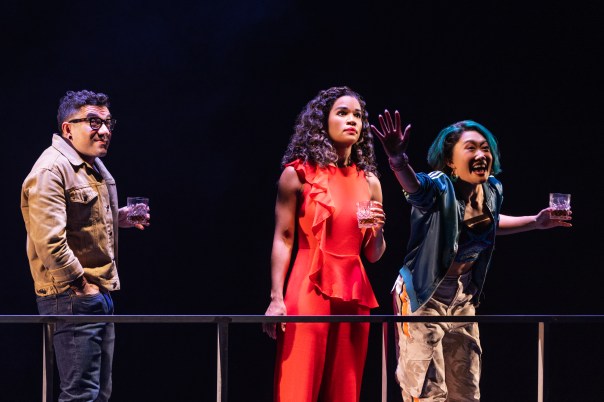
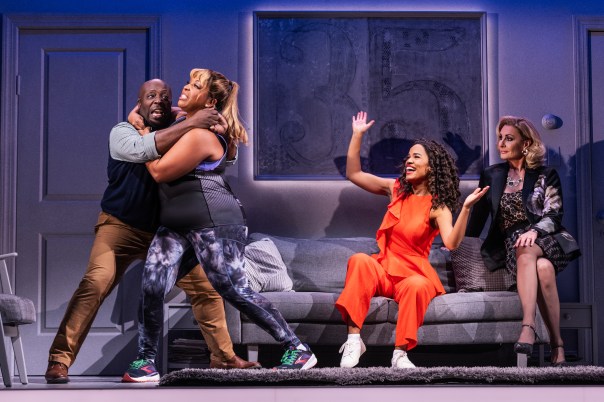
Thanks to Rashad’s casting, there’s plenty more firepower available for both Evy and Ronnie to turn up the heat at the Booth. We love hating Evy almost from the moment the lights come up with all the haughtiness, bossiness, and preacher’s-daughter righteousness that Christina Sajous lavishes upon her. Whether plotting to waken her summer school students or sitting down to a game of bid whist, this is one serious woman. The slow burn she does at the card table is beautifully modulated and explosive.

As hinted earlier, it’s Britney Coleman as Ronnie who gets shortchanged on chances to turn up her fire – though you won’t be at all disappointed when Coleman reaches her boiling point. Not only does Ronnie miss out on a full-frontal assault on Evy’s homophobic pantheon of Black icons, but Coleman doesn’t really get a chance to build grandly to her destructive drunkenness in Act 2. It kind of creeps up suddenly, notwithstanding Stovall’s foreshadowing in Act 1.

Less subtlety, and maybe some comical misdirection, would work better. When Stovall does detonate his denouement, albeit without sufficient build, the effect and the efficiency of his work are breathtaking.

Chemistry between the Bryant brothers could hardly be better. The scene where Jones “comes out” to Tony is simply a gem, with Freddie Fulton as fresh-mouthed to his elder brother as he was to Evy. But Tony doesn’t always come off as the carefree hipster in the family. When Jesse’s partner of three years, Kristian, not only reveals himself as a man but a white man, Fulton aligns with Evy in his disapproval – drawing some of the flak reserved exclusively for her until then.

Andy Mientus’s arrival early after intermission was therefore a litmus test of sorts. Those in the press night audience who gasped at Kristian’s Svedish vhiteness obviously hadn’t opened their playbills and scanned the cast photos. I kinda envied their surprise. Jesse’s difficulties with Evy, specifically his ploy of passing Kris off as the wedding photographer, rightfully test the men’s relationship, so Mientus gets to show us some strength of character as well as wholesomeness.

But Stovall doesn’t stop there. There’s an unexpected late-night scene, one of his best, where Mientus and Sajous are all alone by the bookcase. Nicely done all around.

Blow Out the Candles, Bobbie!

Review: Company at Belk Theater

By Perry Tannenbaum

Fifty years can begin to date and dismantle the most meticulously crafted Broadway musical, let alone one originally stitched together from five unrelated sketches by George Furth in 1970. The gilded thread that made COMPANY shine – enough for Furth to win the 1971 Tony Award – was to be found in Stephen Sondheim’s gorgeous music, wedded to his preternaturally insightful lyrics.

Over and over, the cavalcade of wondrous Sondheim’s songs to be found in the opening act alone – including “Sorry-Grateful,” “You Could Drive a Person Crazy,” “Have I Got a Gal for You,” “Another Hundred People,” and “Getting Married Today,” – have been covered by three generations of the best singers in the business. As for the end of Act 2, the one-two punch of “The Ladies Who Lunch” and “Being Alive,” two sharply contrasted gems, is arguably the best eleventh-hour combo ever seen on a Broadway stage. Affirmation upstages disillusionment – if it can. No extravagant staging required.

But the book of COMPANY has been a perennial liability. On the one hand, it circles modernistically around a single point in time, Bobby’s 35th birthday, and becomes a study of marriage as he seeks to determine whether he wishes to take the plunge or if he’s ready for it. Trouble is, Furth’s story is superficial. Sitcom deep. We get to the end of Bobby’s spiritual journey without any time having elapsed, without any scene impacting profoundly, and without being sure any scene ever really happened outside of Bobby’s head, dreaming or drunk.

Maybe the best way to treat this problem was the 2006 revival starring Raúl Esparza, which nearly dropped the pretenses of scenery and ordinary storytelling completely as the entire cast played multiple instruments throughout the evening. That production of COMPANY, directed by John Doyle, was more about the performers and the music. Yet the communal togetherness of Bobby’s circle and their marital intimacies were somehow deeply enhanced by their playing as well as singing together.

Directing the newest Broadway revival, now on tour at Belk Theater, Marianne Elliott took a bold new tack: diversifying Bobby’s circle, switching genders, and even remaking one of the couples as gay. Bobbie, nee Robert/Bobby, is now emphatically female, portrayed by Britney Coleman – a peripheral cast member in the Broadway production who also understudied Katrina Lenk in the lead role. Opposite the legendary Patti LuPone.

It all plays rather well, though the superficiality of Furth’s book is probably enhanced rather than diminished. The couples that entertain Bobbie are three notches zanier now in Elliott’s hands, so her friends are no longer drole or slightly poignant. They’re more energetic and eccentric. While Bobbie is wondering whether to plunge into the kinds of couplings her friends are modeling, you might be wondering why Bobbie doesn’t shed the whole bunch. Then ditch the boyfriends. None of the three “Have I Got a Guy for You” admirers stands out as a shining knight who might joyously sweep her away.

Coleman’s role, thin enough for a hero to start with, seems to retain her as an observer, but with the zaniness and eccentricity around her amplified, she also comes off as a bit of a level-headed intruder. Less connected to her more diverse circle. Observing the shenanigans, I guiltily felt more distanced as well. Elliott’s update can be a little off-putting.

Most awkward for Coleman are the two scenes that should be the climaxes in her drama. The showstopping “Marry Me a Little” was added by Sondheim at the end of Act 1 to help us see an arc in Furth’s story, as Bobby sang to a woman who had chickened out of marriage on her wedding day – a partial proposal offered as consolation to the would-be bride that becomes a little epiphany for our hero. Coleman belts it now to a balking gay man, a proposal that can’t even be taken as partial.

The situation is even worse when Bobbie confronts Joanne, in the climactic “Ladies Who Lunch” scene. There was some suspense for me on opening night as that scene approached. How would Elliott restage Joanne’s offer? Sadly, the original had more sting.

So what Elliott does best is freshening the 53-year-old musical, making this Sondheim masterwork seem more like a portrait of life today in New York. In a jolly fashion, Bunny Christie’s scenic design literally belittles the Big Apple’s pretensions, cramping Bobbie into a living room so small that there’s barely enough room for her to squeeze around the wee dinner table. Crouched down with their assorted gifts, waiting to spring their surprise birthday greetings as Bobbie enters, the cheery circle of friends is like a molten mass with barely enough room to breathe.

This image has an empty alt attribute; its file name is 0147-james-earl-jones-ii-as-harry-kathryn-allison-as-sarah-britney-coleman-as-bobbie-and-judy-mclane-as-joanne-in-the-north-american-tour-of-company.-photo-by-matthew-murph.jpg

Other apartments we see are similarly drab and confined. On the first of Bobbie’s excursions, she visits Kathryn Allison as Sarah, on a strict regimen of exercise and dieting, and James Earl Jones II as her husband Harry, nervously on the wagon. As the couple’s verbal jabs at their mate’s failures at abstinence hit home, escalating into physical martial arts combat, the mid-lifers have nowhere to safely collapse when they’re exhausted other than their couch – on top of their hapless guest.

The scene is a fertile launching pad for “The Little Things You Do Together,” triggered by Judy McLane as Joanne before other couples incongruously intrude – from multiple doors, including Bobby’s little apartment, attached to her hosts’ like adjoining hotel rooms. Of course, Jones II has a marvelous voice as he triggers “Sorry-Grateful,” incongruously joined by two other husbands as the scene fade-dissolves, but his range is higher and his timbre mellower that you might expect. Allison is a very zestful and complementary comedienne onstage, likely unapologetically anti-diet in the real world.

Despite the somewhat clunky aftermath – and Coleman’s inability to be on hand anymore as the couple’s best man – Matt Rodin as Jamie (nee Amy) and Ali Louis Bourzgui as Paul, still on the precipice of marriage, are the most charming and hilarious of all the couples. It doesn’t hurt that Christie’s scenic design reaches one of its zeniths with the couple’s cheery kitchen. Christie’s most radiant Act 1 costume design is reserved for Emma Stratton as The Priest, making her most surreal entrances into “Getting Married Today” through the French doors of the fridge.

A faulty electrical cord sabotaged opening night at Belk Theater, pausing the action twice before intermission so that circuits could be checked and restored. Blumenthal Performing Arts prez Tom Gabbard not only apologized to the crowd but staged an impromptu Q&A with two of the stars, McLane and Tyler Hardwick, who played PJ, the grungiest of Bobby’s frustrated admirers. Soon to excel in “Another Hundred People,” Hardwick charmingly refused to disclose his favorite moment in the show.

Thankfully, everything was shipshape for Act 2. This Charlotte audience stayed with it.

McLane acknowledged that she was following in the footsteps of megastars as Joanne, including the likes of Elaine Stritch, Lynn Redgrave, and LuPone. She wasn’t at all self-effacing as she answered, and she grandly met the challenge of her biggest moment, delivering “The Ladies Who Lunch” with a lounging crescendo of decadence. Draped in another smashing, glittering getup from Christie, McLane personified New York vogue in all its Fifth Avenue complacency. That in turn laid down the gauntlet to Coleman, who belted “Being Alive” out of the park.

Then, on her fourth or fifth attempt, she finally blew out Bobbie’s birthday candles.

B’Way “Beetlejuice” Messes With the Franchise Mojo – Design to the Rescue!

Review: BEETLEJUICE at Blumenthal PAC

Beetlejuice-2By Perry Tannenbaum

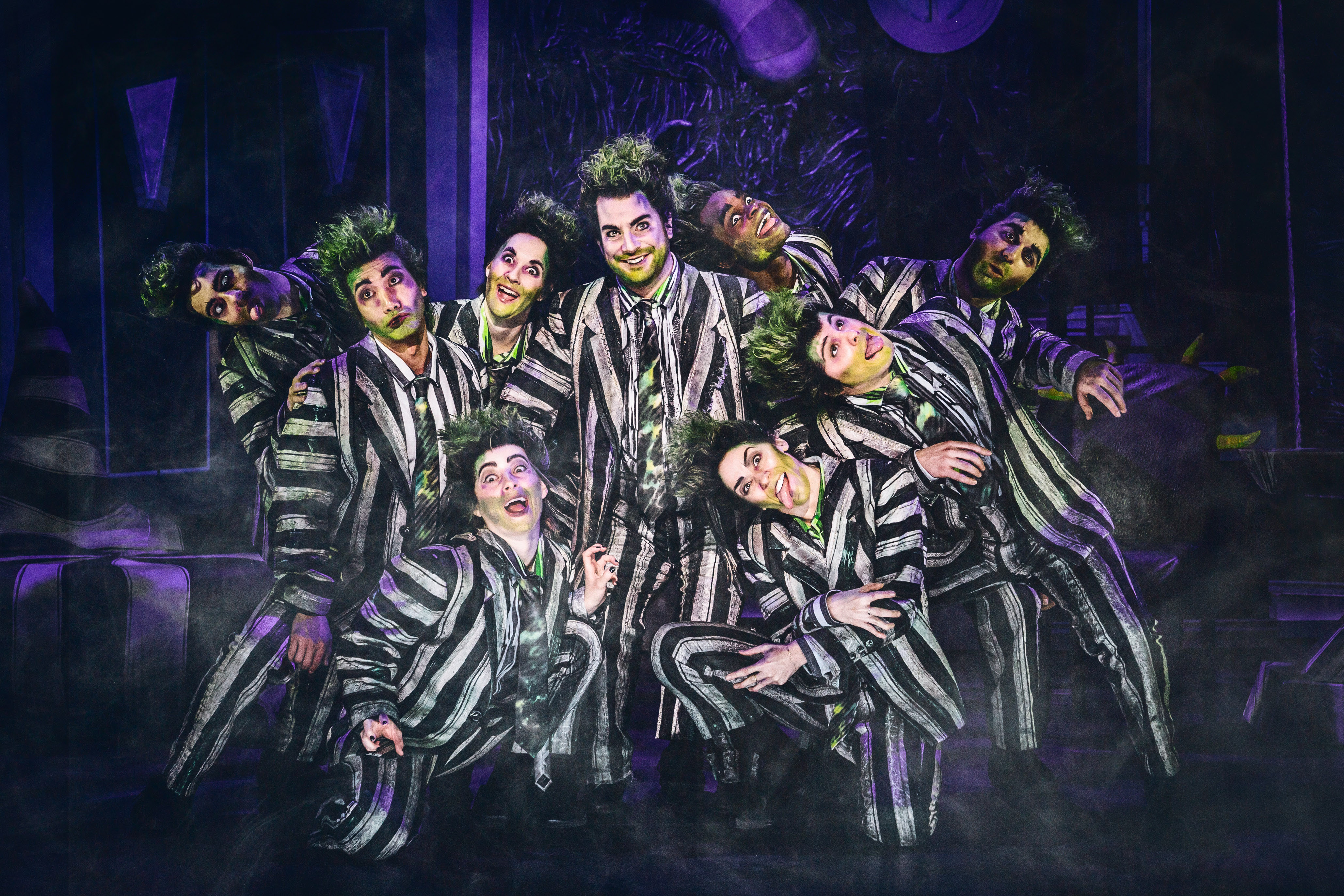
Prepare yourself for an onslaught of ghoulish purple – and wicked green! The Broadway Lights series was fiendishly lighting up Belk Theater for its first opening night there in 2023. No less than 29 purple and green spotlights are arrayed around the proscenium, the box seats, and the balcony. Some of them swivel and sweep around the hall like a bat signal, periodically slapping you between the eyes and blinding you. Twenty more LED arrays – guess what colors! – frame the stage, blinking ominously.

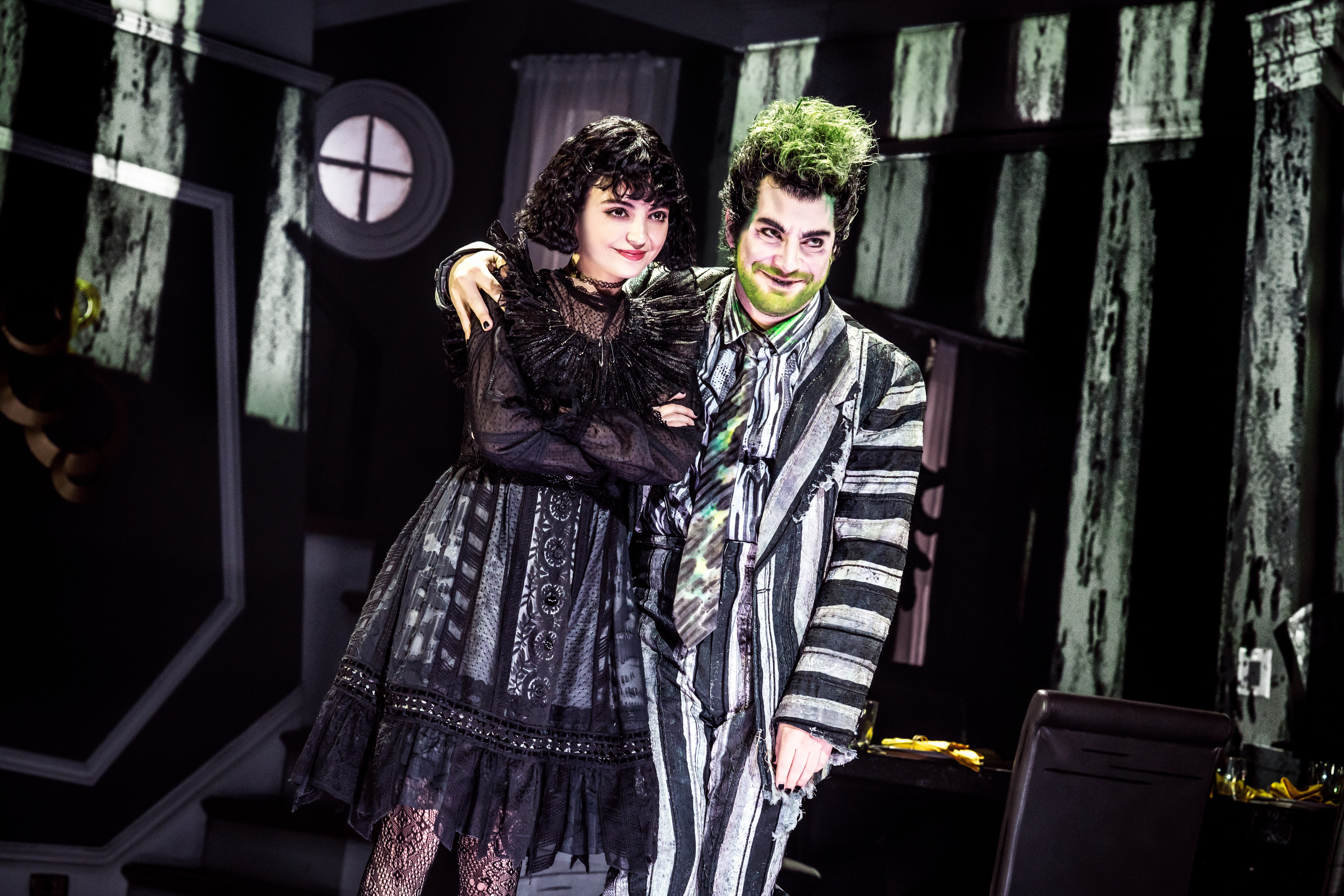
Organ music broods in the background, its Gothic drone abruptly halting for the BIG BANGS, two mighty jump scares that launch each of the two acts of Beetlejuice The Musical. Meanwhile, your helpful Encore playbill sports a different design scheme on its cover: black and white. Not a biggie, true, but lurking all around you, dressed in cosplay creations, are human echoes of the demonic Betelgeuse and his most famed and formal prison-striped suit. Complementing these parolees, waifs of all ages were sporting all-black ensembles such as those favored by Lydia Deetz, the title groom’s funereal bride-to-be.

Yes, I’d say somewhere around 10% of the Belk crowd on opening night were not merely pre-sold on the infernal nectar of Beetlejuice but also eager to proclaim their membership in its cult following. Scott Brown and Anthony King knew their audience well when they overhauled the 1988 screenplay that director Tim Burton wildly accessorized.Beetlejuice-9

Both the Betelgeuse role played by Michael Keaton and Winona Ryder’s Lydia have been hugely enlarged. Instead of standing in the wings (or camping underground), on-call until Barbara and Adam Maitland die and become desperate ghosts, Beetlejuice is our emcee, ingratiating himself with the audience moments after the curtain rises with a steady stream of shticks, topical references, wisecracks, and personal insults flung out to the audience. Or Justin Collette tries – oh so hard in his makeover of the Keaton portrayal, ululating his tongue when all else fails.

That obnoxious appeal can be hard to sustain when the meddlesome Bee is invisibly urging the wholesome and liberal Maitlands to electrocute themselves. Don’t remember that from the movie? Brown and King keep all their action indoors – or on the haunted house’s roof – after the opening funeral scene.Beetlejuice-11

You won’t see that scene in the movie, either. Here the graveyard scene begins to layer on new grieving and suicidal dimensions to Lydia’s familiar goth couture, establishing a new gravitas for the troubled teen. In the wake of Mamma Emily Deetz’s death, Lydia also acquires a seething Hamlet-like bitterness as she, Daddy Deetz, and his wanton fiancée Delia move into the Maitlands’ quaint country home. The sequence of events is painfully compressed here, and Lydia isn’t merely plagued by a goofy, artsy stepmother.

Since they haven’t tied the knot anymore, this is more of a betrayal and an abandonment by Daddy Charles and an opportunistic intrusion by Delia. Of course, this is a gift to Isabella Esler, who gets more of the spotlight here as Lydia and has more substantial woes to bewail in her interactions with the friendly Maitlands – more angst and yearning to belt in the punk ballads written by Eddie Perfect, most notably “Home” and “Dead Mom.”

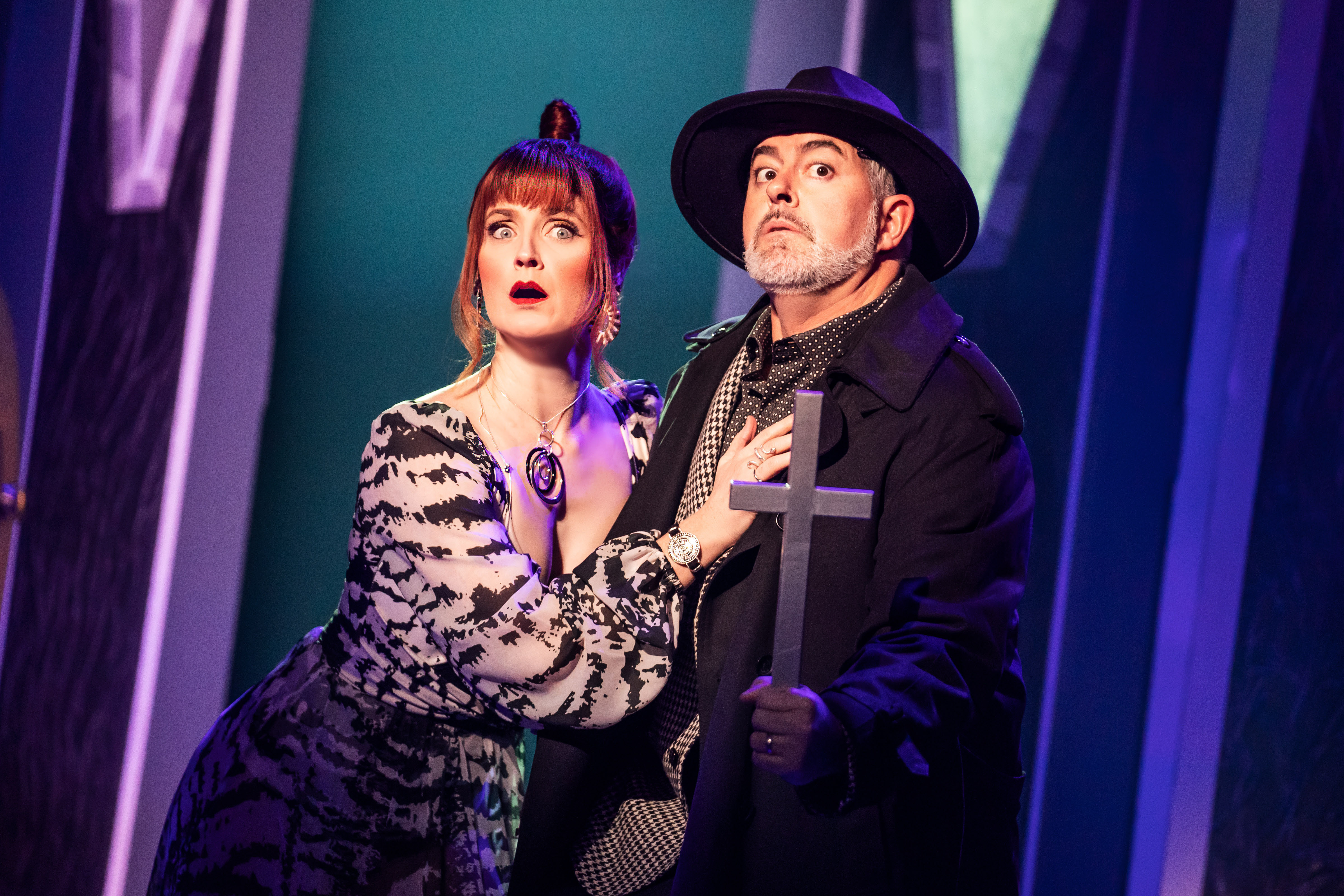
Grievance and energy have noticeably shifted away from the rookie Maitland ghosts, played by Alec Baldwin and Geena Davis in the film. Picking up on the opening shots of Baldwin, where Adam meticulously picks up an invading spider and liberates it through his attic window, Perfect expands the Maitlands’ bleeding-heart reverence for life to the point of absurdity, demonstrating in “Fright of Their Lives” that they wouldn’t hurt a fly, much less haunt a house.

That’s likely Perfect’s best lyric, proving that the Maitlands are the neediest of the needy for Betelgeuse’s services as a “bio-exorcist.” Britney Coleman and Will Burton are so successful at convincing us of their air-headed ineffectuality that even devout Beetlejuice fans will be hard-pressed to care about whether they ever achieve their ghostly aspirations. Saving Lydia from herself and ridding the home of B-Juice become the top priorities.

Not that the elder Deetzes are any more repellent than their celluloid counterparts. Jesse Sharp actually projects a Raymond Burr-ish respectability as Daddy Charles, but even as Kate Marilley outshines him as Delia, getting her teeth into a couple of new songs, she’s no less kookie than Catherine O’Hara was, just oddly more salacious as she swaps professions, becoming a cliché-spouting life coach instead of a sculptress.Beetlejuice-1

With the diminished importance of the Maitlands and the constant pesky presence of Collette as Beetlejuice, further detaching our involvement with the story by breaking the fourth wall over and over, this horror-themed musical comedy might devolve into irredeemable silliness. Certainly, Perfect’s score doesn’t help Brown and King’s update.

Design to the rescue! However you might react to the film’s storytelling, which also implicated Robert Goulet and Dick Cavett in cameo visits, Burton’s comedy-horror stew was a visual wow, with touches of Disney, Dali, Hitchcock, and Edward Gorey. Onstage at Belk Theater, we behold an orgy of scenic, costume, lighting, makeup, wig, and projection design – augmented by magic, SFX, a special illuminated edition of The Handbook for the Recently Deceased, and puppets. Fear not, the pinhead guy we encountered in Tim Burton’s netherworld has not been left behind.Beetlejuice-6

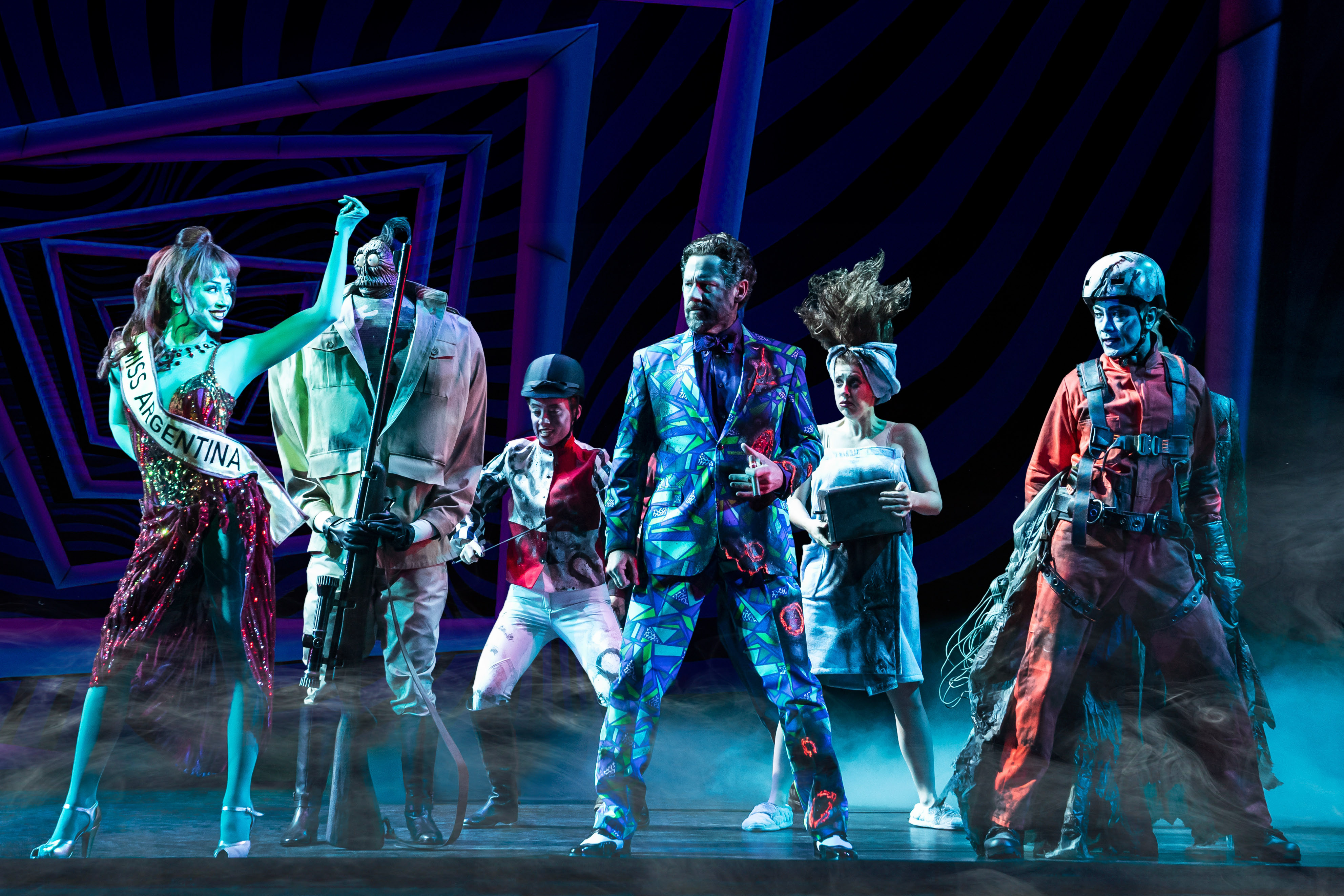
Although we must tolerate the tasteless intrusion of an NPR tote bag, we still get the zany “Day-O” possession via Harry Belafonte, our colossal man-eating sandworm, and a free consultation with Juno in hell, featuring a surprisingly frumpy Karmine Alers in the role previously graced by Sylvia Sidney onscreen. While we’re down there, we get to see how Beetlejuice The Musical producers added fresh Carmen Miranda spice to the 2022 Broadway remount of their COVID-stunted 2018 gumbo, when they upsized the role of Miss Argentina, now shaken and shimmied by Danielle Marie Gonzalez.Beetlejuice-4

Miss Argentina’s skimpy attire, one of local legend William Ivey Long’s many bizarre and resourceful creations, cues a startling alteration in the overall color scheme. Wicked and Emerald City may be eternally green, but once Lydia returns from the realm of the dead, there are startling infusions of fiery red into the décor, including the spectacularly gauche formalwear that Beetlejuice and Miss Deetz sport for their nuptials.

It all added up to complete delight for pre-sold Tim Burton worshipers, whose enthusiasm after the calypso finale tallied even higher dB readings than those jump scares. All was foreseen by the wizards of Blumenthal Performing Arts, who announced the return of Beetlejuice – for the Christmas vacation! – the morning after opening night.