Tag Archives: Brian Lafontaine

“The Play That Goes Wrong” Fits Perfectly at The Barn

Review: The Play That Goes Wrong at Theatre Charlotte

By Perry Tannenbaum
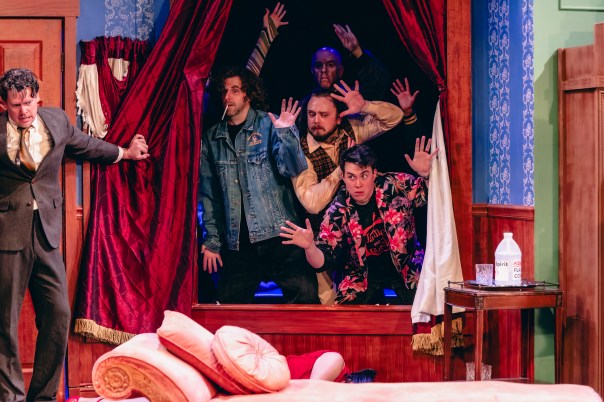
Every time Inspector Carter declares his determination to solve “The Murder at Haversham Manor,” lights at Theatre Charlotte suddenly turn a lurid red to triple-underline the melodrama. This may be the only technical element that consistently goes right in The Play That Goes Wrong, now running – and decomposing before our very eyes –through February 23.

The mantelpiece over the fireplace in Charles Haversham’s study remains a work-in-progress long after the master is murdered. The painting above the mantle – clearly the wrong painting – doesn’t stay where it belongs, and a pesky door stubbornly resists efforts to unlock it when it isn’t wandering off its hinges. In similar disrepair, we may count the phone, the intercom, the elevator leading up to the second-floor office, and the walls themselves.

It is a precisely flimsy set, lovingly put together by Theatre Charlotte artistic director Chris Timmons, so precisely flimsy that it must conform to approximate dimensions to accommodate the cast. So active that the set predictably won the Tony and Drama Desk Awards for best scenic design in its 2017 Broadway debut. Like Michael Frayn’s famed Noises Off, another British play-within-a-play that goes comically wrong and wronger – but on a stage that revolves a full 180ᵒ – the set is like a machine. It could be packaged like an Ikea kit.

Written by Henry Lewis, Jonathan Sayer & Henry Shields, The Play That Goes Wrong nestles more naturally at the Old Queens Road Barn than at Knight Theater, where the national tour touched down in the QC six Novembers ago. The basic concept is that a small-time community theatre, perennially understaffed and underfunded, has suddenly received a grant that will finally enable it to present a full-fledged production.

No longer will Chekhov’s classic Three Sisters be reduced to Two Sisters at the Cornley University Drama Society. Nor will Lloyd Webber’s resplendent Cats be shrunk to Cat. It’s the birth of a new era!

But unfortunately, the new era hasn’t ushered in an influx of fresh acting talent and technical know-how. Dennis struggles with her lines and usually mispronounces the tough words written on her hands. Jonathan repeatedly re-enters the action before he’s supposed to. Sandra has an unfortunate knack of being in the wrong place at the wrong time; and her understudy, Annie, after subbing for Sandra when she’s knocked unconscious, reads terribly. Yet she refuses to yield back her role when Sandra revives.
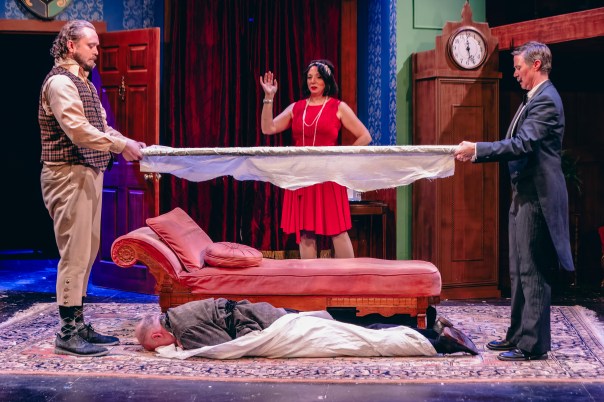
Props aren’t reliably placed in their assigned locations by the incompetent crew. When they are properly placed or deployed, like the stretcher needed to carry the corpse through the finicky front door, they may not function properly. The Duran Duran CD, sought after by lighting-and-sound man Trevor before the play begins, will turn up inconveniently onstage deep into Act 2.

Which reminds me: even though those redlight cues are absolutely reliable, the portentous sound cues accompanying them are not.

Tonya Bludsworth directs all this carefully calibrated chaos with an able assistant director, Brian Lafontaine. Together, they and Brandon Samples as Chris bring out a key point that didn’t strike home for me as forcefully when I saw the touring version in 2019. Chris not only plays the plum role of Inspector Carter in The Murder at Haversham Manor, but he also serves as the stage director, prop maker, box office manager, and PR rep – totally responsible for this catastrophe, and obviously overstretched.

On the smaller Theatre Charlotte stage, Samples is closer to us and we can focus on him more sharply than if his flop sweat were dripping down at Knight Theater. Makes a difference when one protagonist seems to be especially invested in the worsening outcome, valiantly trying to cover up the metastasizing miscues, and gaping at the sheer scale of his own mismanagement and incompetence.

For me, Sample’s visible struggles – from his nervous shit-faced grins on up to his hissy fits – made Chris a little more poignant for me. Here is a man who cares so much about theatre, and he’s watching all his multiple shortfalls in artistry and management implode so spectacularly. We can feel for the rest of this woeful team, but not nearly as much.

Lee Thomas earns a distant second place in our sympathies just for the physical punishment he takes as Charles Haversham, the stepped-on, sat-on, and mishandled murder victim. Or for the dismal ratio of abuse absorbed to dialogue delivered. When he finally does speak, maybe for the first time at Theatre Charlotte since 2020, it is as an actor of mind-boggling incompetence, eclipsing nearly all of his castmates. Thomas is rather good at looking quietly embarrassed, confused, and discombobulated.

Jenn Grabenstetter as Sandra starts off in a sympathetic slot, cast as Florence Colleymore, the murder victim’s bride-to-be. Our empathy for her slackens when we learn that Charles’s brother, Cecil Haversham, is Florence’s true love. Or when we see how stylized Sandra is as a performer. Or when she skips ahead one line, answering Inspector Carter’s questions before he asks them. But we feel for her – a little bit, anyway – when the front door flattens her and her castmates prop her up inside a clock. When Florence revives, she has to battle Annie to reclaim her role with some fine screwball fight choreography by Allison Collins.

The character arc for Rachel Mackall as Annie is even more transformational, for her Florence starts off in a near-catatonic monotone until she does the first of her pratfalls, scattering the pages of her script and maybe dislodging a contact lens. That raises Annie’s energy level, leading to the subsequent miracle where, battling Grabenstetter for the spotlight, she suddenly has her lines memorized while becoming a vicious gladiator.

More WWWF-style action would not have been amiss, but there’s still plenty.

Like Selsdon in Noises Off, Dennis’s prime reason for existing in The Play That Goes Wrong is to roundly muck things up. Lewis, Sayer & Shields seem to be indicating that he’s inept, miscast, or over-the-hill. What the hell, Bludsworth casts a woman in the role, the venerable Andrea King, who may have actually portrayed more women on QC stages than men and describes herself like a cute puppy for sale in the digital playbill.

With so much incompetence surrounding the Haversham Murder production, it’s a bit cruel to arraign her as the sole culprit for substituting turpentine when a decanter of adult beverage is served to guests at the Manor. Or it is when that happens for the first time. It’s on her when the screwup is repeated, sparking a prolonged series of spit-takes because she has also forgotten a line that would propel the action forward instead of casting it into a never-ending loop.

King maintains a cheery insouciance no matter what kind of havoc she causes, enabling Cody Robinson as Robert to become king of the spit takes as the bride-to-be’s brother, Thomas Colleymore. With a preternatural Joe Belushi energy, Robinson demonstrates that Robert’s distaste for “White Spirit” can actually increase with each sip! When we think Robinson’s frustration and rage have peaked or even exceeded expectations, he still turns it up a couple of notches.

Adam Peal as Robert and Roman Michael Lawrence as Trevor fill out the roster of actors implicated in the murdering of The Murder at Habersham Manor. Robert is not only amateurish but also a carefree hambone, so naturally Chris gives him two roles to botch. Initially, Peal appears as Cecil Haversham, Charles’s scheming brother and Florence’s true love. But there’s more to butcher when Robert resurfaces as Arthur the gardener, laying on some eyewitness evidence.

Did I mention that Trevor, after losing track of his Duran Duran treasures, must abandon his functions as lighting and soundman when Annie, replacing Sandra, is also stricken? That script-scattering pratfall was just the beginning of her misadventures. While Lawrence has already shown us – and will continue to show us – how badly Trevor performs at his chosen specialties, we can brace ourselves for his slaughter of Florence Colleymore, postponed only by his reluctance to play the role.

On my second viewing, it was possible to pay more attention to the convoluted mystery plot by “Susie H. K. Brideswell.” Now I can confidently proclaim that Habersham Manor is a masterpiece of implausibility. Doesn’t work at all.

Woefully, Theatre Charlotte doesn’t seem to have experienced a financial windfall that parallels Cornley University’s. That would have enabled them to append a faux playbill for the Habersham Manor production to the conventional Play That Goes Wrong program. Then we could learn the last names of the players and the Habersham roles they play with less fuss and bother. A few tidbits about the players also enriched the experience of the touring production.

Apparently, when the playwrights founded their Goes Wrong franchise (Peter Pan and The Nativity are among the spin-offs), they must have been focused on crafting three of the roles for themselves to perform in London and Broadway – and meshing with Nigel Hook, their mad genius set designer. So they didn’t insist that their faux playbill must be printed to accompany the show.

That lack of detailing serves to emphasize where The Play That Goes Wrong doesn’t measure up to Noises Off! Frayn’s work fleshes out relationships between the actors onstage when they’re backstage and, with its first-act rehearsal scene, gives us a more vivid idea of how the play-within-a-play is intended to go. For that reason, despite all the hilarity that Lewis, Sayer & Shields deliver, I’d hesitate to recommend The Play That Goes Wrong to anyone who is new to theatre – or hasn’t experienced a play that goes right.

But for sheer fun in frightening times, this show is welcome medicine for everyone else. TikTok & Friends may have brought nostalgia for America’s Home Videos to a screeching halt, but this latest romp at the Queens Road Barn revives the special pleasure – and laughter – of similar train wrecks large and small running right at us, non-stop, on a live stage.

Joe Turner’s Come and Gone, directed by Corlis Hayes, last came and went at Central Piedmont Community College in 2015. Back then, the production demonstrated how ill-suited even a renovated Pease Auditorium was for the best of August Wilson’s dramas. Panoramic Pease has now been demolished, so it will be interesting to see Hayes come back again to the CP campus, along with Jonavan Adams reprising his role as Herald – at a real theater in the fledgling Parr Center. Dominic Weaver, also in the mix ten years back, gets a juicier role this time as Bynum, the conjuring root doctor.

Turner, the second play in Wilson’s decade-by-decade traversal of the 20th century, The Pittsburgh Cycle, is set at a Pittsburgh boarding house in 1911. Rather than hinting at WW1 later in the decade, the drama hearkens back to slavery, the Civil War, and their aftermath, both glorious and sad.

“Every character has a story, and every story has a song,” says Hayes. “The play explores African American identity, healing from trauma, and the power of community and self-discovery. More significantly the play is an examination of Black people in transition during The Great Migration.”

This weekend only!

Climb Aboard a Retro Laugh Riot

Review: A highly animated Odd Couple revival with a professional-grade cast

By Perry Tannenbaum


IMG_2229

With the benefit of hindsight, we can see more clearly that Neil Simon and his esteemed stablemates – Woody Allen, Larry Gelbart, and Mel Brooks – who all wrote for Sid Caesar during the early days of television, didn’t simply disperse into the realms of stand-up, movies, and theatre for the obvious practical reasons. Autonomy, fame, and fortune were surely enticing, but so was the satisfaction of working in longer forms than TV sketch comedy or a star comedian’s monologues.

Come back to The Odd Couple – or revisit Bananas and Zelig, A Funny Thing Happened and Tootsie, The Producers and Blazing Saddles – and we see a mature writer working beyond the limitations of zany characters and snappy one-liners. Simon develops his Oscar and Felix, tells a full-length story about them, and keeps the hilarity going. Entering Theatre Charlotte, where Jill Bloede is directing a highly animated Odd Couple revival with a professional-grade cast, I wasn’t thinking that I’d be seeing this old cash cow so freshly.

Somehow the difference between this 1965 comedy and TV sitcoms of the same era – including the spinoff Odd Couple sitcom that came to ABC in 1970 – suddenly seemed rather radical. The cardinal rule for most 22-minute sitcom writers back then was to hit the reset button at the end of each episode, so that next week’s episode would start out as if this week’s had never happened. On Broadway, you could expect the uptight, neurotic, neat freak Felix to wear out his slovenly pal Oscar’s patience by the time the curtain came down. On TV? No way. Felix made himself at home in Oscar’s Manhattan apartment for nearly five seasons.

IMG_2222

Many in the sold-out house at the Queens Road barn on opening night were struck even more freshly by Felix, Oscar, their poker-night buddies, and the neighboring Pigeon Sisters. Unless the younger people in the house had been hooked on the Matthew Perry reincarnation of the sitcom during 2015-2017 on CBS, they likely hadn’t run into much Simon or Oscar in their lifetimes. I was a little taken aback when I came home, double-checked, and found that I’d only seen Odd Couple once in Charlotte during the last 30+ years, back in 2007 at CPCC.

On the other hand, this comedy staple had been quasi road-tested at Theatre Charlotte when the Female Version – with Florence, Olive and a klatch of Trivial Pursuit-playing women replacing the poker buddies – dropped by in the summer of 2012. Bloede also directed then, an overachievement that certainly warranted her current return engagement.

Whether it’s Lady Bracknell or Lucy Ricardo, Bloede knows her comedy, and she has prospected long enough in Charlotte to be able to mine its finest talent. Doesn’t look like she had to twist any arms, either. For her Oscar, she landed the most experienced Simon exponent in town, Brian Lafontaine. Breaking in to Charlotte theatre in 1992-1994, Lafontaine played leads in three of Simon’s comedies, Brighton Beach Memoirs and Biloxi Blues on Queens Road – and Lost in Yonkers at Charlotte Rep.

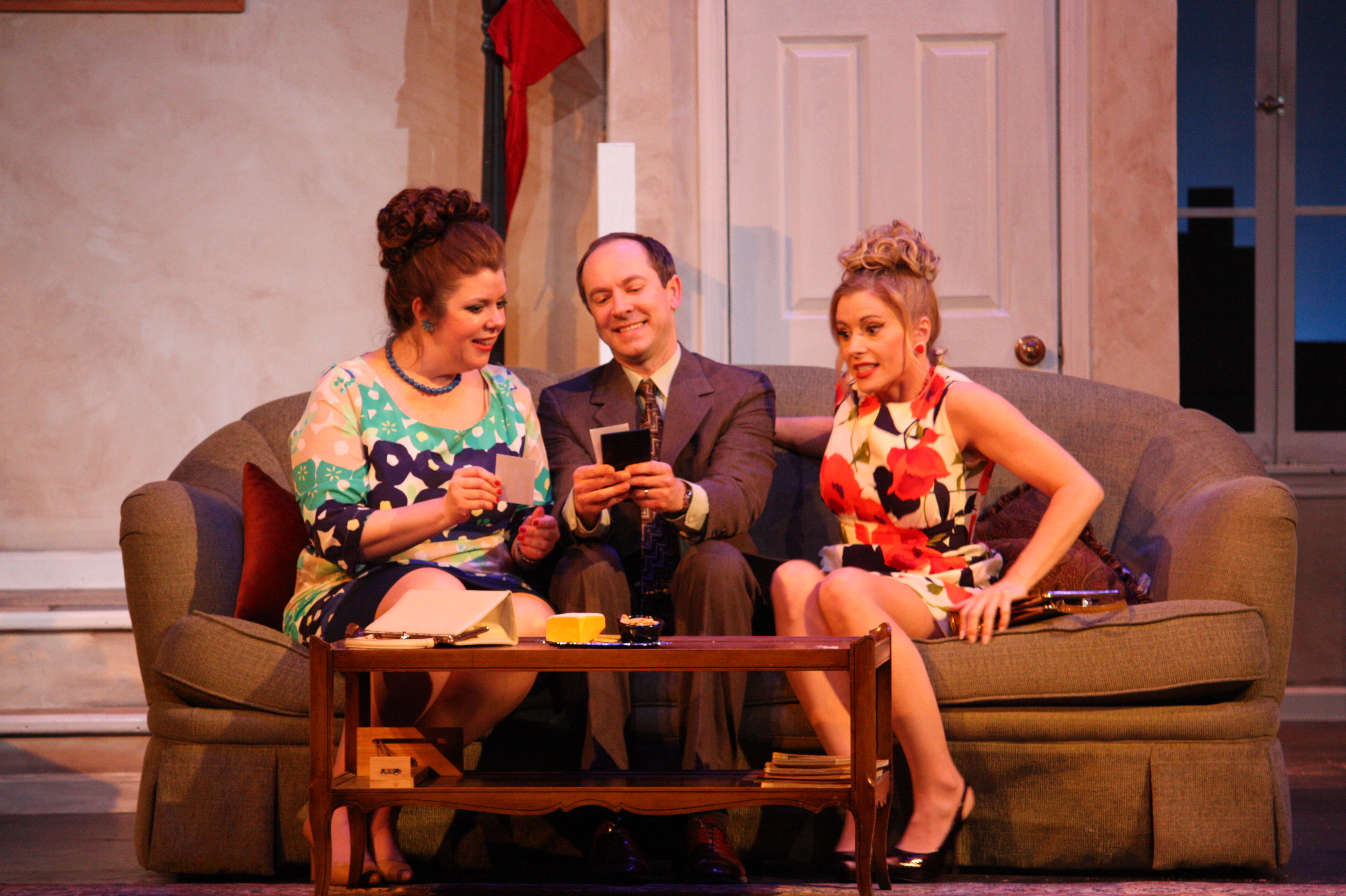
Bloede goes edgier and high-energy for her Felix with Mark Scarboro, who first carved out his eccentric niche in 2001-02 with standout performances in Thumbs, The Pitchfork Disney, and Fuddy Meers. Yet Bloede has Lafontaine playing the 43-year-old Oscar with more energy than I’ve ever seen from this slovenly New York Post sportswriter. If she’s going to turn Scarboro loose to be as anal, neurotic, outré, and irritating as he can imagine Felix to be, then she’s returning the favor to Lafontaine and turning him loose to be as irritated, provoked, and out-of-control as he can imagine a devout 44-year-old slob can be.

No less pleasurable is the build-up to Felix’s first entrance. That’s because Bloede has a deep bench sitting around Oscar’s dining room poker table, supporting her stars. If we’re returning to Odd Couple, we’re likely surprised to find that Felix isn’t going to show up until we’re 17 pages into the script. Even Oscar isn’t onstage at the outset in his own apartment! Simon’s poker preamble steadily stokes concern for fragile Felix’s welfare in the wake of his breakup with his wife, but there’s already hostility and comedy shtick at the table before the two marquee combatants show up.

Just watch Michael Corrigan and Patrick Keenan at work, sparring as Murray and Speed, and you’ll see that Bloede has selected a second comedy team for us to revel in, very much in the same Felix-Oscar, Laurel-Hardy template. Decades ago, when Corrigan was younger and slimmer, he tended to remind you of Tim Conway. So the particular quirks of Murray the policeman come to readily to Corrigan, his exasperating slowness in shuffling cards and his alarmist reactions to any new news about Felix. Keenan is the master of the slow burn and the bellowing explosion, repeatedly supplying perfect exclamation points to punctuate the comedy.

Tall and lanky Matt Olin is the perfect choice for the spineless Vinnie, the guy Murray and Speed can both agree to pick on, the dutiful husband who submits to his wife’s curfew, and the man who deeply appreciates Felix’s sissy sandwiches. Meanwhile, Lee Thomas continues to ply his teddy bear charm as Oscar’s diffident, occasionally witty accountant, Roy.

IMG_2270

If you’re worried that Bloede might be taking PC pains to update the Pigeon Sisters and present them as more evolved, rest easy. Vanessa Davis as Gwendolyn and Johanna Jowett as Cecily stay true to their origins, Davis the flirtier sister and Jowett the more empathetic bleeding heart. Set designer Rick Moll, costumer Yvette Moten, and sound designer Rick Wiggins have all climbed aboard Theatre Charlotte’s retro train. With a soundtrack that includes James Brown, Petula Clark, Jack Jones, Herb Alpert, and The Shirelles, Bloede and her all-pro cast are bent on taking you back to the ‘60s, like it or not. I’m betting you’ll like it.

High-Grade, Homegrown and Professional

Preview:  Three Days of Rain

By Perry Tannenbaum

Maybe you’ve noticed: since the beginning of September, there has been an abundance of high-quality, homegrown and professionally crafted theatre productions around town – from new or returning companies as well as the usual suspects. Brand New Sheriff ignited the upswell with Jitney, the best drama of the year, and the drive continued with scintillating efforts by donna scott productions, OnQ Performing Arts, and The Playworks Group.

And that was just during the first three weeks!

3Days-ART[8]

Within the next two weeks, Actor’s Theatre unveiled a fiery American Idiot, PaperHouse Theatre trailblazed at the Goodyear Arts Center with The Revolutionists, and Children’s Theatre outdid themselves at ImaginOn with a high-flying Mary Poppins. Three Bone Theatre has sustained the seasonal glow with Fahrenheit 451 and the Actor’s Theatre encore, Hand to God, was merely better than the Broadway production.

You have several more chances to experience professional-grade excellence in local theaters before the winter solstice, including reprises by Chickspeare, OnQ, Children’s, and Actor’s of holiday faves. But if you’re itching to get a taste of the grassroots fervor that has gripped the Queen City throughout the fall theatre season – and escape the oncoming blizzard of Christmas repeats – your only choice is to check out Charlotte’s Off-Broadway.

Gestating at the Warehouse PAC up in Cornelius for the past five years in storefront productions, Charlotte’s Off-Broadway is staging an Uptown rebirth with the Metrolina premiere of Richard Greenberg’s Three Days of Rain. For founding producer Anne Lambert and her company, it’s their first presentation at Spirit Square since 2005 – and their first Actors’ Equity production ever.

Lambert isn’t coy about what she hopes will begin sprouting from all the recent professional grassroots action around Charlotte this season – a professional company with the same regional status and prestige that Charlotte Repertory Theatre had before it folded in 2005.

“Yes,” says Lambert, “I do see Three Days of Rain as a project that represents the beginning of a concerted effort to lift Charlotte’s Off-Broadway to a new level, to impact the city’s theatre scene and, yes, to move Charlotte closer to re-establishing ourselves as a logical home for a LORT (League of Resident Theatres) company.”

It begins by consistently producing high-quality shows that the community will continue to come out and see – and continue to hit their wallets and support. Butts and bucks. Part of the push on Lambert’s side is signing Equity contracts with her actors so that they are all treated and paid according to union standards. Two of the three Equity players, Caroline Bower and Brian Lafontaine, are longtime Charlotte favorites.

Lafontaine is also co-producing. He and Lambert last collaborated in 2003 when he acted in The Hotel Project, a pair of one-acts produced by Lambert and Matt Olin while they were, respectively, director of development and managing director at Charlotte Rep during its sunset years. More recently, Lambert and Lafontaine have been attending Creative Mornings, a monthly happening for Charlotte creatives organized by Olin and Tim Miner.

The old mojo began to work again during the supercharged meet-ups. Three Days of Rain was among the scripts that Lafontaine had brought with him from New York when he moved back to Charlotte. He was at a point in his career where he was thinking about producing a show that he wanted to do – at a professional level.

“Anne had told me if I ever wanted to get a show produced, she could get it done for me after we had worked together on The Hotel Project,” Lafontaine remembers. “I know how passionate she is, and how capable she is. She loves theater. She loves actors, and she loves contributing in any way that she can to the artistic community in Charlotte. She’s an incredible partner. There’s no way this would be happening without her.”

There was a notorious Broadway run of Three Days of Rain back in 2006 starring Julia Roberts, so Lambert had heard of the script when Lafontaine brought it to her. But she hadn’t read it. Months of discussions culminated in opting for the Greenberg play.

“It’s a well-written, Pulitzer Prize-nominated script,” Lambert stresses. “It’s sophisticated, it’s funny, it’s compelling, and it’s mysterious, full of Easter Eggs that reward the attentive audience member. It has six completely beguiling characters. I’m excited by the device of the dual roles, where the actors we see portraying Walker, Nan and Pip in Act 1 turn around in Act 2 and play their parents. These three talented actors in our show are so adept, so good at what they’re doing, they really are two different characters for me.”

Notwithstanding all that Roberts hoopla, Walker and Ned, the son and father Lafontaine will play, have always been the core characters at the heart of Three Days. Both are startlingly eccentric – and brilliant. After his dad’s funeral, Walker had vanished so completely that his sister Nan, the sensible branch of the Janeway family, had given him up for dead while he was holed up in Italy for a year. The siblings now meet at an unoccupied loft where, 35 years earlier, Walker’s dad had designed his masterwork, Janeway House.

But wait a second. When they finally read Daddy’s will, the sibs discover that, instead of going to them, the Janeway House has been inherited by their longtime friend Pip, the son of Theo Wexler, who was Ned’s partner at their architectural firm. It’s a mystery. To get to the bottom of it, Walker obsessively pores through his dad’s terse diary, which he discovered soon after he returned to the loft.

Friction, mystery, and brilliant minds are all in the mix.

“The dialogue is fantastic,” Lafontaine enthuses. “It has an almost Aaron Sorkin feel to it. Sure, I think it’s funny in a lot of places. Thank God. Otherwise, I think we’d be driving audience members to therapy after. And the mystery adds another interesting element to the play. But for me, it really is more of [a dramatic] study about the relationship between children and parents.”

Bower, who plays Nan and her mom Lina, burst onto the Charlotte scene in 2007 with starring roles in Thoroughly Modern Millie and The Wizard of Oz. By the time she dropped out in 2014, Bower had drawn acting paychecks from every company in town that cuts them – Actor’s, Children’s, and CPCC Summer Theatre. She became the most persuasive poster child we had for the notion that stage acting could be a viable profession in Charlotte.

Then she took a position as teacher and director at Providence Day School to expand the theatre program there and carry herself from car payment to car payment. She came out of “hiding” this past summer, choreographing Cry Baby at Theatre Charlotte, and now she is acting under her second Actor’s Equity Association contract within the space of two months.

“I am so lucky to have been a part of The Revolutionists and Three Days of Rain. Being a part of two projects that care enough about their actors to jump through the AEA hoops is humbling. Not only do the production teams care about their actors, but both of these scripts are the best of the best.”

Paige Johnston Thomas, who directs, brings an additional chunk of Charlotte Rep DNA to the Lambert-Lafontaine production team. Her first acting gig in the Queen City was in another three-person cast, playing C in Rep’s 1995 production of Edward Albee’s Three Tall Women. Thomas’s most recent paying gigs in theatre have been directing at Theatre Charlotte and Davidson Community Players.

But her most important role on the local scene is as an “anti-relocation advocate,” having founded C&J Casting with Mitzi Corrigan to help local theatre pros get steady work in commercials and film.

Thomas saw Bower’s outing at Goodyear Arts, where she portrayed a vain, charismatic, and bubble-headed Marie Antoinette.

“I texted her this after the show: ‘I couldn’t keep my eyes off you,’” Thomas relates. “Which in real life sounds kinda creepy, but in the acting world, it’s a huge compliment. She has an innocence that is constantly being belied by her quick intellect and emotional depth. It makes for great conflict, which makes great drama.”

Head for Duke Energy Theatre if you want to see it. Then consider hitting your hip if you like what you’ve seen.

Charlotte’s Off-Broadway Poignantly Pieces “Three Days of Rain” Together

Review:  Three Days of Rain

By Perry Tannenbaum

At a pivotal moment in the opening act of Richard Greenberg’s Three Days of Rain, Walker Janeway pounces on a sentence in his dead father’s journal that only becomes visible in a certain slant of light – a stain that turns out to be words. Written by celebrated architect Ned Janeway shortly after the untimely death of his business partner, Theo Wexler, the phrase leads Walker to believe he has found the answer to why his father’s will divided his estate so shockingly.

There’s a bit of a cosmic joke that Walker is playing on himself here, but we don’t get to see it until deep into Act 2, which takes us back 35 years to 1960. In the same loft where Walker pored over Dad’s journal, we encounter Ned, Theo, and Lina, the woman who is torn between them. These are the parents of the people we’ve met at the start – Walker, his best friend Pip, and his sister Nan. And they’re the same actors, so you’ll catch the resemblance.

What Walker gets wrong is the true object of that wee stain of a sentence. He presumes it refers to all the world-famous buildings and homes conceived by the Wexler-Janeway architectural firm with their genius designs. Turns out that Lina, Nan, and Walker himself were more likely at the heart of what Ned was getting at.

“Everything,” you see, can mean a lot of different things.

Probably because all eyes were on Julia Roberts when Three Days of Rain made its Broadway debut in 2006 (nine years after its original run at Manhattan Theatre Club), more than a couple of critics were as off-target as Walker in their suppositions when they sleuthed out the point of it all. Restoring the original balance of the script, which centers its concern on the relationship between Walker and Ned, the current Charlotte’s Off-Broadway production at Spirit Square enables us to see more clearly.

Sure, it might be tempting conclude that Three Days of Rain demonstrates how narrowly children know their parents, flipping the plot of King Lear. Yet this production at Duke Energy Theater, so meticulously directed by Paige Johnston Thomas, reveals all of the pains Greenberg went to in making sure that Walker and Nan are exceptionally ignorant of their parents’ relationship and inner lives. So is Pip, vis-à-vis his dad.

We hear early on from Walker that his dad was nearly mute throughout his childhood, though we don’t learn why until we meet Ned after intermission. As for Lina, she has been strung out on drugs and/or insane since Walker was eight years old. Perhaps Walker could have gained some additional insights if he had attended Dad’s big A-list funeral and listened to the eulogies, but he skipped that, preferring to brood artistically in Italy for a year. Add to those deprivations the usual distance between fabulously wealthy parents and their kids – both of whom are free to globetrot when the impulse hits – and you can see why the journal that Walker discovers at the fateful loft is like a precious canteen filled with water that surfaces in the vast Sahara.

Ryan Maloney’s set design has a loosely precise look, like a blueprint drawn free-hand. Even in its abstractness, the design doesn’t destroy the workshop vibe of the loft. From the moment he appears on these hand-drawn quadrangles, Brian Lafontaine delivers a beautifully calibrated performance as Walker. You might look back, when it becomes obvious that he’s a snooty, shiftless, and irresponsible underachiever – with sprinklings of self-pity and hypochondria– and think that Lafontaine was a little too genial and yielding at the start.

Yet he’s not only speaking to us for the first time, he’s also meeting up with Nan for the first time since he disappeared without telling anyone where he was going. During his yearlong absence, Nan had come to terms with the probability, after hired detectives came up empty, that her brother was dead. So a bit a caution and contrition must be stirred into Walker’s Bohemian mix. Especially since he has forgotten that he was supposed to rendezvous with Nan at the airport. Ooops.

The meanness and arrogance of the man, peppered with resentment and delivered with some nasty sarcasm, come out after the disposition of the estate, when Walker comes back to the loft. Now the brunt of his attention is directed at Pip, who has drawn the one property that Walker cherished most. Pip actually offers a more plausible reason why this has happened: he had actually established a normal speaking relationship with Ned. But watch the seething, stony way that Lafontaine absorbs this and other revelations from his friend. He’s not much of a listener.

As for Lafontaine’s work on Ned, it may stand as the best he has given us in over 25 years on Charlotte stages, surprisingly effortless and touching at the end. Who saw this all winding up like a bittersweet romantic comedy after the fire that brought us to intermission? Restoring Lina to lifesize, Caroline Bower is a huge reason why the Act 2 denouement is so poignant and satisfying. In the opening act as Nan, Bower is far more subtly nuanced, demonstrating how the role can bloom with a real stage actress.

Nan is the offended normal sib who has the right to be absolutely disgusted with her brother’s inconsiderate flights, but if you closely watch her reaction to his blather, you’ll see that she momentarily drops her front of stern reproach, charmed and loving in spite of herself. There’s a parallel ambivalence in her attitude toward Pip, hints thrown our way when he appears in the second scene, fireworks ready to explode when the reason is disclosed in the Act 1 climax.

If Lafontaine and Bower embody one of the chief satisfactions of a vibrant local theatre scene, watching familiar professional performers radically transforming themselves into new roles, Chris Speed personifies the excitement a newcomer brings. After his richly textured accounts of both Pip and Theo, I can hardly wait to see what he does next. Pip realizes that, making his living as a soap opera stud, he is little more than a thin shadow of what his great father was. But he’s cool with that, though he seethes at Walker’s perpetual hypochondria and condescension, helping to bring the 1995 action so nicely to a boil.

Less open to the charge of superficiality – because he has loftier ambitions – Theo is like his son in his charismatic ability to navigate his career path. Yet he’s as undervalued when we see him in 1960 by Ned and Lina as Pip will be by their children 35 years later. We need to piece it together, connecting Theo’s final exit with the story Pip has told about him in Act 1, to realize that he’s really the best person we see, more than worthy of the barely legible tribute that Ned has written to him in his journal.

While Ned was reticent as a father after his disloyalty to his best friend, Theo was devoutly secretive with his wife and son, keeping hurts hidden that only Ned and Lina could have suspected. Speed does an excellent job of making the virtues of both Wexlers mesh together as a family trait. I found that Theo’s last walk into the wings, huddled in a trench coat on the last of Greenberg’s three days of rain, lingered long in my memory.

One other little signpost to catch in Act 2 – one that Greenberg himself pointed to in a 1998 interview with American Theatre magazine – when measuring Ned’s actual attitude toward his son against Walker’s perception. Ned expatiates at length on his desire to abandon architecture and become a flaneur, a loafer who strolls idly around town. “I find it moving,” said Greenberg, “that the father would name him after what he loved.”

And I find it ironic that, in the upshot of Walker’s life until we get our last glimpse of him, a father’s blessing has become a curse.

No, the point isn’t just that we narrowly know our parents. That’s taking Greenberg’s drama rather obtusely, for Pip lost his father at the age of three! Time after time, these young people who are so familiar with each other prove to utterly misjudge one another. They know each other narrowly and, on top of that, know themselves narrowly in different ways. So eventually, Three Days of Rain and old King Lear actually intersect.