Tag Archives: Brian DeDora

Get as Close as You Can to “She Kills Monsters”

Review: She Kills Monsters at the Parr Center

By Perry Tannenbaum
When you think about it, not too many comic books get to be adapted into plays or musicals. Movies and TV seem to be the hallowed afterlife of superheroes and Marvel headliners – except for that regrettable Spiderman the Musical fiasco. Only video games, if memory serves, make it to the big screen. But never to a live stage. Monopoly, Chutes & Ladders, and other pop culture board games were similarly neglected until Clue proved that it could have legs onstage.

So now we have playwright-director-choreographer Qui Nguyen’s She Kills Monsters, inspired by the legendary Dungeons & Dragons board game, onstage in Charlotte for at least the third time in the last 10 years, beginning with a UNC Charlotte production in 2016. In some ways, the current Central Piedmont Theatre production is an upgrade from the 2022 version presented at the Arts Factory by Charlotte’s Off-Broadway.

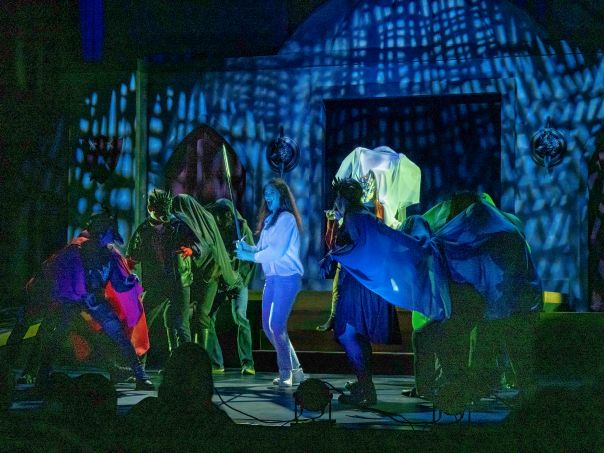
The bigger, newer Parr Center offers the spaciousness for scenic-and-projections designer James Duke to make Nguyen’s spectacle more spectacular. In cahoots with lighting designer Jeff Childs, costume designer Freddie Harward and prop designer Maxwell Martin have the equipment and budget to splash additional color across the Parr stage. Add the sound designs of Montavious Blocker and Carly McMinn and you have a sensory-rich fantasy brew.
To stage his own scripts and bring martial arts action into live theatre, Nguyen established the Vampire Cowboys Theatre Company in 2000 – and himself as the godfather of “Geek Theatre.” Presumably, he was convinced stage combat and martial arts could be a more visceral experience in live performance than it is on film, even if the resources of slow-motion photography, AI, and animation had to be tossed aside.

Much of Nguyen’s geekery can be comic book silliness and free-range Gothic imagination, delighting as much in creating outré villains as in birthing super-powered heroes – with a smattering of witchery and magic on both sides. What makes She Kills Monsters especially clever and brilliant is Nguyen’s use of Dungeons & Dragons as a game within a drama. His hero, Agnes Evans, uses D&D as a tool to recover the essence of her younger sister Tilly after her untimely death.

You will wonder how this can be possible if you don’t already know that D&D can be deeply and extensively personalized. You can create your own module for the game and envision heroes and monsters based on your own friends and enemies: a wonderful way for high school teens to vent their thwarted loves and seething hates.
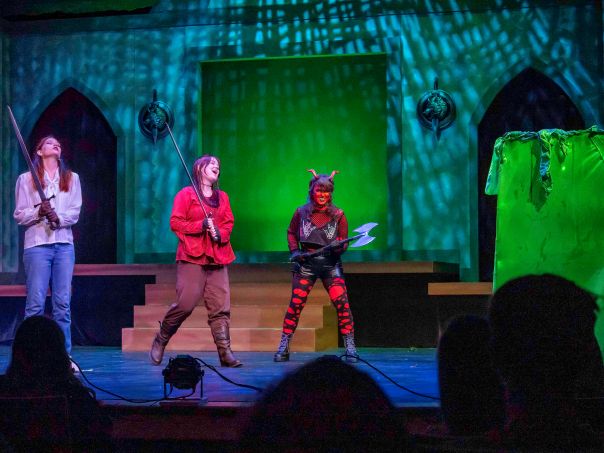
Key example: Tilly, venerated as Tillius the Paladin among D&D geeks in Athens, Ohio, was jealous of her elder sister’s boyfriend, Miles. So along the path of Tilly’s scenario, Agnes will discover that Miles is a villainous force who must be vanquished, even though the evildoer has been imprisoned in a huge gelatinous cube.

That discovery will pale in comparison with the discoveries Agnes makes about Tilly’s sexuality. Geeks are merging with Greeks in Athens, as Nguyen is quite aware, so his female warriors will not be as straight as Homer’s Amazons.

Nor can Nguyen’s Athens be down in Georgia, for he has ordained that Agnes is average – the birthright of all Ohio citizens. For Agnes, it’s a journey into the underworld just to meet Chuck, who will serve as Dungeon Master for the surviving sister while entrusted with the precious posthumous work of Tillius the Paladin.

Layered onto all this teen angst (Tilly’s) and Agnes’s quest to recover her dead sister’s lost soul – both in the D&D game and in real life – is another Narrator, a high school guidance counselor, and numerous mundane classmates that Tilly has mirrored and immortalized in “The Lost Soul of Athens.” My picks for most lethal are the Athens High cheerleaders, Tina and Gabbi, turned into succubi in the D&D realm.

Carly McMinn directs the show, immersing herself and her cast in the action to a fault. I’m not sure McMinn sat herself more than three rows away from her players during rehearsals at the Parr Center. By the time Nguyen’s words reached my party in Row G, much of the Vietnamese playwright’s snappy dialogue had become unintelligible.

Get as close as you can if you wish to hear as joyfully as you’ll see.

If you don’t mind experiencing She Kills Monsters like Greek drama, knowing the plot beforehand, you can freely read and/or download the script online. Otherwise, you’re adding the Neil Simon layer afterward. If at all.

Generally speaking, the vaunts, boasts, and challenges within the game are louder than the conversations inside Agnes’s apartment, Chuck’s store, or the guidance counselor’s office – and more often competing with the soundtrack, which is not at all Dean Martin. Is it Beck’s “Loser” or LL Cool J’s “Mama Say Knock You Out” or Smashing Pumpkins as suggested by the script? Couldn’t say.

McMinn and her choreographers capture the spirit of Agnes’s odyssey beautifully, true to Nguyen’s saucy mix of fantasy and reality, silliness and profundity, fun and feeling, play and play. Fight choreographer Elizabeth Sickerman and dance battle choreographer Becky Rooney both grasp the double layer of artificiality that protects us from viewing violence, injury, blood, or death in the D&D world as any more serious than AEW on TNT.

But unlike AEW, Sickerman and Rooney can take advantage of the outright artifice for comedic purposes. How bad is it, then, if Tillius the Paladin wields her mighty sword – The Eastern Blade of the Dreamwalker, forged from the fiery nightmares of Gods and blessed by the demons of Pena – and slashes at a Bugbear, missing her target by two yards? Not at all. Especially if the Bugbear is mortally wounded anyway. Or if any other fearsome adversary writhes in agony, breathing its last for no apparent reason.

A little of this ridiculous fakery goes a long way.

To be fair, if McMinn doesn’t have her protagonists consistently declaiming at sufficient decibels, she has the wisdom to see that their character arcs are moving in opposite directions to make reconciliation – or even acquaintanceship – possible. Nguyen takes more care with the nuances of Agnes’s evolution since it’s moving in parallel directions in altering her relationships with Tilly and with Miles.

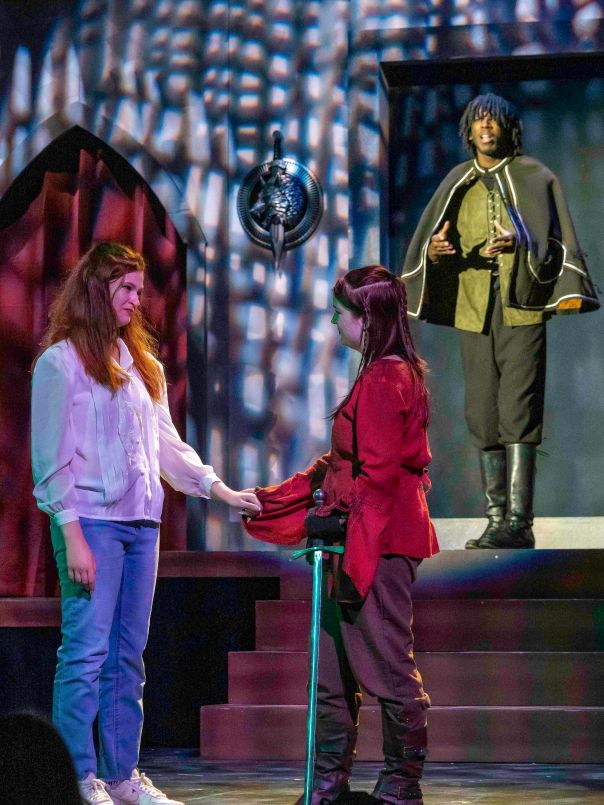
So Saskia Lewis as Agnes has a bunch of calibrating to do as she moves from average and static to insightful and savage. Lewis must be awkward for a while with her blade, shield, and helmet before Agnes the Ass-hatted can morph into Agnes the Badass. She also goes through gauche stages with Miles, with Vera the guidance counselor, and her squeamish attitude toward Chuck (some of it quite warranted).

It’s a curve that Lewis delineates well, though she never quite figures out how to give Average Agnes any spark or gusto. A little dopiness might do it. Or a little surprise when Agnes discovers she can have fun.

Whether or not McMinn saw the 2022 Monsters at the Arts Factory, she and Claire Grant demonstrate that less can be more in portraying Tilly and Tillius. Grant is never quite the legend Charlie Grass was as Tillius in 2022. There is no warpaint on Grant. You might even catch her slouching once or twice. She is mighty, yes, but we also see her as vulnerable. This Tillius is one that Agnes can envision, not the invincible Tilly she wants her to see.

Very likely, Brian DeDora was mostly enticed by the monster-in-gelatinous-cube side of Miles when he auditioned for the role, but I couldn’t help liking him even more as the wholesome boyfriend. Nguyen gives DeDora a wonderful pathway into making mundane Miles likable, for he earnestly wants to be a part of the D&D fun and fantasy once Agnes has gotten the bug.

Aside from Kameal Brown as the guidance counselor, slightly tainted by adulthood, all the other women get to revel in D&D nastiness and badassery. My favorite is Ashlie Hanke as Lilith Morningstar, Tilly’s right-hand fantasy demon, followed closely by Anaiah Jones and Kristina Ishihara as the Evil cheerleader succubi.

Hanke gets the best crossover into reality as Lily, more closeted at Athens High than Tilly. To Hanke’s credit, Lily is poignantly burdened with the sad consequences of spurning real-life Tilly to keep her cover. When they aren’t tormenting Tillius & Crew as succubi, Jones and Ishihara can tag-team Tilly, cruelly teasing her over her sexuality. Even if they’re a bit stereotyped as cheerleaders, they make Athens High more real.

All three of these wicked slayers are radically red-faced in New Landia, the country where Tillius tries to recover her lost soul. Their having to un-paint and repaint is the only good excuse I can imagine to explain why everyone onstage isn’t miked. So for me, it’s a love-hate relationship with these vicious vixens.

Among the remaining men, we should first consider the storytellers, Elon Womble as our Narrator and Maximilian Novick as geek master Chuck. Nguyen doesn’t specify how our Narrator should be attired, but he broadly suggests that she or he radiate a Lord of the Rings aura. Accordingly, Novick sports a garish green medieval outfit over long black boots, an implicit invite for us to straddle the real and fantasy worlds as the story unfolds.

Novick can roam more freely between teen nerdiness and master of the dark arts, a transition marked by donning a monkish cowl and deepening his voice. There’s also a mix of gawkiness, horniness, and bravado that Novick obviously relished.

As Orcus, the retiring Demon Overlord, Truman Grant gets to wear more majestic horns than those sported by Lilith (some history between them is hinted at). For old-school aficionados of The Wizard of Oz, Orcus might pleasantly echo the roaring veneer of the Cowardly Lion. Grant’s demon doesn’t suffer from self-image hangups, and he’s more of a careless, world-weary slacker than timid, having shrewdly traded Tillius’s soul for a badass TV/VCR combo.

Evangelicals and assorted homophobes despise She Kills Monsters, especially when it defiles their precious schools. Once again, such harmless and rollicking sacrilege is happening again in the QC. It’s particularly distressing for the haters to see Tillius and Orcus uniting with Agnes on her adventure. Both of them can tell the Ass-hat a thing or two about how to die.

“One Year to Die” Is a Premiere to Be Proud of in Matthews

Review: One Year to Die at Matthews Playhouse

By Perry Tannenbaum

September 11 has been part of LaBorde family lore much longer than for nearly all other American families. On that date in 1943, the USS Rowan was sunk in Mediterranean waters by German torpedoes after delivering an arms shipment to Italy to combat the Nazis. Local actor/director/playwright/school principal Charles Laborde’s Uncle Joe was among those aboard the Navy destroyer lost on that day, along with 201 other officers and crew. Only 71 survived the attack, rescued by the USS Bristol.

Curiously enough, the official date of Uncle Joe’s death is listed as September 12, 1944 – still a full five years before Charles was born – because none of those 202 bodies was recovered. As the Naval Officer informs Charles’s grandma Edwina with full-dress formality in LaBorde’s new play, One Year to Die, Joe was officially “missing” after the Rowan was torpedoed until one year and one day had elapsed. Then the Naval Death Certificate would be issued.

The world premiere of LaBorde’s play opened last week at Matthews Playhouse and runs through September 29 at the Fullwood Theater.

While it’s intriguing to wonder how Charles’s grandparents, Oscar and Edwina, coped with this limbo year of unofficial death – maybe holding out hopes of a miracle for a few weeks or months – it’s hardly the stuff of sustained suspense and drama. To achieve these enhancements, LaBorde applies some research, imagination, and basic math.

Time-travelling back to his grandparents’ farm in Hessmer, Louisiana, which wasn’t big enough to be incorporated until 1955, LaBorde modestly multiplies the number of local families impacted by the Rowan’s sinking. Now two moms down in Cajun country are grieving over their lost sons, Edwina and Ella Broussard, an ailing black washerwoman who takes in laundry from the richer families in the region.

Everybody seems to know everyone else around town, so when the Naval Officer shows up on Edwina’s front porch to deliver his sad news, she can point him in the right direction toward the part of town where Ella presumably lives. The fact that LaBorde has invented her makes no difference. But it’s going to take far more resourcefulness from the playwright for him to even begin exploring the racial divisions and tensions that prevailed in the little town of Hessmer when the dark days of Jim Crow hadn’t been dispelled, even after African Americans were welcomed by our military.

No, for that to happen, LaBorde had to find a compelling reason for Ella to appear at Edwina’s doorstep. Indeed, to fully engage us and win our admiration for Ella, the mission driving her to Edwina’s farmhouse had to be compelling enough for her to knock on the LaBordes’ front door. Now you have an action sufficiently outré to set a little Jim Crow town in turmoil.

What on earth could be so important for Ella to commit such an effrontery?

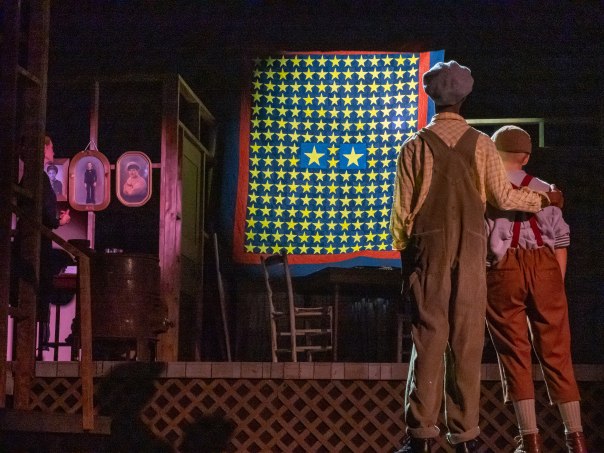
She has enough imagination and ambition to match her chutzpah, for she plans to pay tribute to both her son Lonnie and Edwina’s Joe – along with all the other 200 soldiers aboard the USS Rowan who perished fighting the Nazis. The tribute will be a quilt of 202 gold stars on a field of blue, with the two stars representing Lonnie and Joe conspicuously larger than the 200 others.

The project is worthy, and quilting 202 squares with 202 perfectly centered stars, along with a suitable border to frame it all, seems to be a sufficiently monumental task to occupy two women for the better part of a year – once the ladies have solved the math problem of how to symmetrically configure those 202 stars. Director Dennis Delamar certainly isn’t going to gloss over the problem of getting the math exactly right.

But that front door thing is key (even though Edwina is proud to say it’s unlocked) and obliges LaBorde’s family to be tested onstage in a manner they probably never faced in real life. To the playwright’s credit, neither of his kinfolk is perfect in receiving their surprise guest – who should, as everybody in Hessmer knows, be knocking at the back door.

That is the attitude here from both Edwina and Oscar when they first encounter this unfathomable cheek. Just to double-underline the point that the LaBordes are not perfection, Edwina rebuffs Ella twice. Yet we soon see that they are willing to evolve, uniting with Ella’s cause once they’ve heard her out. Granting her the unique privilege of entering by the front door. But what about the rest of the town? Here is where LaBorde can inject suspense, drama, and a sprinkling of terror.

Joshua Webb’s set design, with its wood-burning stove and perpetual coffee pot centerstage, has a rusticity that allows for a wisp of primal danger and violence lurking beneath its humble domesticity. Both kitchens are lovingly dressed, but sightlines are a rather dreadful problem: unless you’re seated in the center or toward the right side of the Fullwood Theater audience, you might go home never knowing that Oscar had been visible building his stone wall – hidden by the Broussard kitchen to those of us sitting on left – in defiance of stone-throwing yahoos (or KKK) repeatedly breaking the LaBordes’ windows.

Complemented by Sean Ordway’s moody lighting design, which casts a spell even before the action begins, Yvette Moten’s costume designs have the timelessness of Norman Rockwell paintings on the covers of old-timey Saturday Evening Post magazines. It’s hard to resist the visual charm of this production as Delamar frames one memorable tableau after another. From the time we first see the spirits of Young Lonnie and Joe (Aaron Scott Brown and Bennett Thurgood in rather touching non-speaking roles) to the great starry quilt reveal, Delamar lavishes a series of freeze-frames that are a memorable slideshow within the show.

Some discreet subtraction is applied to LaBorde family history that results in somewhat awkward casting for the leading ladies, Paula Baldwin and Corlis Hayes. Nowadays, we’d expect moms of strapping young military enlistees to be in their forties or fifties, not 60+ – but the real Edwina had way more offspring than two sons, so she actually was aged 60 at the time of Joe’s death.

So sitting at her kitchen table, sustaining her renown as the county’s quilting queen, and looking rather matronly, Baldwin is exactly what LaBorde envisioned as Edwina. Life on the bayou does take its toll here, so Joe will merely be the beginning of Edwina’s ennobling griefs. Baldwin endures these crucibles like so many we’ve seen from her over her distinguished QC stage career, with signature stoicism. Neither Delamar nor LaBorde had any hesitation in casting her.

As for Hayes, I first encountered her at Johnson C. Smith in 1988 when she directed for colored girls at the tender age of “24” – just guesstimating here – so she’s also perfectly cast as Ella. Maybe the most heartwarming aspect of this production is the gift LaBorde has given her with a world premiere credit in this role. Confronted by both black and white folk, Ella is a far more nuanced and varied character than we normally see Hayes portray.

We instantly see the strong spine that brings her to Edwina’s door – twice – and we see her pragmatism in backing off the first time. She seethes back home and resolves to repeat her effrontery, still knocking at the front door. Then there’s the beautiful passive aggression when Edwina belatedly agrees to allow Ella over her front threshold. Hayes pointedly hesitates, referencing the insults she has previously absorbed and the dignity she maintains.

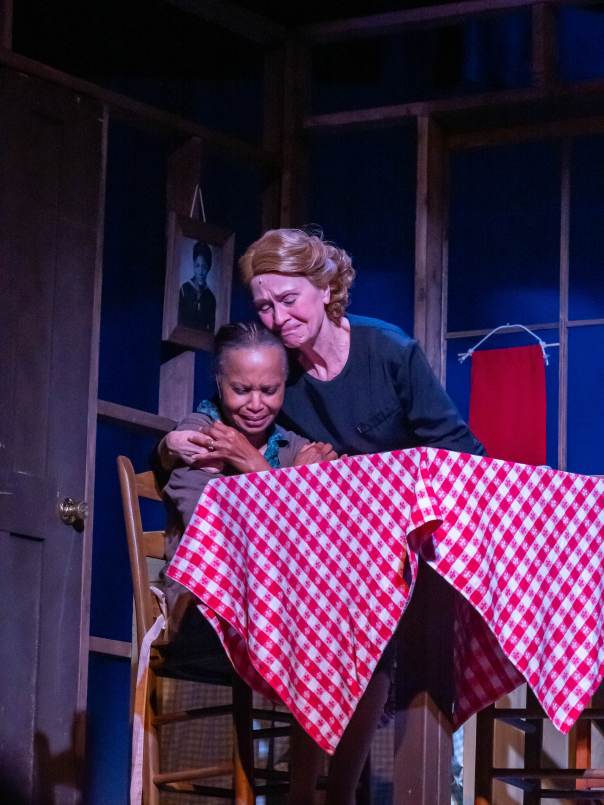
LaBorde has obviously labored over Ella, for she has her maintaining this steely dignity when confronted by her minister, Reverend Johnson, and even when she is complimented by white churchlady Nodie Ardoin, Edwina’s nemesis. Yet there’s one more telling Easter egg to be found in LaBorde’s script, that Hayes and Delamar brilliantly emphasize. As soon as Ella gets the first clear sign from Oscar that she might not be welcome in his kitchen, we see Hayes instantly cowering, clutching her pocketbook, and readying for a quick exit.

That’s the kind of good sense Ella has, for all of her sturdy spine. We can be thankful that this rich role has finally found Hayes.

If it weren’t obvious before, One Year to Die signals that Matthews Playhouse has joined the ranks of Metrolina community theatres that consistently present pro-grade work. The standard set by Hayes and Baldwin is met by the men who portray the Hessmer clergy, Steve Price as the soulful Father Morton only slightly upstaged by the charismatic Keith Logan as Rev Johnson. LaBorde would have done better by both of these religious leaders if he had refrained from broadly hinting that Catholic and Baptist ministers follow the exact same script when upbraiding wayward lady congregants.

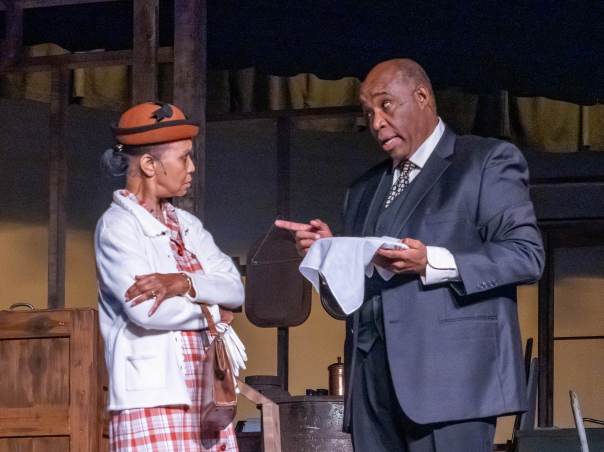
Aside from Oscar, the other guys we see onstage are military, so we never sample the boorishness or the toxic philosophies of the town’s window breakers. The military cameos, however, are beautifully handled by Vic Sayegh as the Naval Officer who rocks the LaBordes’ world and Brian DeDora, who appears as The Sailor after the Normandy invasion.

Possibly, LaBorde dropped the idea of including the rock-slingers onstage, for Nodie bears the same last name as one of them. Robin Conchola as Nodie is actually the more benign of the “watchin’ committee” that darkens Edwina’s doorstep to register their condemnation, a lot more conflicted than Barbara Dial Mager as Sarah Jeansonne. It’s Conchola as Nodie who has the chance to be rebuffed by Hayes. Sarah is slower to evolve, so we can despise Mager longer, if only for her horrid wig.

As Oscar, also aged 60 when Joe perished at sea, Henk Bouhuys is delightfully homespun, although there’s still enough Jim Crow ingrained in him to be shocked by the ladies’ audacity. Bouhuys continues to project ambivalence long after Oscar decides the memorial project is worth doing no matter how the rest of Hessmer may think. Once he gives Edwina his assent, his loyalty is as steadfast as his love.

Whether it was absent-mindedness or a directive from Delamar, Bouhuys only intermittently sounded Cajun on opening night – while the rest of the players hardly bothered with an accent. So it was startling when Oscar became full-out Cajun just before intermission after a cowardly attack on the LaBorde farmhouse. Out of nowhere, the accent was stunningly convincing, adding some sharp ethnic spice to the most fiery monologue of the night.

Photos by Perry Tannenbaum