Tag Archives: Ayane Kozasa

Wiancko Takes the Baton at Spoleto’s Fabled Chamber Music Series

Review: Spoleto Festival USA Chamber Music at Dock Street Theatre

By Perry Tannenbaum

When Geoff Nuttall died of pancreatic cancer in October 2022, Spoleto Festival USA lost its most distinctive personality, the “Jon Stewart of chamber music,” before any of us had noticed a single gray hair on his glorious mane. Replacing him as director of the festival’s noonday chamber music series, the backbone of Spoleto, seemed like sacrilege last season to those close to the ebullient violinist. However, Nuttall’s stylish hosting chores still needed to be done.

Fittingly, a cavalcade of other chamber music players stepped into the role, for hosting at Dock Street Theatre had always been handled by musicians who contributed to the playing. Esteemed harpsichordist Charles Wadsworth had passed the baton over to Nuttall after many years as Spoleto’s most recognizable personality and the series’ jovial noonday host. Nobody would say whether the parading pinch-hitters were auditioning for the role of Nuttall’s successor. Still, it felt that way, especially since the festival’s general director, Mena Mark Hanna, had declared that the musician-host tradition would go on in Charleston.

And Charleston is a very traditional city.

So for cellist/composer Paul Wiancko, 2023 was an auspicious year. In late winter, before his fourth appearance at Spoleto, Wiancko became the new cellist with the pioneering Kronos Quartet, and in early fall, he was named SFUSA’s third chamber music director. Changes to the series have been noticeable: nine of the 22 performers in the 2024 festival are making their Spoleto debuts, and there are 50 percent more pieces by living composers in the program lineup.

Coupled with the abrupt terminations of resident conductor/director of orchestral activities John Kennedy and his Music in Time series, Wiancko becomes not only Spoleto’s chamber music guru but also the festival’s chief purveyor of contemporary classical music.

And he’s doing it with his own unique style.

Wiancko is more about theming each of the 11 concerts in the chamber music, more about the Zen of each program. Nuttall was very laid-back and West Coast in his attitude toward programming and concertgoing, stressing variety in his repertoire choices and encouraging his audiences to be at ease. If you want to applaud between movements, go right ahead. At a couple of concerts, Wiancko took what seemed like a Far Eastern approach, requesting that we withhold applause – to magnify the cumulative effect of two pieces he was presenting in tandem.

The first time Wiancko employed this tactic, it became emotional on the Dock Street stage. In retrospect, we can understand why. For this coupling, Wiancko led off with an unfamiliar work, Marejada, created during the 2020 pandemic by Puerto Rican composer Angélica Negrón, and then in the silence segued to Franz Schubert’s posthumous String Quintet in C, perhaps the most-played chamber work in Spoleto history – for many years, the last piece performed in the lunchtime series.

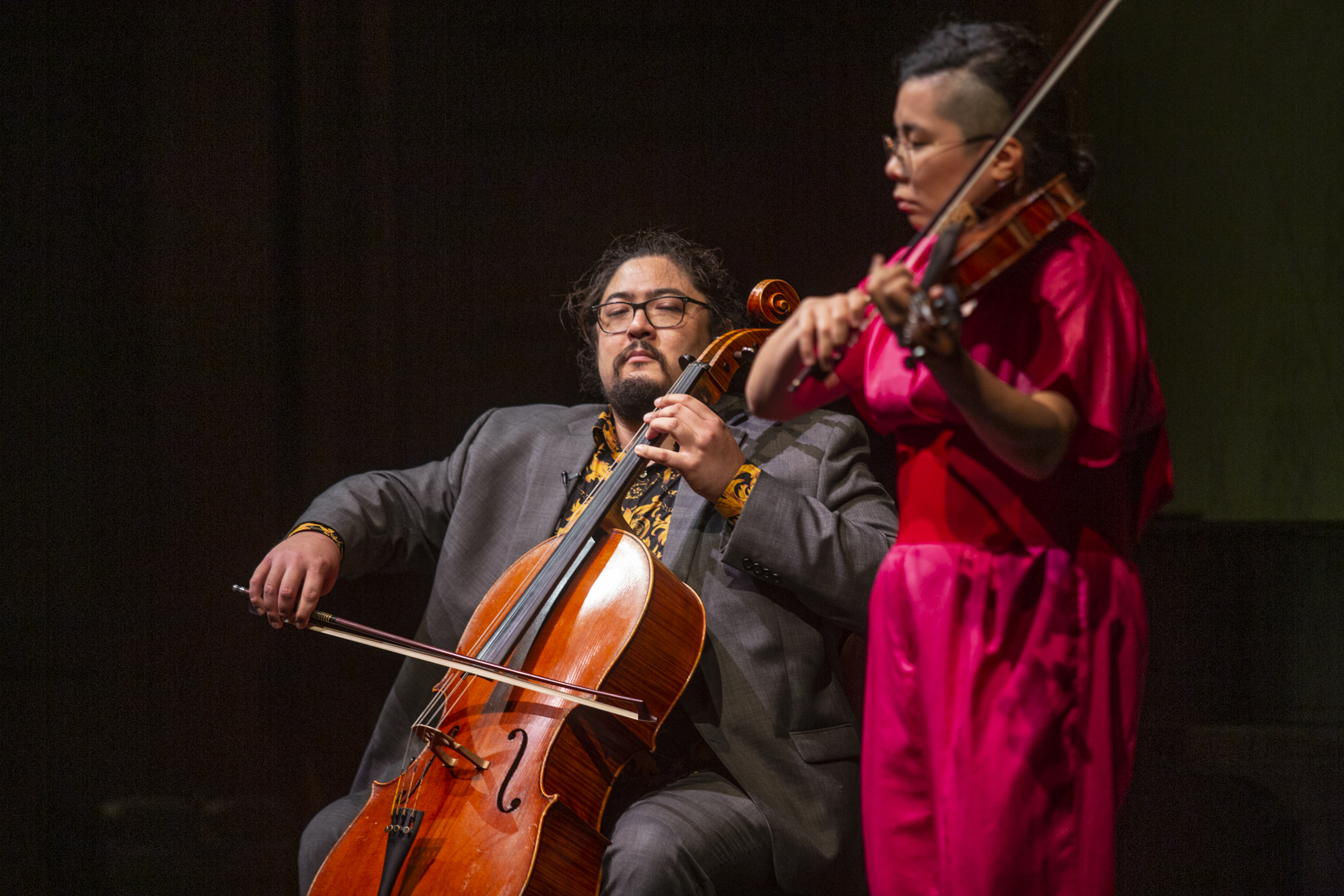
Written for string quartet, assorted percussion, and pre-recorded ocean waves (referenced in Negrón’s title), performers for Marejeda included Wiancko, violinists Alexi Kenney and Livia Sohn, and Wiancko’s spouse, violist Ayane Kozasa. Kenney would leave crumpled paper onstage after the piece as he exited along with Wiancko and Kozasa, respectively carrying a conch shell and a can – plus a spoon to hit it with.

That left Sohn and her gong onstage as Owen Dalby entered to take over the first violin chair, Lesley Robertson replaced Kozasa place on viola, and cellists Christopher Constanza and Ramakrishnan spelled Wiancko. It was quite possible to overlook the fact that three of the four members of the now-defunct St. Lawrence String Quartet – Dalby, Robertson, and Constanza – were now reassembled, minus their first violin, Geoff Nuttall. Or it was until, more than a half hour later, the sweetly mournful, fiercely and achingly turbulent second movement Adagio concluded and Sohn, Nuttall’s widow, broke down momentarily.

Dalby understood as the delay continued, softly clutching Sohn’s bow hand until she could go on. More of us would have shed tears, I believe, if they had reprised that Adagio.

More tears flowed more predictably three days later when Wiancko coupled two contemporary composers, Jonathan Dove and Valentin Silvestrov, in his next hold-your-applause tandem. Another string quartet was augmented by a fifth voice, this time tenor Karim Sulayman in Dove’s In Damascus, set to the prose poem sequence by Syrian poet Ali Safar, as translated by Anne-Marie McManus.

Eclipsed by Rhiannon Giddens’ Omar when he brought his Unholy Wars to Charleston in 2022, Sulayman has been indelible this year, first in the world premiere of Layale Chakar’s new opera, Ruinous Gods, which embraces the most vulnerable refugee children from war and terror worldwide, and then in this absolute Dove-Safir stunner.

Two days ago we were standing where the long line of Syrians trying to leave the country waited… Nothing happened, except that we saw a nation where the sun had burned out. Over time, no spark remained for its residents except the sparks of their eyes, which were fading… Like tears…

After Dove’s 11-part cycle – only the sixth part was wholly instrumental, featuring Wiancko, violist Masumi Per Rostad, and violinists Alexi Kenney and Benjamin Beilman – the lights dimmed as Pedja Mužijević entered from the wings to play Silvestrov’s touching Lullaby at the Steinway. But the funereal gloom and Mužijević’s entrance at stage right weren’t sufficient to distract us from Sulayman, still standing at centerstage, weeping profusely before he daubed his eyes.

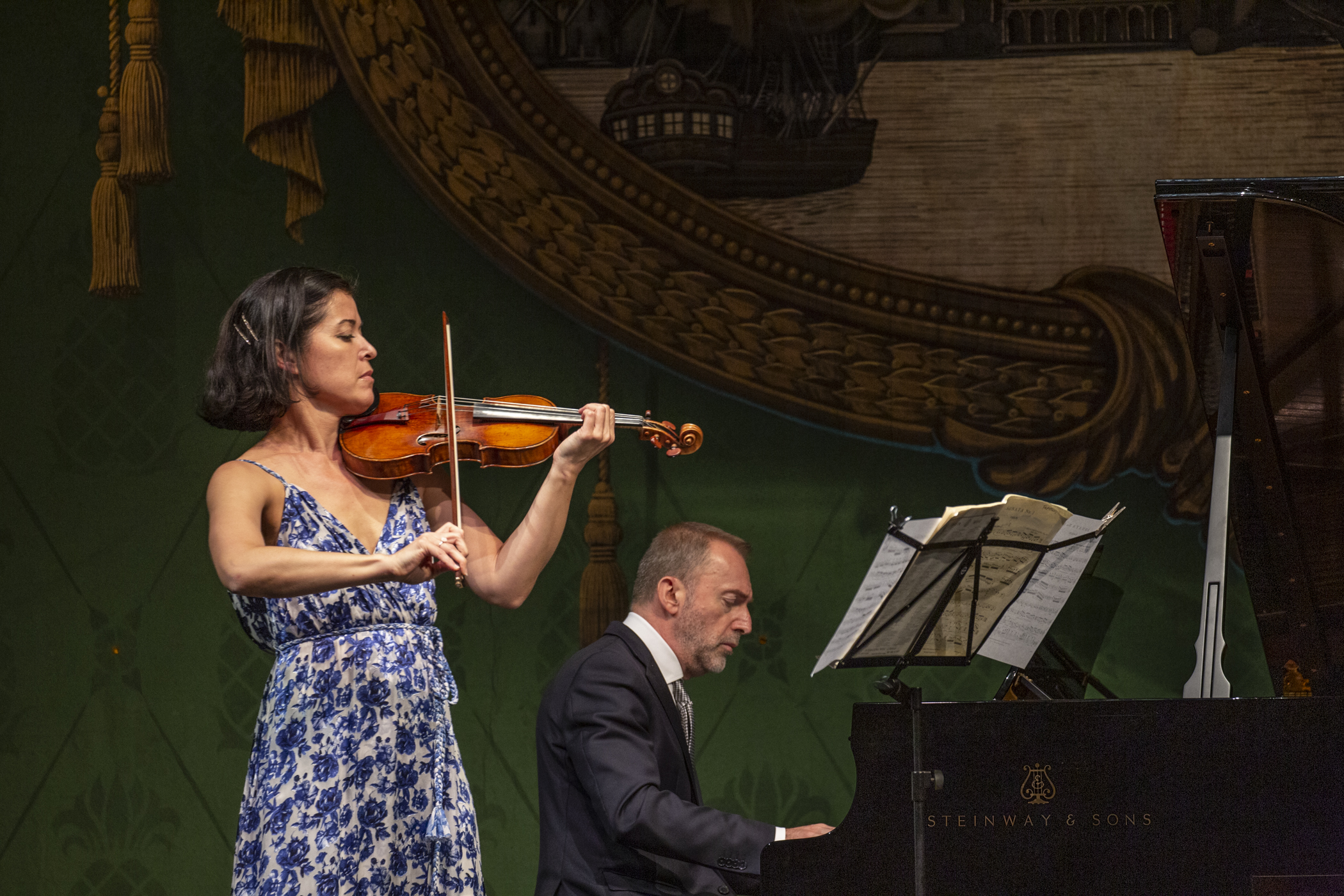
Preceded by Beethoven’s Piano Trio No. 3, with Beilman playing violin, Ramakrishnan cello, and newcomer Amy Yang at the keyboard, this was surely one of the greatest of the many great chamber music concerts ever performed at the Dock. Yet just two hours earlier, I’d witnessed Yang’s debut at Spoleto, definitely one of the most sensational in recent years as she teamed with Kenney on Robert Schumann’s majestic Violin Sonata No. 1, the best and most passionate live performance I’ve seen of a violin sonata since Daniel Hope and Sebastian Knauer played Beethoven’s Kreutzer at the Savannah Music Festival in 2011.

Both Yang and Kenney can be regarded as among Wiancko’s inner circle, Kenney along with Kozasa being fellow members of Owls, an “inverted string quartet” with two cellists, and Yang being one of the artists Wiancko has composed for. They seemed to be kindred spirits from the opening bars. With admirable subtlety, Wiancko themed this concert as a “Celebration of Resonance,” never mentioning that Yang’s debut solo album of 2019 was Resonance, including pieces by Bach, Caroline Shaw, and Schumann.

Of the 11 programs presented during the lunch hours at Spoleto in 2024, I only saw seven, so I cannot offer an authoritative judgment on whether Yang’s big splash was surpassed by any of the other debuts. But two strong contenders emerged in Program VII on my last day in Charleston, cellist Sterling Elliott and percussionist Ian Rosenbaum, both of whom made their debuts in Program VI the previous day.

Elliott had slipped in among a string septet that played the original 1978 version of John Adams’ breakthrough piece, Shaker Loops, where fitting in was a prime objective. Standing out became the mission when the cellist sat down with Mužijević to play William Grant Still’s Mother and Child – Elliott’s transcription of Still’s 1943 Suite for Violin and Piano, Part II. It really sounded like his own piece, the tenderness of the composition darker and more aching and the affirmation nearly as joyous.

Rosenbaum’s debut had kicked off Program VI, more high-profile since he was paired with Wiancko on Andy Akiho’s 21 for cello, marimba, bass drum, tambourine, and electronics. Plucking strings, clapping, tapping the top and sides of the cello, and pedaling the big drum – as well as plain bowing – Wiancko garnered most of the attention at the beginning and end of the piece, though the percussionist was also performing some extracurricular antics behind the marimba, switching mallets, rapping the tambourine, and triggering the electronics.

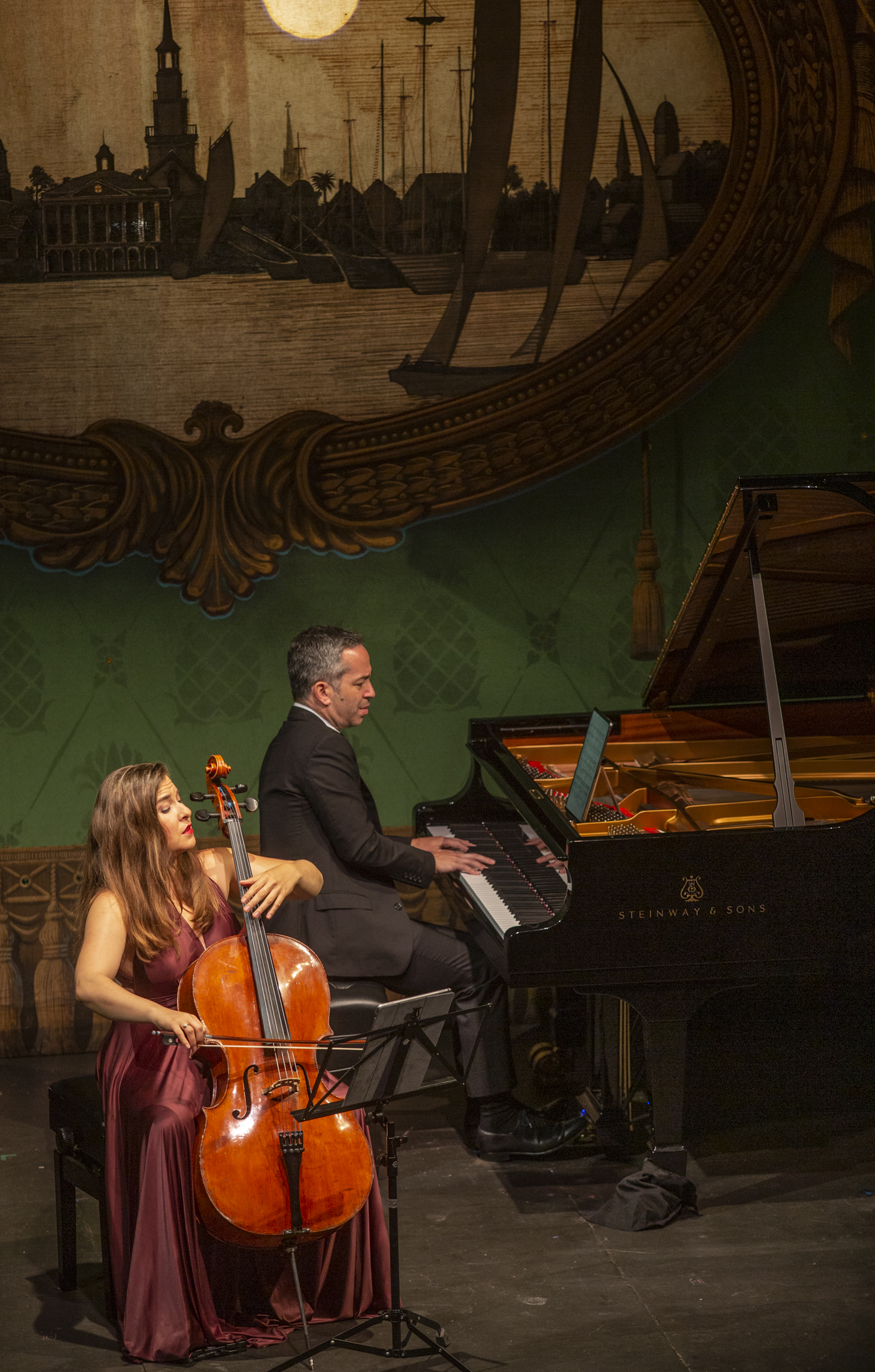
Played on steel pans as it was originally written, Akiho’s piece looks and sounds a little better, particularly when the sides of the pans are struck. But the marimba version was still spectacular, building to a pounding climax, four instruments and electronics sounding simultaneously. Almost as spectacular, Christopher Cerrone’s Double Happiness, with Rosenbaum playing vibraphone and a small array of malleted instruments in duet with a prepared piano, was far more sublime. We watched over Wiancko’s shoulder as Yang prepared the Steinway’s innards.

Nor did Wiancko disappear after he and Yang delivered their play-by-play of the piano prep, retreating to one wing to operate electronics on cue. At a somewhat hypnotic pace, Yang was obliged to stand up at the keyboard, plucking or strumming or dampening the strings inside the Steinway, sometimes while playing the keys with her free hand. Usually wielding two mallets in each hand, Rosenbaum performed similar wonders at his instruments, occasionally striking both the vibraphone and a smaller instrument behind it with mallets wielded by the same hand.

Paradoxically, the prerecorded electronics and reverb effects layered onto Double Happiness added the echoey steel pan aura that was missing the day before. The cathedral of sound at Dock Street Theatre was magical, like nothing I had experienced since I first heard A Genuine Tong Funeral,composed by Carla Bley, on Gary Burton’s memorable CD with quartet and orchestra.

Wiancko may not be a perfect fit for the Jon Stewart label, but there’s something in each of his programs that reminds me of the Comedy Central shows I once watched regularly. More than Nuttall ever did, Wiancko makes it his business to interview at least one other musician or composer during every program. More often than not, he frames these encounters like a podcast. Very entertaining.

When composer-in-residence Reena Esmail made her debut on the same program where Rosenbaum and Elliott made their bows, Wiancko greeted her like a starstruck fan. The build-up stood up as Yang and longtime Spoleto stalwart Todd Palmer gave a very fine account of Esmail’s Jhula Jhule for clarinet and piano.

Spoleto Ends an Era With Infusions of New Works and Artists

Review:  “Spoleto is back!”

By Perry Tannenbaum


51224315640_e101915ab2_o-1

When Martha Teichner spoke with Nigel Redden over the Memorial Day weekend, there were three major takeaways from the Spoleto Festival USA general director – in what will stand as his exit interview for most of us in the live or online audience. As we might have guessed, setting up the 2021 festival has been notably awkward after the cancellation last year’s 17-day event: if Redden and his staff had anticipated how quickly vaccinations would open up Charleston’s indoor venues, Spoleto scheduling could have been more robust.

Because this year’s festival is so downsized after the hiatus, Redden also stated, next year’s festival will be pivotal for Spoleto’s survival. The normal balance between popular and outré events will need to be skewed toward the cash cows. Staying on until October but keeping his hands off the search for his successor, Redden will certainly play a key role in framing the 2022 lineup.

Notably modest about his impact and achievements during his most recent 26-year tenure – and his prior stint at the helm from 1986 to 1991 – Redden was surprisingly frank about his decision to step down. He pointed unhesitatingly to the #BlackLivesMatter Movement that arose amid the turbulence of 2020 and, more specifically, to the manifesto issued by the We See You White American Theatre coalition of BIPOC theatre artists demanding radical, immediate, and long overdue reforms.

Or to those willing to overlook the often-scathing tone and occasional militancy of the 29-page “Accountability Report” and its demands, WSYWAT was offering a blueprint on how to create an anti-racist American Theatre. Though not primarily a theatre person, Redden saw himself checking two major boxes in the laundry list of justifiable grievances, the color of his skin and the length of his reign.

What Redden said back in September, that the cancellation of the 2020 Spoleto and enforced isolation had weighed heavily upon him, sounded right for a press release. This more recent elucidation sounds right for Redden. We can see a continuous line of white males at the helms of various sectors of Spoleto since its opening season in 1977, beginning with festival founder Gian Carlo Menotti leading the student orchestra, Charles Wadsworth hosting the lunchtime chamber music concerts, and Joseph Flummerfelt leading the Westminster Choir.

The younger men carrying on their tradition are notably more adventurous in their programming, Joe Miller leading Westminster, Geoff Nuttall hosting the chamber music at Dock Street Theatre, and John Kennedy wearing one of the two hats worn by Menotti as resident conductor of the orchestra. Since the Westminster is a separate entity from Spoleto and Nuttall was Wadsworth’s hand-picked successor, Redden’s hand in pushing the festival to a fuller embrace of new and contemporary music was most emphatic in his appointment of Kennedy.

Yet the international tone and resources of the festival have led Kennedy to widen his horizons in recent years, and an unmistakable tidal shift has occurred in the choral and chamber music programming as well, now permeated with contemporary repertoire and studded with world premieres. COVID restrictions have kept Kennedy and Miller away from Spoleto for two seasons now, relegated to digital presentations on YouTube during this year’s festival – video self-portraits and bite-sized performances that will linger online through June 18. So it has been Nuttall’s responsibility to carry the torch in live events for the 2021 season, reasserting the festival’s right to be recognized among the world’s preeminent champions of new music.

Nine of the 11 programs at this year’s festival (each one is repeated three times) are showcasing works by living composers, including five pieces by composers appearing live at Dock Street Theatre, and four world premieres. Most of these were clustered at the top end of the schedule, making tickets – tough to score on opening weekends of all Spoletos – particularly tight in this atypical year of social distancing. So we were obliged to miss all four live performances of works by this year’s composer-in-residence, Jessica Meyer, and asked to limit our requests for press seats to one concert.

51237256635_891351fef7_o

Turning my attention to the second of Spoleto’s three weekends, I had little difficulty settling on my choice: Program VII, the return of cellist Alisa Weilerstein to the festival in the world premiere of Osvaldo Golijov’s Milonga. With Beethoven’s Septet in E flat on the same program, I would also get to see five players I’d never seen before at Dock Street.

Hoping against hope, I also requested Program VIII: more Alisa Weilerstein – again paired with pianist Inon Barnatan – and the return of Anthony Roth Costanzo, the superstar countertenor, beloved at Spoleto years before the huge éclat of his Met Opera debut. “Nothing ventured…,” right? My first choice was granted. Although Costanzo’s return was solidly sold-out for all three of its iterations, my chutzpah was rewarded with an offer to choose between two additional programs.

51224005159_3f4cd34198_o

Had I known that violinist Livia Sohn, Nuttall’s spouse, would be returning from a hand injury in Program III to premiere a Meyer composition written specially for her, From Our Ashes, my choice of her subsequent appearance in Program V would have been easier to make. That concert included the Handel Oboe Concerto in G minor and Saint-Saëns’ fearsome “Hippogriff” violin sonata, with a contemporary wildcard in between them, Kenji Bunch’s The 3 Gs for solo viola.

Whether he’s anticipating next season’s make-or-break festival or simply realizing that much of what he does on the Dock Street stage will endure in perpetuity on YouTube, where excerpts of every concert are streamed as little as one day after a program bows out, Nuttall has noticeably sharpened his emceeing. Simply watch the streamed excerpts of Program VII and you’ll see.

To gin up excitement for Golijov’s Milonga, Nuttall not only hailed the return of the Weilerstein-Barnatan duo and the stature of the composer, he brought on hornist David Byrd-Marrow to help demonstrate the two rhythms clashing with each other in the piece. These two rhythms, the 3-3-2 pattern of the milonga and the 4/4 of Joseph Achron’s “Hebrew Melody” (written for Jascha Heifetz), repeatedly diverging and converging, personify the composer himself and his Argentinian/Jewish heritage.

Before bringing Byrd-Marrow on, Nuttall mocked himself a little by confessing that Barnatan had suggested that he demonstrate the milonga beat with one hand and the 4/4 with the other – a “total fail,” he recounted, when he made the attempt. At the end of the demo, having said that the two rhythms bumped against each other, Nuttall and Byrd-Marrow actually finished back-to-back, bumping each other.

In short, Nuttall scorns the seriousness of “setting the mood” in favor of trying to make his enthusiasm contagious. Remarkably, this humorous approach worked for a melancholy piece, cuing us to look for something we would surely find. That turned out to be chiefly Achron’s tune and Golijov’s variations on it, for Weilerstein is such a mesmerizing and rapturous performer that I gladly dwelled in the soul of Jewish melody while I was at Dock Street Theatre, mostly oblivious to the countercurrent of Barnatan’s Argentinian flavorings at the keyboard. That friction was more readily savored a day later when the YouTube replay was released.

Nuttall analyzed the Septet in a manner that would have pleased Wadsworth, but he added a couple of layers: the wild popularity of the piece, which eventually annoyed the more mature Beethoven, and his own iconoclastic preference for early Beethoven over the more widely admired masterworks of the middle and late periods. The sunniness of the music and the fecundity of melody, Nuttall extravagantly predicted, would surely send us off into the streets singing and dancing.

The Septet was a wonderful chance to see most of the newcomers in action, including bassoonist Monica Ellis, violinist Jennifer Frautschi, violist Ayane Kozasa, cellist Arlen Hlusko, and Byrd-Marrow. While this genial romp gave Byrd-Marrow a merry workout on the French horn with repeated hunting calls, the chief protagonists were Frautschi and clarinetist Todd Palmer, facing off at opposite sides of the stage. Palmer was as jocund and propulsive as ever, leading the woodwinds, while Frautschi was liveliness, intensity, and joy leading the strings. Anthony Manzo, like Palmer a longtime fixture at Spoleto, stood like a pillar between the two sections, genially keeping time on the double bass.

51237256305_a9be5d159b_o

Frautschi had already distinguished herself in the “Hippogriff,” lavishing her bold fruity tone on the Saint-Saëns sonata with even greater intensity, zest, and decisiveness, bringing Program V to a triumphant conclusion. Peak ferocity was reached minutes after the notorious torrent of 704 sixteenth notes that begin the closing Allegro Molto, when Frautschi and pianist Pedja Muzijevic, already red-lining the tempo, turned on the turbojets.

Ignoring the note count of the frantic Allegro Molto, Nuttall cited it as among the greatest moments in all of chamber music and asserted that Saint-Saëns is inexplicably underrated in the pantheon of great composers, a genius in the Mozart mold. His intro for the Handel concerto was more droll, embarrassing oboist Smith by floating the idea of celebrating his manly beauty by making him a centerfold in a Spoleto swimsuit calendar. Then he prevailed on Smith to demonstrate how Handel expected his featured soloists to improvise. To contrast, Nuttall now invited all the musicians onstage, instead of playing their written parts, to improvise behind Smith as he repeated his little performance.

Cacophony. A bad idea – illustrating the Baroque balance Handel adhered to. One of Nuttall’s cornier shticks.

Like Wadsworth before him, Nuttall doesn’t scorn pedagogy altogether. He seemed to revel, in fact, in teaching us the concept of scordatura, purposeful mistuning, as violist Hsin-Yun Huang prepared to make her Spoleto debut soloing on Bunch’s The 3 Gs. Nuttall and Huang showed us the normal tuning of her instrument from top to bottom, A-D-G-C, and how Bunch would be obliging the violist to retune two of strings to an A-G-G-G configuration.

Then a parting shot for us to mull over as Nuttall exited to the wings: “Hsin-Yun will never be closer to Jimi Hendrix as you are about to see her.” We soon realized what he had meant – and why there was a piano bench onstage next to Huang. Strums on the strings were the easiest of Bunch’s demands on the violist’s right hand in the hectic opening section of his piece. A sprinkling and then a barrage of finger taps on the four strings and along the fingerboard launches the solo, utilizing three or four fingers and making it impossible to grasp a bow.

When the piece did permit Huang to pick up her bow from its resting place on the piano bench, the music moved slightly closer to Hendrix, settling in a region somewhere between jazz and bluegrass, a bit funky and definitely appealing – with plenty of ricochet and double bowing to test the soloist’s mettle. In the video excerpt, which remains free online through June 18, Huang’s exploits on viola are followed almost instantly by Frautschi’s bravura in the Saint-Saëns finale, a rather remarkable sequence.

51236402383_d39b604ab7_o

Three of the four Jessica Meyer works featured at Spoleto this year are also preserved on the streamable excerpts. Sohn’s comeback is predictably captured, as is “American Haiku,” cellist Paul Wiancko’s touching tribute to his wife, Kozasa, and their mixed heritages, which the couple performed in a memorable cello-viola duet. Kozasa is even more impressive in Program IV, where she teams with Palmer – at the top of his game – and Muzijevic in Mozart’s “Kegelstatt” Trio. None of that performance is omitted. Nuttall’s intro, a typical mix of humor and nostalgia, will tell you why.

Redden’s valedictory season will have a momentous afterword when the curtain goes up fully again in 2022. Then we will finally behold the world premiere of Omar, the new opera by Rhiannon Giddens. Originally scheduled for a 2020 premiere, Omar is based on the autobiography, written in Arabic, of Omar Ibn Said, a Muslim-African man who was enslaved and transported to Charleston. The twice-postponed premiere will be a final testament that Redden’s vision for Spoleto is grounded in diversity – and firmly rooted in Charleston’s chequered history.