Review: Alabaster at The Mint Museum
By Perry Tannenbaum
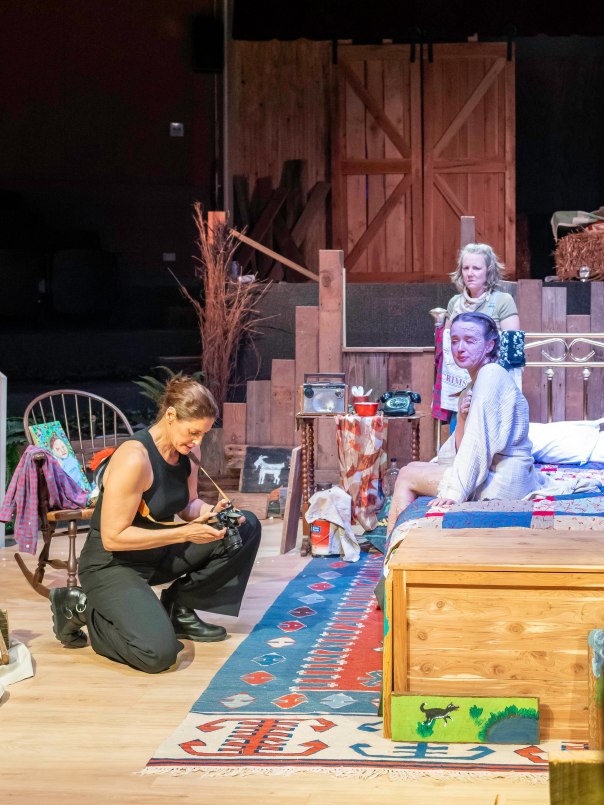
Google and Alexa will tell you if you ask: it’s a little bit more than a 17-mile drive from Bessemer to Alabaster, Alabama. Every source I’ve checked also confirms that Gip’s Place, the last backyard juke joint in America, was in Bessemer until its blues guitarist founder, Henry “Gip” Gipson, passed away in October 2019 at the age of 99. It’s useful to know that when we meet Weezy, the first character to speak at the Mint Museum – in the first Carolina Actors Studio Theatre production anywhere since its 2014 NoDa demise.
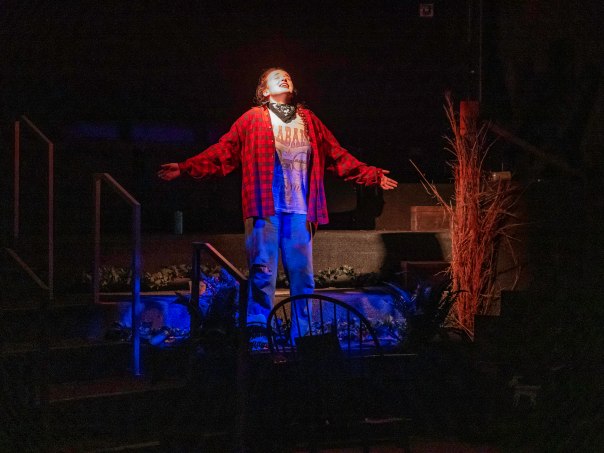
Weezy tells us that she lives at a small farm “right near” Gip’s Place in Alabaster.
True, we have ample reason to question Weezy’s veracity from the get-go, since she also introduces herself as a goat. Titling her comical drama Alabaster,playwright Audrey Cefaly could coyly blame her geographical inaccuracy on this cantankerous barnyard beast she created. But the choice, invoking the special malleability of a stone that has been reshaped by sculptors and artisans for millennia, is clearly an artist’s choice.
As we continue to follow the scrappy encounter between two artists in backwoods Alabama, one a celebrated photographer of celebrities and the other an unknown painter, we often find that Weezy – among other things – is Cefaly’s surrogate. In one meta moment you can look out for, Weezy even delivers a message from the playwright to one of our protagonists.

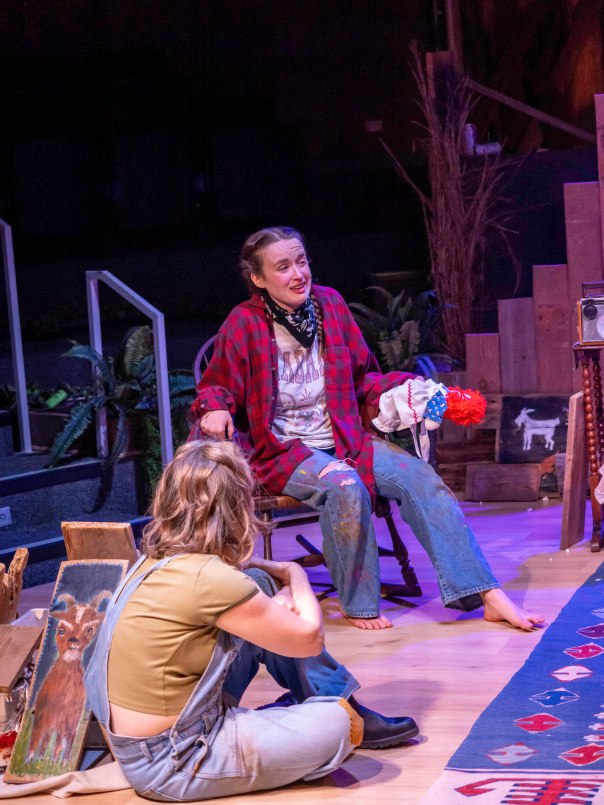
Mostly, Weezy serves as an irascible Jiminy Cricket for June, the one human survivor on the farm. When she isn’t offering up prompts and explanations channeled from Cefaly, she becomes June’s better self, the self that is wishing to break free of her self-imposed isolation and artistic obscurity. When sweet optimism sours into clear-eyed skepticism and cynicism, Weezy becomes the painter’s inner voice: June’s worst critic.
And sometimes, she’s a goat, caring for her ailing mama. Weezy is fluent in English and goat. Occasionally, she’s also clairvoyant.
Both Bessemer and Alabaster are prone to tornadoes. Cefaly’s tornado has radically reshaped June, demolishing her farm and turning the entire left side of her body into a relief map of scars, patches, pocks, and swirling melty skin. Playing the role of June, Zoe Matney has a l-o-o-o-o-ng pre-show routine, for she must spend much more time than usual backstage getting director/makeup designer Michael Simmons’ concept applied – front and back, from torso upwards – with help from assistant director/makeup artist Dee Abdullah.
Then she is onstage as the audience arrives, long before lights dim and Weezy enters.
If Weezy weren’t there, we must also remember, we wouldn’t have a reason to hear from June, though her first response to the goat’s prodding is no more than a well-chosen finger. Fortunately, we are quickly liberated from the confines of an inner dialogue by June’s distingué visitor, Alice.
Acquainted, you can bet, with Annie Leibovitz and no further than a light meter’s distance from Demi Moore, Alice’s career has recent taken a hairpin turn to the scarred-women project she’s working on now. June is her seventh subject, and Alice works in multiple media. Trying to reach the traumatized inside of her subjects – all women – while finding the dignity and beauty mixed with the deformity outside, Alice documents them in video interviews and, when the time and light are right, by snapping coffee-table-quality portrait photos.
Are these scars a form of artwork?
A fresh aspect of artist’s choice comes into play with Cynthia Farbman Harris as Alice. Alabaster premiered in December 2019, just two months after Gip’s passing, in Fort Myers, Florida – the first stop in a “Rolling World Premiere” presented at 11 member companies of the National New Play Network, a rollout spanning from New Jersey to Oregon. The QC had a company in that Network, Actor’s Theatre of Charlotte, which had rolled with some of these co-op premieres before.
When asked about the switch away from glamor assignments, Alice deflects at first. She only gives herself away slightly when asking June about her “accident” – a word more apt for her own trauma – and when, egged on by June’s questioning, she scrolls back far enough among places she’s been before Alabaster to her rehab.
So it shouldn’t be too surprising to learn that Actor’s Theatre was scheduled to premiere Alabaster in the latter half of its 2022-23 season, just over two years ago. More of you will remember that Actor’s Theatre did not make it to the end of 2022, planting its gravestone among the most honored companies in Charlotte’s theatre cemetery before the halfway point of its 34th year.
For Harris, who auditioned for that abortive ATC production, it was a matter of not forgetting. She had worked with Simmons at CAST, with a variety of other stints at Moving Poets, Queen City Theatre, and Theatre Charlotte – including a pair of diva roles, Maria Callas in Master Class and Blanche DuBois in A Streetcar Named Desire. If the role of Alice stuck with her after ATC’s demise, there must have been plenty of meat on the bone.
With an eye toward reviving the edgy theatre vibe that reigned while ATC, CAST, and QC Theatre were all up and running, Cynthia and her husband, actor Michael Harris, have founded Actors Collaborative Theatre to help make it happen. The new ACT is an associate producer of Simmons’ rebirth, while Moving Poets and Charlotte Contemporary Theatre are among the companies listed in the digital playbill on CAST’s thank-you list.
If you know how long ago Harris starred as Blanche, then you know Alice is bit of a stretch, no matter how much she wanted it. We’re not just talking about the yoga scene. With Abdullah serving as intimacy director, June’s master bedroom becomes more than an artist’s studio. Scars and all, June brashly inquires whether Alice is gay, before we learn the photographer’s full backstory.

Somehow, Matney and Harris make their love-hate relationship work altogether naturally and spontaneously. It only becomes a little more cerebral than Cefaly imagined it. They lean into the age difference a little instead of pretending it doesn’t exist. But they do traverse the long, rugged terrain to the primal mode. The two artists debate whether their meeting is like The Bridges of Madison County or not. Yet they could also debate whether they are both hostile animals locked in cages of their own making – while the liberating keys are always in their hands.
Actually, they do talk about that.
Matney’s performance is every bit as stunning as Harris’s, if for no other reason than June is so moody and mercurial. Ambivalent about having her paintings exposed to outside world, June is living with desperate intensity in her present isolation, hoping for a sunnier future – she has invited Alice here, though she is wary – while repeatedly tortured by her past trauma.
Something as trivial as the beep of Alice’s camera can trigger flashbacks to the worst. Adding to the inner psychological circuitry are the stresses of fresh lightning and thunder – plus the partial nudity at the start of the photo session. Matney calibrates her various disturbances well when her hurting is raw, and she channels energy convincingly into compensatory actions when June is striving to appear calm and well-adjusted. She also leaves room for just the right amounts of flirtation and coquetry.
Kelly Mizell, who plays Weezy, can tell you how long ago Harris sashayed into Nawlins as Blanche, for she was an outstanding Stella Kowalski in that same Theatre Charlotte Streetcar way back when. Given the opening entrance, this talking goat decisively demonstrates that she can still command a stage before discreetly receding into the background, sometimes as a handy guide, sometimes as an annoyance, and sometimes as a mind-reader.
Mizell gets to show Weezy’s tender side caring for Bib, her mostly pallet-of-hay-ridden “Mmaaahaaaahaaaa… maaaaaah!” You can see Harris wanting to play Alice enough to partly bankroll and publicize a production, but with so much stage time and so little spotlight (or vocabulary) as this old goat, Debbie Swanson had to really want this Mama Bib role. She’s wonderful when her moment comes.
Otherwise, there are remarkably few signs that Simmons and the Harrises are doing all this on a shoestring. Lighting design by Dave Meeder easily ranks with the best we’ve seen at the Original Mint’s Van Every Auditorium on Randolph Road. Tim Baxter-Ferguson, another name we fondly associate with a bygone era, installs a marvelously rusticated twin-level set design that simultaneously gives off vibes of woodsiness, springtime color, and irreversible damage.
Sophie Carlick’s costumes don’t have to be lavish, but they enable June, Weezy, and Alice to radiate an outdoorsy aura. Cleverly enough, June’s bedroom outfit hides her preoccupation with painting as decisively as her splotched overalls proclaim it, but the goat costumes also strike a perfect note. So do the many artworks fashioned for June’s artistic oeuvre on barnwood, to be auctioned off when Alabaster completes its run.
Simmons’ sound design and special effects are on-point, but I wish they had impacted more: louder, with more lightning crackle and windy sweep. Nor was the ringtone on Alice’s cell as ugly as Cefaly intended. As a photographer, I had to chuckle at the sadly unprofessional equipment we were seeing, including a camera with an onboard flash. Yet I could empathize with Harris – and admire her all the more – when she had to keep that lame videocam running and the still camera showing snaps on its screen.
When Alice instructs June on how to use a smart phone, when she shows her how to trip the shutter, and how to review the photo portraits on the wee screen… Quiet moments like these resonate with us, because they are part of a bonding process, two healing processes intertwining. Two resurrections. Three if you count the rehab June and Alice join in on with those barnwood scraps.
Good reasons to smile as we left the Mint. Along with the resurrections of CAST and a vital drama Actor’s Theatre never got to present.

 Art on My Sleeve