Tag Archives: Andrew Samonsky

Uhry’s “Parade” Marches on, Trampling Justice for Leo Frank

Review: Parade at Belk Theater

By Perry Tannenbaum

A couple of simple online searches confirm the widespread shibboleth. “Everyone loves a parade” summons up millions of quotes and images – not to mention the occasional book, song, movie title, and a BRAND NEW sealed board game on eBay. Try “everyone does not love a parade” on Google and the engine blinks, seizes up, and drops a couple of pistons, yielding pretty much the same results, except for a couple of incredulous newspaper headlines.

“Who Doesn’t Love a Parade?” asked the New York Times in an opinion piece back in 2018. Jim Tews, the author of the piece, breaks rank with his headline in his opening sentence: “I love a parade.” No, we must go further back to 2007, when opinion writer Susan A. Nielsen wrote in the Seattle Times – on the Fourth of July! – asking, far more accusingly, “What kind of sick person doesn’t love a parade?”

“I recently became aware,” she begins solemnly, “that some people, including my spouse and closest friends, hate parades.” Mercifully, she does not name names, but you can almost hear their diabolical cackles in the background.

Not a peep of dissent from the Google results on the rest of that webpage or the next five. Everybody loves a parade; that’s the settled truth. Unless they are still alive and sequestered in Seattle.

So be forewarned: in Alfred Uhry’s retelling of the events that led up to Leo Frank’s murder trial in 1913 and his lynching two years later, his protagonist/victim is a man who despises a parade. A specific parade. Instead of attending the Confederate Memorial Day parade in Atlanta on April 26, 1913, he opted to go to work at the National Pencil Company, where he was superintendent. It will cost him.

Onstage at Belk Theater, where the touring version of Uhry’s PARADEopened on Tuesday, Frank gets to say that, as a Jewish man from the borough of Brooklyn, he still feels like an outsider: “How Can I Call This Home?” he laments. His bad feelings would only be exacerbated if he were to attend a parade celebrating the Confederacy. What is there to celebrate?

Atlanta prosecutor Hugh Dorsey and extremist pamphleteer Tom Watson were the foremost public figures – and the loudest – to proclaim that such an explanation for Frank’s truancy from the parade was impossible. No, the real reason he went to National Pencil that day was to ambush, rape, and murder 13-year-old Mary Phagan, who came to her workplace simply to collect her weekly pay. Quaintly enough, in cash.

For those who rushed to judgment against Frank without solid evidence to back their convictions, The Confederacy, civic pride, and celebration were all synonymous with this spurned parade. Just by choosing Parade for his title, Uhry was taking Leo’s side, flouting the idea that the word blends naturally with bliss. Led by Watson and Dorsey, the parading goes on despite criticism or opposition, becoming an orchestrated stampeding of Frank’s rights and humanity, deeply drenched in antisemitism.

Retribution for Dorsey and Watson? Hardly. Dorsey would subsequently be elected Governor of Georgia and Watson would become a U.S. Senator.

Plagued by technical difficulties when Halton Theater was young, the 2006 production of Parade at CPCC Summer Theatre didn’t rock my world, though my world is deeply drenched in Judaism and Jewish culture. So my wife Sue and I were surprised by how powerfully this touring production impacted.

It was like a stunning gut punch for me in the wake of Charlottesville, Pittsburgh, and the uptick of antisemitism since October 7. I felt physically nauseous as this horror of sensationalized press, suborned testimony, and a grotesque parade of cookie-cutter witnesses – factory girls who were obviously coached – took on the rancid smell of an inevitable conviction.

You could see Frank’s righteous self-confidence crumbling along with the suave composure of Luther Rosser, his cocksure defense attorney. Long before vigilantes entered the picture.

For others without my Ashkenazi DNA and yeshiva background, Parade might not elicit the same visceral response. It would be interesting to see whether Uhry, the Atlanta native who also gave us Driving Miss Daisy and The Last Night of Ballyhoo, would have had more success if he had worked alone on Parade – without the music and lyrics of Jason Robert Brown and the co-conceiving of the esteemed Harold Prince, who also directed the original production.
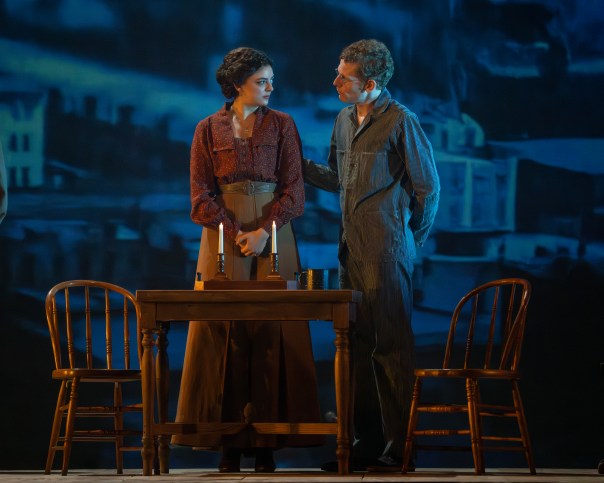
The upscaling of Uhry’s script was certainly warranted by the Leo Frank tragedy – and the crucial action that must unfold in a chaotic courtroom – but the timing was not ideal after Ragtime, painted on a far broader canvas, opened earlier in 1998 in a bigger house. Michael Arden’s restaging for the 2023 revival of Parade can also be off-putting if you don’t care for actors lurking silently around the action between scenes and becoming stagehands during transitions.

We cannot accuse the lead performances of any such artificiality. The passion of both of the principals reaches deep down into this cast, from Max Chernin as Leo to Jack Roden as Mary Phagan’s aspiring boyfriend. So the level of melodrama in their voices, ardently singing Brown’s Tony Award-winning music, rises to operatic levels and beyond.

Chernin is freed from meek innocence during Leo’s trial, becoming his own demonic caricature in “Come Up to My Office” as the robotic factory girls horrifically distort his personality. It was painful to watch him rise from his seat at the defense’s table, climb to the platform where witnesses gave sworn testimony – and Judge Leonard S. Roan presided – only to surrender totally to the girls’ perverse depiction of him and jubilantly surpass it.

Easily as talented as Chernin, Talia Suskauer struggles to clarify Lucille Frank’s marital problems with Leo, perhaps because her biggest opportunity, “What Am I Waiting For?” is saddled with lyrics by Brown that are too subtle. They have an arranged marriage in Uhry’s telling. While Leo has yet to cope with the cultural distance between Brooklyn and Atlanta, there is still an intimacy gulf after four years.

It would help a little if Suskauer sounded Southern more often, but if Parade is already grabbing you with its systemic intolerance, Lost Cause immorality, Gestapo cops, and hypocritical pomposity, the drawl deficit will evaporate amid the deluge of her straightforward “You Don’t Know This Man.” One of the chief beauties in Uhry’s script, true history be damned, is the growth of Lucille in Act 2, triggered by her “Do It Alone,” flung at Leo while he’s festering in jail, hoping for a retrial.

On the cast album, that song sounds like a vehicle for Streisand at her most histrionic, but Suskauer blazes her own trail. Implausibly, I haven’t found a single cover of this raging powerhouse outside of cast albums on Spotify.

As the ranting Tom Watson, we get Griffin Binnicker in a Colonel Sanders suit feverishly waving a bible – like a nightmare premonition of a J.D. Vance presidency. No less irritating or unscrupulous, Andrew Samonsky as prosecutor Hugh Dorsey is yet another evocation of the sort of pure evil politician we thought was ancient history.

There is more than a sprinkling of prejudice in Leo’s views of the South and his sexism. These go unchecked until Lucille rightfully scolds him and proves herself. As for Leo’s chronic alienation, aloofness, and lack of social skills, Uhry seems to overlook the fact that Frank was elected president by the 500 members of his local B’nai Brith and was instrumental in getting the national organization to stage its 1914 convention in Atlanta.

As a truly innocent little weakling, Olivia Goosman still stands out as Mary Phagan, and the creators are wise to bring her back to life a couple of times – during the courtroom trial and when the lynching becomes imminent. The only taint on her is her susceptibility to her dearest admirer, Roden as Frankie Epps.

It wasn’t her fault that Roden reminded me so chillingly of Hitler Youth once the mass hysteria began, another flashback to fascism that refuses to die.

Maybe the most delicate part of the storytelling is Uhry and Prince’s concept of the three African Americans who testify against Frank. Though both men are likelier suspects than Leo, neither Robert Knight as janitor Newt Lee nor Ramone Nelson as escaped prisoner Jim Conley comes off as a mouth-breathing predator. Knight is the meeker character (and the likelier suspect), yet even without Leo’s Ivy League education, Newt has a better grasp of how to deal with cops.

Same with Nelson, though as Conley he is gifted with a more elegant and dangerous street wisdom. You might easily associate him with the world of Porgy & Bess if you can imagine him as the best of Sporting Life and Crown – capsulized to a point where it under-employs Nelson’s talents.

Most nuanced among the Jim Crow roles is Danielle Lee Greaves as the Franks’ housemaid, Minnie McKnight. Scenic designer Dane Laffey gives us a playing space that looks more like a lumberyard or a construction site than a battlefield, a boulevard, a governor’s mansion, a courthouse, or a business executive’s home. We’re more inclined, in this hardscrabble world, to empathize with Minnie’s corruptibility or tribal loyalty.

And she has regrets over her incriminating testimony to luxuriate in after the trial. Unlike Chris Shyer as Governor Slaton, Greaves has little power to act on her remorse. Shyer has a wider, more satisfying character arc to work with. Thanks to projection designer Sven Ortel, we get stage-filling front-page headlines every step of the way, a parade of Watson-sparked alarms from the first news of the Phagan’s murder until Leo is hanged. So our first visit to Slaton’s mansion after the murder shows him prodding Dorsey to find and convict the killer as quickly as possible.

Capitulating to media pressure.

Later, once Lucille gets the green light to advocate on Leo’s behalf, the Governor of the great state of Georgia becomes Lucille’s private investigator, a white-haired Paul Drake to her Perry Mason. Then, in a U-turn to real life, he commutes Leo’s sentence. Nice try, Guv!

We have some empathy as well for Michael Tacconi as on-the-skids reporter Britt Craig, who “scoops” all other Atlanta reporters in spreading malicious disinformation about the case. Until he sees the light, he may seem like a tool for Dorsey and Watson. Just an average Joe grasping where his bread will be buttered.

Not a bit of empathy goes out to Evan Harrington as the Old Confederate Soldier and Judge Roan. Because of their majestic dignity, neither of these upright gargoyles has any regrets. To our great misfortune, such folks are still around, still waving their flags, and still parading.

Farewell, America

Review: Come from Away

By Perry Tannenbaum

9195_The First North American Tour Company of COME FROM AWAY, Photo by Matthew Murphy, 2018

Traveling to Europe by air, you may recall the animated maps that flash onto the seatback screens facing you, orienting passengers during the flight as your pilot follows the great circle route over the Atlantic. At the very eastern edge of North America, you’re likely to notice the name of Gander, a Newfoundland outpost oddly mixed among the names of larger, more familiar cities.

So when all of North America’s airspace was shut down during the emergency of September 11, 2001, and 38 commercial and 4 military flights were diverted to the Gander International Airport, it was the next-worst thing to forcing more than 6,600 civilians and soldiers to wait it out on the ocean. Passengers almost had to bid America farewell. It was no picnic for the citizens of nearby Gander, either, who suddenly discovered that their airport had been transformed into a major immigration hub – while the population of their sleepy town mushroomed by over 66%.

Yet somehow, the hubbub sorted itself out beyond all expectations. At the time when news hit of the warm-hearted welcome strangers were experiencing in the wilds of Newfoundland, it was the feel-good story to break through a tsunami of anger, grieving, finger-pointing, and Islamophobia. A little island of hospitality in an ocean of hostility.

Sixteen years later, when Canadian husband-and-wife team Irene Sankoff and David Hein retold the story in a Broadway musical, Come from Away, the time was ripe for the Gander love-in to strike a nerve once again. When the show opened for previews in mid-February 2017, less than a month after Inauguration Day, an infamous Muslim ban had recently gone into effect, a thousand-mile Southern border wall was still a political imperative – most intensely among small town rustics, it seemed – and a wave of anti-immigration sentiment was sweeping Europe.

In that climate, Come from Away must have seemed like a rallying cry, hearkening back to a time when Christian values hadn’t devolved into round-the-clock xenophobia. This week, as the touring version of the Broadway hit rolls through Belk Theater, there hasn’t been a politically-charged photo op from an internment camp in recent memory. Iran, Ukraine, Russia, or our pathetic Panthers are more likely to inflame our passions than any imminent threat from Guatemala.

We’ve turned the page, right? I wondered if the warmth of the quirky Canadians and their spontaneous connection with a global hoard of uninvited guests would still resonate, especially when the storytelling turned out to be so objective, bland, and non-confrontational.

As studiously as Sankoff and Hein avoid controversy, analysis, or agonized post-mortems, they do go into admirable detail about the logistical challenges of accommodating thousands of detainees in the middle of nowhere. Pandemonium may have broken loose near Ground Zero, but airspace across the continent was in virtual lockdown, security precautions around aircraft especially tight. Our first peeps inside a passenger cabin, as planes languish on the ground until proper processing can be set up, show us people going stir crazy during the 28 hours they must wait before deplaning – separated from their checked luggage in an information blackout.

The North American Tour of Come From Away Photo Credit Matthew Murphy_0423-Edit

Raiding their supply cabinets and freely handing out booze is one remedy a crew might try to ease the tedium, even if it doesn’t altogether restore quiet and calm – or appease the claustrophobic crone in the back row. Twelve actors draw the task of simulating all the global passengers and all the Newfoundlanders involved in this massive coping drill, so there’s an electric bustle as the actors switch from their traveler roles to townspeople.

While the passengers hovering over airstrips are disoriented, experiencing the surreal, on the ground in Gander, the impact is very much like a benign invasion has suddenly hit. An ordinary day that begins with the mayor ordering up his customary cuppa joe at Tim Horton’s is no longer pre-programmed. Instead of meeting with the leader of the school bus drivers to negotiate an end to their strike, he’ll be soliciting cooperation from this foe in transporting over 6,000 aliens from the airport to town.

Elsewhere, a school teacher will need to take charge of opening an emergency shelter and breaking the news of the attack to the passengers. Feeding, washing, and bedding all these travel-weary people must also be managed. The newcomers speak a host of languages and have a host of unforeseen needs – including kosher meals – and helping so many to simply check in with friends and relatives, by phone or by email, is a formidable challenge. It is almost comical when a local SPCA worker pops up, concerned about the plight of the cats, dogs, and monkeys stowed in the belly of the planes with the cargo.

In short, there’s a multitude of practicalities in the hurly-burly of this 100-minute musical that largely distract us from the two main things: the massive kindness that the Newfies showered on the newbies, and the massive changes to our world that came with the events in Manhattan, at the Pentagon, and aboard Flight 93. A few of the passengers remind us of the big picture. Beverley, a pilot, and Hannah, a mom, worry that loved ones may have perished, and there are multiple hints that the seeds of Islamophobia have already started germinating.

Otherwise, life goes on. Kevin T and Kevin J, a gay couple with personality differences, may or may not break up. A Texas woman and a British guy may get together, overcoming wariness, shyness, and the brevity of their acquaintance.

We aren’t deluged with one-on-one kindness from the friendly natives, but there are choice examples. The teacher, Julie Johnson as Beulah, bonds with Danielle K. Thomas as Hannah because her son is also a firefighter. Two Kevins walk into a Gander bar and find that their fears of Laramie homophobia are groundless – they’re accepted warmly and instantly. A nearby mayor invites the wary Bob to his home, opens up his liquor cabinet to the stranger, and helps him overcome his fear that he’ll wake up tomorrow without his wallet. Or how about the local store clerk? After thanking a first-time customer for shopping at Walmart, she invites her home to take a shower.

The North American Tour of Come From Away Photo Credit Matthew Murphy_0950-Edit

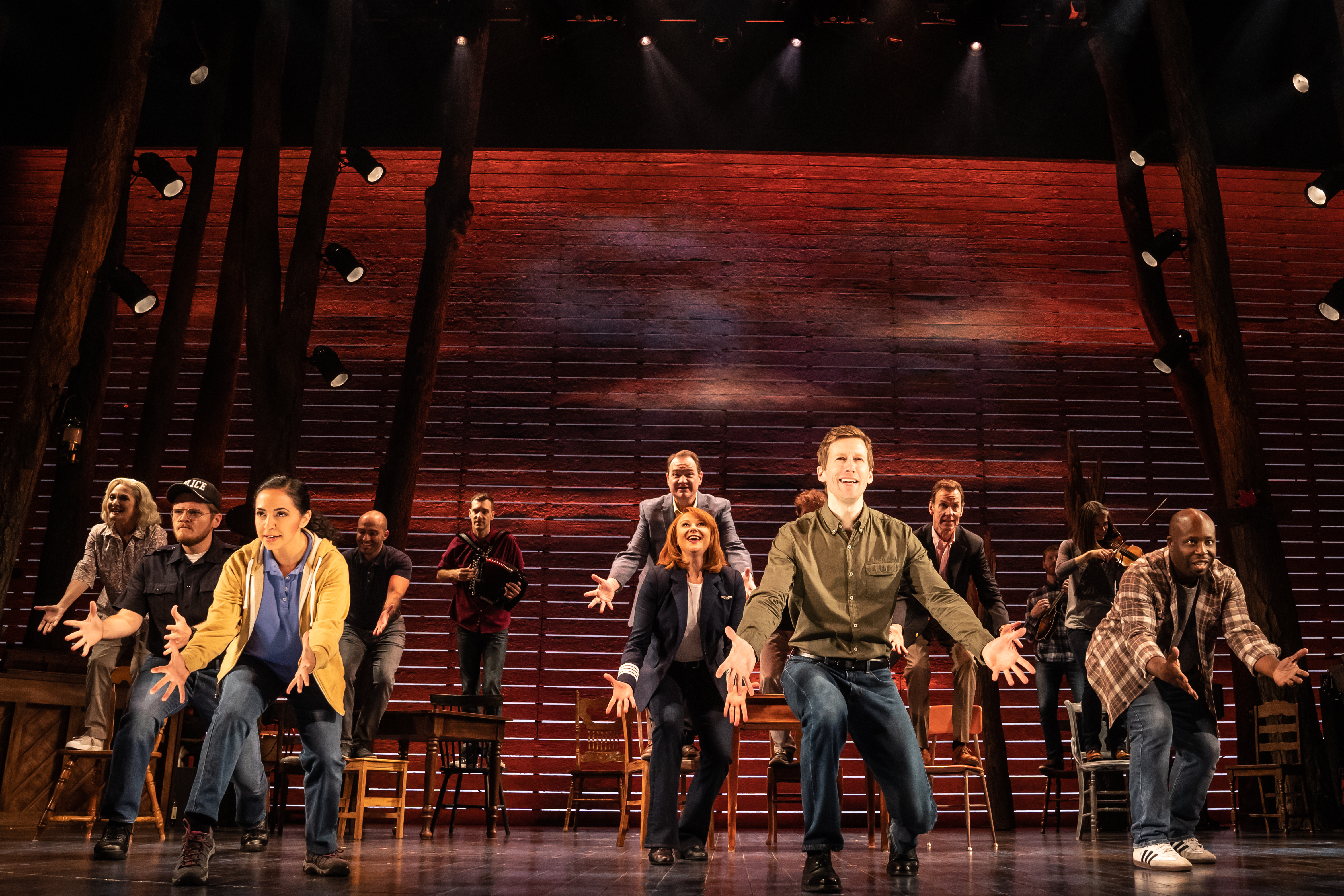
Beginning with “Welcome to the Rock,” most of the songs in the score are sung by the entire ensemble, choreographed with the right kind of vivacity by Kelly Devine, so we often get a sense that we are watching an energetic community response after all. With a script that doesn’t have the Twin Towers, al-Qaeda, radical Islam, Osama, or even terrorism prominently in its vocabulary, that communal energy seemed to be the most potent reason why Come from Away connected so viscerally with the near-capacity crowd at Belk Theater on opening night.

While there are plenty of feel-good experiences to be found on our current media landscape, including synthetic fantasies of communities bonding together and accepting one another, Come from Away comes to us at a time when we seem hopelessly fractious and divided, digging in against each other instead of helping each other out. And the comity of Come from Away strikes us as very real, very possible – and as a rebuke that isn’t saddled with a party label.

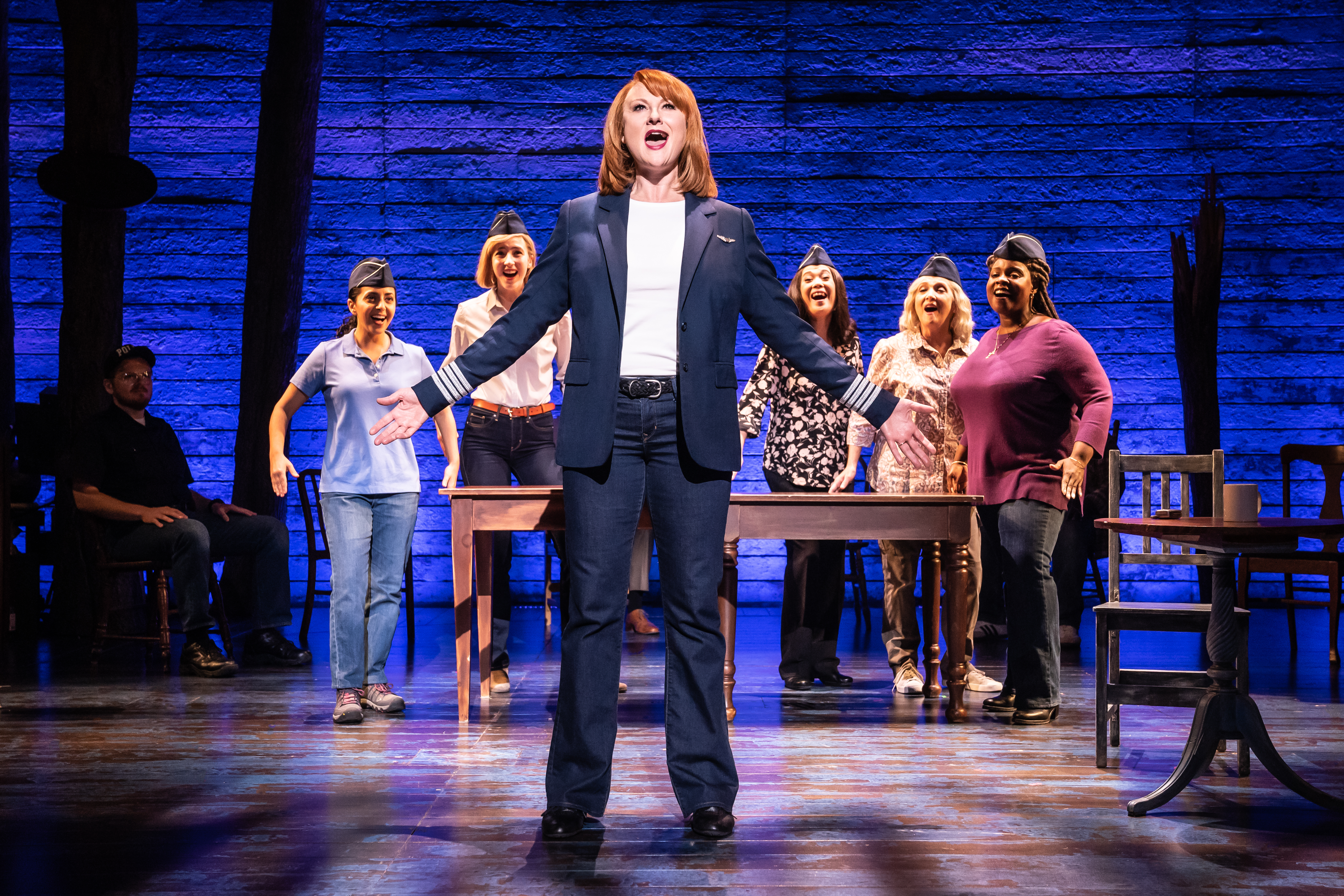
After the opening ensemble, there isn’t much in the Sankoff and Hein score to keep us airborne until we reach “Me and the Sky,” a showcase for Beverley, who turns out to be first female airline pilot at American Airlines. Marika Aubrey ably takes the controls here, counterbalancing the levity of the barroom scene that precedes. In that episode, we get the most genuinely communal spectacle of the evening, presided over by Kevin Carolan as the mayor.

The North American Tour of Come From Away Photo Credit Matthew Murphy_0503-Edit

While visitors get the opportunity to be initiated as honorary Newfies, Andrew Samonsky as Kevin T and Nick Duckart as Kevin J get to define their differences, while Chamblee Ferguson as the Brit and Christine Toy Johnson as the Texan get to share their first sloppy kiss. A local liquor, “Screech,” lubricates the zany ritual, along with a freshly-caught codfish.

Others in the cast who make an impression come across as the youngest – and maybe as surrogates or prompters for us as we watch. James Earl Jones II as the skeptical Bob registers his wonder at Northern hospitality most tellingly and holds our attention after he and his fellow passengers have returned home. When she isn’t clerking at Walmart, Julia Knitel is most notably a cub reporter on the local TV station, faced with the ginormous cataclysm of 9/11 on her first day in the field. Lanky, gawky, and adorable.

Sharone Sayegh may just be even more adorable as the SPCA zealot so mindful of the animals when all of humanity’s minds are elsewhere. No doubt about it, Come from Away comes to us with plenty of heart. Question is, will we come to Belk Theater to escape what we have become 18+ years later, or will we come to experience a reckoning? No matter which, audience reception on opening night seemed to hint that they had felt an unexpectedly positive vibe – an affirmation that, in the face of so much division and adversity assailing us, we can be better.

Searching for an Italian Iowan

Theatre Review: The Bridges of Madison County

Madison County

By Perry Tannenbaum

The problems with this show really began before the first note. I’ve never read The Bridges of Madison County nor seen the movie that was adapted from Robert James Waller’s bestseller. What I vaguely remembered was that it centered on an Iowa housewife who was beguiled by a charismatic photographer, and that Meryl Streep was that housewife romanced by Clint Eastwood in the movie.

But I never knew she was Italian. So when Elizabeth Stanley began to sing as Francesca in the touring version of the Broadway musical, I only intermittently understood a word that she was saying. None of those words, unfortunately, was Napoli. Albany, Cleveland, and Osceola, yes I understood those, but by then I’d missed the boat.

Even when I caught on to the idea that this Iowa housewife was Italian – and what the target accent was that I needed to decipher – it was of little use when Stanley sang. The James Robert Brown lyrics were hopelessly pureed even though the James Robert Brown music was quite lovely.

I’m not sure I’ve ever seen a touring Broadway show so thoroughly massacred by its leading lady.

On the other hand, Andrew Samonsky was all of the lanky dreamboat you could hope for as Robert, the easygoing National Geographic photographer who bounces around the globe with his camera and tripod, hunting down the perfect light and angle for every scenic subject. When Samonsky says Stanley is beautiful, you can momentarily believe it.

I’d seen Samonsky seven years ago as a moody, racist Lt. Cable in the Broadway revival of South Pacific, and I could see why director Bartlett Sher wanted him back. Now his hair has grown long, the mellow opposite of the tightly wound Cable. Even on Broadway, you rarely hear a voice of such astonishing clarity and power. No struggle at all to get to the core of Robert’s restless, yearning soul.

Noisy kids, snoopy neighbors, and a humdrum husband all circle around the vortex of the great Francesca-Robert passion, swelled to Broadway size in the Marsha Norman book but not really overstuffed. We don’t feel like we’re watching a big Broadway extravaganza at Knight Theater. Scenery by Michael Yeargan has the spare fantasy feel of the dream sequence from Oklahoma, and Brown’s orchestrations have a matching classic simplicity, thinning out at times to a lone piano or even a cello.

So for the music and the soulful Samonsky, the trip to Madison County may be worth it. But before you go, it would be wise to catch hold of Francesca’s lyrics on the cast recording. If your Spotify subscription allows you to punch the lyric tab, that’s the quickest way.