Tag Archives: Allison Snow Rhinehardt

If You Loved the Clunky TV Rudolph the Red-Nosed Reindeer, You’ll Adore the Children’s Theatre Musical

Review: Rudolph the Red-Nosed Reindeer at ImaginOn

By Perry Tannenbaum

November 22, 2025, Charlotte, NC – Okay, so Christmas erudition isn’t my thing. Thanks to the Gospels of Matthew and Luke, my familiarity with the biography of Jesus, from the Anunciation to the Resurrection, is sufficiently sketched out, though not nearly as complete as my knowledge of Moses and Joseph. My familiarity with Christmas and the Nativity comes mostly from network TV, the annual inundation of all media, neighborhoods, and supermarkets with the holiday spirit when the season comes around, various musical and movie masterworks such as Messiah and The Christmas Carol, and very infrequent visits to Christians’ homes when their trees were decorated.

All of this is to say that, until a couple of days ago, my ignorance of Rudolph the Red-Nosed Reindeer was quite profound. Silly me, I thought “Rudolph the Red-Nosed Reindeer” was simply a hit song recorded by singing cowboy Gene Autry that has haunted the airwaves and shopping malls since 1949. It wasn’t until Children’s Theatre of Charlotte premiered this past weekend at McColl Family Theatre in ImaginOn that I found out that Rudolph the Red-Nosed Reindeer was also a well-known story – and has been since the original song by Johnny Marks and story by Robert L. May was adapted for an animated TV special by Marks and scriptwriter Robert Penola in 1964.

Sam the Snowman, Hermey the elf, Mrs. Donner, Clarice the doe, Yukon Cornelius, snow monster Bumble, Boss Elf, Coach Comet, and the Misfit Toys were all new to me as the Children’s Theatre Rudolph unfolded. Only later was I informed that my own stepchildren had grown up on all of them. Maybe my daughter, too! Sadly, all this nostalgic family info arrived too late to sway my affections toward what I had just seen onstage. As much as I’ve always adored the Rudolph song – or perhaps because of that longtime adoration – I found that I disliked this precious and sugary musical.

Let’s begin with the costume designs by Kahei Shum McRae, so lovingly faithful to the original TV art. That’s a huge problem for me. Since cartoons and animation were defined for me in my childhood by what they delivered, ranging from Snow White and Batman to Bugs Bunny, Bullwinkle, and Hanna-Barbera, the advent of Claymation, Animagic, and stop-motion – whatever you call it – seemed like a clumsy step backward to me. Sure, the small-scale props and dolls cast 3D-like shadows, but they were as immobile and expressionless as dolls or puppets, plopping you awkwardly back into the real world.

Though McRae successfully recreates the feel of the old TV evergreen, he is hamstrung by that objective and all its cuddly clunkiness. Sam the Snowman seems to truly roll across the McColl stage inside his snowy skirt and plaid vest, and the puppeteers who team up to form Bumble are barely more terrifying than a jellyfish of similar size. To the rescue come youth and adult actors who can visibly inhabit McCrae’s costumes and give them energy and spontaneity.

Woke objections that have been raised against the tale didn’t faze me, though they likely dulled the edginess that director Christopher Parks could have brought to this production if he had defied them. Au contraire: Amp up Santa’s rejection of Rudolph’s shiny nose, the other reindeer’s bullying, Donner’s male chauvinism, and the fearsomeness of Bumble (a name change might also help) so that our hero’s sufferings are more in line with those we find in our favorite fairy tales.

Politically correct or not, triumphs over mighty evils are more satisfying than triumphs over muted evils that fade away as soon as they’re opposed. Forbidden to associate with his sweetheart Clarice and banished from his reindeer team and their games, Rudolph runs away instead with Hermey, the misfit elf who would rather become a dentist than build toys. Vance Riley has the perfect elfin look as Hermey, with a resemblance to Will Ferrell that plays well into the misfit’s wackiness.

But it’s Tilly McDaniel as Rudolph who best models why this live theatre Red-Nosed Reindeer, vapid as it may be,is so much finer to me than the TV travesty. Under her adorable reindeer jumpsuit, McDaniel is recognizably human – or venison – rather than clay. When the lovely Julia Straley, as Clarice, comes on to him with praises galore, Rudolph’s reaction is a cosmic blush: Rudolph’s nose suddenly glows, and McDaniel flies up into the air. There’s genuine emotion here, notwithstanding the slaughterhouse hoist..

On the other hand, I subjected myself to all of the Animagic version I could find on this side of the $8.99 paywall. Everything I saw struck me as painfully primeval and lifeless – you’d have to pay me far more than nine bucks to watch it all. Only a few snippets of Santa can be found in the clips and trailer I sampled, enough to firm my conviction that John DeMicco as Santa and Allison Snow Rhinehardt as Mrs. Claus are far more rewarding than their Claymation counterparts. Rhinehardt even adds some grace notes that give the impression that Mrs. C is pushing back against Santa’s grumpiness and prejudice.

Likewise, Carlos Nieto and Ericka Ross convince us that Rudolph’s parents, Mr. and Mrs. Donner, have real souls instead of clay molds. You can feel that they’re genuinely worried about their cute little oddball offspring. Our host and narrator, Brandon J. Johns as Sam the Snowman, was geniality itself, establishing a fine rapport with the matinee audience and delivering “A Holly Jolly Christmas” with nearly as much avuncular jollity as its originator, Burl Ives.

Moonlighting from multiple puppeteer exploits, including the bodacious Bumble, Alex Manley gets his face time as the Boss Elf, so sunny that you never believe he really opposes Hermey’s dentist dreams in his heart of hearts. Richard Edward III drew two chauvinist bucks to portray: Coach Comet, Clarice’s intimidating dad, and Yukon, the flamboyantly superfluous gold-digger that Rudolph and Hermey meet in their travels. Kids of all ages seemed to delight every time Edward wielded his prospector’s pick-axe, particularly when we learned – or at least I did – that he wasn’t hunting for gold.

Jews, Blacks, and JFK Converge at Concertized Kushner

Theatre Review: Caroline, or Change

2016~Caroline or Change_0028-1_edited-3
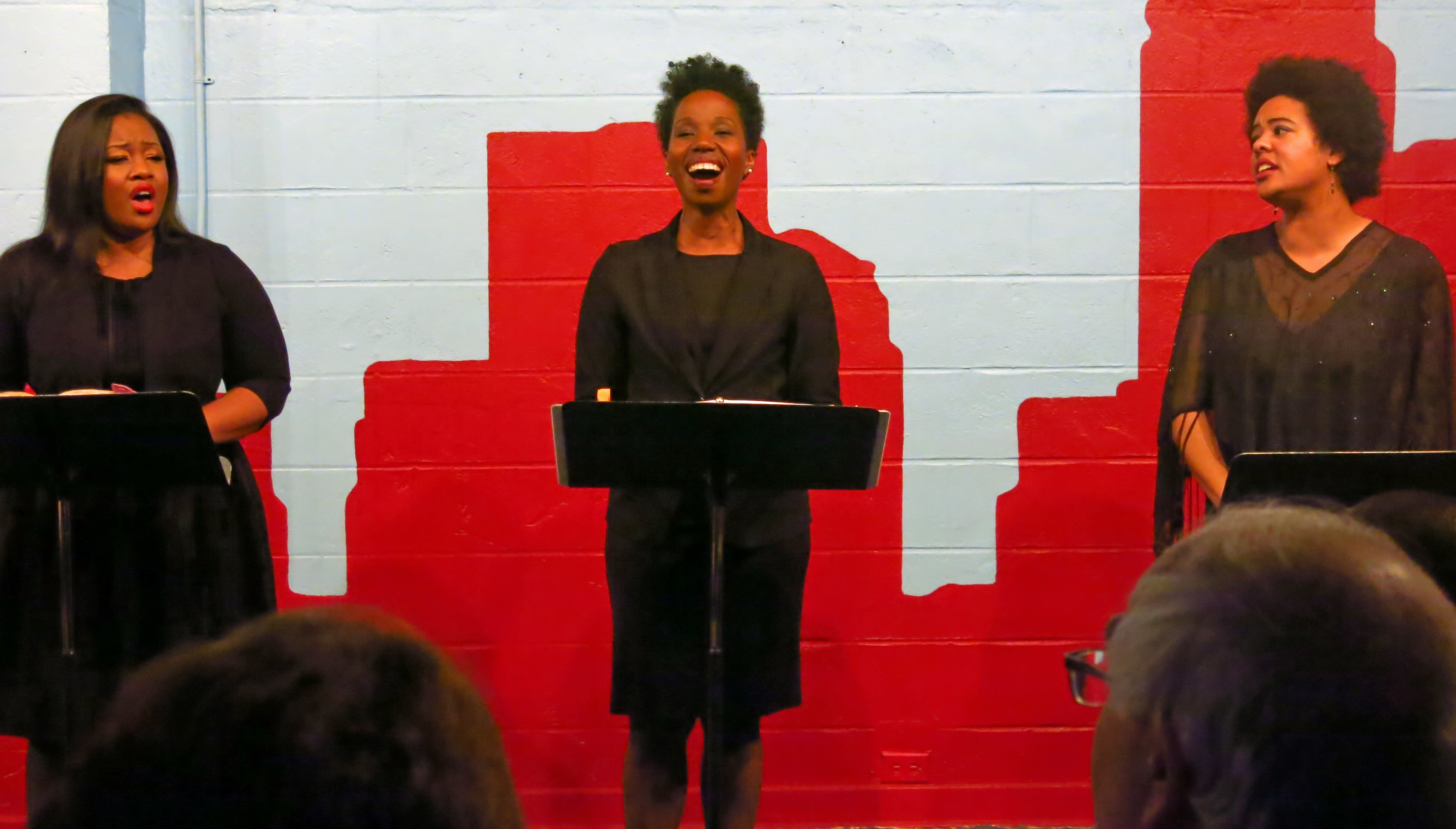
L-R: Brittany Currie, Tracie Frank, and Veda Covington

By Perry Tannenbaum

The relationship between African Americans and Jews has been a fascinating convergence of parallel histories and unavoidable class conflict. We’ve had a couple of dramas here before that dramatized the relationship, beginning with Alfred Uhry’s famed Driving Miss Daisy, which reached the Charlotte stage in 1991, just two years after the Oscar-winning movie. The 1988 Pulitzer Prize winner took us back to Atlanta after World War 2, when the curmudgeonly Daisy was in denial about her physical deterioration, her racist attitudes, and the prevalence of anti-Semitism in her city.

Just over three years ago, Actor’s Theatre of Charlotte brought us Matthew Lopez’s The Whipping Boy, transporting us to the first days of Reconstruction after the Civil War, when two emancipated slaves returned to their former owner’s home for Passover. Between Uhry’s drama and Lopez’s auspicious 2011 debut, Tony Kushner collaborated with composer Jeanine Tesori on a musical – a chamber opera, really – that looks at yet another Jewish household where an African American was employed.

Until last February 26, when Theatre Charlotte brought Caroline, or Change to its lobby for one night only, the widely-hailed 2003 piece had never been performed in the Queen City. It’s unquestionably the most ambitious Grand Night for Singing event held at the 501 Queens Road barn. The format has been in a cabaret spirit, songs selected from a rarely performed musical taking up half of the program, more rarities by the same composers after intermission. With Caroline, music director Zachary Tarlton staged a concert-style production of the full show – and so many people bought tickets that Theatre Charlotte executive director Ron Law nearly had to move the performance out of the lobby and into the auditorium.

Caroline Thibodeaux works in the bowels of a home owned by Stuart Gellman and his second wife, Rose, but the core of Kushner’s story – an autobiographical one according to the playwright’s intro to the printed edition – is the relationship between Caroline and Noah, Stuart’s 8-year-old son from a previous marriage. Although Caroline takes place in 1963, closer in time to Daisy than Whipping Boy, its resemblances to Lopez’s script are strong enough that it could have served as the younger playwright’s model. During the Passover holiday celebrated by Caleb DeLeon in Whipping Boy, President Abraham Lincoln is assassinated. In the November-December timeline of Caroline, John F. Kennedy is assassinated before the Gellmans’ Chanukah celebration.

If Kushner had a model, the likeliest candidate would be another autobiographical play, Athol Fugard’s Master Harold, in which the title character also behaves unforgivably toward a black person working for his dad. In her dignity, in the way Caroline absorbs Noah’s abuse in apartheid Lake Charles, Louisiana, she very much resembles Sam’s forbearance toward Hally in apartheid Port Elizabeth, South Africa, in 1950. The big difference is that Kushner looks at Caroline as critically as he looked at Noah.

She’s a divorced, conspicuously joyless mother of three, staunchly resistant to change. The entire cast was outstanding, but we were especially fortunate to have Tracie Frank in the title role. We had a brief sampling of Frank’s gospel fire last spring in Theatre Charlotte’s production of Jesus Christ Superstar, but even her Whitney Houston bravura singing “I Don’t Know How to Love Him” hardly cushioned the surprise of this sustained excellence, her silent reactions nearly as taut as her vocals.

Stuart and Rose realize they’re not paying Caroline enough to comfortably take care of her three children, but they do what they can. In order to teach her stepson a lesson – and to slip the Thibodeauxs some extra cash – Rose decrees that Caroline can have whatever loose change Noah carelessly leaves in his pockets when she puts his clothes in the washing machine. Noah is more softhearted than Rose, so he starts leaving loose change in his pockets on purpose – until Chanukah rolls around.

Grandpa Stocknick, Rose’s dad, gives Noah a $20 bill in Chanukah gelt. Some days later, Noah is back in school and realizes that he has left the 20 in a pair of pants earmarked for the laundry. His piddling charity is in serious jeopardy of becoming lavish generosity, and he rushes home to retrieve his gift. Too late. It’s nearly Christmas, her three kids expect something under the tree, so do you think Caroline is going to put that $20 bill back in the bleach cup for Noah?

Noah is even less likable than Caroline in the fight that ensues, so it’s to Rixey Terry’s credit that he made the transition from adulating schoolboy to beneficent master to sore and abrasive loser so convincingly over the course of the night – and no fewer than 15 songs. Terry didn’t try to emulate an eight-year-old, so he didn’t sound at all like Harrison Chad on the cast album, a prudent choice for this reading-stage style presentation, adroitly stage directed by Corey Mitchell. He and the other younger members – the three Thibodeaux siblings and The Radio – had their music down pat, thanks to some good hard work and, I suspect, that cast album.

2016~Caroline or Change_0017-1_edited-1

Yes, the dramatis personae included some inanimate objects that brought Caroline’s basement domain quirkily to life, often with a gospel flavor. Dani Burke was Caroline’s Washing Machine while Maya Sistruck, Dominique Atwater, and Kayla Ferguson were The Radio, even more amazing when they harmonized than when they soloed. Among these kitchen accouterments, Tyler Smith was the king of appliances as The Dryer in an electrifying performance, Tesori’s score starting him off with a mix of street shout, yelped with Porgy and Bess gusto, and R&B that he crushed into the depths of his velvety bass baritone – with The Radio providing backup.

More of Kushner’s fanciful universe turned up outside of Caroline’s basement. Much to our delight, Smith returned to the row of lecterns at centerstage as The Bus taking Caroline and her friend Dotty home from work, but Brittany Currie often lurked on the side as The Moon, emblematic of change. The change that Noah leaves in his pants isn’t the only change Caroline struggles with. Although $30 a week isn’t enough to get by, it’s Dotty who is resolved to do something about it, going to night school in an effort to better herself.

So it’s both Dotty’s energy and initiative at the end of a long workday that irritates Caroline. Watching Veda Covington as Dotty, bragging that her daytime employer is actually proud of what she’s doing, I found myself a little irritated with both women, Dotty for needling her friend and Caroline for her unremitting sullenness. Currie as The Moon was a somewhat soothing presence crooning about change, but there was also a wisp of sultry sensuality in her vocals, very effective in this cabaret setting.

2016~Caroline or Change_0030-1_edited-1
L-R: Yabi Gedewan, Ibrahim Web, and TyNia Brandon as Caroline’s children

Mitchell had the races sitting at opposite sides of the stage when they weren’t at the lecterns, accentuating how little they actually interact during this musical. It’s mostly Noah and stepmama Rose who show an active interest in Caroline. Although she badly flubbed the Yiddish word for navel, Allison Snow Rhinehardt was an otherwise credible balaboosteh: a little unsure of her footing with both the new stepson and the help, somewhat sensitive to their feelings, yet definitely reveling in her mission to run the household and to command.

Upstairs-downstairs decorum was broken momentarily at the Chanukah party in one of Kushner’s most insightful scenes. Asked to help with the extra party housework, Caroline’s eldest daughter Emmie gets into an argument with Rose’s father about the efficacy of Dr. King’s non-violent civil rights movement. Caroline is outraged by her daughter’s presumption, Emmie is angered by her mother’s inbred meekness, and Mr. Stopnick thinks this is the first real conversation he has had since coming South to visit his daughter. Excellent work here from Frank, TyNia Brandon, and Vito Abate.

I would have been quite content just to witness some local theatre company putting Caroline on its feet after all these years. The fortunate few who attended the February 26 performance saw something far finer. With a minimum of rehearsal, the 17 singers and Tarlton performed nearly flawlessly, all the more astonishing when you consider that the musical director was never in the line of sight of any of the performers even once as they performed this challenging two-hour Tesori score.

Here’s hoping that we don’t have to wait another 13 years before Caroline, or Change is produced here again – and that, when Kushner’s lone musical returns, it will be fully staged in a larger hall for a larger audience in a longer run. As it deserves.

Photos by Perry Tannenbaum