Tag Archives: Alan Ariano

Puppetized “Life of Pi” Vindicates Its Truthiness

Review: Life of Pi at Belk Theater

By Perry Tannenbaum

Not too many novels weigh the merits of imagination against observation, myth against reality, or fiction against truth: the author’s bias in favor of fabrication is implicit from the first word in his first chapter. But after relating an epic and fantastic tale of a boy’s survival on the open seas, Yann Martel did exactly that in his LIFE OF PI, questioning and testing Pi’s story and measuring it against an alternate narrative.

Son of a Pondicherry zookeeper and named after a Parisian swimming, Piscine Molitor Patel is the only survivor of the Tsimtsum, a mystically-named cargo ship that set sail from the shores of India, bound for Canada. Martel, brooding over reviews of a previous book and suffering from writer’s block, finds out that Patel, now a grown man with “a story that will make you believe in God,” is living in Toronto.

Nearly a year after taking notes at his meeting with Pi, Martel purportedly received a 1978 audiotape and an official report from the Japanese Ministry of Transport, completing his research. Martel’s book won the Man Booker Prize in 2002, the year after its publication. Ang Lee’s film version of 2012, based on a screenplay by David Magee, won four Academy Awards, including one for the director.

The stage adaptation of Life of Pi by Lolita Chakrabarti, now touring at Belk Theater in Charlotte, has gathered even more accolades since it premiered in the UK, first in Sheffield in 2019 and then in a 2020 London production that bridged the pandemic. By 2023, when the production – still directed by Max Webster – arrived on Broadway, the story of the teenager adrift on the Pacific Ocean with a Bengal tiger named Richard Parker must have seemed like an ancient relic to theatergoers, despite its technical dazzle.

Showered with enthusiastic reviews and five Tony Award nominations, the Broadway show ran less than four months, closing shortly after its design team nabbed three Tony wins. Looking around the Belk on opening night, you could see that a hefty amount of nosebleed seats had been sold in the uppermost balcony. Even though that performance was cancelled because of technical difficulties, it seemed like the Charlotte run would sell more tickets than any week of its NYC run.

The “worldwide phenomenon” touted in TV promos has not cooled in Charlotte, and it seems obvious that the tour will outgross the Broadway original. All of the original design team has remained intact through all of this production’s installations and transcontinental travels. Perhaps we should reserve the highest praises for puppet designers Nick Barnes and Finn Caldwell, winners of the Drama Desk Award, for their work likely travels even better than Carolyn Downey’s Tony Award-winning sound design.

An impromptu interview downstage on opening night confirmed that Tim Hatley’s scenic design had been trimmed for the road, so Pi’s lifeboat wouldn’t be rising up onto the stage from below when the tour’s turntable was fixed. Everything in the lighting booth looked calm and shipshape for the opening. It wasn’t too surprising, then, to see a projection greeting us on the front scrim two nights later when we redeemed our raincheck – a reassuring sign that this boat was ready to float.

Aside from the puppetry, delightfully engaging our imaginations all evening long, Chakrabarti takes a simplified, direct, yet convoluted path through Martel’s Pi, stripping away the narrative layers of Martel, his informant in Pondicherry, and the elder Patel in Toronto. The diary that Pi kept during his epic voyage, mentioned just once in Martel’s prefatory “Author’s Note,” is discreetly forgotten.
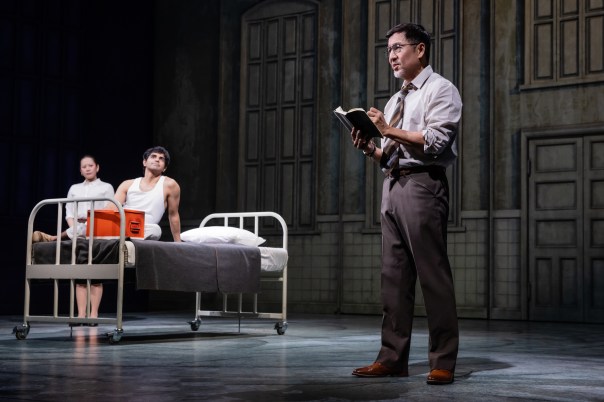
Chakrabarti wants to balance the veracity of Pi’s two tales more delicately, it seems. She takes us directly to the Benito Juárez in Tomatlán, Mexico, where Pi will be interrogated by Mr. Okamoto of the Japanese Ministry and the more empathetic Lulu Chen from the Canadian Embassy. That whisks us to Chapter 95 of Martel’s 100-chapter book, leaping over the narrative we have read without interruptions from Pi’s point of view by investigators.

Further compromising the boy’s credibility, Pi isn’t visible immediately in his hospital room. He is nesting underneath his hospital bed, hidden behind his dangling bedsheets. When he is coaxed by food and other rewards into coming out, we readily observe that he is haunted, traumatized, and animalized by his experiences at sea – appropriate results for both versions of his story – and conditioned to fiercely hoarding his food.

Pi’s histrionics, which punctuate his narrative, give Taha Mandviwala fresh opportunities to rouse Okamoto’s skepticism and Chen’s empathy in the title role, but the added flash – along with the missing diary – must be scored as detrimental to the lad’s credibility.

Yet there’s a buoyancy to Mandviwala as he relives his adventures that wins us over, with plenty of moments that underline his irrepressibility: dancing in the dingy streets of Pondicherry, insouciantly entering Richard Parker’s lair at the zoo, and standing triumphantly on the stern of a lifeboat lost at sea – or on his hospital bed. With or without a paddle, he holds his fist up high. Yes, in a fine bit of theatre magic, bed and boat are the same in both locations.

Paradoxically, all the artifices of puppetry, lighting, and projection make us want to believe Pi’s story more and more. Even when Toussaint Jeanlouis, after playing the ship’s nasty cook, reappears out of Richard Parker’s head and becomes the tiger’s voice. The pushback from Alan Ariano as Okimoto and the caring of Mi Kang as Chen ultimately testify to our inborn needs for fiction, myth, and imagination.
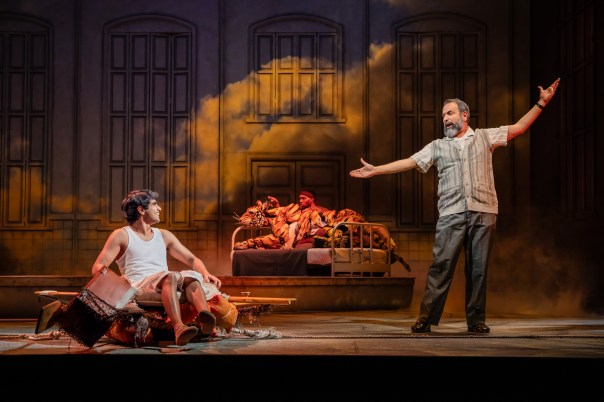
Though I’ve read the book, it’s been a while. I’m not sure whether Martel’s Pi was blessed with family visitations during his animal story or whether these were additions from Chakrabarti’s fancy. Either way, the reappearances of Sorab Wadia as Father, reminding Pi how to tame a tiger, Jessica Angleskhan as Amma, counseling her son on staying vegetarian at sea, and Sharayu Mahale as Rani, scolding her brother for succumbing to fish and turtle meat, do more than keep the rust off these endearing characters after the Tsimtsum sinks.

Collectively, they endow this Life of Pi with more mythic aroma, like talismans or magical weapons gifted to heroes of sagas. They are Disney sprinklings of Tinkerbell’s fairy dust and Jiminy Cricket’s guidance. Of course, they don’t cross over when Pi’s fantastical story dissolves into an antiseptic hospital!

When God has been proven to you, a sinking ship, a shark-infested ocean, a vast flesh-eating island, and an arid Mexican shore with jungle in the distance are all better places to be, as long as there are stars above to wish on. In Martel’s novel and onstage, young Pi has sat devotedly at the feet of Hindu, Islamic, and Christian mentors concurrently for weeks on end because he is so hungry for God – while Martel attests to extensively studying zoology and the cosmogony of Isaac Luria, the great Jewish Kabbalist.

For Pi and Martel, preferring a beautiful, ennobling story to a plausible one is a way of life. Actually, Martel states it more politically than that at the end of his preface: If we, citizens, do not support our artists, then we sacrifice our imagination on the altar of crude reality and we end up believing in nothing and having worthless dreams.

Maybe Martel’s thrust has more currency now in Charlotte than it did on Broadway. Yes, and maybe this message has more urgency now for Americans than it ever had for Martel’s fellow Canadians.

“Girl from ther North Country”: A Dream Dispelled

Review: Girl from the North Country at Belk Theater

By Perry Tannenbaum

When it premiered in 2017 at The Old Vic in London, Girl from the North Country must have seemed like the fruition of a musical theatre dream team. The original book would be by acclaimed Irish playwright Conor McPherson, who would freely roam amidst the vast catalogue of music and lyrics by Bob Dylan, the 2016 Nobel Prize Laureate, to choose his songlist. By most surviving accounts and reviews, Girl from the North Country was must-see theatre in two successive London productions, Off-Broadway in 2018, and on Broadway in 2020.

Previous peeps at the show on the road, chronicled in regional sections of BWW, have only been slightly less enthusiastic. So opening night at Belk Theater earlier this week was a massive shock when the national tour touched down here for the 28th of its 30 scheduled stops.

The first stunner was the sparsity of the crowd. Often sold out on opening night for brand-name shows, the Belk was less than half-filled for the Charlotte premiere. Traffic to the Uptown was no lighter than usual, and blackouts had already been a non-factor for previous events I had covered in Plaza Midwood and Davidson. Were fervid Dylan fanatics, among the most loyal anywhere, diverted by the WNBA Playoffs? Were they glued to their TV sets, watching the Walz-Vance debate?

Whatever reason the stay-aways may have had, the biggest shocker was that the no-shows were so right. The dream team is merely a mirage on the road, though the esteemed playwright is still listed as the stage director.

As much as we both love Dylan – my wife Sue and I held hands when the mighty “Hurricane” was sung – Girl from the North Country never fully connected with us. The boxer and escaped convict in McPherson’s script is Joe Scott, we’re in 1934 Duluth (three years before Rubin “Hurricane” Carter was born), and when Warren Nolan Jr.* plunges into the song, he must segue into “All Along the Watchtower” long before the tale of the framed boxer reaches its epic, cumulative power and intensity.

This is not the story of the Hurricane. Yet the connection of this suddenly anachronistic song, unlike the decisively irrelevant “Watchtower” or “Idiot Wind” that complete the medley, is stronger than nearly all the others we hear. At its worst, the beginning of Act 2 at Nick Laine’s dingy Duluth boarding house devolves into a chaotic Dylan concert with no forward-moving drama at all, the most inert and aimless musical theatre I’ve seen since Cats purred back from its intermission.

Action revolves around the innkeeper, his bipolar wife Elizabeth Laine, his alcoholic and artistic son Gene, and his adopted black daughter Marianne, five months pregnant. Curiously, Nick is the musical eye of this stormy family, the only member who never gets a solo to sing. John Schiappa is devoted to his demented wife, whom he dutifully feeds though she might slap the plate out of his hands, but he cares more for his longtime boarder, Carla Woods as Mrs. Neilsen, a possible financial lifeline if her late husband’s ever gets out of probate.

As Elizabeth, Jennifer Blood gets the most outré actions from McPherson – even when she’s brooding at an upright piano – and a royal gem from the Dylan songbook at the end of each act, “Like a Rolling Stone” followed “Forever Young.” These briefly sounded like echoes from the days of Janis Joplin reign as rock’s blues queen. Days of mad incense and love. Elizabeth has more reasons to be jealous of her admirably stable and ruggedly handsome husband than justifications for her relentless resentfulness and orneriness.

Yet even this most powerful of McPherson’s roles never quite bridges the gap between the footlights and our hearts. My most generous theories for why this was so on opening night are the sheer size of the Belk, double the seating capacities of the houses where North Country played London and New York, and the wretchedness of the sound, a chronic Blumenthal ailment.

Come back to us, MJ! – or at least send your sound crew.

Sharaé Moultrie gives a velvety smooth voice to Marianne and, despite her precarious position as an unwed mother-to-be, enough serenity for us to occasionally suspect that her conception was immaculate. She gets her share of solos, if not the choicest harvest. Dramatically, Marianne is the calm center of a vortex, with love and affection swirling around her from at least three different men.

Concerned about her future, Nick seeks to wed her to the financially secure – but elderly – Mr. Perry, portrayed by Jay Russell with humility, gentleness, and heart. Manuel as Joe is almost immediately smitten by Marianne, no doubt imagining himself as her redemption and she as his. She has reason to be impressed, for when he was challenged to a fight by her drunken brother Gene, Joe reluctantly yielded to the challenge and floored Gene with a single blow.

Prodded by Nick to get a job to help steady the Laines’ finances and avert foreclosure on the guesthouse, Aidan Wharton* as Gene sees his hopes of becoming a writer fading away. More sorrows to drown in drink are triggered by his ladylove, Chiara Trentalange as Kate Draper, when she announces that she is already engaged to be more pragmatically married. The ensuing Wharton-Trentalange duet on “I Want You” was probably the most dramatically apt of the evening.

Might have been more impactful in a smaller house with cleaner sound.

McPherson puts plenty of life onstage that never quite projects to Belk’s empty upper balconies. Aside from Mr. Perry; a wild bible salesman with a frayed clerical collar arrives with Joe, Jeremy Webb as Reverend Marlowe; and our sometime narrator, Alan Ariano as Dr. Walker, pops up periodically at the boarding house, making his rounds. Of the two, Webb as Marlowe is far more dangerous – almost dramatic – for his fugitive status and his poverty make his sales pitches aggressively hard-sell and his fingers tend to get sticky when he thinks nobody is looking.

With so many plots already brewing in Duluth, McPherson thoughtfully adds a family from the outside world that tends to add variety to the inbred local atmosphere of seediness and decay. The well-dressed Burkes are a fallen uppercrust family, as iconic during the Great Depression as the downtrodden wanderers crossing the Dust Bowl to sunny California.

Both Mr. Burke, who lost his business during the Great Crash, and Mrs. Burke, who lost a chunk of her patrician trust and self-confidence as a result, are on the lookout for new opportunities, not necessarily with each other. Both David Benoit and Jill Van Velzer, playing the elder Burkes, also sit down occasionally to play the drums, adding a new musical level to the evening while expanding the social context of North Country. Benoit gets to be more decadent, proposing to manage a ring comeback for Joe.

The couple’s son Elias has some sort of learning problem, so D’Marreon Alexander* gets a breakout moment in Act 2 – parallel to Blood’s with “Rolling Stone” in Act 1 – when Elias suddenly emerges from his cognitive cocoon with “Duquesne Whistle.” Doubly surprising for me, for “Duquesne” hurtles forward with the drive of Dylan’s best work and because I’d never heard the 2012 composition before. Wow.

I wish I could praise any of McPherson’s dramatic moments as highly. We’re not likely to experience a theatre week such as the current one for ages to come. Two living playwrights who have translated works by Anton Chekhov – and do not hesitate to use his methods – have pieces running simultaneously in Metrolina. Arguably, McPherson’s book, repeatedly stressing the consequences of inaction, has more of the Russian master’s most distinctive flavor.

But Stephen Karam’s The Humans, set in post-9/11 and post-Hurricane-Sandy Chinatown, will rock your world. Anyone torn between the two would be best-advised to bypass the Broadway Lights production at the Belk and head up Interstate 77 to Davidson, where Karam’s masterwork is playing at the Armour Street Theatre.

*Note: On opening night, Wharton, who normally portrays Elias, replaced Ben Biggers (sick all week ) as Gene. Alexander replaced Wharton as Elias and Nolan Jr. subbed for Matt Manuel.