Fifty years can begin to date and dismantle the most meticulously crafted Broadway musical, let alone one originally stitched together from five unrelated sketches by George Furth in 1970. The gilded thread that made COMPANYshine – enough for Furth to win the 1971 Tony Award – was to be found in Stephen Sondheim’s gorgeous music, wedded to his preternaturally insightful lyrics.
Over and over, the cavalcade of wondrous Sondheim’s songs to be found in the opening act alone – including “Sorry-Grateful,” “You Could Drive a Person Crazy,” “Have I Got a Gal for You,” “Another Hundred People,” and “Getting Married Today,” – have been covered by three generations of the best singers in the business. As for the end of Act 2, the one-two punch of “The Ladies Who Lunch” and “Being Alive,” two sharply contrasted gems, is arguably the best eleventh-hour combo ever seen on a Broadway stage. Affirmation upstages disillusionment – if it can. No extravagant staging required.
But the book of COMPANY has been a perennial liability. On the one hand, it circles modernistically around a single point in time, Bobby’s 35th birthday, and becomes a study of marriage as he seeks to determine whether he wishes to take the plunge or if he’s ready for it. Trouble is, Furth’s story is superficial. Sitcom deep. We get to the end of Bobby’s spiritual journey without any time having elapsed, without any scene impacting profoundly, and without being sure any scene ever really happened outside of Bobby’s head, dreaming or drunk.
Maybe the best way to treat this problem was the 2006 revival starring Raúl Esparza, which nearly dropped the pretenses of scenery and ordinary storytelling completely as the entire cast played multiple instruments throughout the evening. That production of COMPANY, directed by John Doyle, was more about the performers and the music. Yet the communal togetherness of Bobby’s circle and their marital intimacies were somehow deeply enhanced by their playing as well as singing together.
Directing the newest Broadway revival, now on tour at Belk Theater, Marianne Elliott took a bold new tack: diversifying Bobby’s circle, switching genders, and even remaking one of the couples as gay. Bobbie, nee Robert/Bobby, is now emphatically female, portrayed by Britney Coleman – a peripheral cast member in the Broadway production who also understudied Katrina Lenk in the lead role. Opposite the legendary Patti LuPone.
It all plays rather well, though the superficiality of Furth’s book is probably enhanced rather than diminished. The couples that entertain Bobbie are three notches zanier now in Elliott’s hands, so her friends are no longer drole or slightly poignant. They’re more energetic and eccentric. While Bobbie is wondering whether to plunge into the kinds of couplings her friends are modeling, you might be wondering why Bobbie doesn’t shed the whole bunch. Then ditch the boyfriends. None of the three “Have I Got a Guy for You” admirers stands out as a shining knight who might joyously sweep her away.
Coleman’s role, thin enough for a hero to start with, seems to retain her as an observer, but with the zaniness and eccentricity around her amplified, she also comes off as a bit of a level-headed intruder. Less connected to her more diverse circle. Observing the shenanigans, I guiltily felt more distanced as well. Elliott’s update can be a little off-putting.
Most awkward for Coleman are the two scenes that should be the climaxes in her drama. The showstopping “Marry Me a Little” was added by Sondheim at the end of Act 1 to help us see an arc in Furth’s story, as Bobby sang to a woman who had chickened out of marriage on her wedding day – a partial proposal offered as consolation to the would-be bride that becomes a little epiphany for our hero. Coleman belts it now to a balking gay man, a proposal that can’t even be taken as partial.
The situation is even worse when Bobbie confronts Joanne, in the climactic “Ladies Who Lunch” scene. There was some suspense for me on opening night as that scene approached. How would Elliott restage Joanne’s offer? Sadly, the original had more sting.
So what Elliott does best is freshening the 53-year-old musical, making this Sondheim masterwork seem more like a portrait of life today in New York. In a jolly fashion, Bunny Christie’s scenic design literally belittles the Big Apple’s pretensions, cramping Bobbie into a living room so small that there’s barely enough room for her to squeeze around the wee dinner table. Crouched down with their assorted gifts, waiting to spring their surprise birthday greetings as Bobbie enters, the cheery circle of friends is like a molten mass with barely enough room to breathe.
Other apartments we see are similarly drab and confined. On the first of Bobbie’s excursions, she visits Kathryn Allison as Sarah, on a strict regimen of exercise and dieting, and James Earl Jones II as her husband Harry, nervously on the wagon. As the couple’s verbal jabs at their mate’s failures at abstinence hit home, escalating into physical martial arts combat, the mid-lifers have nowhere to safely collapse when they’re exhausted other than their couch – on top of their hapless guest.
The scene is a fertile launching pad for “The Little Things You Do Together,” triggered by Judy McLane as Joanne before other couples incongruously intrude – from multiple doors, including Bobby’s little apartment, attached to her hosts’ like adjoining hotel rooms. Of course, Jones II has a marvelous voice as he triggers “Sorry-Grateful,” incongruously joined by two other husbands as the scene fade-dissolves, but his range is higher and his timbre mellower that you might expect. Allison is a very zestful and complementary comedienne onstage, likely unapologetically anti-diet in the real world.
Despite the somewhat clunky aftermath – and Coleman’s inability to be on hand anymore as the couple’s best man – Matt Rodin as Jamie (nee Amy) and Ali Louis Bourzgui as Paul, still on the precipice of marriage, are the most charming and hilarious of all the couples. It doesn’t hurt that Christie’s scenic design reaches one of its zeniths with the couple’s cheery kitchen. Christie’s most radiant Act 1 costume design is reserved for Emma Stratton as The Priest, making her most surreal entrances into “Getting Married Today” through the French doors of the fridge.
A faulty electrical cord sabotaged opening night at Belk Theater, pausing the action twice before intermission so that circuits could be checked and restored. Blumenthal Performing Arts prez Tom Gabbard not only apologized to the crowd but staged an impromptu Q&A with two of the stars, McLane and Tyler Hardwick, who played PJ, the grungiest of Bobby’s frustrated admirers. Soon to excel in “Another Hundred People,” Hardwick charmingly refused to disclose his favorite moment in the show.
Thankfully, everything was shipshape for Act 2. This Charlotte audience stayed with it.
McLane acknowledged that she was following in the footsteps of megastars as Joanne, including the likes of Elaine Stritch, Lynn Redgrave, and LuPone. She wasn’t at all self-effacing as she answered, and she grandly met the challenge of her biggest moment, delivering “The Ladies Who Lunch” with a lounging crescendo of decadence. Draped in another smashing, glittering getup from Christie, McLane personified New York vogue in all its Fifth Avenue complacency. That in turn laid down the gauntlet to Coleman, who belted “Being Alive” out of the park.
Then, on her fourth or fifth attempt, she finally blew out Bobbie’s birthday candles.
Review: Pagliacci With Cavalleria Rusticana @ Opera Carolina
By Perry Tannenbaum
October 28, 2023, Charlotte, NC – Long coupled in double bills around the world, Pietro Mascagni’s Cavalleria Rusticana and Ruggiero Leoncavallo’s Pagliacci parted ways at Opera Carolina nearly 30 years ago, immediately after the two were finally wed in Charlotte. Until then, the operas had appeared separately or in successive engagements during the seasons of 1957-58, 1969-70, 1974-75, and 1986-87.
The transcendent popularity of Canio’s climactic aria in Pagliacci, “Vesti la giubba,”has given that opera a stronger grip in the repertoire, which accounts for Opera Carolina programming its most recent presentations of the work in 2006 and 2015 in tandem with two other one-acts. Yet the coupling with Cavalleria is very natural, since Leoncavallo wrote his opera in response to seeing Mascagni’s, and the two premieres were almost exactly two years apart.
Natural and convenient, for the current Opera Carolina production, conducted by James Meena and directed by Garnett Bruce, demonstrates how seamlessly two distinctively different works can be fused together – in their casting and design – after thousands of precedents spanning more than a century. We’ve seen greater scenic alterations in most opera productions at Belk Theater than we saw here from designers John Farrell and Michael Baumgarten for this twin-bill.
On stage right, the church façade remained the same, and across on stage left, a boxcar café was discreetly modified at intermission to become a boxcar theater. Between these, projections by Baumgarten could recycle the centerstage backdrop in the blink of an eye. More radical were the costume changes provided by Allison Collins, who reveled in bringing us the harlequin costumes of the Pagliacci clown troupe, and brought a more urban World War 2 flavor to the garb of the townspeople and visiting soldiers on leave.
Although billed on the OpCarolina website as “Pagliacci With Cavalleria Rusticana,”the two operas are presented in chronological order – the right choice if you’re building to a climax at the end of the evening. With extended instrumental sections at the start, Cavalleria isn’t as instantly impactful as Pagliacci, which begins with a member of Leoncavallo’s commedia troupe directly addressing the audience. For a one-act, the exposition of Cavalleria proceeds at a surprisingly glacial pace, all the more reason to be pleased with how beautifully Meena and the Charlotte Symphony perform the bountiful orchestral episodes.
We didn’t have to wait until the famous “Vesti la giubba” for the vocal splendor of this production to become manifest. Soprano Barbara Frittoli was already a rising star, soon to debut at the Metropolitan Opera, the last time Cavalleria Rusticana was performed in Charlotte, and now she’s the leading lady in both Cav as Santuzza and Pagliacci as Nedda in her Opera Carolina debut – though Yunah Lee will give her a breather in the Sunday matinee performance of the curtain raiser. Nearly as auspicious, baritone Leo An made his debut as the malevolent Alfio in Cavalleria and reappeared almost immediately as Tonio, the odious clown who greets us after intermission.
These are two marvelous singers, normally filling the quota of marvels we have heard in past years at Belk Theater. But we seemed to be entering a new golden age as the curtain rose on Pagliacci, for those two notables were joined onstage by baritone Nmon Ford as Silvio, Nedda’s secret lover, and Carl Tanner’s long-awaited return to the Belk as Canio, after his 2010 triumphs in Carmen and Otello. Nor did resident company member Jonathan Kaufman sound at all outclassed in the tenor role of Turiddu, the soldier who heartlessly yet helplessly abandons Santuzza for Alfio’s wife, Lola. Likewise, mezzo Julia Woodward held her own as Lola, not at all hindered by a flaming red dress.
Everything is beautifully sung, but it was fascinating to note how Bruce navigates the inevitable changes in attitudes and social norms that have occurred since 1890, when Cavalleria Rusticana premiered. Audiences in 2023 may wonder why Santuzza, seduced by Turiddu, feels unworthy of entering a church on Easter Sunday after the adulterers betrayed her. Bruce inserts some silent business between Frittoli and a stranger that might be interpreted as solicitation, but otherwise, he ignores the question, leaving us to assume that Santuzza’s sin is not getting a marriage proposal before sleeping with Turiddu. On the other hand, Bruce and Tanner must confront the reality that Tonio is not a pitiful cuckold we can empathize with anymore when he cold-bloodedly plots to murder his wife and her lover.
Tanner was a volatile volcano of jealousy almost instantly as Canio, and he didn’t sob the final notes of his signature aria to milk our sympathies. Distancing us further, Bruce took the final words of the evening from Canio and gave them to the sardonic and vengeful Tonio. Even here, political correctness reigns, for our host is no longer hunchbacked or deformed, though the ugliness of Tonio is retained from Leoncavallo’s libretto. Opera Carolina’s Pagliacci is thus cleansed while it is so magnificently sung, no longer asking us to empathize with Canio’s vendetta or assuming that we will connect Tonio’s warped morality with his appearance. Most amazing, perhaps, were the Frittoli-Ford duets, still youthful and sensual. Great music can rejuvenate us all.
At the tender age of 29, Veronica Swift can look back on a career that stretches over two decades. Yet it’s just in recent years that she has broken through, getting prodigious airtime on jazz radio and racking up high play numbers on the Spotify and Apple Music services. Her 2021 album, This Bitter Earth, was her breakout, landing her on JazzWeek’s Top 50 listings for 27 weeks – and at the #3 slot for the year in total airplay. That CD came to my attention through those jazz listings and via glowing reviews in newspaper and magazine reviews. The buzz for Swift’s latest release, the eponymous Veronica Swift, has been harder to ignore. My inbox has been hit with emails from publicists, a steady stream of hype from Middle C Jazz, where she performs this Saturday, and news from JazzWeek on September 28 that the album made the highest debut among albums in their Top 50 for that week.
People are clamoring for Veronica Swift partly because there’s more of an industry push behind her, but also because she’s finding her voice and daring to proclaim there are many voices – and languages – at her command. The jazz singer has songs by Nine Inch Nails and multiple dips into Freddie Mercury and Queen. At what might normally be termed the other end of the spectrum, there are a couple of Broadway songs bookending the CD, plus an Ellington and a Jobim in the middle. But that wide range isn’t wide enough for Swift anymore. There’s a gush of Beethoven, Gounod, and Chopin on the songlist, with additional glimpses of Puccini, Leoncavallo, and Rachmaninoff. Her current tour, promoting the new CD, is spreading the word from San Francisco to Italy.
We caught up with her earlier this week on her cellphone.
Hello. This is Perry Tannenbaum from Cultural Voice North Carolina.
Veronica Swift: Hi.
Hi. How are you?
Good.
Where are you?
Los Angeles.
Oh my heavens. Okay. And your next stop is?
Well, tomorrow we’re headed to Alabama to play in Auburn, and then we come to you guys.
What’s it like? I mean, I know the last time you cut an album, This Bitter Earth, I was only hearing about it through jazz media, but now I’m hearing it through publicity agents and you’re out there promoting it. Is that a big change for you?
Well, I just focus on the music part. I’m not behind the scenes with the publicity stuff. I just take the calls when they come. But all I do is I go where I’m needed, where the gigs are happening. That’s the important thing. And so, you know, just moving forward, onwards and upwards. It’s all part of the evolution.
So you’re not noticing any intensification in the amount of bookings you’re getting at this point?
Well, I don’t really go into that, because it’s not always cohesive with someone’s career moving forward. It’s non-linear. That’s something that’s kind of hard to describe. But basically, since I’m doing something now that’s genre-wise, it’s genre-bending and it’s a little bit harder to market. So actually, my bookings have become slightly less because of that. Because a lot of venues, one also post-COVID, a lot of venues, we’ve all had to scale down.
And so I’ve lost a lot of stuff because of COVID. Even though we’re all back out there going to shows, the world, the economy is still like its response to those two years of having nothing going on. It’s just still the aftermath. It’s really very real for us musicians.
So knowing that you do have an eclectic album out, do you feel like you need to tailor that somewhat when you come into a Middle C Jazz Club?
I absolutely do not tailor any part of my set because there’s nothing far-reaching. It’s not avant-garde. All the genres we play were at one point pop music. We do swing and standards and Judy Garland-style theater stuff. We do rock and roll, like 70s classic rock stuff like Janis Joplin. We also do funk and soul, like Aretha Franklin stuff. So basically, everything is palatable.
And so everywhere we play, whether it’s an orchestra, if it’s a jazz club, or if we’re opening for a rock band in a rock club or a festival, we do the same set, because you have to stay true to your message. And if I tailor my set to fit the room, or I hope people like it more if I do this, then you’re going against the message, which is the all-inclusive, all-inclusivity and embracing the full spectrum of who you are.
It goes beyond music. I’m using music as a metaphor, but that’s what I hope to inspire people to do. And everyone’s been getting it. So I’m really happy that the audiences have just been so supportive. And they’ve known my past catalog, but that that hasn’t hindered their experience or enhanced it. It’s just all music. It’s all good music.
Yeah. I’m noticing, though, that there’s a real paradox and a real expansiveness in your new album in terms of the genres, the orchestrations, the arrangements that you’re doing. Are all those clocks in the cover photo supposed to signify that this is a carpe diem album, “live for the moment”?
Oh, yeah. You know me. I like to have multiple ambiguous symbolism, of course. But that’s definitely… you got it. That’s one of the meanings behind the album cover. And there’s an element of that for sure, because I have a 20-year career.
I mean, I know I’m young. I’m 29. But I have a 20-year career of singing one genre. And it’s been my dream to do this album like this, this way. But I have never had the opportunity or the, you know, it didn’t make sense because I had a, there were expectations put on me at a very young age that I just kind of, I was on that trajectory.
And I had to say, no, the time is now or never. So yes, there’s the carpe diem element. And also, I look at myself and my band. Like, we’re playing all these different genres. And the imagery I’ve used is time travel. And we’re almost like, you know, going through time and collecting all of the best of all the genres through different eras.
And so the clocks, if you notice, they come from different eras in history. There’s a sundial, and there’s a cuckoo clock, and there’s a metronome, and there’s all kinds of different ways to tell time from different eras, but time is the constant.
You are not the constant. I mean…
Well, actually, if you think about it, I am the only constant in this. That’s why this works, is because who I am is in all of these genres. I am the cohesive element. My voice is still my voice. It’s not Veronica wears different hats. It’s Veronica wears the same hat different ways. So yes, I am the cohesive element.
But you’re not at all hesitant about embodying opposite philosophies within the space of two or three songs. I mean, “I Am What I Am” is like, I contain multitudes, and just let me be what I am. And whatever it is you’re saying that you are singularly. And then two songs later, you’re in this kind of bossy, “Do Nothing Till You Hear From Me” mode.
Well, if you… Yeah, so basically what this album does is connects the through lines from genre to genre. If you break it down, the elements of each song, there is an element, whether it’s a rhythmic or harmonic or melodic or thematic element that is passed through song to song.
For example, “I Am What I Am” is bebop. It’s got a little of my Bach fugue love for Baroque music in there that I wrote. And then the bebop, which is my roots was passed through to the next song, which is “Closer” with the bebop solo. Right. But that’s a funk fusion tune that’s written by Nine Inch Nails, which is 90s alternative rock. So what we’re doing is actually these aren’t really opposite philosophies, but we’re connecting these through lines that are very subtle and expanding them so that people can see that these genres really are all connected.
And that it’s a part of who all these artists that I love, they’re all a part of me and they inform what I do, whether it’s jazz or rock or funk or classical, that it’s okay to love all of that in one space. You don’t listen to just one genre of music all the time.
No, I couldn’t make a living that way. But I almost suspect a militancy in your crossing genres because you’re swinging Juliet’s waltz and then you’re singing a Jobim almost in an operatic way.
Yeah, it’s connected. That’s what I’m doing. I’m showing how the time, it bends with the time. And so a song that was written 150 years later could have been written 150 years ago. It’s like that Zelig movie. You ever see Zelig?
Yeah.
It’s like he shows up in every picture through time. That’s kind of how I imagine myself in this record and in these songs. They’re like Zelig.
And yet you have no hesitation about revisiting songs like “As Long As He Needs Me” and “He Hit Me (And It Felt Like A Kiss).” I mean, you do these songs unapologetically without any irony or any sarcasm. And it seems like you are time traveling into whatever the mindset must have been at the time that these songs were written.
Yeah, that’s one way our musical mission in life is to… We look at like Mozart and Beethoven, like, oh, that was so long ago. But when you read their journals and their notes they’ve written to students or lovers or what have you, they’re very much relatable people. And the music is the same way. And so that’s my mission in life is to do that, to be the person that connects.
You said militancy: I love that because we actually wear – our band uniform is like black and gold parade military outfits that I put together because we’re kind of like soldiers. We’re fighting this world that wants to suppress creativity and freedom of self-individualism and expression.
But all the like TikTok and be-trendy and be-like-everyone-else. No, we’re fighting that.
Well, I have to admit I was wondering which Veronica we were going to get. Going to get the hoodie Veronica…
The answer is yes!
…the strapless Veronica or the leather Veronica. I just didn’t know, you know?
Well, the outfit is just the outfit, but it’s always been me. It’s the same Veronica, you know?
You say you’re still kind of concentrating on the music. Does it get more difficult when you have such an ultra-produced album like your current album? When there must be just so much input from orchestrators and people from front office saying what you should and what you shouldn’t sing right now?
Well, it’s taken me years to surround myself with the right people, and that’s something you learn as you get, as we all learn as we get older. We start to notice people around us that are negative influences, that are hindering. You know, that are suppressing our kind of, you know, free will, if you will. And just about the last couple years I’ve put together a band and management team and booking team and product.
My producer is actually my drummer, Brian Viglione, who’s been my hero since I was 12 years old. Like I’ve listened to his band, the Dresden Dolls, my whole life and Brian is a brilliant collaborator. So it’s knowing the kinds of people you’re surrounding yourself with: Are they stars and are they collaborators?
You know, everybody has something important that they want to say, but ultimately, they’re looking to me because as the leader, you have to step up to the plate. You can’t, because I usually tend to be like very democratic, like everybody has their input, but I found that people really want to be led, too. They want someone strong who has a vision, like a David Bowie type.
So everything that’s happened on the record has always come to me and Brian as well. We both have the same – it’s very rare to find someone who has the same vision that you do. And Brian and I share not only the same vision but we share the same taste, the expansive multi-genre taste.
I mean he’s a rock drummer that plays jazz and plays all this stuff because his favorite drummer is Elvin Jones and my favorite singer is Freddie Mercury. So we both come from these worlds of, you know, these crossed worlds and we brought them together in such a beautiful way.
Freddie Mercury. I do get the Janis Joplin vein in what you’re doing now, but a lot of people would say, well you introduced one new thing but the classical strain. I didn’t detect that in anything previous. I know there’s a Broadway strain in what your repertoire represented in the past, but to bring it in and to bring it in in such bulk is really very audacious and very much risking to rock the boat of who identifies as your fandom.
It’s interesting, you’re talking a lot about rocking the boat and audacity. It doesn’t feel like that for me, man. I’m just being myself and being very, you know, like at peace with who I am, and that’s what people are responding to. They’re following that strong sense of self and leadership.
People need that right now, because what the world is trying to do, like you look at everything, like I mentioned TikTok and Instagram is this very conformist view even though they want you to follow the trend, follow the algorithm and that’s just what I mean. This whole record is about just standing up to that, and that’s what I think people are responding to, and it’s of course using the music as a metaphor like I said.
It’s easy for me because I love all this. It’s not hard what I’m doing. I’m singing music I love. It’s not simple and classical music is an important part of my upbringing. I mean my first love was Baroque music. I didn’t love jazz as a kid. It’s just something I was good at. I found my love for it much later in life when I matured a little, but my actual love was classical. You know the harmonic content of the Tchaikovsky and, you know. Beethoven.
I would study these scores when I was about seven or eight years old. I started to study scores and playing piano of course you know exposed my ear to that kind of harmonic sophistication and so I loved Bach. I loved how all the lines would intertwine within and out of each other and so I’ve just found a way to do it that way that’s authentic and unique to myself and that includes connecting it with these other genres like “Je Veau Vivre” for example.
Talk about you know Django Reinhart and I mean he’s not he’s not French but he is very big in France and Stephane Grappelli is French and so that lineage is an important part of why I’m because I used to sing at Birdland with the Django Reinhart all-star band, and so that’s the way I’ve gotten to bring that element of who I am in here as well.
I used to sing all those arias in high school. I don’t sing opera anymore but I believe you know maybe with an orchestra someday we’ll do it.
Yeah absolutely, but you were hinting a while ago that now is the time – maybe I’m detecting that some of this these impulses to do all this and be all this have been repressed or advised against.
You got it, man. If it was advised against it was only because I was surrounded by the wrong people, you know, and that doesn’t mean that they’re bad people. They just didn’t have the vision or the image. They just they saw the world that they saw. And that’s fine, you know. It’s like it’s like asking a Subaru salesman to sell a Ferrari.
They’re not going to know what how to sell a Ferrari. So what we’re we’re selling… it’s like talking to somebody who you’re trying to get them to try Baked Alaska when they don’t even know what it is. They know chocolate chip cookies. That’s something that’s easily packaged, easily marketed, and you can sell chocolate chip cookies in a second to anybody. But Baked Alaska is a gourmet dish. When you try it, you’re going to like it, but you got to try it. There’s no way to describe it to you until you’ve tried it.
So that’s what our show is like, and I’ve just surrounded myself with people that get it and know how to help bring that to life, that vision. So yeah it’s just like I’m really excited to bring this show to North Carolina.
How many pieces can you possibly bring to a jazz club?
We’ve brought I mean we brought the quintet with horns three horns before, but that may be a little bit tight on the stage, so we’re just going to bring the quintet this time.
Okay, does that count you as part of the quintet?
Oh yes, absolutely.
Okay, so we could expect one horn?
No, no – myself, piano, bass, drums, guitar.
Ah, okay!
Yeah, you can’t play rock and funk without the guitar in there.
Yeah, yeah, I forgot about that aspect of it. Okay, I remember some guitar licks on the new album. Wow, yeah. “Was it on Don’t Rain on My Parade”?
Yeah, that’s the that’s the book-ended somatic message. The first song, “I Am What I Am,” of course being about being yourself and all that. But then, it book it’s bookended with the last song, “Don’t Rain on My Parade.” It’s the same kind of song, you know, to send people off with the message of the the album. keep yourself alive of course is like the finale and don’t rain on my parade is like the encore.
But “Keep Yourself Alive” is the Queen song and “Don’t Rain on My Parade” – I mean that that arrangement just wrote itself because just it’s such a brilliant song.
Yes. I was in fact thinking about “I Am What I Am”: that could serve at either side of the bookend as an encore. Or it’s probably too emphatic to be an encore, because you’re going to have to sing another song after that one.
Yeah. No, that’s the one that always works as an opener.
Uh-huh. Yeah, that that definitely introduces yourself. How intensely do you concentrate on the stuff you have just issued, and how much might we see of what’s coming in the future?
That’s a really good question. I try to, talking about time, I try to comprise a show that speaks to past, present, and future, because quite most people now have only just discovered me. So that’s been an interesting experiment, you know? Like I’m still building my career, so of course the emphasis is on present because I as a person tend to be so future-oriented that I miss the now. So we are really focusing on the present and pushing the record now, and that’s the statement.
But there is an element of the future as well in this show, and that is the next phase, which is to show people that okay, I’ve established myself as a jazz singer and my roots in jazz music with my parents having been brought up with jazz singers on the road. Then I’m showing you who I am now, which is this multitude, this beautiful color palette or spectrum of genres.
Then what I really identify as is a storyteller, and I’ve never gotten to tell my own story with my own words, save for a couple songs. So my next future album may be an album of all original music, so I think we’ll be including a lot of originals on this show as well.
Oh, that’s exciting! Do you regret calling yourself Swift for your stage name?
Why would I that’s my that’s my that’s my biological name!
Is it? I look at your father’s name and your mother’s name, and I don’t see a Swift in there. Okay…
Yeah. My mother has used her maiden name as her stage name, Nicasian. My father was adopted by O’Brien he’s not really an O’Brien by blood. He’s a Swift.
Oh, okay!
So I’ve chosen to stick with my biological name.
Ah, there you go! Then you can always measure up against and Taylor and feel modest.
I don’t measure up against anybody. I measure up against myself and myself alone.
So you’re not daunted – or driven – by the fact that your most popular tracks get maybe two million plays, and she has multiple tracks with a billion?
No, she’s a pop star! I don’t sing pop music, you know? I have my own artistry, and what I teach to young artists – because I teach as well – and I talk to a lot of artists trying to navigate and find themselves in this new world in this new industry that’s really kept by the gatekeepers. For artists that have something unique: one, when you have something so niche like this – it’s you – when you create your own universe that is uniquely yours, like no one else can touch it…
Right…
…then you’ve really touched on a goldmine. You’ve come across something really special, because then you have your own universe, your own fan base, your own career that is truly yours. You can’t compare it. It’s like Ella or Sarah: you can’t compare, you know?
There’s people with different tastes. Some people may not get you, and then, okay. Your job is not to get them to get you, your job is just be yourself and carve your own path.
Right. So in no shape or form should we confuse the fact that your new album is eclectic and multicolored with the idea that it has anything to do with your ambition to become more marketable.
That is just an added bonus, my friend. That was absolutely a joke. Look, if I wanted to be marketable, I wouldn’t have been a jazz singer for 20 years, you know what I mean? I just sing music I love! It’s that simple. I mean I love rock music and classical music because it’s passionate, powerful, dramatic, and it fulfills that dramatic side of who I am. And I love singing jazz because it fulfills the connection to my family and my roots. It has nothing to do with anything other than that!
Yeah, so you must have the same joking attitude that Ella had – at every concert – when she bemoaned the fact that she never had a big hit.
I don’t focus on that stuff. You can’t focus on that shit as an artist, you know?
Right.
You have to focus on the art, because otherwise you’re going to lose why you do it in the first place. I see it happen with so many friends and artists, constantly comparing themselves to other… Once you start doing that, you’re dead. you can’t compare yourself to anybody You can’t. There’s no measuring up. It’s you and you alone.
I notice, really deep in your records, that there’s what I would say is a foundational interplay between you and the piano, and I know it begins with you and your dad, but say something about the piano and what it means to you and how you interact with it.
Hmm, that’s a really, really good question. So on an emotional level the piano has always been – that was always my first instrument, as it is with most people, you know? Like you take piano lessons when you’re a kid, right? The piano was – just because of my father – his approach to piano was so different than mine. I’m more classical, like I said, like my first love is classical. So my approach to piano is I try to play like…
When I found Queen, of course, that was like, oh my god, you put these worlds together! Forget about it, I love this! But the Rachmaninoff and the stuff like Chopin, like Liszt – all that stuff you know. The best songs I write come from playing the classical stuff on the piano and then trying… to work some of these harmonic structures into a song.
WTC, I’ve written a couple songs of WTC pieces. So really, my relationship to the piano is very personal, you know. I actually had a house fire about 11 years ago, and the piano that I learned to play on was saved from the fire. And so, the piano has become just like the phoenix – my phoenix – the phoenix is my spirit animal because of the concept of fire and, you know, rejuvenating, reborn from the ashes, and how the piano survives the fire. So it’s kind of become a whole extra set of symbolism, you know?
Maybe the next record will have me playing the piano within a fire or something, you know? And I don’t know, that’s kind of what it is. I look at the piano, and I just see, you know, me being reborn.
I’d like you to exhume some of those tantalizingly described early recordings of you where you’re putting vocalese to Lester Young so…
Oh, that album I did when I was 21!
Yeah, I know! I’d like to hear them, but I don’t find them on any of the services. Because I have to look them up on amazon or something
It’s a little bit of power I do have. I don’t have to cater. I can put – those albums are just physical copies. So I’ll be – are you going to be at the show? I’m going to be selling those, actually. I can – I’ll have those records with me.
Yeah, I’ll be at the show definitely. I’m coming to the early one.
Wonderful!
So… and the rapport that you have with the horn players. A lot of singers just resist recording the way Billie Holiday did way back when, and you’ve jumped right into it, which is really a heartening thing for me.
Oh, thank you! Well I think music – I see it as a language, you know? And it’s very conversational, the way I approach it. And the way you look at Billie and Lester, the way – it’s a conversation between two people. And being a scat singer as well, I look at bebop and the vocabulary of music as if it was a language: the notes are like words, and musical phrases are the sentences.
When you have notes by themselves, yeah, they have some meaning and qualities but they don’t have much of meaning without the context of the musical phrase or the sentence surrounding it. And so, when you have that element of that understanding of music, then you can have rapport with any musicians. Of course, the fact that I play trumpet makes it fun for me to play with the horns, because then I actually bring out my trumpet and…
Oh, all right
…but I won’t be doing that in North Carolina, because I don’t have the horn, sadly.
Oh, that’s a shame all right yeah that would that would be something to really tout or balleyhoo or have a scoop about. Yeah, so I’m looking forward to it and thanks so much for for your time and for your candor.
Thank you very, very much. I’ll see you at the show.
In a year when ginormous pink Barbie dolls and balloons are making inroads on normally ghoulish local lawns, there are valid reasons to fear for the soul of Halloween – though the marketability of its candy and saturnalia seems to be as healthy as ever. Civilization really is over if the lines of cars I’m seeing along I-77, stretched all the way back to the I-485 Interchange, are really inching toward this year’s Scarowinds just to see skeletal makeovers of Barbie and Ken.
Over at the Old Barn on Queens Road, one of the ripest places for haunting in the whole Metrolina region, Theatre Charlotte is presenting Ken Ludwig’s Baskerville, a comedy version of Sir Arthur Conan Doyle’s most famous and scarifying Sherlock Holmes novel. Make no mistake, Ludwig is the man for the job, odious as it might be. Best regarded for Lend Me a Tenor (1986), Moon Over Buffalo (1995), Shakespeare in Hollywood (2003) and his resourceful Gershwin musical, Crazy for You (1992), Ludwig is at his best dealing with showbiz.
Ludwig can do comedy and farce, comes at us with a great love of backstage intrigue, and knows the tricks of the trade. He racked up a wide range of adaptation experience before tackling the pinnacle of Sherlock: Murderon the Orient Express, The Game’s Afoot (Holmes for the Holidays), Moriarty, Sherwood, Treasure Island, and The Three Musketeers.
Rather than following his own voluminous playbook in 2015, Ludwig seemed to be enthralled with The 39 Steps, Patrick Barlow’s stage adaptation of Alfred Hitchcock’s screen classic. In that megahit, four players took on over 100 characters, two of them tethered to the superspy protagonist and his three romantic interests, while two others quick-changed and speed-dialed all the rest.
Here there are two main actors once again, the suave Allen Andrews as Holmes and Robert S. Brafford as a less-stuffy-than-usual Dr. John Watson, the great detective’s sidekick and Boswell. We encounter a grand total of merely 69 characters and cover less geography, shuttling between London and the sparsely populated Dartmoor. That is where Baskerville Hall is surrounded by fogs, bogs, heaths, mire, and moors, terrorized by a mythical canine for more than two centuries. Or is the massive, fearsome beast real?
Costume designer Sophie Carlick and a couple of ninja-clad stagehands, Rachel Griffin and Henry Schaffer, have the answer.
So will Holmes, of course, in due time. Meanwhile director Tom Hollis, after 40 years of haunting various Charlotte area stages, chiefly at CPCC, finally makes his Theatre Charlotte debut, deploying Caryn Crye, Christian Casper, and Roman Lawrence in a fairly dizzying array of roles, shtick, scenery-shifting, and mangled accents. To the extent that you don’t revere or care about the slowly building horror of The Hound of the Baskervilles – or haven’t experienced the madcap 39 Steps – this is fun.
Woe betide if you don’t fulfill these conditions, or if you like your comical foreign accents less mangled and more intelligible.
For decades, the CP Summer Theatre had one farcical comedy or mystery thriller wedged into its annual lineup of three musicals, so Hollis is very much at home with Dartmoor and Ludwig. At the center of the Baskerville whirlwind, you can expect Andrews and Brafford to deliver the time-honored mix of brilliance and judicious admiration. Holmes’s ratiocination is more squinting than pacing, yet there is a sprinkling of neurosis in Andrews’ portrayal. Deployed more than usual as the supersleuth’s scout, Brafford is a willing if not eager Watson, an action hero who can infuse some warmth into the doctor’s narrative chores.
Amid the whirlwind encircling the dynamic duo, Casper is the stabilizing force and the most consistently successful comedian. We see him first as Dr. James Mortimer, spinning the Baskerville yarn and importuning Sherlock to hasten and investigate the most recent murder of Sir Charles Baskerville on the moors. Later he’s probably the Baskerville butler under a fabulous black wig and the brother of Laura Stapleton, with whom Sir Henry Baskerville, the Texas heir to the Baskerville estate and fortune, instantly falls in love.
The blissful rapport between Crye and Lawrence as the lovebirds yields their best work, for Ludwig has wisely transplanted Henry from Canada to Texas before the action begins. That gives Lawrence the best of his accents to butcher while delicate idealized ingenues are definitely in Crye’s wheelhouse. Casper’s most memorable shtick probably occurs when he stoically stands in a picture frame as the portrait of Sir Hugo Baskerville, dutifully following the prompts of Holmes’s keen imagination.
As the mystery unfolds, there are flurries of quick costume changes, mustaches that fail to stick, actors playing multiple characters in the same scene, and some playful, purposeful screwups. Our main suspect for the frequent infusions of fog and smoke is Theatre Charlotte artistic director Chris Timmons, listed here as lighting designer, but perhaps the company’s tech director, Chris Morgan, was too modest to be credited. Either way, these eerie puffs of delight are desperately needed amid a dearth of actual scenery.
Projections on the upstage wall would have provided better transport between Baker Street and Baskerville Hall – but not as much sloppy confusion. Hollis isn’t the first director to enlist a dialect coach for Baskerville, but a broader, slower Peter Sellers approach to foreign accents would have yielded more comedy gold. Some of Lawrence’s best moments are as the crook-backed Inspector Lestrade, but he would have been an even more hilarious nitwit if we had more clues to what he was saying.
After an amazing reading stage production of Angels in America in Matthews this past spring, followed by a regal Diana: The Musical up in NoDa this summer, nothing seemed to be beyond the grasp of Queen City Concerts. Their unique concert style has seemingly been bent to the breaking point, with actors mostly going off-book while more and more scenery and costumes have been layered on.
Yet the upcoming Sunset Boulevard this weekend takes everything that Zachary Tarlton and his sensational company have done so far to an even higher level. Onstage with diva Norma Desmond, her youthful paramour, Joe Gillis, and the legendary Cecil B. DeMille will be a 40-piece orchestra led by Tarlton, the first band of that size to play the full Andrew Lloyd Webber score since the 2017 Broadway revival starring Glenn Close.
“When I got the email out of blue asking to talk about the possibility of me directing it,” says Stuart Spencer, “I did have to read it a couple times before it sunk in.”
It’s a preciously short and intense opportunity for performers and audiences alike. Rehearsals are few and audiences will only get three shots at witnessing this glorious Sunset, perhaps Lloyd Webber’s very best musical. With 40 musicians onstage with his cast, Stuart’s time and space are severely cramped as opening night approaches.
“With fewer rehearsals, I have to be more specific and move faster,” Spencer admits. “A few times, I thought ‘if I had more time, I’d run that again… but we have to keep moving.’ In the end, you have to trust that your actors will do the extra work on their own to keep us moving.”
As Norma, Charlotte diva Allison Rhinehardt will be the performer that Spencer must trust the most. We had this exchange with Rhinehardt about the role, her prep, and the whole giddy experience.
QC Nerve: Is Norma Desmond the role of roles for you, or does the concert format – and the brevity of both the process and the run – dampen your enthusiasm?
Allison Rhinehardt: Norma Desmond isn’t just the role of a lifetime, it’s the role of a generation. I had never even considered taking on this role as a possibility in my life, so spending these last several weeks studying Norma, singing her iconic songs, retorting: “I am big, it’s the pictures that got small,” and watching this entire cast bring 1,000% has been both my honor and sheer delight. I think you will find this concert format to be different from past QC Concerts. This is fully staged and costumed with set pieces and props. Everyone is off-book, which was definitely a feat for some of us! Would I like more time? Absolutely. But not just for me. This show is something incredibly special. I would love to be able to share it with as many people as possible.
What in your mind makes Norma unique?
I love Norma Desmond. She is wonderfully complex. She is bursting with passion, and despite her grandeur, there is insecurity and need for validation. As a working actor in Charlotte, one of my gigs is working as a simulated patient for Atrium. This program gives med students and nursing students the opportunity to practice in a safe environment of simulated situations to help with diagnosis and patient care. One of my regular characters is exhibiting signs of mania with bipolar disorder. The character is undiagnosed and just living her life at this point. I am not a doctor and certainly wouldn’t try to diagnose anyone, but I see a lot of similarities in both characters.
Norma’s emotions swing wildly between elation and despair. She clings to “what once was” instead of forging ahead during a time of big change. Falling in [a perverted co-dependent version of] love with Joe, is just the current obsession that the audience witnesses. You get to have a 6-month living room view of a decades-long “normal.”
If you’ve experienced the performances of Patti LuPone, Glenn Close, or Betty Buckley in the role, is it a struggle not to be intimidated by the challenge – and to resist emulating at least one of them?
I have studied A LOT since being cast in this iconic role. I read an interesting book (Close-Up on Sunset Boulevard by Sam Staggs) which was a fascinating retrospective on the darkness of Hollywood dreams and the actresses that may have inspired the character Norma Desmond. I also had a trip to London the beginning of October, so I went to see the reimagined Sunset Boulevard starring Nicole Scherzinger in the West End (a whole separate interview, haha!).
Naturally, as a musical theatre person, I have always adored Betty Buckley, Glenn Close, and Patti LuPone (I saw her when I was child in Evita!). It’s impossible not to be influenced by these Broadway divas in general, but I have made a conscious effort to make my performance my own and to not rely on those before me. You may find a vocal nod to Stephanie J. Block or Elaine Paige, but Norma Desmond is such a rich and complex character, she deserves genuine authenticity which requires one to be fully immersed and present in the moment.
Am I intimidated? A month ago I would have said “intimidated” wasn’t a strong enough word (Zack and Stuart can tell you when I got the casting offer, I emailed back making sure they knew it was me they had sent it to). But now, I almost feel like I’ve joined a sisterhood of strong women telling a tragically beautiful story…or is it beautifully tragic? Am I still intimidated? Of course. I always am with any role honestly. If you’re not a bit afraid, then there’s no risk, nothing to fight for, and you’ve lost your edge.
Is the point for you to penetrate beyond the musical divas and Gloria Swanson to your own authentic Norma Desmond, or must you stop at Gloria’s iconic screen performance, obviously Lloyd Weber’s inspiration, and transfuse Swanson’s screen Norma into a fresh musical Norma?
I think it’s important to understand that while this story is on a grand scale, it is not a fairytale. The movie came out in 1950, yet it’s a tale as old as time, still relevant today. I remember distinctly the moment I was made aware that I was no longer in consideration for the ingénue; that I had moved on to the more matronly roles. It hurt. A LOT. I myself struggled with identity. Who I had always been, I no longer was, and never would be again. There were still roles I wanted to play, but had somehow “aged out of.”
As a woman in her 50s, who has been in the business for nearly 5 decades and is now looking for where I fit, I absolutely empathize with Norma. I understand her. I love Gloria Swanson’s embodiment in the movie. I love Glenn Close’s embodiment in the musical. My goal is to bring the story to life through Andrew Lloyd Webber’s words and music having not just my own decades of experiences, but also having whispers with me of all the Glorias, Glenns, Bettys, Diahanns, Pattis, Stephanies, Elaines…all the actresses “of a certain age” in my life.
What excites, frustrates, or frightens you about working in the concert stage format? How much will you be able to abandon script and score to become Norma?
What I love about the concert format that Zack has created is the trust between the creative team and the actors. We may only have a handful of official rehearsals, but that doesn’t mean work is not being done outside that time. The entire cast received the script before rehearsals began. On day one of rehearsal we were running and staging songs because everyone had done their homework, everyone came in knowing the music.
Trusting the actors to do what good actors do is what makes it work. While my script and score have been an extension of my right arm for weeks now…it goes everywhere I go and is currently sitting right next to my laptop…I’ve been off-book for at least a couple of weeks and able to really concentrate on nuance. Of course moving into the Booth on Wednesday and gaining a 40-piece orchestra on the stage will present new logistical challenges, but that is par for the course in theatre. I think theatre folk roll with the punches better than most. As Little Red so aptly put it, I’m “excited and scared.”
More rehearsal time would help, right?
More rehearsal time for a show this size certainly wouldn’t hurt, though I firmly believe things can (and often are) over rehearsed. I wish we could run the show for more than 3 performances over 2 days after putting so much heart and hard work into it. We have to work within the reality many theatre groups in Charlotte face. Rehearsal space takes money. Performance space takes money. Charlotte is a vibrant city with an incredible network of talented artists. Support and funding for the arts in Charlotte is imperative to the community.
Fun fact: This 40-piece symphonic orchestration production is only the 2nd of its kind in the country with the first being the 2017 Broadway revival with Glenn Close. So New York’s Broadway and now Charlotte, NC? That is cool. The Booth holds about 400 seats, so over our three performances, 1,200 people in a city of nearly 1 million will get to see Sunset Boulevard. That is Zachary Tarlton and QC Concerts’ gift to the city of Charlotte…
October 20, 2023, Charlotte, NC – Face it: in the wake of #MeToo, #BlackLivesMatter, and COVID-19, we’ve entered a complex cultural transition. Charlotte Symphony, never the most daring nor the most timid of orchestras in their programming, serves as a useful barometer. Their current program, with works by Emilie Mayer and William Grant Still, is even more impressively diverse – judging strictly by the playing times of these pieces – than their season opener, spotlighting the music of Valerie Coleman and The Butterfly Lovers Violin Concerto by two modern Chinese composers, Chen Gang and He Zhanhao.
But in 2023, these are not yet household names, or even widely known among Symphony subscribers. Accordingly, the season opening concert was titled “Beethoven’s Eroica Symphony No. 3” and the current offering is billed as “Chopin’s Piano Concerto No. 2,” pragmatically restoring balance and marketability. We haven’t reached the Promised Land in claiming our full musical heritage, but we’re definitely beginning to cross the Jordan.
As recently as 12 years ago, when I purchased The Gramophone Classical Music Guide for the last time, there was no mention of Mayer (1812-1883) in that doorstop nor in the Penguin Guide,The Oxford Dictionary of Music, or The NPR Listener’s Encyclopedia of Classical Music – all upstanding residents on my bookshelves. Indeed, the earliest recording of Mayer’s work that can found on Spotify, Apple, or Amazon was released in 2000, and the earliest that can be streamed came out in 2010, seven years before the first recording completely devoted to her compositions – pretty remarkable for a 19th century German composer who wrote eight symphonies, six of which have now been recorded. We had a nice taste of Mayer’s handiwork in her Faust Overture with resident conductor Christopher James Lees on the Knight Theater podium.
Recorded twice in the past two years and topmost among suggestions when I type the composer’s name in a Google search, the work has unmistakable gravitas, build, and power, welling up in the strings and releasing from its somber Adagio opening with a tattoo from the timpani that shifts us more lightheartedly into an Allegro colored by the wind section and easing into waltz tempo. Of the two name-brand pieces lurking in the program, Chopin’s Concerto and Antonín Dvořák’s The Noonday Witch, the Faust pairs best with Dvořák and his storytelling. Mayer’s work became more volatile and episodic past the halfway mark, a palpable struggle between good and evil as sturm and drang sections alternated with milder retorts from the winds, which gradually more assertive, with more sinew, before the antagonists merged majestically in the climax. Lees’ tempos and dynamics could have been more restless and spasmodic, but none of the walloping power was lost.
My last sightings of pianist Orli Shaham were at Spirit Square in 2002 at the Brightstar Music Festival, so I had no live experience of her full voltage beyond her exploits in a Brahms Piano Quintet, a Prokofiev flute sonata, and a Poulenc trio. Any doubts that Shaham and Symphony had the muscle and finesse needed for an optimum Chopin 2 vanished by the time the pianist finished her first kaleidoscopic turn in the opening Maestoso, after a spirited orchestral intro. Shaham’s delicacy, already convincingly established in this epic opening, became even more ethereal – and personal – in the sublime larghetto that followed. Neither Shaham nor Symphony was as captivating as the winsome 1999 recording by Christian Zacharias, where both the pianist and the Lausanne Chamber Orchestra honed in on the lilt of the waltzing rhythms that are so emblematic in Chopin’s work. But there are plenty of other flavors to Chopin, as the many master recordings of this concerto readily attest, and Shaham merely chose a different journey, rousing enough to trigger an ovation that demanded an encore.
When Lees picked up a microphone after intermission, it was to summarize the story of Polednice, the Czech poem by Karel Jaromír Erben, for the maestro maintained that Dvořák’s The Noonday Witch – one of four tone poems set to Erben’s ballads – followed the story bar-by-bar. Whether or not Lees’ claim can be verified, the piece offered Erica Cice, in her first outing as Symphony’s acting principal oboist, a swift opportunity to shine just 13 days after her predecessor, Hollis Ulaky, made her farewell appearance in the Eroica.
Here the oboe represented the misbehaving boy who was threatened with a visit from the fearsome by his frustrated mom in repeated attempts to quiet him – until she loses it and issues her fatal summons. Enter Allen Rosenfeld with his bass clarinet as the wicked visitor, who surprises and alarms both mother and son with her arrival. Much orchestral tumult ensues as the witch implacably chases her prey – until the tubular bells chime 12 times and the witch disappears at noon. Ah, but the story isn’t quite finished, with more orchestral turbulence on the horizon.
With a brief paragraph in the Oxford Dictionary and a more respectful entry in the NPR Encyclopedia, we can’t tout Still (1895-1978) as newly-discovered. As Lees hinted in his intro, however, the “Dean of African-American Composers” has been unconscionably neglected. The appearance of work in the clean-up spot on Symphony’s program, mighty orchestral works by brand-name Europeans usually dwell, may be unprecedented. With all of Symphony’s artistry and enthusiasm behind it, Still’s “Afro-American” Symphony No. 1 proved worthy of its esteemed position on the bill, even after Shaham dazzled us. In the bluesy opening movement of this 1930 work, “Longing,” you may actually catch a violinist or two smiling as she plays. You might have the same reaction. The middle movements, “Sorrow” and “Humor” retain a residue of ethnic flavoring, but here it’s less a part of the mix with traditional orchestral writing all-American strike-up-the-band jubilation. The sheer majesty of the closing “Aspiration” movement took me by surprise, for I’d never heard it before in live performance. America is very much carved into this closing, encompassing the swagger of our cities, the grandeur of our mountains, the serenity of our prairies, and maybe a few echoes of Native Americans we took it all from.
For nearly 60 years, Funny Girl has been a Broadway musical in desperate need of fixing. With songs by Jule Styne and Bob Merrill like “People” and “Don’t Rain on My Parade,” there was enough musical merit for the show to stay afloat for a little while. Isobel Lennart’s book was the lead weight that threatened to capsize the 1964 score. Attempting to tell two stories, Fanny Brice’s rise to showbiz fame and her doomed romance with Nick Arnstein, Lennart botched them both.
Luckily, director Garson Kanin and production supervisor Jerome Robbins found an already-blossoming Barbra Streisand for their lead. All the show’s problems were magically solved: with Streisand’s talent and charisma, the weakly-scripted musical now had strong legs. Strong enough for there to be a Hollywood version four years later, where Lennart could sharpen her storytelling, drop some of the original Styne songs, call for a couple of new ones – including a title tune – and commandeer a couple of songs that Fanny Brice actually sang.
What a concept! Can you imagine a bio-musical written nowadays that wouldn’t package the hits that made Frankie Valli, The Temptations, Janis Joplin, Elvis, Carole King, The Supremes, or Michael Jackson famous?
So the 2022 Broadway revival of Funny Girl, now touring at Belk Theater, was really, really retro. Not only did it drop the two signature Brice songs added to the movie adaptation, “My Man” and “I’d Rather Be Blue Over You,” it also continued to shun Brice’s beloved “Second-Hand Rose,” a vaudeville hit that Streisand herself had been performing for over 50 years.
Now the eminent Harvey Fierstein was summoned to serve as a script doctor, but not to huge effect. There’s a new frame to the storyline that makes bookends of “Who Are You Now?” the song that only came late in Act 2 when Funny Girl premiered – and vanished from the 1968 film, replaced by the more affecting “My Man.”
So after all these decades when the most obvious void in Funny Girl could have been amply patched up and fixed, the show is now a curious relic, an updated replay of the vehicle that catapulted Streisand to superstardom rather than anything like an authentic homage to the fellow Brooklynite who rose to national fame and celebrity a generation earlier.
Was the goal in 2022 for Beanie Feldstein and, subsequently, Lea Michele to portray Fanny Brice? Or was the assignment to embody a youthful Barbra Streisand? Judging by the electrifying opening night performance by Katerina, I’d say director Michael Mayer’s compass is primarily pointed at Barbs, not Brice.
Even if the book still strays from the biography, we find that Brice, vaudeville, and the Ziegfeld Follies still dominate the ambiance. David Zinn’s set design, reminiscent of the old-timey Gentleman’s Guide to Murder, frames the action in an extra RKO proscenium, and Susan Hilferty’s costume designs remain devoutly old-school, whether she’s dressing Ziegfeld’s elegant chorines or she’s slumming with the kibitzers who schmooze and play poker in front of their Brooklyn tenements.
While McCrimmon belts every tune her larynx touches out of the park – and knows enough from Jewish to give her Fanny a slightly yiddishe ta’am – she doesn’t arrive with the name recognition of her Broadway counterparts. So the tour not only comes to us equipped with McCrimmon’s considerable verve and talent, we’re also favored with the presence of Melissa Manchester as Fanny’s mom, Rose Brice, a role that was juicy enough for Kay Medford to earn Tony Award and Oscar nominations back in the ‘60s.
Manchester’s poise, dignity, and zest help speed the early scenes off the runway even though we’re often grounded in Brooklyn – and the flight of “Who Taught Her Everything She Knows?” with tapdancing Eddie Ryan, formerly in Act 1, is now delayed until Act 2. Adorned with the tap choreography of Spoleto Festival favorite Ayodele Casel, Izaiah Montaque Harris as Eddie is a ray of sunshine every time the spotlight shines on him.
The other men are all top-notch. First heard as a disembodied voice of God at Fanny’s big audition, Walter Coppage’s awesome authority as Florenz Ziegfeld gradually melts upon further acquaintance to a stern, supportive, empathetic, and avuncular confidante. He remains a formidable and pragmatic Ziegfeld, one who will not partner with Arnstein in his latest get-rich scheme.
Stephen Mark Lucas has that Sky Masterson swagger about him as Nick, wicked enough to gamble and swindle for his livelihood but principled enough never to sponge off Fanny – until he does. Lucas doesn’t dance with the same robust confidence he sings with, but he executes a comical levitating move in his seduction scene with such suave insouciance that we forgive him.
Cranky, impish, and Irish, David Foley Jr. consistently delights as Tom Keeney, the two-bit revue entrepreneur who reluctantly recognizes Fanny’s talent before Ziegfeld whisks her away. Back in the neighborhood, Eileen T’Kaye and Christine Bunuan are Rose’s card-playing cronies, Mrs. Strakosh and Mrs. Meeker, T’Kaye freer to indulge in scene-stealing mischief.
Lighting designer Kevin Adams plays around with all the incandescent bulbs studding Zinn’s proscenium when music director Elaine Davidson and her 13-piece band (including seven locals) reach the climactic “Don’t Rain on My Parade” during the overture. That gives us a foreshadowing of the extravaganza awaiting us when McCrimmon will get her teeth into this scorching anthem to bring down the first act curtain. Milder eruptions accompanied “I’m the Greatest Star” with McCrimmon and Manchester and then “I Want to Be Seen With You,” the first love duet – itself a preamble to the more delicious “You Are Woman, I Am Man.”
Though the sound system wasn’t tweaked to the same perfection as MJ The Musical two weeks ago, there were no annoying glitches after one mic conked out early in Act 1. Audience enthusiasm was nearly as crazy, particularly when McCrimmon belted out her breathtaking “People.” Powerful, with plenty left in the tank.
Those footlights never did seem to come into play, but that’s showbiz. Second-hand or not, Blumenthal Performing Arts’ 2023-24 Broadway Lights Series is on a winning streak, with a pre-Broadway premiere of The Wiz waiting in the wings.
Review: Breaking Boundaries at McBride-Bonnefoux Center for Dance
By Perry Tannenbaum
With a lineup that has repeatedly included Fall Works, Spring Works, Innovative Works, and Nutcracker over recent seasons, it isn’t too harsh to say that Charlotte Ballet’s programming could stand a refresh – or at the very least, a more dynamic approach to its marketing. They’ve been pouring mostly new wine into those old bottles in recent years, bit an aroma of predictability was beginning to seep in.
Now in his second year as artistic director – and fielding the first full season he has chosen himself – Alejandro Cerrudo is starting to shake things up. “Works” must not have been working, for Cerrudo has banished all three from CharBallet’s 2023-24 lineup.
Starting out the season at the McBride-Bonnefoux Center for Dance instead of waiting until winter, Cerrudo is setting the tone with Breaking Boundaries, running through October 28. It’s more than a name change: Cerrudo is innovating how the Center’s studio and lobby spaces are used. Partnering with Middle C Jazz and the Charlotte Art League, he’s also extending intermission and making it a more integral part of the experience. Afterwards, assigned seating goes away.
For that reason and others, the world premiere of Mthuthuthzeli November’s From Africa With Love is actually the more conventional choreography now on display at the McBride-Bonnefoux. That is not at all to discount or belittle the beauty, deep emotional resonance, and cohesiveness of November’s artistry, including his costume design and musical composition.
Nor should you think that less of an assault on boundaries implies none. What we might expect From Africa are eye-popping colors, primitive revelry, jungle cats, or savannah beasts, syncopated with intensive drumming. What inspires the South African-born choreographer and costume designer instead are mauve-colored ostriches from his native land that CharBallet’s dancers’ grace will have you associating with flamingoes. First the women dance quietly into the intimately-lit studio space with their matching mauve skirts and leotards, almost floating across the floor.
Mildly surprising, the men join in shortly afterwards wearing similar outfits, their skirts destined to serve as their plumage in the final tableau. Initially, they are different from the women but the same, whether we view them as human or animal. November pointedly freezes the ensemble for a moment or two in a formation without symmetry or geometry, so we behold their randomness, diversity, and harmony like a vast meadow teeming with life, peacefully grazing, somehow safe from predators. Lighting design by Aaron Muhl adds mystery and magic.
A couple of tracks, “Ibuyile l’Africa (Africa Is Back)” and “Qhawe (Hero),” from South African cellist Abel Selaocoe’s debut Where Is Home album, animate most of the movement and define its range once the full ensemble gathers. There is ethereal solemnity when the tempos are halting; while singing, exultation, and defiant guttural exhortation drive the quickened choreography over a pulsating drumbeat and handclaps. Seamlessly, our attention narrows to a single couple, Evelyn Robinson, more consistently at the center, and Luke Csordas, who will lift his partner several times but remain the only dancer who briefly leaps into the air. Three other duos rotate during the 15-performance run.
Earthbound, with a seething impulse to soar, From Africa With Love is haunting. It’s impossible for me to be sure whether November views its lively yet fragile beauty as emerging or fading.
You will need to abandon your seat – and the McBride-Bonnefoux studio – during intermission. You will also be asked to change your seat when you return and give some thought to the question of whether you wish to sit in the front row. My wife Sue, the tender-hearted Tannenbaum, was concerned that the elderly and disabled who normally populate the front row would be displaced, forced to climb stairs to reach the rows behind them.
My faith in Charlotte Ballet was not shaken. Or to put it another way, I was not at all worried. After intermission, my faith was vindicated. Not only were there greatly expanded opportunities to grab a front-row seat, the other natural option, to return to our original seats, was eliminated. They were gone.
While this exciting transformation was happening behind closed doors, Patt and Sara, alias trumpeter Matt Postle and keyboardist Jess Borgnis, nestled into the Center for Dance lobby in front of the stylish staircase, framed by rows of purple lights as they played. Past the headshots of the CharBallet dancers, at the top of the staircase, we could look down at the cool jazz duo from the balcony or appreciate the artworks mounted on the walls behind us.
Sadly, my heartlessness extends beyond the elderly and physically challenged to the artists representing the Art League and the jazz duo. Other than enjoying the art and the music or noting that all was quite good, I observed an intermission of my own from reviewing and whipped out an iPhone to help me document the stylish ambiance. No other local company even strives to match the hospitality at the McBride-Bonnefoux, and only the Music @ St. Alban’s series up in Davidson seems to have stumbled upon similar possibilities of desserts and extra entertainment for all their patrons.
Yet the fullest impact of Breaking Boundaries was undoubtedly reserved for after intermission. The grandstand where our seats had been was now collapsed into the rear wall. Instead of one front row facing the studio performing space, there were now four rows of benches boxing it in. We made a beeline for a bench with a back rest, noticing along the way that there were spaces marked “Reserved”: our first hint.
It wasn’t long before the 15 dancers performing Ohad Naharin’s Kamuyot, dressed in loud woolen plaid skirts and slacks, settled into those designated spaces. By this time, the reason for the front-row caution was clear enough. If you don’t mind being invited to join the dancers on the floor – or you don’t mind turning down such an invitation – you’re OK. Otherwise, second row. Those who experienced second-row remorse could remedy their plight with a little extra exertion when the time came, capturing a dancer’s attention and an invite.
Even translated from the Hebrew as “Quantities,” Naharin’s title didn’t offer much of a clue to what might follow. There were no song titles in the program, but the list of 22 composers and artists, ranging from John Tavener and L. V. Beethoven to Lou Reed and The Ventures, broadly hinted at a bumpy ride. Indeed, the delight of unpredictability was sustained throughout the piece as single dancers or couples from all four sides of the stage took their turns on the floor and returned to their places. From the randomness of the order of dancers seizing the spotlight and yielding it, a certain inevitability set in if we were noticing who hadn’t yet risen and performed.
From then on Kamuyot was more of an ensemble piece. Distilled from previous works, Naharin aimed this work specifically at young audiences and, logically enough, created it for The Young Ensemble of the company he founded in Tel Aviv, Batsheva. The work has been staged across Israel in school gymnasiums, so the work aligns more closely with the studio space than most of the choreography we have previously seen staged at the McBride-Bonnefoux. On the other hand, staging the work at night in front of an adult audience alters Naharin’s calculus and the whole atmosphere of the dance.
Instead of encouraging kids to get involved with dance and experience its joys, Kamuyot now stretches out its hands to adults and old-timers to bridge the gap between themselves and their youth. With a soundtrack that ranges from the opening bars of Beethoven’s Kreutzer Sonata to The Ventures’ “Theme Song from Hawaii Five-O,” Naharin’s lively, kaleidoscopic work encourages traffic in both directions, for nothing is dumbed-down for his intended family audiences, ages 6 and up.
When dancers stand silently in front of you, or when they beckon you to join them on the floor, you know exactly what Cerrudo meant when he named this rousing season-opening program Breaking Boundaries. I would rate my own performance, when I answered the dancers’ calls, as rather wretched – but I surrendered my objectivity and the ability to even view the entire spectacle as soon as I entered it. What I gained in exchange for those losses was the full flavor of the experience.
I invite you to try it, and to bring a child along with you.
Whether it was his skin, his sunglasses, his surgeries, or his sleepovers, Michael Jackson always gave his fans – and his detractors – plenty to think about aside from his music and his iconic videos. Even if you tried to maintain ignorance or indifference, there were just too many of him to ignore. He seemed to be everywhere, all the time, always visibly troubled and in flux. The loudest soft-spoken person we’ve known: the most grandiose hermit, progressively weirder and more deformed as the years went by.
So in condensing the King of Pop’s life and art into the 150-minute MJ The Musical, without plunging into inconvenient truths that might revoke her “Special Arrangement with the Estate of Michael Jackson,” script writer Lynn Nottage had to look very, very carefully for a place where she could begin – and a place where she could discreetly and dramatically end. A two-time Pulitzer Prize winner (Ruined and Sweat), Nottage knows her way around the theater, so she chooses wisely and safely.
Approaching its 700th performance in its current Broadway run after premiering in late 2021, the touring version has been spreading the moonwalk, the cocked hat, and the glove across our land since the beginning of August. Rounding into its second week at Belk Theater, there’s no question whether this production is a crowdpleaser. Whether or not Nottage has made storytelling mistakes or sugarcoated the facts of Jackson’s life, there’s more than enough hot smokin’ talent onstage to incinerate such nitpicking concerns in white-hot flames.
We begin in an LA rehearsal hall, where Michael, his backups, his line dancers, his handlers, and a small band are gearing for their upcoming Dangerous tour in 1992, following up MJ’s latest smash album and trying to live up to expectations created by his past glories – Off the Wall, Bad, and, greatest of all, Thriller. Ultimately, after much discussion and consternation about how MJ can uniquely open his stage show, Nottage spirals slightly ahead to the opening moments of the Dangerous tour for our ending.
By this time, there’s more than ample inventory from the Jackson 5, the Jacksons, and MJ’s solo album catalog to fuel a four-hour musical – with additional detours into the Isley Brothers, James Brown, Olatunji, and Richard Rodgers – if Broadway producers had thought those were in vogue. There’s also enough weird MJ and cosmetically altered MJ swirling around in people’s minds for media to assail the King of Pop with troubling questions and pry into his past 25+ years as boy wonder and superstar to find out what makes him tick.
As soon as Roman Banks struts into this artsy loft, he begins flipping those legitimate questions into annoyances, for we can see that the silky moves are all there before he’s halfway through performing “Beat It,” meshed with a vocal that transcends impersonation. Musicians onstage are fortified by a dozen more lurking in the orchestra, adding heft to the opening number, and the dancers are Fosse sleek and Broadway tight. This is what came to see.
So we can empathize with MJ when Rachel and Alejandro, a TV reporter and her cameraman, walk into the busy room, hoping to get an in-depth interview and a behind-the-scenes scoop. Speaking with that preternatural softness of a singer saving his voice for his next performance, MJ yields to the eager cubs – but only on the condition that they keep it strictly about the music. Banks manages to suffuse that softness with a winsome sweetness.
Nottage doesn’t lavish much of her MacArthur genius into Alejandro, enabling Da’Von Moody to pour a smidge of his own personality into a generic, slightly geeky fanboy. There’s a modicum of humor because Rachel, not MJ, is his boss. Here Nottage gives us some texture, bringing us an opportunistic fan-tagonist in Rachel – pushing back over and over against MJ’s restrictions, pesky, persistent, and sometimes annoying. Stepping into this crucial role on press night last Friday from deep in the list of Swing players, Ayla Stackhouse added a touch of wicked allure to Rachel.
A wisp of seduction was in the air. As a result, Banks’ continued softness and firmness may have gained fresh strength. Yet when MJ kept saying no, he seemed to be veering toward maybe.
This sensation, that we were meeting the real MJ in person as Banks shuttled between guarded and candid moments, can be partially credited to the tech crew now at the Belk. MJ often speaks the gospel of detail and perfection, but this crew fulfills it. Over the last couple of Broadway Lights seasons, I’ve become so accustomed and resigned to the sound not being right on opening night at the Belk before Act 2, if at all, that I’ve lately tolerated the problem without comment.
Maybe that’s why Press Night for this two-week run was put on hold for two performances. On ordinary opening nights, you could expect Belk’s audio crew to turn MJ’s softspoken dialogue into the sound of microwaving popcorn. This time, everything was dialed in perfectly for the critics. Moments when I might be holding my breath, bracing for sonic gremlins to afflict MJ, were simply breathtaking.
All night long, the show maneuvered deftly, revealing subtle new merits. Timeshifts between the ‘90s rehearsal loft and the eye-popping ‘60s charm of the Jackson 5, juxtaposed with the abusive Jackson household and Michael’s taskmaster dad, could become somewhat disorienting as the retrospective took off. Part of what Nottage and director/choreographer Christopher Wheeldon are trying to accomplish is steering the narrative smoothly between songs in the Jackson catalog without the storytelling stalling and landing us at a gimmicky concert.
By the time we get our bearings in Act 2, about 23-25 hits into the 40-song list of musical numbers, we realize that anybody portraying MJ is pumping out too much energy onstage, singing and dancing, for him not to be whisked off to the wings for some rest. Giving Banks some breathers is also part of the navigation calculus. No less than three Michaels were onstage between 8:00 and 10:45 at the Belk, Banks as MJ, newcomer Jacobi Kai as Middle Michael, and Josiah Benson as Little Michael, timesharing the role on tour with Ethan Joseph.
If Banks amazed me, getting every signature move and vocal intonation of MJ, moonwalking through everyday life, Benson as the Afro-coiffed Little Michael left me gob-smacked. Maybe the Jackson Estate’s worries were misdirected: who knew that the roles of MJ and Little Michael could be cast so successfully, both on Broadway and on tour simultaneously? Little Michael’s timbre had always seemed to come from a once-in-a lifetime voice since that “ABC” moment when I first heard it. Not anymore.
What could have set MJ apart from the performers portraying him at various stages of development were his songwriting gifts and inspirations, never really explored in Nottage’s book. Likely, that would have rendered the show more intimate and even more Michael-centric. We get a fairly broad tapestry instead, including glimpses of singers Jackie Wilson and James Brown, along with the ballroom grace of Fred Astaire.
The supporting cast is very fine. Devin Bowles and swing-understudy Rajané Katurah were worthiest of mention as Little Michael’s parents, Joseph and Katherine, fleshing out their marital discords. Both make good on the vocal solos carved out for them. Bowles time travels as much as Banks, portraying MJ’s stage manager, Rob, throughout the contentious rehearsal scenes. Dancers, even when supposedly driven in rehearsals to smooth out imperfections, are exemplary, living up to Wheeldon’s strict demands. Is MJ pushing his dancers too hard to reach perfection – because Dad pushed him so relentlessly? We don’t miss the emotional turmoil lurking inside this connection.
Nottage is sufficiently fascinated by the intricacies of putting a show together that she not only reveals the micro levels of drilling the synchronicity of dance routines and sweating details. She also has Michael, Rachel, Rob, and Dave – MJ’s on-edge beancounter, excellently portrayed by Matt Loehr – discussing the larger concerns, namely the architecture, pacing, and budgeting of a show.
That helps us to swallow all the action in the drab rehearsal loft before the delayed gratification of seeing the all-out “Thriller” extravaganza deep into Act 2. A whole show of such MTV-like spectacles would have cost zillions, too mind-boggling to pack onto the biggest moving van known to man. An armada of trucks and set builders would need to be deployed for a full evening of such fantastical wonder.
In many ways, Nottage and Wheeldon deliver as much as we can expect of Michael Jackson’s life and artistry onstage without surrendering the rights to the music. I’d like to think that Nottage, dealing with the Jackson Estate’s constraints, saw herself as resembling her own persistent Rachel character during the process, pushing the envelope further and further, inch by inch, as far as it could be stretched. Perhaps her Pulitzer pedigree helped Nottage to make more territorial gains and bring us closer to the real MJ than The Estate was truly comfortable with when her work began.
Review: Dett & Bernstein at the Cain and Gambrell Centers
By Perry Tannenbaum
September 28 and 30, 2023, Cornelius and Charlotte, NC – Historically, a collaboration between Charlotte Symphony and the Charlotte Master Chorale is far from a groundbreaking event, since the two organizations had been joined for a while before breaking apart when Symphony absorbed the original Oratorio Singers of Charlotte after many years of proud collaboration. But when the rebranded Master Chorale not only partners with Symphony but also with two additional choirs, the Queens University Chamber Singers and The University Chorale of UNC Charlotte, something special must be brewing. Bring in five guest solo vocalists and expectations rise to Mahlerian proportions. That wasn’t the kind of extravaganza that the longtime collaborators had in mind, however, when they conceived their Dett & Bernstein program and reached out so dramatically.
Less intimidating, the event at Gambrell Center, on the Queens University campus, was a welcoming epic of diversity and inclusivity. For all the ensembles never gathered grandly together in symphony-of-a-thousand fashion. R. Nathaniel Dett rightfully headlined the bill, for The Ordering of Moses (1937) is more than double the length of Leonard Bernstein’s Chichester Psalms (1965) and armed with more vocal soloists and instrumental artillery. In something of a tune-up for the Gambrell event, the Master Chorale and Symphony had performed both of the headliner pieces at the new Cain Center in Cornelius two nights earlier. Neither of the University ensembles made the trip up I-77 to Cornelius, but tenor Jason Dungee, who would sing the title role in Dett’s oratorio, is also director of UNCC Chorale, so a couple of his prize students mysteriously appeared as two of the four adult solo singers in Chichester Psalms, obviously smuggled onto the tour bus.
Losing out on seeing the full University choirs, missing the opportunity to hear the gems by Adolphus Hailstork and Margaret Bonds that kicked off the Saturday program at Gambrell, the Cain Center still had the honor of hosting the North Carolina premiere of The Ordering of Moses. Commissioned by the May Festival Chorus, who premiered the piece in Cincinnati, the piece triumphed in front of the festival audience, but its live national NBC radio broadcast was abruptly snatched from the airwaves about 40 minutes into the performance, clearly a craven cave-in to a few racist listeners. Righting this wrong, if not the subsequent neglect of Dett’s oratorio, Moses was revived by the Cincinnati May Festival in 2014 and given a Carnegie Hall premiere a few days afterward – adorned with a live broadcast by WQXR that was not aborted.
As the Bridge recording of that concert demonstrated, the revival conducted by James Conlon was well-deserved. Hearing the live performance with Chorale artistic director Kenney Potter conducting the Charlotte Symphony was a very different experience from the sonorous broadcast version on the Bridge label, longtime champions of American composers. From the start, the work of Symphony’s assistant principal cellist Allison Drenkow stood out more boldly in relief, yielding a better grasp of how Dett structured his piece, for there are cello solos strewn throughout the piece, acting as friendly bookmarks, that she gorgeously performed with gossamer tone. Nor were the vocal soloists less than the equals of their Carnegie Hall counterparts, mezzo Sarah Brauer bringing wondrous elan to The Voice of Israel, soprano Anne O’Byrne fortifying Miriam in her biblical song and in duets with brother Moses with her fervor, and bass-baritone Marques Jerrell Ruff thundering The Word and afterward The Voice of God – with rumbling timpani quaking the earth around him.
In his introductory remarks during a pre-show segment, Dr. Marques L.A. Garrett had us looking out for the core of Dett’s music, the two themes of “Go Down, Moses.” The famous refrain theme peeps in behind a veil of different melodies, most notably the keening “When Israel was in Egypt land” theme before the full chorus breaks forth – after a vocal trio from Brauer, O’Byrne, and Ruff followed by a swirl of cellos and a bassoon – with the fortissimo command, further developed with fugal filigree. Yes, Ruff’s Voice of God is a tough act to follow, but who knew that Dungee, rising from his seat with the aid of a cane, had such a piercing, rafter-cracking tenor voice to answer the Almighty’s call? The dialogue between God and Moses was a thrilling highlight, enough for me to justify attending the second North Carolina performance as well as the first.
Fresh rewards awaited me at the Gambrell that lived up to my expectations. The Master Chorale is a large chorus, too large to share the Cain Center stage with Symphony, so they doubly split on both sides of the audience on two levels of the building. Gambrell Center has a more commodious hall and stage, but only one side level for deploying the choristers, so the Master Chorale waited to make their appearance while the two University choirs gathered on opposite sides of the audience, spilling onto short flights of stairs the led up from the orchestra to the sloped exit aisles. To our right, Dundee led the UNC Charlotte ensemble in two songs by Hailstork (b. 1941). Crucifixion or not, “My Lord, What a Moanin’” had a grace and energy worthy of a program finale or an encore. The hushed and reverent “Blessed Is the Man” was written as a gift specially for Dungee, who chose Hailstork as the subject of his doctoral dissertation, and the tenor’s fondness for the piece suffused his choir’s performance.
Not to be outdone by her UNC Charlotte colleague, soprano Sequina DuBose has had a song cycle written by Maria Thompson Corley for her recent Blurred Lines: 21st Century Hybrid Vocal Works recording on the Albany label, reviewed at this site earlier this year. You could say she crossed the line when she appeared as a guest soloist with the Queens U Chamber Singers in excerpts from Credo by Margaret Bonds (1913-1972) – if there were a rivalry between the two schools rather than hospitality and fellowship. Set to a prose poem by W. E. B. Du Bois, the posthumous Credo was premiered by Zubin Mehta and the LA Symphony shortly after Bonds’ death but not recorded until earlier this year on a magnificent Avie Records release by the Dessoff Choirs and Orchestra.
Presented at Gambrell with a spare piano accompaniment, the performance was admirable for its promptness, but it gave only a hint of the work’s full grandeur when heard unabridged with a full orchestra behind it. At Gambrell, pianist Brenda Fernandez provided all the accompaniment. The complete work, now that it has conquered with a brief foretaste, should be on top of Charlotte Symphony’s short list of new and newly-discovered pieces to be programmed at their Uptown venues.
Nor was DuBose to be outdone in her rendition of the second song in the six-song suite, “Especially Do I Believe in the Negro Race.” If you’ve heard her luminous performance of “Summertime” in two extended runs of Porgy and Bess in Charlotte, most recently with Opera Carolina back in January, or her Elvira in Don Giovanni, you won’t be surprised to learn that the smoothness of her tone and the clarity of her diction far eclipse what you might hear on Spotify in the world premiere recording.
Recordings do have an influence on repertoire selection, which may be why I’ve never heard Charlotte Symphony perform Chichester Psalms before – and why I haven’t heard a performance of Bernstein’s paean to peace in the Queen City since 2009, when Carolina Voices’ Festival Singers brought a slimmed-down version of the work to Temple Beth El for a Yom HaShoah commemoration, accompanied by piano, percussion, and harp. Marin Alsop’s version of the work on Naxos with the Bournemouth Symphony and Chorus is only slightly less wretched than Bernstein’s own version on DGG with the Israel Philharmonic and the Vienna Boys Choir.
Both of their engineering teams failed them miserably in the pivotal middle movement, where Bernstein juxtaposes the incandescent Psalm 23, “The Lord Is My Shepherd,” sung by a boy soprano, with the angry Psalm 2, sung by the Master Chorale in a sudden crescendo. The Hebrew text is probably most familiar to us via the powerful aria in Handel’s Messiah,“Why do the nations rage so furiously together, and why do the people imagine a vain thing?”
To replicate the dynamic range so easily rendered at the Cain and Gambrell Centers, you’ll need to turn your volume knob to the one or two o’clock position to make out the boy soprano faintly in the outer sections of this movement – and hurriedly turn back to the 11 o’clock position for the midsection to avoid waking your wife and neighbors when the full chorus unleashes their fury. Even sitting at the front end of these halls, I never felt assaulted by the fortissimos: acoustic balances and clarity were always tight. It was a joy to hear Calvin Potter singing the soprano part so clearly, stealing nervous glances at his dad on the podium as he awaited his cues. The boy was nearly perfection on the Hebrew until his unfortunate gaffe in the final line, mispronouncing the penultimate word at both performances.
Immediate consolation gushed forth after the Potter lad departed, for the final Chichester section, set to the warm and placid Psalm 131 with a sprinkling of 133, is preceded by a gorgeous orchestral lament that brought out Symphony’s best playing of the night. The transition between these last two Psalms was also treasurable, a lovely cello quartet. A wonderful vocal quartet – including those two UNC Charlotte imports – led into the final sublime fadeout, dominated by the women’s treble. Again: the last minute of Chichester Psalms was divine in live performance, but turn your hi-fi volume past 12 o’clock at home.

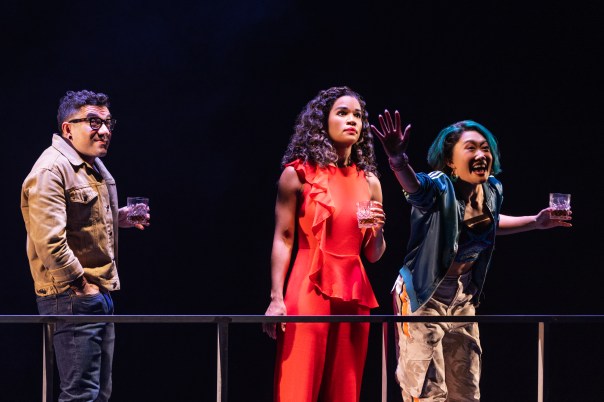

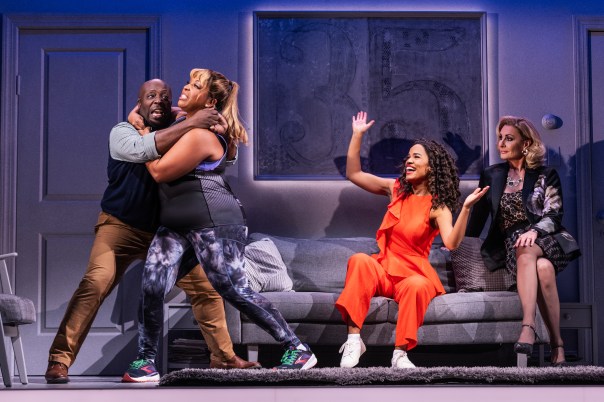


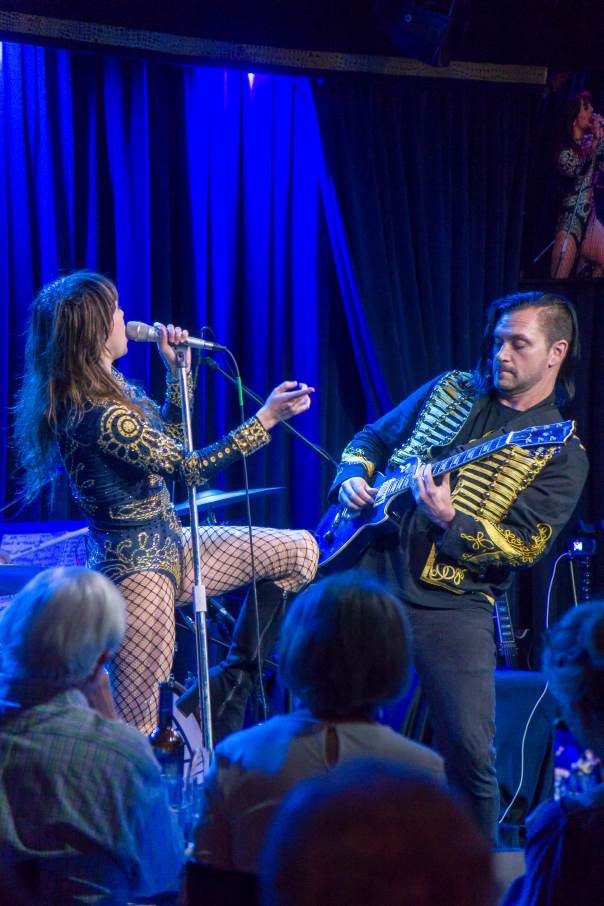
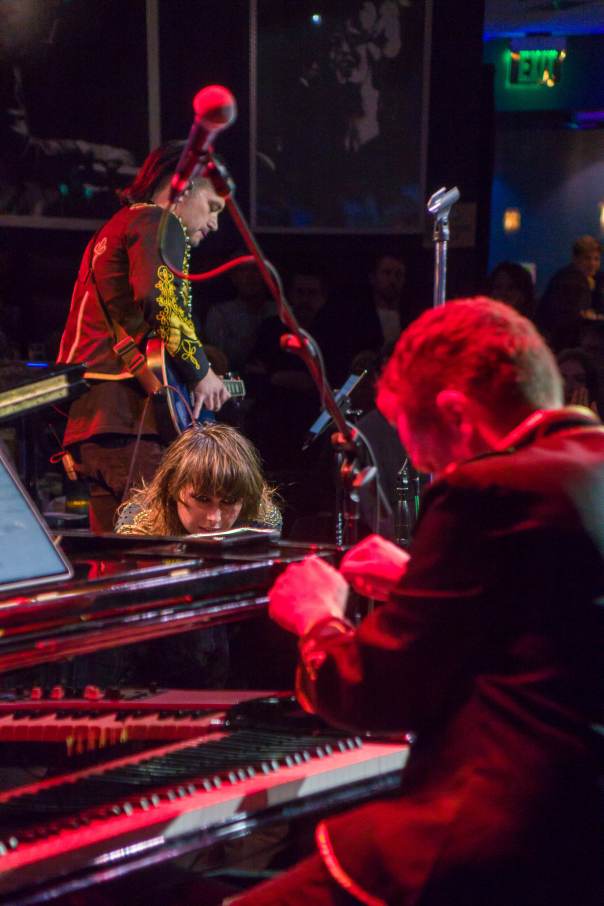


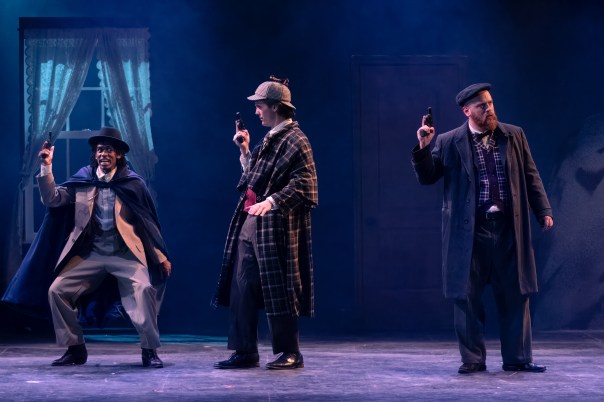
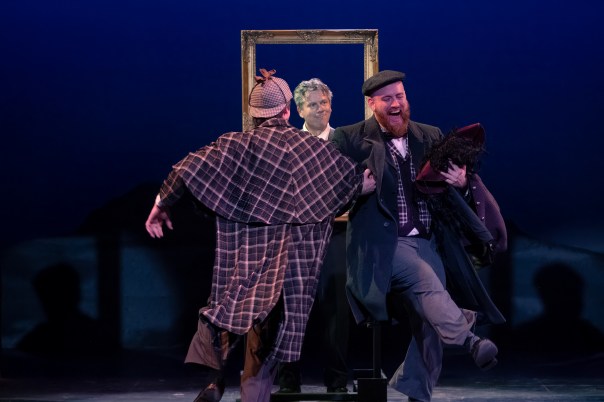


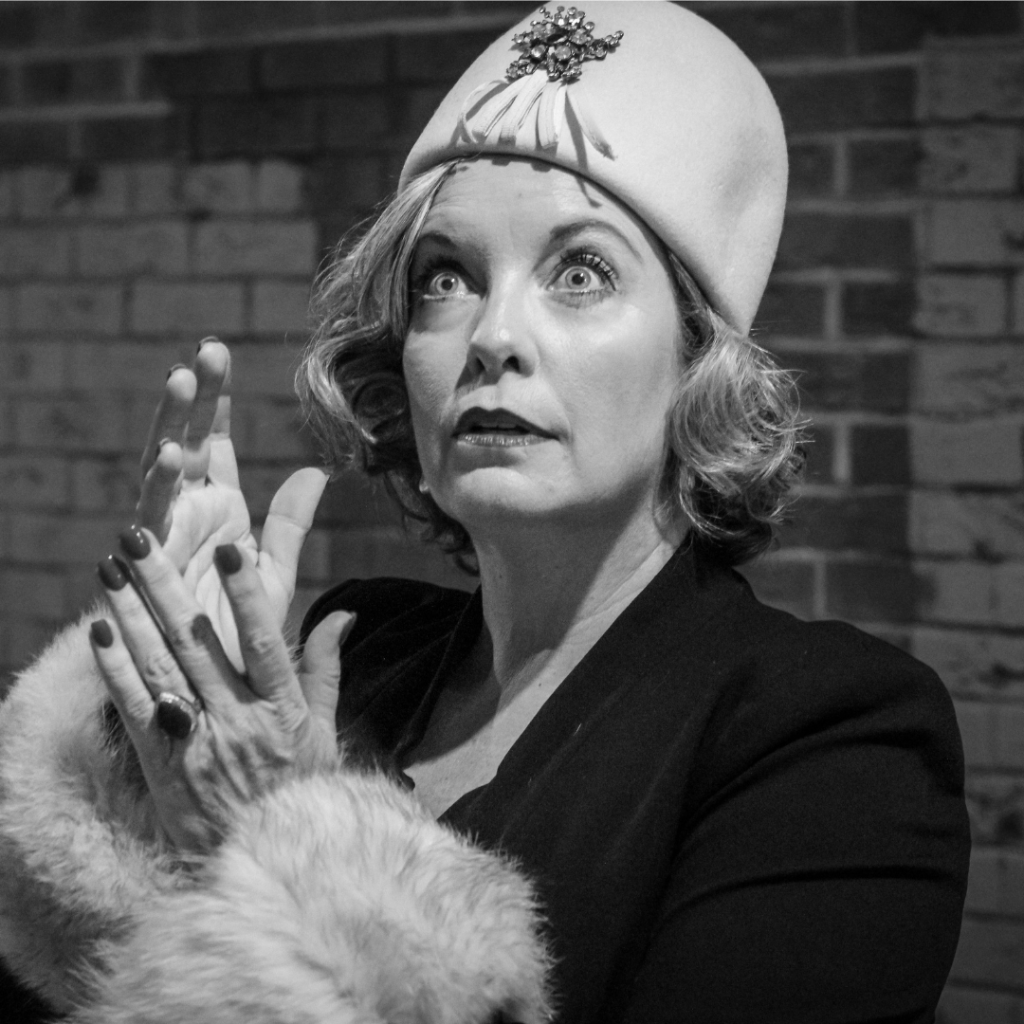
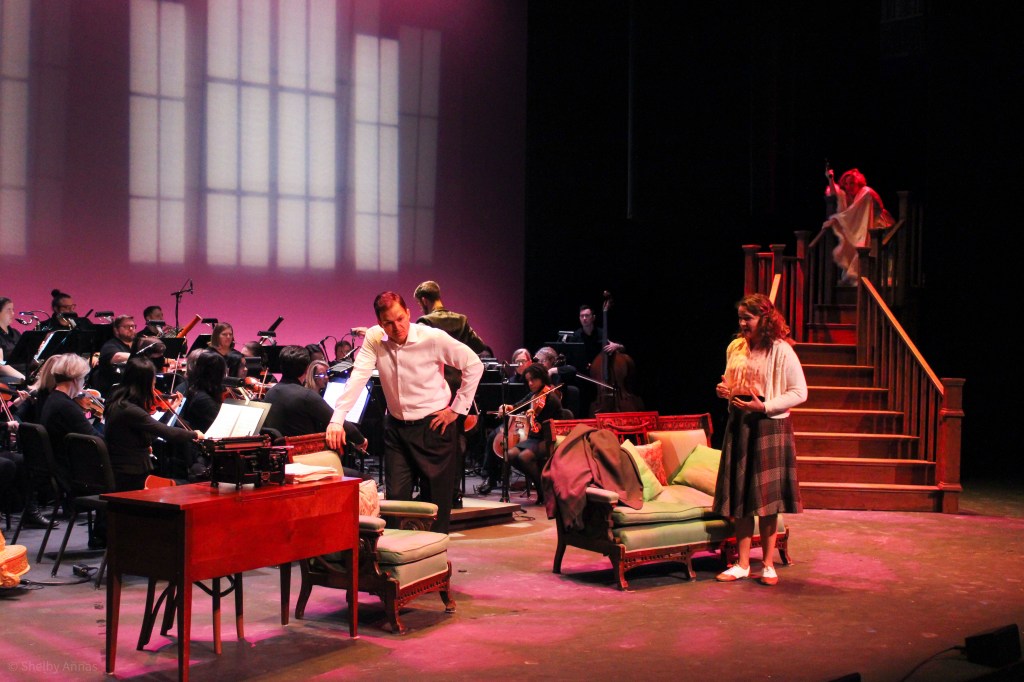


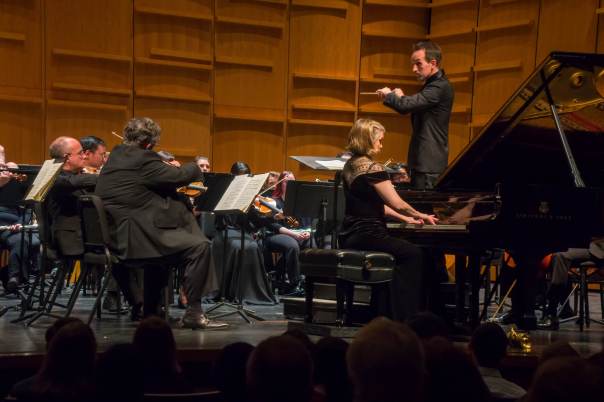


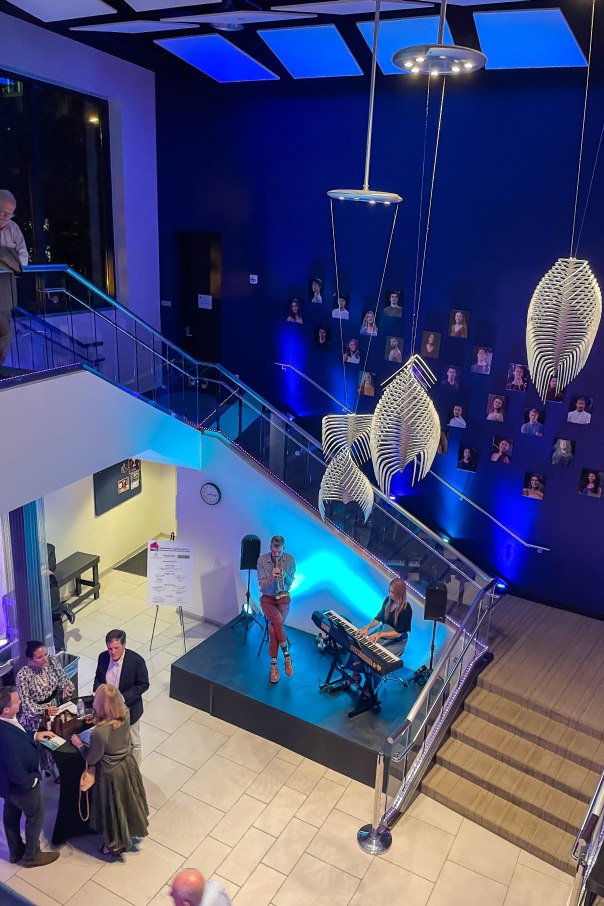
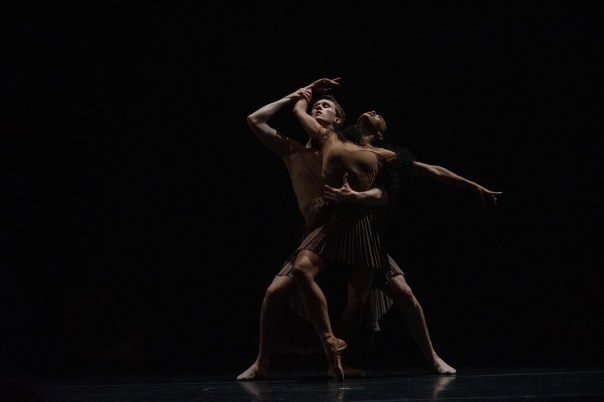


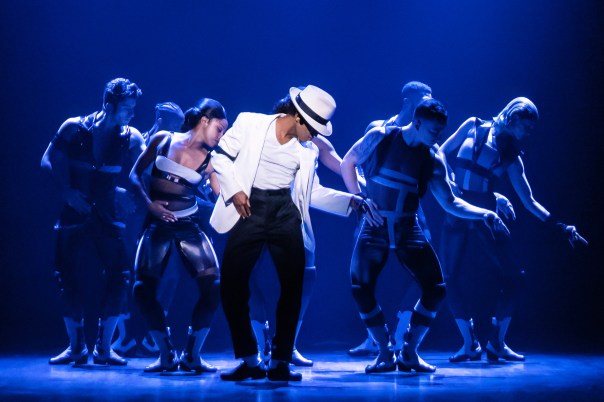


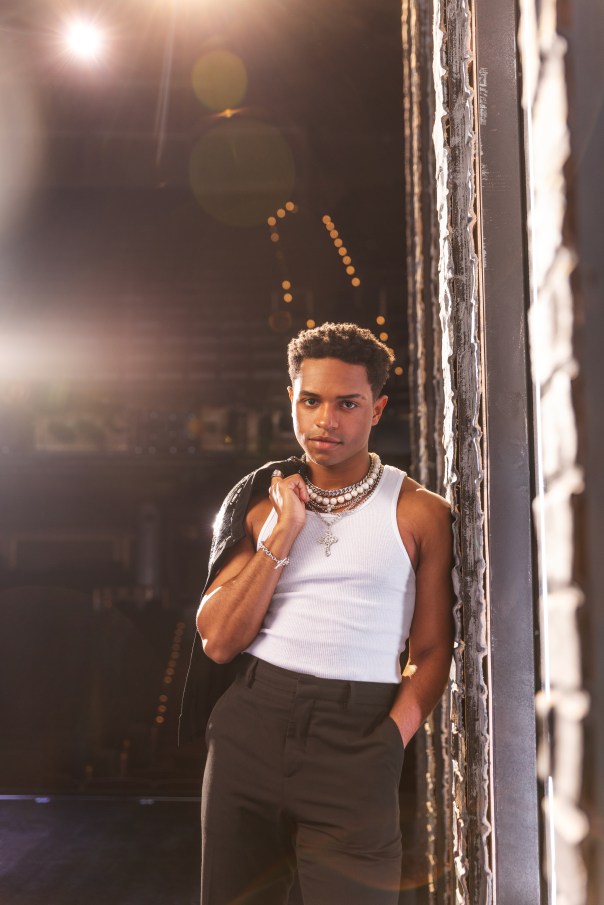


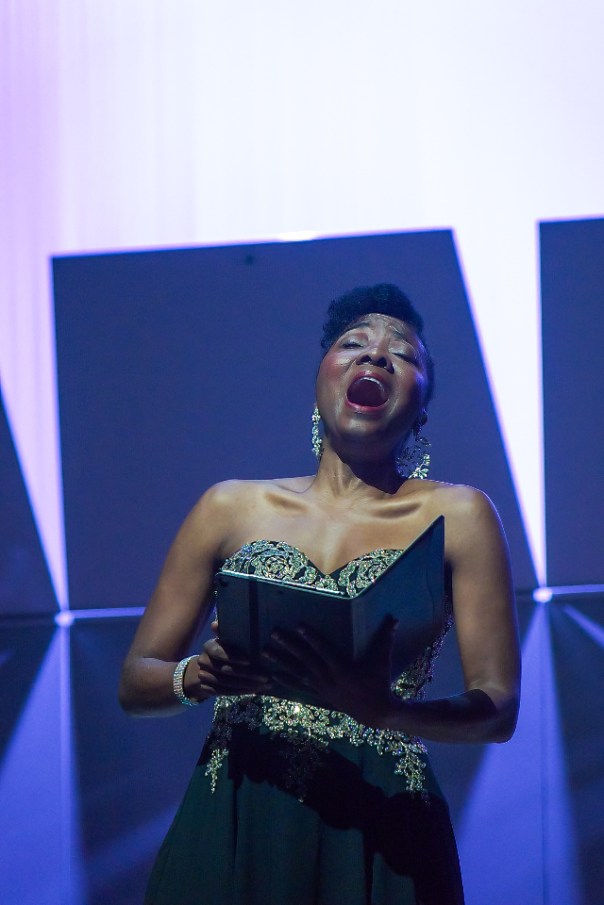


 Art on My Sleeve