Category Archives: Theatre

“The Book of Liz”: A Bifocal Satire of Life in the Heartland

By Perry Tannenbaum

Life on the prairie in small towns is pretty much how Garrison Keillor has been describing it for so long on NPR, except in university towns scattered across the Midwest and the occasional religious enclave. I sampled both during my sojourn at the U of Iowa in Iowa City, visiting the nearby Amana Colonies on a couple of boring weekends. Breaking the monotony of one of my drives back from a winter break, I also took a tip from my mom and looked in on the Amish in Pennsylvania.

Those humble years in America’s heartland came back vividly last week as I watched The Book of Liz, the second piece that Donna Scott Productions has performed at the Charlotte Art League. If you’re familiar with the other pranks by the playwriting siblings who conspired on this script in 2001, Amy and David Sedaris, you’ll readily guess that laughter far outweighed my nostalgia.

A stern ascetic strain is readily apparent in the Sedarises’ portrait of the Squeamish who live in the seclusion of Clusterhaven. Yet the script steers deftly around religion, aiming its satire primarily at the stodgy sexist patriarchs who rule the colony and their absorption with Clusterhaven’s prime product: cheese balls, traditional or smoky.

Both varieties of the colony-sustaining cheese balls are crafted by Sister Elizabeth Donderstock, following her own secret recipes. Reverend Tollhouse doesn’t seem to appreciate Liz’s kitchen artistry, and when young Brother Brightbee arrives in town, he sternly decrees that Liz hand over the cheese ball recipes – and all of the manufacturing responsibilities – to the sparkish newcomer. Already suffering from a profuse sweating problem, the redeployment sends Liz into crisis. She not only leaves the recipes behind in the community kitchen, she abandons the colony entirely and sets off into the real world.

The odyssey that follows is as circumscribed as Liz’s experience, education, and audacity. Even if she doesn’t get as far as Chicago – or even the Quad Cities! – we see the outside world, its zaniness and insularity, colored through the lens of Liz’s inner purity. It’s a picaresque journey or a bifocal satire; take your pick.

On the road, the first person she runs into is dressed as a Planter’s Peanut, trying to offer samples to passing motorists. We instantly get the idea that Liz’s adventure will juxtapose her with an outré character or two, and Oxana, the woman inside the ginormous peanut shell doesn’t disappoint us even when she sheds her costume, a Ukrainian immigrant with an English accent dwelling in a trailer with husband Yvone.

Thanks to Liz’s innate kindness, both women soon find new jobs. The situation – and the costumes – are slightly less outrageous as Liz comes to work at Plymouth Crock, a Pilgrim-themed restaurant that just might be trading off the proximity and cachet of Clusterhaven. Purposely or not, Liz’s new world resembles her old world in the way Oz resembled Kansas, and so does its effect.

Any temptation to take all this too seriously is quickly defused by director Glynnis O’Donoghue and her mischievous cast. Costumer Luci Wilson spares all expense in outfitting Reverend Tollhouse and Brother Brightbee with their beards, attaching them with crude elastic. The Pilgrim finery at the restaurant and Oxana’s peanut shell provide additional roasting as we move along.

Matthew Corbett begins double-underlining Rev Tollhouse’s starchiness and pomposity before anyone joins him onstage, offering some oddly phrased praises to his savior as he prays. A mercifully inserted blackout sweeps us along to the 38th of these “compliments” before Liz enters, with Tonya Bludsworth double-underlining her naïveté and her squirming diffidence from the outset. With Corbett’s imposing size, they’re instantly feeding off one another in a comedy symbiosis that dates back to Laurel & Hardy.

All isn’t quite as the Sedarises intended. Field Cantey enters with a perfectly calibrated excess of self-regard as Brother Brightbee, but it is Scott as Sister Butterworth, Liz’s associate, who is salivating in a subsequent scene at the very thought of seeing the heralded newcomer. Scott is also dialed in, since nasty, petty busybodies are her longtime specialties. What’s curious is the lack of reaction from Liz, a more natural indifference from our heroine if she were 20 years older than Bludsworth, as the playwrights prescribed – but this age misalignment only becomes glaring in the Act 2 denouement.

Corbett, Cantey, and Scott all reappear in multiple guises after Liz flees Clusterhaven, their slipshod costume changes adding further fizz to the story – but not before we come upon Tania Kelly, clearly the ideal nut topping for this cheese ball comedy. I’ve been raving about Kelly’s comedy prowess for nearly eight years, and she still never fails to delight and surprise. Here she makes up for her tardy arrival by taking on four varied roles.

During her travels, we wonder if Liz will find a cure for her sweating disorder – and whether reconciliation at Clusterhaven and appreciation from the Squeamish will be possible. The resolution isn’t likely to be exactly as you imagine, which is why you’ll probably be happy to find that the whole story turns out to be very much like a secret recipe revealed.


Hollywood Brings out a Sunnier Neil Labute

The Money Shot and Diana Grisanti’s The Patron Saint of Losing Sleep (nee Inc.)

https://i0.wp.com/media2.fdncms.com/charlotte/imager/u/zoom/3678994/artfeature.jpg

By Perry Tannenbaum

More than a couple of Neil LaBute plays have waltzed through Charlotte in the past dozen years, including Fat Pig, Reasons to Be Pretty, The Mercy Seat, Autobahn, Some Girl(s), and the suite of Mormon one-acts, Bash, that introduced the BYU grad to the Queen City in 2003. They aren’t teeming with admirable heroes — or even evil folk we might acknowledge as rogues. In Fat Pig, Reasons to Be Pretty, and Some Girl(s), LaBute was chiefly adept at showing what boorish, sexist assholes men can be. Comedy rarely intruded in LaBute’s world. When it surfaced, in a brief two-hander that was part of the Autobahn suite, results were quite tepid.

No, LaBute was funniest when he shocked us with how unabashedly crass and unapologetically cruel his boors could be. I’ve never seen LaBute as bent on comedy as he is in The Money Shot, the newest of his plays to hit town in a smart Queen City Theatre Company production at Duke Energy Theater.

With three women and just one guy in the cast, the demo has altered somewhat in this latest LaBute effort, but what triggers the playwright’s newfound comic vein are his decisions to amp up their egos while tamping down their intelligence.

Although outnumbered here at co-star Karen’s plush home, Steve wields the most clout and drives the plot. He’s a former Sexiest Man Alive and a bona fide Hollywood action hero, but his career desperately needs a reboot. So he has reached out to a trendy European director, hoping to bring new artsiness to his image by way of a new film that Steve will be executive producing.

If you are already familiar with what a “money shot” is in the realm of porn flicks, then you already have a good idea why Steve and his glam gold-digging wife Missy are calling upon Karen and her butch partner Bev, an established film editor. Otherwise, you would need to wait until we’re fairly deep into this 108-minute production — or have read some pre-publicity or this review — before Steve and Karen broach the point of this get-together.

So, there will definitely be drama here, but not until we’ve crossed plenty of comical character-study terrain aimed at taking down Hollywood’s pretenses of sophistication and culture. The key specimens are the co-stars. Steve follows in the footsteps of LaButean louts, but with his wealthy arrogance — compounded by his ignorance of the location of Belgium, the lineage of David Crosby, and the western march of civilization — he brings a unique suavity to the loutish breed, its aura further magnified by his bimbo wife’s worship.

Karen’s vapidity seems to have a more specific target: the shameless self-promotion of Hollywood celebs through branded products, business enterprises and endorsements. She already has a restaurant, a fashion line and a website extending her marketability. After the upcoming film, Karen has visions of launching her own line of sex toys! So yes, if you haven’t already guessed, it’s a raw sex scene — not a simulated one, mind you — that will crown the upcoming Steve-Karen hook-up with artistic legitimacy.

Missy is already enthusiastically on board with her husband’s scheme, giddy over the prospect of soon reaching their first anniversary (with the assistance of their marriage counselor). But beware, Missy has artistic aspirations of her own, and you will be obliged to endure a portion of her capabilities, as she reprises an episode from her role in a high school production of The Crucible.

Bev is the only true obstacle in the way of Steve and Karen copulating onscreen, since she’s hard-working, intelligent and saddled with a modicum of modesty and decency. There probably wouldn’t be quite as much friction within this foursome if Steve weren’t so boorishly tactless and homophobic, except that Bev brings so much righteous political correctness to the table that she’s almost as irritating as he is. Furthermore, Bev’s petulance toward Karen is so toxic that, at one point, even the dimwitted Missy can see that her marriage counselor might be helpful.

How all this plays out is pretty wild and delicious, thanks to an energetic cast directed by Glenn T. Griffin, who keenly amplifies the effervescent comedy. You may not think that J.R. Adduci is old enough to be pretending he’s only 45, but once we’re rolling, that hardly seems to matter. He brings such charm to Steve that he personifies the Hollywood paradox: a pantheon of demigods we worship while fully grasping their shallowness. As Adduci sat there on the couch, desperately googling on his cell to back up his contention that Belgium is not in Europe, I found myself feeling sorry for the schmuck.

Michelle Fleshman captures even more of the pathos of Hollywood’s fading stars, brilliantly brittle as Karen, especially poignant as she affirms her bisexuality to her sneering guests. You’ll also like Karen’s assorted meltdowns when she fails at mediation and conciliation. In so many ways, Iesha Nyree’s steely portrayal of Bev brings uneasiness to the piece. She’s sufficiently abrasive to make us wish that Steve and Karen will have their way, and when the gloves come off, she convincingly emerges as the alpha predator.

Nobody comes off nearly as shallow as Karen Christensen in her exuberantly silly portrait of Missy. Many of Griffin’s directorial excesses are lavished on this bleached blonde, whether she’s shamelessly spooning with her new husband on the hosts’ couch or when she finally turns on him in the denouement.

The ills of Hollywood may be crass and clichéd. Yet they pepped up David Mamet’s work when he wrote Speed-the-Plow — and they’re ministering a similar therapy here for the misanthropic LaBute. This may be the sunniest piece he ever writes.

https://i0.wp.com/media1.fdncms.com/charlotte/imager/u/zoom/3669927/top10-4_28.jpg

Playwright Diana Grisanti won first prize again for a staged reading of her new script at last winter’s NuVoices festival, so Actor’s Theatre is bringing The Patron Saint of Losing Sleep (nee Inc.) back to Stonewall Street for its fully-staged world premiere. I wasn’t among the judges who thought Inc. was the best script at NuVoices, but I thought it was distinctively better than Grisanti’s previous winner, River City, which premiered here last September.

Unfortunately, Grisanti’s rewrite has degraded her product — particularly her title heroine, Ada, who might be described as the patron saint of catastrophic interventions. Back at divinity school, Ada intervened on behalf of a college pal, who was fielding some sexual harassment from her advisor. Memories of this intervention, which merely resulted in Ada’s dismissal from school, are dredged up when she stages a more harmful intervention while working at a customer service phone bank.

Nicia Carla gives us a vivid account of Ada as she deals with the insomnia stemming from her misdeeds; and her supporting cast, meticulously directed by Elissa Goetschius, stir up a lively mix of comedy and drama. But Grisanti has botched her formula and lost moral focus, making Ada less savory while tilting the overall tone toward comedy. Just because Ada pierces (stigmatizes?) her hands with a fork, Grisanti and the college chum seem to be granting the meddlesome sinner forgiveness for causing the death of an unborn child.

Nope, I wasn’t cool with that.

CPCC Theatre Bests Broadway in Beautifully Steering “The Trip to Bountiful”

By Perry Tannenbaum

BWW Review: CPCC Theatre Bests Broadway in Beautifully Steering THE TRIP TO BOUNTIFULNow nearly qualifying for senior citizenship, Horton Foote‘s quirky 1953 idyll, The Trip to Bountiful has always been a delicate little shrub. Imprisoned in a three-room Houston apartment, where she’s watched over by her sickly weak-willed son Ludie and her temperamental daughter-in-law Jessie Mae, Carrie Watts yearns to revisit her ancestral home in Bountiful, Texas, just a short liberating bus ride away. Stymied in previous attempts to fly the coop by train, the pensioner’s dearest wish is finally achieved, largely through the kindness of strangers – who perceive virtues in Carrie that her family has grown blind to.

It’s a rather bland tale that challenges a director to perk up the drama, which threatens to vanish once we must pull away from the close-ups on Carrie that TV and movies so readily provide. In the current CPCC Theatre production at Pease Auditorium, Charles LaBorde has a more satisfying way with the script than Michael Wilson did in the recent Broadway revival.

Casting is crucially important, for both of the Watts women’s roles are tasty. It was Jo Van Fleet who won the first Bountiful Tony Award as Jessie Mae. But the lead role has long since asserted trophy dominance, with Geraldine Page taking the Oscar for the 1985 film adaptation, Lois Smith taking multiple awards in the 2005 off-Broadway revival, and – inexplicably to me, since I witnessed her performance – Cicely Tyson winning the Tony when Bountiful returned to Broadway in 2013.

Corlis Hayes gives us an autumnal Carrie, far more lively and likable than Tyson’s wintry rendition, which was chronically underpowered and often unintelligible. There is a beautiful distillation of frailty and determination from Hayes that continuously sparks this Carrie on the rocky road to her little victory, so we see more readily what the helpful strangers – a small-town sheriff and a fellow bus passenger – are finding so appealing.

Wilson’s idea of perking up Foote’s script called for turning Cuba Gooding Jr. as Ludie into a wheedling henpecked husband, yielding with barely a whimper to the beauty queen vanity and near-S&M tyranny of Vanessa Williams as Jessie Mae. Carrie and Ludie both seemed to be suffering under the same oppressive regime, except that Gooding seemed to be playing his subservience for laughs.

Jonavan Adams gives us a different kind of weakness. We not only get more of the sense that Ludie is still on the mend after a long convalescence, we also get the idea that his apparent weakness is less a fear or worship of his wife than his touchy walking-on-eggshells position as the eternal peacemaker between his warring wife and mother. Nor is Tracie Frank quite the implacable goddess that Williams made out of Jessie Mae. Frank is more petulant and resentful than domineering in asserting control over Ludie, and except for Jessie Mae’s insistence upon going to the beauty parlor weekly, she pretty much discards the Broadway vanity.

All of these adjustments make a significant difference after Carrie reaches her ruined ancestral home, both in the climactic confrontation between the two women and in the ultimate message of Carrie’s story. On Broadway, Carrie seemed to capitulate entirely to Jessie Mae, and when Jessie Mae made her concessions to Ludie afterwards, they seemed like crumbs she could afford to toss his way once she had triumphed.

Here there is a richer sense that Carrie has really gotten all she wanted and needed when she beheld her childhood home one last time. In this production, I can also believe her claim that she has no more reason to rebel against Jessie Mae. And when she sees her son making demands upon his wife, LaBorde and Adams craft a moment that reminds me of A Raisin in the Sun, when Lena sees her son coming into his manhood in the denouement.

So instead of the dark takeaway in the Broadway revival that intimated a parallel between the disintegration and extinction of small towns and the slow dying away of the good people who came out of that simple prairie life, we’re left with something far sunnier and personal. It’s an argument between Ludie and Carrie that’s decided in Mom’s favor: while it might be morbid to wallow in the past, it’s better to keep connecting with your past and your roots from time to time than to be eternally trying to deny and sever yourself from your heritage.

Supporting players radiate their sympathy toward Carrie without oozing it. Amy Wada as Thelma is Carrie’s first enabler when she meets her at the bus station attempting her getaway. Foote is resourceful in getting Thelma to warm to Carrie, sending Jessie Mae to the bus station hot on her prisoner’s heels, and it’s delightful to watch Wada picking up these cues and evolving Thelma’s attitude.

A couple of obstacles that Foote tosses in Carrie’s path after she boards the bus will make her more pitiful, yet there’s a nice restraint to the sympathy that she gets from Al England as Roy, the station manager, when she debarks in the middle of the night at the Harrison station – because the bus no longer stops at Bountiful. Contrasting with England’s cracker-barrel geniality is Tom Scott‘s crustiness as the Harrison sheriff, so when he yields to Carrie’s entreaties to take her the rest of the way to Bountiful, his softening is all the more affecting.

Of course, Scott has a lot more reason to be accommodating, for on the threshold of completing her journey, Hayes is far more willing to surrender her dignity and beg for the sheriff’s help than Tyson was. When it came down to that crucial moment, the Tony Award winner wasn’t willing to go that far, even if that was closer to where 1953 Texas truly was for an African American.

Spare and weathered, James Duke’s set design for Bountiful – nicely illuminated by Duke’s sunny lighting – is pure poetry compared to the bumper-car set pieces that cast and crew roll around the Pease stage as we journey from the Wattses’ apartment to the Houston bus station. Noticeably simpler, the Harrison depot strikes us as an apt halfway point in this retro TRIP.

Jamie Varnadore’s costume designs seem most dignified when we reach the old crumbling homestead, wordlessly making a point that the Broadway revival labored so hard at. That rickety porch and the home beyond it were places where we could be most human, most ourselves. We lose something of our essence cooped up in a tenement or herded together – and segregated – at a Greyhound terminal.

Constantly Under Siege, Hurston’s Heroines Retain Their Admirable “Spunk”

👤By Perry Tannenbaum

Growing up in an all-black Florida town, Zora Neale Hurston faced – and distilled – hardships in her youth that weren’t about race. So in the canon of black literature, Hurston has had to wait her turn for the full value of her strong, understated feminism to be appreciated. By 1990, a full 30 years after she was buried in an unmarked grave, Hurston’s star had risen sufficiently that George C. Wolfe, already prominent at New York’s Public Theatre, adapted three of her sauciest tales for a production at the Public Theatre’s New York Shakespeare Festival that he called Spunk (actually the title of a fourth Hurston story), complemented with a blues score by Chic Street Man.

Hurston’s career actually shuttled between literature and anthropology, with stints as a folklorist before one of her last documented jobs, a substitute drama teacher at North Carolina College in Durham. If you read her most-anthologized story, “The Gilded Six Bits,” which is among the three Wolfe adapted, you’ll notice some shuttling in her style. As a narrator, Hurston is a precise detached observer with only a sliver of idiom impinging on her prose. Once her characters begin to speak, however, she’ll fracture grammar and spelling as zestfully as Mark Twain ever did.

“It is suggested,” Wolfe says in his intro to the published playscript, “that the rhythms of the dialect be played, instead of the dialect itself. A subtle but important distinction. The former will give you Zora. The latter, Amos and Andy.”

In the current On Q Performing Arts production at Spirit Square, director Jermaine Nakia Lee and his ebullient cast aren’t altogether intent on heeding Wolfe’s warning. Masks and puppets that appear in “Sweat” make no attempt to evoke Africa rather than minstrelsy. Jelly and Sweet Back, the hilarious self-pimping gigolos in “Story in Harlem Slang,” may be better dressed and better spoken, but they could still pass for Amos and Andy’s cousins. And while Shar Marlin as Blues Speak Woman cuts a figure very much like her previous onstage incarnations as Bessie Smith and Shug Avery, we have to take in Gabriel Jules as Guitar Man through the filters of a boater hat and a painted gray beard. Grayface?

Set in Hurston’s childhood home of Eatonville, “Sweat” is about the torments that Sykes Jones inflicts upon his wife Delia – parading a mistress around town, bombarding Delia with verbal abuse, and bringing a venomous snake home just because it terrifies her. Physical abuse might have been added to that list if Delia hadn’t gotten her hand around a frying pan. While outfitting the townspeople with masks and puppets further telegraphs to us that Sykes’ tyranny will be short-lived, the cracker-barrel flavor of the narrative is as much Uncle Remus as it is fairytale.

Lee’s style, flirting with downright offensiveness, is actually quite edgy, taking up the idea that, if whites can mock their country cousins as trash or rednecks, Northern blacks can claim the same liberties with their Southern brothers. In this respect, “Harlem Slang” has the same viewpoint as the opening story. Before fully rejecting the flatteries of Jelly and Sweet Back, with a scream worthy of a white woman, the Harlem washwoman (same profession as Delia) unmasks the two oozing sponges as Southerners who have moved North so they can sweet-talk their way through life instead of holding a job.

Fortunately, our savvy washerwoman takes her time rebuffing Jelly and Sweet Back, for they are quite the comedy combo vying for her favor. Omar El-Amin and Quentin Talley have been honing their onstage rapport for over seven years, mostly as the title protagonists of Miles & Coltrane, but this little one-act with its Jelly-Sweet Back foppery is the funniest they’ve been.

They remain antagonists after intermission, yet Hurston is flipping the geography thematically when we return to Eatonville for “The Gilded Six Bits.” All the false glitter comes from Chicago in the form of Otis D. Slemmons, played by Talley, who comes to town and opens up an ice cream shop, dazzling Missy May with his sweet talk and his rich façade.

As moody and nasty as El-Amin was as Sykes in “Sweat,” that’s how moody and virtuous he is as Missy May’s husband Joe in “Six Bits” – sufficiently stung by her infidelity to leave her, yet loving her deeply enough for there to be a path to forgiveness. There’s a naïveté to Nicole Watts’s portrayal of Missy Mae that puts me in mind of Nora, flitting around in her gilded cage as The Doll’s House begins, an innocence that has carried over into marriage. But she’s pathetic, melodramatic, and saccharine enough in her guilt to remind me of the smarmy urban fairytales of O’Henry.

Combined with the grim grit Watts brings to her earthy Delia and the sassy ripostes she tosses off eluding her pursuers in “Harlem Slang,” there’s enough variety and spunk from Watts to match up well with El-Amin and Talley – maybe enough to establish her two washwomen and a mostly dutiful housewife as authentic feminist heroines. But the style Lee brings to the production doesn’t completely commit to placing Hurston and her protagonists up on that high pedestal. Remembering how Wolfe had lovingly lambasted the pieties of A Raisin in the Sun in his Colored Museum, I suspect some lingering ambivalence was exactly what the playwright slyly intended.

The blues songs that suffuse the storytelling, rooted in sadness and suffering yet somehow bursting with joy as Marlin sings, underscore this rich gumbo of conflicting moods. It takes blues, grit, pain, spit, and spunk to “Git to the Git,” the song that frames the evening. From a revolutionary’s perspective, celebrating the struggle may be copping out, but Wolfe lets Blues Speak Woman interpolate some remarks into her swinging intro that explain Hurston’s viewpoint. These three stories, she says, “celebrate the laughin’ kind of lovin’ kind of hurtin’ kind of pain that comes from bein’ human.”

Sounds about right.

Ich Bin ein Beethoven! 

Opera Carolina’s Fidelio Upstages Children’s Theatre’s Creepy Coraline

By Perry Tannenbaum

The advantages for relying on readily recognized plays, novels, myths, or historical events for operatic storylines become quickly apparent in conventional productions of Beethoven’s Fidelio. When the title character appears in a prison courtyard, we already know that the jailer’s young daughter, Marzelline, is dizzily in love with Fidelio, having rejected Jaquino, the jailer’s assistant, as emphatically as she knows how. So why is Marzelline’s dreamboat, heartily endorsed by her dad, a soprano?

It’s tempting to presume that the difficulties in grasping what’s going on in Fidelio have multiplied since Beethoven’s day. Ludwig’s only opera, initially premiered during the French occupation of Vienna in 1805, was set at a fortress in Seville during the previous century, though its political aspirations were intended to resonate with the French Revolution.

True enough, the work was originally named Leonore after the masquerading Fidelio’s true name, but that name wasn’t spoken until the third and final act. Subsequent revisions trimmed the work to its current two-act format. Rocco doesn’t even know the name of the prisoner he’s starving in his deepest dungeon – the husband Leonore secretly seeks though he’s presumed to be dead. So the name of the dissident Florestan isn’t spoken until his nemesis, Don Pizarro, arrives on the scene.

In that dim light, the radical changes in Opera Carolina’s new production, under the stage direction of Tom Diamond, only do favors for Beethoven’s opera that the re-revised libretto by Joseph Sonnleithner and Georg Friedrich Treitschke cries out for. While maestro James Meena conducts the Charlotte Symphony Orchestra in the stirring overture, we’re getting some very important information on the transparent scrim as the Belk Theater curtain rises.

Maria Katzarava first appears in her starring role with long hair under a stage right spotlight and “Leonore” flashes onto the scrim in front of her. Then with the aid of her friends, acting with revolutionary purposefulness, she undergoes a strategic makeover. By the time the overture has ended, she has emerged with short hair. Putting on a man’s military jacket, she stands under a stage left spotlight as her undercover name flashes onto the scrim.

More context comes our way in a title projected onto the gray cinderblock wall of Dejan Miladinovich’s parsimonious set design. We’re in East Germany on November 8, 1989, a day before the fall of the infamous Berlin Wall. A recorded excerpt from JFK’s “Ich bin ein Berliner” speech gives us more Cold War flavoring – surely a more spot-on echo of Beethoven’s spirit than some obscure intrigue in 18th century Seville – and you can bet on hearing Reagan’s challenge to Gorbachev before the night is done.

Names of key characters have also been changed to enhance the East German ambiance. The implacable governor who spitefully imprisons Florestan, Don Pizarro, has become the East German head of state, Walter Ulbricht, the man who prevailed upon the Soviets to build the wall. Florestan is now listed in the program booklet as Kurt Wismach, a laborer who famously heckled Ulbricht, calling for free elections. His ultimate liberator, the beneficent Don Fernando, is reincarnated as Walter Momper, the first mayor of reunified Berlin.

Historical accuracy may be tossed out the window by linking Momper with the others, but the additions fill in some gaping narrative holes, giving Katzarava something to sing about in Act 1 as she drops hints about her motives. The soprano sings powerfully and beautifully but without sufficient urgency in Act 1, so the strange Fidelio-Marzelline-Jaquino triangle matters a little more than it should. What ignites Katzarava – and indeed this entire production – is Andrew Richards’ soulful portrayal of Florestan.

From Florestan’s first famished outcry as we behold the shackled prisoner for the first time, we ascend to a loftier level, even if Richards’ highest notes aren’t completely secure. Katzarava rises to the occasion with him. This is a man who has lived purely, idealistically, and after trifling with Mazellina and Rocco, Leonore is purified in his presence.

After an auspicious outing earlier this month at Opera Carolina’s Art • Poetry • Music over in CPCC’s Halton Theater, Raquel Suarez Groen was underpowered in the larger Belk hall as Marzellina, barely audible over the orchestra at times, and drowned out in the Act 1 vocal ensembles. What we did hear from the soprano was quite sweet, and her fainting spell in the final scene, upon learning the truth about her fiancé, was the comic highlight of the evening.

Otherwise, the supporting cast was strong and satisfying. Andrew Funk gives a rich account of the obedient, good-hearted Rocco, his copper-colored suit an island of color amid the drab costume designs of the opening act. Kyle Pfortmiller strikes terror from the moment he enters as the imperious Ulbricht, sporting a spiky bass that the notoriously squeaky voiced real-life Ulbricht could only dream of. Funk is suitably shaken when the despot first appears, but Pfortmiller’s confrontation with Florestan and Leonore in the denouement is even more electric.

Along with the robust Opera Carolina chorus, two locals round out the cast. Earnestly courting Marzelline, tenor Brian Arreola as Jaquino gives Leonore ample reason to feel guilty over her deceptions, and baritone Dan Boye is warmly authoritative meting out justice as Momper in the final scene. The conclusion is often cited as a harbinger of the “Ode to Joy” that ends Beethoven’s Choral Symphony with unmatched exhilaration. But having seen the public acclamation of Hans Sachs earlier this year at the Metropolitan Opera, I’d say that the praise showered upon the brave Leonore also prefigures the wondrous final scene of Die Meistersinger by Richard Wagner.

Beethoven takes about three hours less to reach his happy ending, an achievement that should endear him to Opera Carolina’s abstemious subscribers.

Coraline ON SALE NOW!

No doubt about it, the current Children’s Theatre production of Coraline at ImaginOn is the thinking family’s alternative to the purely visceral Scarowinds – and the insanely long lines of traffic to get there. The surreal scenic design by Tom Burch, with its gnarled tree and outsized moon, is nicely calibrated to the strange creepshow adapted by David Greenspan from Neil Gaiman’s novel. Costumes and puppets by Magda Guichard, ranging from zombie paleness to nightmarishly over-colorful clownishness, will have you wondering whether your toddler can keep it together.

And perhaps eeriest of all, the music! – delivered by a ghostly trio at electric keyboards and guitar, directed by Mike Wilkins. Also conspiring in the creepiness are sound designer Benjamin Stickels and Moving Poets choreographer Till Schmidt-Rimpler.

So I probably would have enjoyed Coraline if I’d been able to hear more than 70 percent of it. Stonefaced Parker Mullet was often inaudible as Coraline, but she was clarity itself compared to the three ghost children who help our hero find her true parents and escape the clutches of her evil Other Mother – in the parallel twisted universe beyond her closet door. Why Coraline was collecting marbles was far clearer to the kids around me who knew the book or saw the movie than it was to me.

Even the adults onstage could be difficult to understand when they weren’t singing alone, so I was often equally mystified about the lyrics Stephin Merritt had written to complement his music. But Nicia Carla and Grant Watkins are superb as the button-eyed Other Parents, proving there can be different paths to scariness, and before we reach their spectral domain, Devin Clark is a delight as the Cat.

Directing this colorful spookfest, Mark Sutton only lets us down by not ensuring that we hear it. I strongly suspect he would have achieved far more satisfying results moving the show from the Wells Fargo to the larger McColl Theatre. All the actors could have been outfitted with mics there, lighting designer Eric Winkenwerder and his cohorts could have unleashed a more powerful barrage of tech artillery, and when Carla made her grand exit, a trapdoor could have whisked her to the infinite void.

COTU Gives “Nosferatu” the Silent Treatment

 photo Nosferatu-Remix-art-Recovered_zps8s0k50qk.jpg

By Perry Tannenbaum

Recent rumblings have reached me hinting that Citizens of the Universe may soon be taking its last lap around the track. As Nosferatu was opening last week, it was certainly disconcerting to hear that Charlotte’s most unique theatre company may soon announce a final season. Yet a possible flame-out is not out of character. Founded just over six years ago, COTU has always personified the restless energy, creativity, and eccentricity of its artistic director, James Cartee.

Hunter Thompson himself would have gasped in astonishment at Cartee’s hyper-caffeinated portrait of him in his one-man paranoid fantasia, Gonzo: A Brutal Chrysalis, COTU’s signature production. Cartee & Co. ranged from Beowulf to Eternal Sunshine of the Spotless Mind, from Uncle Vanya to Reservoir Dogs, and from Titus Andronicus to The Princess Bride. No less restless than the range of Cartee’s interests is the range of venues he has taken his company to – surely unprecedented in Charlotte theatre history.

The fact that there are no real theaters on Central Avenue or in Plaza-Midwood has never discouraged Cartee. COTU’s guerilla invasions have targeted The Graduate, Studio 1212, Snug Harbor, the defunct Story Slam, and a warehouse loading dock on Central Avenue. Cartee’s explorations in NoDa have been no less pioneering, including UpStage, the Chop Shop, Seeds 100, and an epic tour of NoDa restaurants, bars, and coffee houses – in pouring rain – chasing down Jack the Ripper. The Beowulf at Duke Energy this past July was an out-of-body experience for COTU followers. We were all in seats you couldn’t budge!

No, Cartee hasn’t settled in there – or at any other place aside from Story Slam where he could become acclimated to the equipment. So COTU’s new NoDa foray, outdoors in the loading area of Salvaged Beauty, the community’s “music and art collective,” is almost as technically plagued as its maiden voyage into musicals, The Rocky Horror Show, was at Seeds back in May.

But it really doesn’t matter that much in Nosferatu. You wanted to hear what Brad, Janet, and their assorted tormentors were saying and singing in Rocky Horror, but in turning to silent film for the first time, Cartee mostly gives the silent treatment to Friedrich Wilhelm Murnau’s 1922 classic.

Henrik Galeen’s screenplay was an unauthorized adaptation of Bram Stoker’s Dracula, with all the names changed and the ending deftly condensed. Cartee’s stage adaptation adds a smattering of spoken narrative, but it is not from Thomas Hutter, nee Jonathan Harker in Stoker’s novel. Through strings of journal entries and letters home to his dear fiancée, Harker was the purported author of our tourguide to Transylvania.

At Salvaged Beauty, it’s Professor Bulwer, the crucifix-swinging Van Helsing in Stoker’s original, who occasionally creeps across our field of vision, reading snatches of an eerie narration. Among local actors, JC Kingsley is only eclipsed by Tom Scott and Brett Gentile for the sheer loudness of his voice, so my usual preference for sitting as close as possible to the action – especially for outdoor productions – could be confidently tossed by the wayside.

The more compelling reason to move away from the playing area is the wide vista of the action, which encompasses about half of Salvaged Beauty’s considerable depth. While titles flow downwards from the top of a closed garage door at the side of the building, action is usually staged off one of the sides, near front one of the adjoining entrances. Even when I withdrew from the rows of seats at floor level to the platform behind, keeping track of the titles and the action was often like watching a tennis match.

At the macabre ruins of Carolina Theatre, where Cartee originally intended to present his Halloween saturnalia, the whole concept could have worked far more effectively, with titles projected above the action – or below it, if the rickety old stage has been rehabilitated. But the main problem with the titles on opening night was that they were totally out of sync with the action, falling awkwardly behind the dialogue or leaping even more awkwardly ahead. Worst of all, when the titles were allowed to languish too long, catch-up was accomplished at the expense of watching whole chunks of dialogue and connecting narrative scroll by at an impossibly blurry speed.

Mandy Kendall as Hutter’s wife, Ellen, takes the brunt of this technical glitch in scene after scene fretting over Thomas’s return from Count Orlok’s horrid castle and reacting to his bizarre correspondence. As Thomas, Bryan Green hardly needs any supertitles to fortify the purity, idealism, and astounding naïveté of our hero. We can see him absently cutting himself with a knife at Orlok’s castle and his host’s ravenous response to the sight of blood. Likewise, Thomas’s discovery of Orlok in his coffin, his fainting, his comatose days, and his delirium are all visually explicit.

Thanks to the make-up wizardry Kendall, Kingsley, and Cartee, Justin Mulcahy doesn’t need to emote extensively to plumb the evil depths of Orlok, nee Count Dracula. Oh, but he does anyway! Joseph Tenney gets a similar pass as Knock, Orlok’s man in Hutter’s hometown, though there’s already a craziness in his eyes worthy of the insect-eating Renfield, Stoker’s most oddball creation.

The exhilaration that an unabashed surrender to silent screen hamming can bring us is probably best exemplified by the minor players, all of whom get to dig into multiple roles. Whether warning Thomas of the perils of Orlok’s castle, tending to our hero in the hospital, or protecting his hometown against the onset of plague, you can count on Ervin Green, Michelle Lampley, and Mirachol Carroll to inject some levity into the ghoulish story, either as dimwits or incompetents.

Aboard the ghost ship that carries Orlok to his new HQ across the street from the Hutters, the levity comes from an excess of Halloween melodrama by the Captain and the First Mate – or it will when the titles roll properly. The interplay between the Innkeeper and his servant is already slapstick gold.

In fact, once the big tech snafus are solved, all the problems of COTU’s Nosferatu are likely to vanish, except for one: the nagging annoyance of Kingsley’s pronunciation of the title. Emphasize and elongate the third syllable and you readily evoke the horror of vampires and the nocturnal fright of Transylvania. Transfer that emphasis to the second syllable, as Kingsley does over and over, and it sounds like we’re dealing with some milk company in New Jersey.

“Bad Jews” Venerates and Perverts a Family Icon

By Perry Tannenbaum

With a good portion of his congregation nodding their assent or laughing out loud, my rabbi recently devoted a good portion of his sermon to cataloguing the different, often hilariously quirky paths that individual Jews choose in keeping the dietary laws and customs of kashrut. For most Jews, deciding what’s kosher and what’s not is just one of many personal decisions made without consulting rabbinical authorities.

Between the dictates of the Bible and the rabbis, there’s plenty to navigate. For those Orthodox and Chasidic Jews who diligently observe the commands of the Old Testament and the labyrinthine addenda of multitudes of rabbis – from before the birth of Jesus down to the present hour – slackers who do their own thing can be conveniently classed as the Bad Jews of Joshua Harmon’s dramatic comedy, now in its local premiere at Actor’s Theatre.

Within the framework of Harmon’s story, judgments aren’t that simple. Poppy Feygenbaum, the beloved patriarch of his family, has just died, and the funeral has already concluded when we encounter two of his grandchildren, Daphna and Jonah. They’re bunking together at Jonah’s posh apartment in the Upper West Side, overlooking the Hudson River, which his mom has thoughtfully bought for him.

Daphna, a more purposeful and self-righteous person than her mellow cousin, doesn’t take long before trying to make Jonah feel guilty over all this luxury that has fallen into his lap, but the guilt-mongering barely succeeds in getting him to lift his gaze from his MacBook. Yet the brunt of Daphna’s ill-will isn’t harbored against Jonah, anyway.

Through the tangle of her pugnacious, infrequently interrupted harangue, we get the full current of her resentments toward Jonah’s older brother, Liam, beginning with the damning fact that he missed the funeral. This is symptomatic in Daphna’s eyes of Liam’s moral laxity and his utter contempt for Judaism. We get a whole case against Liam before he even arrives – with all the contrasts between the combatants.

Veering away from her given name – Diana – Daphna is embracing her Hebrew name. She has an Israeli boyfriend whose Hebrew name, Gilad, keeps making its way into her conversation, and she intends to make aliyah (to settle in Israel) and pursue rabbinic studies. (For those who need decoding, that career path would mean she is a Reform or Conservative Jew.) Liam, on the other hand, has struck Daphna as deeply ashamed of his Hebrew name. He’s getting his degree in Japanese studies, he’s constantly dating outside the faith, and though he attends the family seders, his manner suggests an eye-rolling superiority to all the Passover rituals and outright contempt toward the holiday’s special dietary laws.

Daphna’s epic indictment is aimed at tipping Jonah toward her side in the great controversy to come. No, despite the unconscionable largesse of Jonah’s apartment, Daphna isn’t seeking a huge chunk of the estate or even a handsome bequest. All she wants is the chai pendant that Poppy wore around his neck. It’s a traditional religious object – chai is life or living in Hebrew – but among the Feygenbaums, it’s a relic. Braving the Nazis’ prohibitions against possessing any jewelry inside the notorious death camps, Poppy kept the chai under his tongue for the full duration of his captivity.

With Poppy gone, the chai is the last family survivor of the Holocaust.

Of course, it’s Daphna’s venom against Liam and his run of girlfriends, all the while bullying Jonah with her onslaught of verbiage, that makes her so comically insufferable. By the time Liam flies in from the ski slopes of Aspen with his new love, Melody, we understand why he instantly bridles at the mere idea of spending a single night in the same apartment with his cousin – and exposing Melody to her lacerating spitefulness.

On the other hand, the description we’ve gotten of Liam isn’t grossly exaggerated. In fact, the amped–up skittishness of Daphna’s presentation can be largely explained by how formidable Liam proves to be. He oozes arrogance and entitlement, nonchalantly domineering over his little brother. Nor is he an intellectual lightweight. He has evidently given some thought to his views on culture and religion, and he has a heartfelt reason why the chai pendant should belong to him. His plan for the pendant proves to be a highly-charged litmus test for both Jews and Christians in the audience.

Although Harmon’s script offers some latitude in presenting the relative badness of the main antagonists, director Tonya Bludsworth maintains a modicum of balance between them. Tommi May McNally gives Daphna a hyperactive oppressiveness that is almost precisely offset by the privileged smugness Brandon James bestows on Liam. Aside from a shared regard for Poppy, their family bond is mostly evidenced by the mutuality of their fear and detestation, leavened by a single episode when they share a laugh recalling old times.

The pacing is furious, but so is the pressure applied by both these warring titans on Jonah, the cousin and brother in the middle of the hostilities – overbearingly recruited by both sides. There’s a steady outlet for comedy as the insouciant Jonah shrivels and withdraws under the protracted two-pronged assault, but Chester Shepherd gallantly resists taking the easy way. Shepherd is never quite diminished to an inconsequential fetal ball, and that turns out to be the prudent decision in the end when Jonah makes his silent claim to be the best of the Jews onstage.

With her straight blonde hair and her simple beaming smile, Christine Noah is the perfect shiksa casting choice. Melody is so meek and simple, so uninitiated in the rough-and-tumble of Jewish needling and disputation, that I found myself yearning for moments when the Christian lass from Delaware would show some smarts and backbone. Happily, Melody isn’t as far beneath Liam as Daphna has presumed, but Noah’s squeaky rendition of the Gershwins’ “Summertime” gives her solid reasons to misperceive.

There is also one key miscalculation by Liam and Melody. Liam should definitely know better – he knew he was pushing Daphna’s buttons when he once offered her a shortbread cookie right after a Passover seder – but Melody has no clue how deeply this devoted granddaughter is invested in preserving the chai pendant as a holy Jewish heirloom. So at this impromptu family gathering, she will blunder into the role of paschal offering.

Dietz’s “Dracula” Is Revamped With a Vengeance

By

Steeped in ancient folklore and superstition, Bram Stoker’s Dracula began life in 1897 as a fiendishly clever Gothic novel. Layers of stage and screen adaptations, chiefly the 1931 Bela Lugosi film, have transformed the Transylvanian vampire into an industry, a genre, and a tradition, chiefly funneled toward Halloween celebrations.

Leah Wiseman (Lucy) and Tony Wright (Dracula). - DIANA WAKEFIELD

  • Leah Wiseman (Lucy) and Tony Wright (Dracula) / Diana Wakefield

Here in Charlotte, there have been highs and lows to our Dracula tradition. The unquestionable low was Charlotte Rep’s adaptation at McGlohon Theatre in 1989, an “authentic” adaptation so universally despised that one of the production’s participants, Duke Ernsberger, wrote a comedy, Dracula Bites, deriding it. Far more successful in meeting common expectations were the dance versions presented by NC Dance Theatre (now Charlotte Ballet) and Moving Poets Theatre of Dance.

The Moving Poets version, unforgettably staged in the ruins of Carolina Theatre in 1997, was a landmark, arguably the chief reason why creepshows now rule our theatre scene each year with the onset of October. Steven Dietz’s adaptation, now running at Theatre Charlotte, doesn’t add a new chapter to the tradition, for it first opened here on Halloween night in 2003 at CPCC.

But it’s certainly a high point, ranking right up there among the best with the Moving Poets’ saturnalia. Directed by Dave Blamy, this new version at the Queens Road barn sports the set and lighting designs of Chris Timmons, making for some spectacularly unexpected entrances and exits by the Prince of Darkness and his maniacal slave, Renfield.

Lena Olson’s costumes are similarly commendable. I haven’t seen Tony Wright look this dashing onstage since he took on the wicked title role in Zastrozzi, the Master of Discipline three years ago. There’s a vivid contrast now between the aged Count that Jonathan Harker encounters in Transylvania and the rejuvenated vampire we see after he has feasted on quarts and gallons of English blood.

Wright and his chief adversary, Tom Scott as Professor Van Helsing, were both prominent in the CP production 12 years ago, but the tech and intensity surrounding them weren’t nearly the same. Dietz is neither an authenticist nor a rapt purveyor of the film’s numerous re-shapings. He scrambles the narrative in such a way that we’re frequently flashing back and forth from Mina’s bedroom in England to the castle where her husband, Jonathan Harker, suffers in the thrall of Dracula and his vamping vampiresses. Harker is no longer our epistolary narrator, replaced by Renfield, who appears before us as an urbane gourmand before suddenly transforming into a raving lunatic.

Juxtapositions are managed so deftly that, when the curtain falls at intermission, action and energy are peaking simultaneously at three locations, the imperiled Mina’s bedroom, the dungeon where Jonathan is imprisoned, and the asylum where Renfield is in chains. It’s like George S. Kaufman comedy mayhem flipped over into horror, and under Blamy’s direction, the scene comes off as Dietz must have intended. If not better.

Dan Brunson’s manic energy as Renfield and his repulsive devotion toward Dracula are like nothing I’ve seen before. Coupled with Brunson’s outré ravings, Scott’s raging fire as Van Helsing now plays like grimly righteous determination. The swashbuckling Wright as the lusting Dracula becomes slightly sympathetic in this company, more fearsome when he’s elderly at his castle or when his strength increases so terribly that the usual charms are powerless against him. “Toys!” he exclaims scornfully, brushing aside the garlic necklace and the crucifix waved in his face.

Never the most dashing of heroes, Harker recedes pretty far into the background here, but Jay Masanotti keeps him wholesome and fairly manly in an auspicious Theatre Charlotte debut. Upstaging him are the two women making their Queens Road debuts, Caryn Crye as Mina and Leah Wiseman as her wanton, coquettish best friend, Lucy. Wiseman reminds us just how juicy the role of Lucy is, luxuriating in Dracula’s signature embrace, and hissing at her pursuers when Van Helsing & Co. come to liberate her from the ranks of the undead. It’s deliciously ambiguous whether she loves or loathes her vampire rambles, feeding on the jugulars of innocent children.

Dietz dwells no less lovingly on the exploits of Mina, veering audaciously from previous retellings by turning her into an action hero. Journeying from her initial moorings in Victorian propriety, Crye takes us convincingly to a new borderland between ladylike serenity and full vampire rapacity, trapping Dracula with a stratagem that’s too tasty to divulge.

I’ll be damned if Dietz, Blamy, and Theatre Charlotte haven’t given us a truly feminist version of Dracula. Bwaaa-ha-ha!

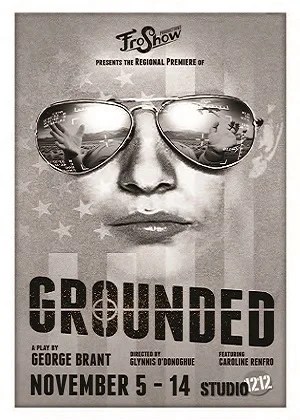
“Grounded”: A Pilot’s Tour of Duty in the Chair Force

FroShow’s Grounded Flies Higher Than Queen City’s Birds of a Feather

By Perry Tannenbaum

Little more than a century has elapsed since the dream of powered human flight became a reality, barely a dot on the timeline of history. Yet as travelers and pilots, we regard flight as a birthright, a capability we were born with. In George Brant’s Grounded at Studio 1212, we encounter an articulate eagle who undergoes the experience of having her wings cut off.

Flying her F-16 for the Air Force, dropping her Sidewinder and Maverick missiles on “Saddam’s dipshit army,” The Pilot feels invincible riding her Tiger in the sky, turning the minarets that punctuate the desert back into desert. She doesn’t hesitate to show us her arrogant, predatory pride, which begins with her flight uniform. She rocks. She rules.

In Brant’s taut, jagged script, the speedy Mamet-like spasms of The Pilot’s monologue are laid out like free verse on the page. We’re just hitting the 200-word mark when she’s home on leave at a pilot bar in Wyoming, letting her defenses down for Eric, a local who manages a hardware store. The baggage he saddles her with before she returns to combat in Iraq swells into a baby bump, a signal to military brass that our Pilot must be grounded.

The plot thickens years after marriage and motherhood, when The Pilot acts on her itch to return to her Tiger and her beloved blue. Instead, the Air Force deploys her to a windowless bunker outside Las Vegas, where she learns to fly drones. With just a 1.2-second lapse between pressing her button and missile launch, she is soon firing missiles on verified enemy targets in Afghanistan, seen on a monitor she stares at for hours and hours at a time. She despises this ignominious demotion to the “chair force,” but as her commander predicts, it’s the wave of the future.

You might expect Brant to target the dehumanized brutality of drone warfare, yet heaps of ammunition aren’t forthcoming from a protagonist entrusted with piloting the $11 million devices all day long. But this is a one-woman show, so the parallel between this hero’s job and generations of pimply Americans raised on bloodthirsty videogames is never mentioned. We get a glimpse of what’s really on the playwright’s mind when we hear that Eric, supportively joining his wife in Vegas, lands a job dealing blackjack.

Like the convoys under Air Force protection in Afghanistan and like the bad guys planting roadside landmines in the middle of the night, Eric is constantly under surveillance. Even the Pilot in her top-secret battle station is constantly scrutinized by the unblinking eye of a camera. A weird kind of desert kinship is established between The Pilot at Creech Air Force Base, her Afghani targets, and her husband, the gambling predator – who works at the pyramid-shaped Luxor Hotel in Vegas, to underscore the point.

All of this happens as The Pilot dispels the notion that sitting in an office chair, staring at a monitor, and hunting down insurgents from nine time zones away is a dispassionate, stress-free job. With Veterans Day upcoming as my wife Sue and I watched this FroShow production last Saturday, I found Grounded keenly mindful of the stresses and sacrifices our servicemen and women endure at stations around the globe.

FroShow Productions founder Caroline Renfro zigzags through this richly textured script so deftly that it was surprising to realize that barely 62 minutes had elapsed when she was done. All of The Pilot’s dimensions as demigod, stud, and mom come through as Renfro does nothing to tarnish the accolade I handed out to her when I included her among Charlotte’s top three actresses for 2014. She gets dynamic direction from Glynnis O’Donoghue, with an effective blackout separating the main action from the emotional in-your-face coda.

All of the aspects that are likely to remind you of 1984 and A Few Good Men come through vividly. Brant and Renfro convincingly nail the special stresses that set stateside drone piloting apart. You may be inhabiting a virtual world in the “chair force,” but you’re shuttling back and forth from the war to your family every day. More to the point, when The Pilot’s missiles were hitting their targets in Iraq, her F-16 was long gone by the time the explosions went off miles below. Drones hover, and their multiple eyes maintain their gaze with telescopic intimacy. Confirming your strike after a 1.2-second delay, you can see body parts flying onscreen as you cheer.

Grounded leaves you thinking after its hour is up. The wondrous technology that exposes the wrongdoings of rogue cops and babysitters also has a serious downside.


L-R: Karen Christensen, Stephen Seay, Kristian Wedolowski and Robbie Jaeger star in Queen City Theatre Company’s Birds of a Feather. (Photo by George Hendricks)

Three other flightless birds are waddling onstage this week as Marc Acito’s Birds of a Feather celebrates a family of chinstrap penguins at Spirit Square in a cutesy Queen City Theatre Company production at Spirit Square. These are the notorious Roy and Silo of the Central Park Zoo, two males who famously began parenting a daughter in 1998 while she was still in the egg. When Justin Richardson and Peter Parnell turned their story into an award-winning children’s book, And Tango Makes Three, they learned what it means to legitimize same-sex unions in the Land of the Free.

Many, many libraries and school districts – including our own CharMeck for a while – disgraced and embarrassed themselves by banning the book. For three years in a row, beginning in 2009, Tango topped the American Library Association’s list of most-challenged books.

So the absurd maelstrom is a natural for the stage, where audiences will readily accept the concept of two human actors waddling around as the trailblazing Silo and Roy. In some ways, Acito goes further than the kids’ book in personalizing the couple. As Roy, the expansive Kristian Wedolowski can spread his flippers and be a showtune-loving, nurturing extrovert, while the pert Stephen Seay can be stiffly demure and publicity-shy as Silo. Closeted, perhaps.

Surrounding them, we expect the zookeepers, the journalists, and the book authors who catapulted Roy and Silo to fame, juxtaposed with the idiots who were outraged by all they stood for. This wouldn’t be the first children’s theatre piece with animals that were more sensible and mature than humans.

To some extent, Acito follows this path, but mostly, he goes far astray. Besotted by some kind of New York state of mind, he insists on telling the saga of Pale Male (Wedolowski) and Lola (Seay), two red-tailed hawks who nested on top of a Fifth Avenue apartment, across the street from Central Park, becoming a prime attraction for birdwatchers. Their controversy occurs in late 2004, when their nest was removed by the building co-op, rousing the ire of the Audubon Society, birders, and Mary Tyler Moore.

This part of the comedy, in which CNN correspondent Paula Zahn and her husband figure prominently, was excruciatingly boring and irrelevant for me. These silly bickering humans only succeeded in sucking time away from the yahoos who hated Silo and Roy. We hear from just one. As for the hawks, Lola’s jealousy over Pale Male’s previous mates siphons more attention.

With stage direction by Glenn Griffin and set design by Wedolowski and Tim Baxter-Ferguson, the production at Duke Energy Theater is charmingly mounted. Robbie Jaeger, chiefly as a Birder, and Karen Christenson, most significantly as the Zookeeper, soldier on through multiple roles and scenes, most of them as tiresome as the hawks. Jaeger’s costume designs count as another big plus.

Warehouse’s “Grand Boeuf” Serves up a Tribute to Papa Hemingway – with a Side Dish of Takedown

By Perry Tannenbaum

November 12, 2015, Charlotte, NC – Sacrifice and service are the specialties of the house in Michael Hollinger’s An Empty Plate in the Café du Grand Boeuf, a Franco-American concoction that alternately mocks and reveres the Lost Generation élan of Ernest Hemingway. The play is particularly beloved in Cornelius at the Warehouse Performing Arts Center, where it was the first production scheduled at the Westmoreland Road storefront in June 2009. Yet the local debut was staged four years earlier by the BareBones Theatre Group at a real warehouse in Charlotte’s SouthEnd.

There are interesting contrasts between the two productions, demonstrating the latitude offered to directors by the script. The BareBones version directed by Chad Calvert (the current production’s graphic designer) emphasized the macho elements of the Hemingway-esque protagonist and the French elements of the ceremony, turning the Grand Boeuf into the snootiest of restaurants. At the Warehouse production directed by Jim Esposito, service is far more frayed and frenetic, and our hero is more notable for his tragic impotence and suicidal self-loathing.

There is no menu at the Café du Grand Boeuf, new waiter-in-training Antoine is instructed by the impeccable maître d’ Claude, because the establishment is committed to serving “Monsieur,” the restaurant’s owner and sole patron, anything and everything he desires. Much to Claude and his wife Mimi’s alarm, Monsieur shows up alone without his longtime lady friend. “This does not usually happen,” Claude tells Antoine, which describes the utmost of catastrophes for the prideful headwaiter.

Like the humor that fueled so many Marx Brothers shticks, more and more breaches of chichi decorum are yet to come. Monsieur has returned from the bullfights in Madrid, not Milan as previously planned. Antoine stutters uncontrollably asking for Monsieur’s order, and Monsieur declares that he will have nothing to eat. He has decided to starve himself to death at his own restaurant and, in a final relaxing of decorum, insists that his staff call him Victor.

Panic naturally runs wild at Grand Boeuf with this turn of events. Chef Gaston is summoned from the kitchen to describe the prolonged horrors of dying by starvation, a suicide that cannot be consummated in a mere couple of days or weeks. Yet we are well aware – as is Hollinger – that a detailed description of an excruciating death may not be the ideal method of stimulating the listener’s appetite. The group arrives at an amicable compromise that is no less absurd. Grand Boeuf staff will enjoy the honor of preparing and presenting Victor’s valedictory seven-course meal, but it will be delivered and lusciously described on an empty plate. The actual feast will remain in the kitchen, unless Victor relents and decides to eat. In the meanwhile, Victor will narrate his life’s story between courses to Antoine, who is conveniently gifted at transcription.

All in all, this makes for a satisfying win-win-win-win. Victor gets to expound on his life while committing a suicide this is even more renunciatory than the one he conceived. Staffers at Grand Boeuf get to go out with a suitable flourish. We get it all: Victor’s story, the elegant ceremony with its slapstick breaches, and the mouthwatering culinary descriptions. Warehouse is a winner too, serving up all this bounty without needing to fork out the cash for the extravagant food.

If the props by Jackie Hohenstein and Nicole Miller steer us somewhat from café to cafeteria, Esposito’s tasteful set design is closer to an off-Broadway standard. The cast is well-suited to Esposito’s more robust view of the script, including the director himself as the outré chef. Philip Robertson sets the tone early on as the punctilious Claude, nothing whatsoever inward about his ultra-sensitive nerve endings. Yet he does not sacrifice propriety during all his visible episodes of seething. I can summon plenty of sympathy for Dominic Weaver as Antoine. Back in 1994, when Hollinger wrote his oddball comedy, stutterers were more of a comedy staple onstage and on TV than they are in our own politically-correct times, but I think Weaver attempts the right degree of affliction, though his Antoine is occasionally more labored than believable.

Aside from his tragical brooding, there are no larger-than-life dimensions to Brian Willard’s portrayal of Victor, so its merits are very different from those of Hugh Loomis when he performed the role in 2005. Here we savor the disparity between Victor and Hemingway. He’s still an ardent admirer of the great Papa but a shadow of the Nobel Prize personality rather than a replica, so the fact that his journalistic ambitions brought him no higher than The Daily News struck me as funnier this time around and less disappointing.

There is also tragedy in the kitchen, because Mimi feels her husband vastly underappreciates her and Gaston is too honorable and shy to declare his love for her. I’m not always sure that Pam Coffman quite gets what it meant for a Parisian to admire Jacqueline Bouvier Kennedy in July 1961, but she contributes deftly enough as Mimi to her husband’s frequent explosions. Esposito is delightful as the incorrigible Gaston, relentlessly indiscreet and irresistibly upbeat. Just by resisting Esposito’s zesty sketch of perishing by starvation, Victor nearly rises to heroic stature.

Late in Act 2, Stephanie DiPaolo walks in as “Mademoiselle,” the paramour that Victor last saw in Madrid. As Louise, DiPaolo serves us our final dish, the full account of the bullfights and the breakup. She’s as beautiful as a rose and as tearful as a widow. If you know your Hemingway, you’ll understand in the denouement that this love affair is the one part of Papa’s sensibility that Victor successfully manifests.