Category Archives: Theatre

Butchering a Tearjerker

Review: Terms of Endearment

By Perry Tannenbaum 

IMG_0406

In spite of its Academy Awards and critical acclaim, I’ve never much wanted to see Terms of Endearment. Reading the old Roger Ebert review of the film does a far better job of changing my mind than the current stage adaptation at Theatre Charlotte, I can say that. My working theory on tearjerkers is that I already know it’s sad when good people die young, sad that people allow petty differences to stand in the way of enjoying one another, and that sorrows and pointless conflicts are redeemed by moments – too few moments – of sweetness and laughter. Watching the 129-minute Hollywood version of these self-evident truths still doesn’t entice me.

The stage adaptation by Dan Gordon trims James L. Brooks’ 1983 screenplay, based on the novel by Larry McMurtry, to a mere 108 minutes at the Queens Road barn. No doubt some butchery was involved, for I can’t find serious fault with Chris Timmons’ cheery and versatile scenic design, Mitzi Corrigan’s direction, or the efforts of her cast. Can’t find the characters played by John Lithgow or Danny DeVito, either. Maybe McMurtry and Brooks were better judges of their worth.

Gordon starts with a scene so cinematically short that I couldn’t see its connection with the rest of the story. It’s useful for you to notice that the newborn Aurora Greenway is screaming at in the cradle is Emma. The next time we see Emma onstage, she’s being played by Gabriela Celecia and she’s at least 20 years older. Cynthia Farbman Harris as Aurora cannot age so radically so quickly, helping me to miss the passage of two decades. What Harris can do very well is retain Aurora’s imperious prissiness, her total self-absorption, and her industrial-strength vanity.

These are wonderful traits for Celecia to play against as the normal wife and mother of three who hopscotches from one Midwestern locale to another with Flap, her college teaching husband. Suffering the slings and arrows of Aurora’s patrician superiority, Maxwell Greger makes good on his scant chances to fire back. He’s also an effective Middle America edition of Don Juan. If James Dean ever became so humdrum that his utmost rebellion against propriety were sneaking kisses with one of his students, that Dean would look very much like Greger’s Flap.

But the juiciest pushback against Aurora’s dominion comes from Garrett Breedlove, a former astronaut whose ego outstrips his fading celebrity. He’s as open about his profligate ways as Flap is furtive and delights in offending Aurora’s elegance with his vulgarity. Why not? He still has the goods in the sack. Kicking, screaming, and sputtering, Aurora is putty in his hands.

In an auspicious Theatre Charlotte debut, Vince Raye mixes charisma and conceit into this aging moonwalker – with a chunk of tenderness that took me by surprise. At his most impressive, Raye took up Garrett’s revelation that he still boasted friends in high places. If not, he certainly showed he could bluff a weak poker hand at a championship level.

By the time this happened, the drama had seemingly dragged on for seven hours, Emma had been diagnosed with Stage 7 cancer, and the only chance she had at survival was to be admitted to a special clinical trial that was already closed to new applicants. Only Dr. Maise, the head of the hospital could make that happen, and Maise had no intention of being cowed by a mere astronaut with VIP connections.

To guard the gates against Emma’s last chance, Corrigan chose the formidable Tim Huffman, who has chewed and spit out scenery as Capt. Slank in Peter and the Starcatcher and as the thunderous Deputy Governor Danforth in The Crucible. This was quite a heavyweight confrontation, Raye’s celebrity cool as Breedlove pitted against Huffman’s towering dignity as Maise. I’m not sure which delighted me more, watching Raye coolly assailing Dr. Maise with Breedlove’s vicious threats or Huffman’s trembling capitulation.

Ah, but after that clash, the very sweet and likable Celecia had miles to go before Emma slept. Farbman had to absorb additional rebuffs and regrets as Aurora and learn additional lessons before she grieved. Let it be noted that costume designer Chelsea Retalic dresses Farbman beautifully during all her changes. When Breedlove leers at her, it is not for naught. There are also lighter moments between Aurora and Emma that allow Farbman respites from her hauteur and Celecia respites from her wholesome bland forbearance. Maybe three of them.

Facing Your Fears in a Haunted Basement

Review: The Ghost of Splinter Cove

By  Perry Tannenbaum

DSC07820

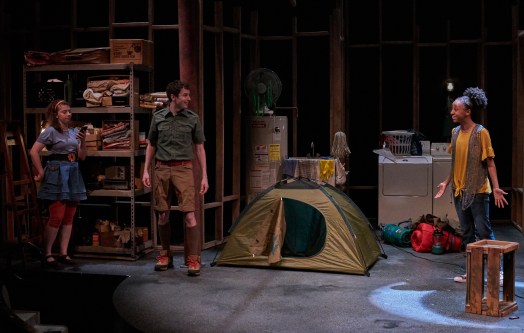
There’s a glint of magic as the adventure begins in Children’s Theatre of Charlotte’s production of The Ghost of Splinter Cove that you’ll only appreciate if you’ve already seen playwright Steven Dietz’s companion piece, The Great Beyond, in the world premiere Actor’s Theatre production at Queens University. What’s going down? Make that who, for Nate Banks and his sister Cora, on their first night at their late grandfather’s house, have been sent downstairs into the basement to spend the night.

Yet their parents are far from callous. With the camping gear that their dad bought Nate for his birthday, they will break in his new tent – with a dome! – while their parents get their “adult time” upstairs. Nor has Rex, their dad, been lazy. To liven up their adventure, and to make up for canceling an outdoor expedition, Dad has downloaded a nifty smartphone app that will help simulate a true wilderness experience. Rex has troubled to hook the app up to loudspeakers, lights, and even a fan, so a starry night and stormy weather are both on the horizon after sundown.

But wait, there’s a holdup during the setup. Sydney, the daughter of Aunt Emily’s partner, Rene, asks Nate if he has chosen the destination for their wilderness adventure. Nate is dumbfounded until Sydney explains that she has the latest version of the same wilderness-simulating app, and it offers that cool option. Nate will need to take the time to download the update.

DSC07694

Now here’s where the magic happens. Once the Sim-Camp app is downloaded to Sydney’s phone and all the necessary Bluetooth connections are made, the most advanced Deep Wilderness option it presents – past the “Peppermint” and “Sunset Trail” baby options – is Splinter Cove. None of the kids has ever heard of the place, but if you’ve already seen what unfolds upstairs in Great Beyond, you will not have forgotten how important Splinter Cove is in the family history. It’s the place where Dad wants to bury Granddad’s ashes, for one thing.

Pure coincidence? “Hey, it’s selected already,” Nate observes as soon as he sees the most advanced options. When we hear him saying “Splinter Cove” for the first time, it triggers the loudspeakers.

Long before this, however, a foreboding sense of dread hovers over the overnight adventure. There’s a fourth person in the basement, J, that both Nate and Cora imagine they can see. This imaginary friend doesn’t look anything like what the siblings imagine, he’s always in a different spot from where they point, and he’d rather talk to us than either of them.

DSC07874

There’s a comical aspect to the kids’ misperceptions, of course, but J is not the clownish comedian that Nate imagines. So who and what is he? Why has he been in the kids’ lives for as long as they can remember, and what are his intentions now?

Finding out will be part of the adventure, to be sure, and you can bet that Dietz has built plenty of suspense into the action leading up to that revelation. Among the works I’ve seen over the past 32 years of covering Children’s Theatre productions, only The Wizard of Oz, The Hobbit, and The Lion, the Witch and the Wardrobe were scarier, which makes Splinter Cove the scariest original children’s play I’ve ever read or seen.

It could be scarier at the Wells Fargo Playhouse if director Courtney Sale had put the pedal to the metal on all the jolts of surprise and terror that Dietz has sprinkled into his exemplary script. And it could be more spectacular if all the technical capabilities of ImaginOn’s larger theater, the McColl Family Theater, were marshaled to the cause.

While I felt Sale had been too cautious about crossing the fright threshold, my mom wondered if this show might be too intense for 8-year-olds after viewing Cove with me. So this is far from a punchless production, though our friend Carol opined that she also was disappointed in the fright factor after seeing Great Beyond earlier in the week.

Dietz’s craftsmanship certainly shines through, all the more brightly if you see both plays in this unprecedented Second Story Project. You don’t simply have adults upstairs and kids downstairs. Dietz makes sure we see a family at both ends of the staircase, with traits that align across the generations.

Like her mom, who resists the idea of holding a séance upstairs, Cora is anything but gung-ho about the camping trip, letting out a stream of sarcasm that parallels Mom’s resistance. Nate not only embraces his dad’s camping idea, he expands upon his resourcefulness, adding a campfire and a moon to the experience.

You’ll readily recognize moments that must occur in both plays, when Rex calls down from the top of the stairs and the kids respond, but I’ve discovered another one that isn’t so obvious. When Sydney asks the time, Nate responds, “Dad would say: ‘Straight-up six o’clock’” – while Dad is saying those exact words to Aunt Emily.

There are amusing misalignments as well. Cora is contemptuous of the prospect of joining hands and saying something enthusiastic before embarking on their wilderness adventure, yet her mom, Monica, does a little pinky-square ceremony with Rene, Sydney’s mom, shortly after they meet for the first time. Upstairs, with Rene presiding, they will dim the lights and light candles for a spooky séance, so it’s apt – if not particularly healthy – that her daughter is afraid of the dark.

Telling you what happens on the Splinter Cove camping adventure would be spewing spoilers for two Dietz dramas at once. It’s more prudent to point out that the playwright follows a tried-and-true storytelling formula by having Sydney face and overcome her fear in the heat of her adventure. Following the Wizard of Oz template, Dietz does this in triplicate, for Nate is afraid of deep water despite his swimming lessons and, again like her mom, Cora has serious trust issues.

Sale’s all-adult cast is marvelous, even if she doesn’t allow them to be as frightening as they could be. Chester Shepherd, whose electrifying high-strung performance in The Curious Incident of the Dog in the Night-Time will be long remembered, is hamstrung as Nate by Sale’s trepidations, scurrying around in terror as if he were doing one of the comical minor roles in Disney’s The Lion King. Notwithstanding how excellently it is done, that shtick dampens a moment when the fear factor should be dialed way up. You always believe Shepherd is a child, though, and his eagerness for the adventure fuels momentum from the start. Thrown by the adventure into the deep water, his terror is more human but still homogenized.

DSC07819

Carman Myrick seems to enjoy freer rein conveying Cora’s doubts and fears, for Dietz is demonstrating in both of his plays how much more readily we believe when our heroes face strong and nasty skepticism. Cora is the heavy, no doubt, but only intermittently like her mom, and I loved how thoroughly the magic of “Splinter Cove” worked on Myrick from the first time it was said out loud. On a relatively spare Anita Tripathi set design, Myrick makes her climactic climb and discovery compelling, and her achievement of trust becomes a dramatic watershed moment in more ways than one.

Coming off her stint, just last month at ImaginOn, as the pesky would-be girlfriend in Bob Marley’s Three Little Birds, Kayla Simone Ferguson doesn’t get to be cute or obnoxious this time around. The physical resemblance between Ferguson and Tania Kelly, the actor playing Sydney’s mom, is pronounced, but the personality parallels aren’t as obvious as the Banks kids’ with their parents. You could say that Rene is the spiritual guide and her daughter is the phone app guru, but the more lasting kinship is their calm and impartiality reacting to the sibling squabbles going on upstairs and downstairs.

Ferguson understands that she’s to be the sounding board for Nate and Cora to tell her (and us) all the important things they already know about each other. Meeting strangers in a strange house – “Wait – I’m spending the night?” – gives her license to be a little forlorn and pathetic. Most importantly perhaps, in confessing her fear of the dark, Sydney brings the squabbling sibs together in sympathy and starts the conversation going about each one’s greatest fear. Facing and overcoming these are the core of the adventure from a classic theatre-for-young-audiences perspective.

Bemused detachment typifies J as he slinks unseen among the children, along with a light sprinkling of menace – a bit heavier when he steals a smartphone from one of the kids’ backpacks. Sooooo shrewd of Sale to cast Arjun Pande in this intriguing role. He doesn’t immediately tell us he’s an adult, but with his low voice, he contrasts with Shepherd, whose sound and energy mark him as a kid. Pande also towers over all his castmates, so even those 8-year-olds in the audience who are braving this thriller will likely realize he’s the adult in the basement before he actually lets on.

If Pande isn’t quite as sardonic as he could be ridiculing the siblings’ basic misperceptions, he has the strong quiet confidence of an enigma waiting to be discovered, presciently knowing that this is the night when he will be. It’s a magical, magisterial role that Pande inhabits almost nonchalantly. Quiet confidence is more than justified, for even after everyone has vanished, J will remain a dizzying enigma.

One last wonder is how Dietz packs so much into the 53 minutes of Splinter Cove, only slightly slowed down by the two mind-blowing set changes. For that matter, what Dietz packs into less than 80 minutes in The Great Beyond is an equal marvel. Perhaps one day, a single theatre company will produce both Beyond and Cove on the same stage on the same night, and perhaps that’s what Dietz had in mind when he put the finishing touches on his Second Story Project.

Maybe then Dietz will decide which play should be seen first! He wrote Splinter Cove first, but my vote goes to seeing it last. And last it definitely will.

A Séance With 200% Certainty

Review: The Great Beyond

By:  Perry Tannenbaum

Great Beyond 4

When you walk into Hadley Theater on the Queens University campus for the world premiere of Steven Dietz’s The Great Beyond, you’ll be treated to a rare “don’t-think-about-elephants” experience. Even if you haven’t read the prepublicity around town, seen the spots on local TV and the web, or thoroughly perused your playbill, your emissary from Actor’s Theatre of Charlotte, artistic director Chip Decker, will call your attention to the elephant in the hall. While Dietz’s spooky new drama can stand on its own, it was written with an interconnected companion piece, The Ghost of Splinter Cove, that is now premiering at ImaginOn in a taut 53-minute Children’s Theatre of Charlotte production.

So once you’ve heard that, can you really be satisfied seeing The Great Beyond without going to see Dietz’s companion piece? Probably not.

If you’ve somehow failed to pay attention to the prepublicity, the playbill, and the curtain speech, all of them telling you that the action of Splinter Cove is happening downstairs in the basement of the same house at the same time in the same family as the action we’re seeing upstairs, the parents upstairs will remind you frequently enough of the strange adventure their kids are having below.

More than that, thanks to Evan Kinsley’s scenic design, which offers us a smidge of the home’s exterior, we get glimpses of the basement action through translucent windows that peep above ground. So it isn’t just a matter of Rex, the dad, opening the door to the basement and checking up on how his kids are doing – with prerecorded replies. No, no, no. Beginning with camping gear that he bought for his son Nate’s birthday, Rex has sent them on a wilderness adventure, with a smartphone app hooked up to the home’s electronics simulating the sounds, the natural lights, and the weather of the great outdoors.

At unexpected moments, then, the handiwork of lighting designer Hallie Gray and sound designer Rob Witmer captures our attention – and whets the curiosity of the three women who have gathered with Rex for an adventure of their own. The historic collaboration between two theatre companies is called “The Second Story Project,” but it’s at Queens U that we see why.

GreatBeyond3

Dietz has said that The Great Beyond is a reunion play, and it certainly follows a template we’ve seen before, bringing far-flung and estranged kinfolk together, comically or dramatically uncomfortable with each other, after a death in the family. Here Rex has brought his two kids to the home of his former father-in-law, where his distraught ex, Monica, served as caretaker during Tobias’ last difficult days. Relations between Rex and Monica seem cordial enough, though she isn’t a big fan of his elaborate camping scheme for their children – since it brings unpleasant family history to mind.

It’s also obvious that Rex retains a genuine affection for Tobias, whom he calls The Captain like everybody else in the family. The real family strife will rev up when Monica’s wayward younger sister Emily arrives. Or actually, it begins before, because the rigid and judgmental Monica has labelled Emily as a chronic latecomer – on the basis of one past incident – so hostilities can begin as soon as Emily arrives. On time, of course.

Not that Emily is flawless. A recovering alcoholic who now limits herself to one full glass of wine at the same time every day, Emily has made Dad’s home the last stop on an epic apology tour, launched five years ago when she achieved sobriety, spanning 23 states and two foreign countries. A straight arrow and a black sheep, the bread-and-butter combatants of countless theatre clashes are poised to have it out! But unlike Sordid Lives or Appropriate, two of the funeral-triggered plays we’ve seen before in Charlotte, the dead Tobias will also be invited to the reunion.

GreatBeyond4

You see, Emily is bringing her bisexual partner Rene to this sad reunion, hoping to summon up the spirit of Tobias at a séance later in the evening. It’s Tobias, not Monica, that Emily has really earmarked for receiving her last apology, and she thinks that Rene, a spiritual medium, can make contact and make it happen.

As if the friction between Monica and Emily weren’t torrid enough already! Now they need the scornful, skeptical, and sarcastic Monica to complete the circle around the séance table. Outnumbered three to one in this tussle – and somewhat pre-empted by Dietz’s two play titles – you can guess how Monica’s opposition to the séance turns out. As for whether Tobias shows up, I can safely defer to Dietz himself, who was present at the post-performance powwow on opening night. He told us that one of chief pleasures he found in telling this story came in conveying his 100% positive conviction that the supernatural visitations at séances are absolutely bogus and his 100% certainty that those visitations are absolutely real.

Whatever you may think of the action around the table, you can’t deny that Dietz has made intensive efforts to sustain our ambivalence, giving us numerous reasons to believe that the house Tobias built with his own hands is in the grip of the supernatural – countered by an equal number of escape routes to disbelief. But to his credit, Dietz leaves us with a giddy sense of confusion rather than a rational set of alternatives as we attempt to arrive at the truth now – and the truth about the tragedy that has haunted the family for nearly 40 years – teasing us out of thought.

That giddy confusion will be compounded when you factor the climax of Splinter Cove into your calculations. If you go to Hadley with somebody – whether an adult or a child – you can expect that conversation on your way home will be peppered with lively clarifications and disputes.

Decker certainly holds up his end of Actor’s Theatre’s historic collaboration with Children’s Theatre. Rather than missing core elements of the script that I’d seen when I read it (a fundamental reason I customarily avoid reading scripts I’m scheduled to review unless I’m planning to interview a playwright before seeing the production), Decker and his superb cast managed to bring Dietz’s drama more intensely to life and reveal the power – and comedy – of a couple of moments that I’d overlooked. Didn’t hurt that Dietz was here in Charlotte, tweaking both of his scripts during the process.

Great Beyond 2

All of these roles are beautifully rounded, so it wasn’t surprising to see the keen relish that the players took in them. It would be hard to overpraise Tonya Bludsworth’s work as Monica, the meanie who has worked so devotedly and so selfishly to be The Captain’s favorite. Bludsworth brings out the humor and the sharpness of Monica’s mocking sarcasm, turns it off when she realizes she’s wrong, has moments of self-awareness, and is delightful in so many different ways during the séance she has so grudgingly agreed to. There’s a bit of swagger to her, for all of her starchiness.

Robin Tynes-Miller mixes Emily’s feelings of resentment and remorse to perfection and turns them up high. Her wrenching efforts toward reformation make Bludsworth’s cynicism and rejection all the meaner. Tynes also hones in on just how thin-skinned and childish Emily remains as the younger sib, allowing Bludsworth the delight of intentionally provoking her, elevating Monica’s wickedness at times to villainy. For all her weakness, it is Emily who powers the story forward when her determination is steeled, yet Tynes makes her lapses likable, so we’re still rooting for her when Rene and Rex must rally behind her cause.

Dietz has Rene doing a lot of the heavy lifting when it comes to coaxing Monica to the table – and an even greater share of the calming and reassuring that Emily needs when her frustrations with her recalcitrant sister get the better of her. Tania Kelly does it all with a confident authority, belying Monica’s presumptions of what a medium should be. Not a dreamcatcher earring in sight, and no Whoopi Goldberg kookiness.

As patient and sure as she is at the séance table, unruffled by Monica’s taunts, Rene also takes it upon herself – without any desperate urgency – to rectify Monica’s obsolete assessment of Emily’s character. Rene is the mother of Sydney, the third child downstairs at play with Nate and Cora, and Kelly dials in the right amount of parental concern and trust in Rex. Most of all, when the doors and windows are unlocked, the candles lit, and the incantations begin, Kelly makes us believe that Rene is in earnest and something amazing could happen.

Rex is the glue that binds Dietz’s plays most firmly together, and Scott Tynes-Miller beautifully captures his strength, his self-deprecation, and his insouciance. For the most part, Rex’s role is as a peacemaker in the siblings’ brawls, the steadying force that Monica realizes she was foolish to discard. Miller not only gets the last of the play’s four monologues, addressed directly to us, he also demonstrates to closest bond to Tobias, briefly recalling how The Captain taught him to be a man. Turns out to be a surprisingly important plot point. There’s a nice through-line that Miller finds in Rex, for he has a firm and quiet purposefulness, and like Emily, arrives with a mission. That turns out to be yet another way that he binds Dietz’s magical plays together.

There’s much more to the story of The Great Beyond than I’ve disclosed here – with surprises stirred in that are calculated to startle and astound. Much of this story is expanded upon and illuminated in The Ghost of Splinter Cove. So your intuition to see the companion piece will not lead you astray.

Jewish Playwriting Contest Dramatically Involves Charlotte Audience in Selecting a New Play for a New York Production

Review: The Jewish Plays Project

By:  Perry Tannenbaum

The Jewish Plays Project, currently in its ninth season, seeks to recognize and develop new plays that freshly address contemporary Jewish life. In their annual Jewish Playwriting Contest, plays that peddle stock Jewish humor or deal directly with the Shoah are graciously discouraged. Like other playwriting contests, it solicits scripts that haven’t received professional productions and welcomes playwrights of all ethnicities. Of course, an expert panel is part of the selection process, but unlike the Pulitzers, the Tonys, or the Steinberg Awards, the JPP panel only screens the hundreds of entries and winnows them down to a group of finalists.

Cunningly, JPP invites theatre communities around the country to engage with the scripts, winnow them down to a Top 3, perform the Top 3 publicly in abbreviated staged readings, and have the live audience vote for their winner. In the 2019 cycle, Charlotte is the first of seven cities to complete its participation in the process, so the ultimate winner won’t be announced until after the Palo Alto readings on May 1 – moving on to a full production in New York this September.

The seven finalist scripts were emailed to us back in November, and I can proudly say that our reading panel in Charlotte had the most listed members, edging out Houston and New York, sharing the honor for the most populous panel with Chicago. Our panelists met at the Levine Jewish Center for a dinner powwow during the last week in January. After spirited discussions of each script, we wound up choosing In Every Generation by Ali Viterbi, The Shabbos Goy by Cary Gitter, and Dox Modern Middle by Megan Pope for the public event at Gorelick Hall, the J’s theater facility.

Last year’s national winner, Summer Night with Unicorn by David Rush, had been produced by the Levine Cultural Arts department’s JStage at the Gorelick in November, so there were people in the audience – and onstage – who had experienced last year’s playoffs and/or seen its fruit. This was the third year that Charlotte had participated in the annual contest, my second year of participating on the community panel, and my first time at the competitive readings. I was a bit taken aback by the robust turnout. Word has gotten around.

Unlike the staged reading festivals presented in the past by Actor’s Theatre of Charlotte and the defunct Charlotte Rep, the Levine’s Jewish Playwriting Contest maintained its professionalism without stuffiness or excessive formality. If you were an actor, you weren’t warned against the impropriety of wearing a color or dressing for your part, but you did lay your script on a lectern as you performed. If you bought a ticket, you could grab a free nosh at the back of the hall and schmooze with your fellow cognoscenti before David Winitsky, the founder and director of JPP, moved up front to issue welcomes and thanks. Then he explained the JPP and the Contest before testing the technology that would be used for the individual playwright intros and the voting. Directing all three entries, he also read the stage directions during the readings.

Old schoolers could vote on paper ballots as God intended, or if you had a smart phone, you could text your vote to a prescribed number. My first two test votes, before and after the first play reading, were for macaroons and Bernie (who lost to Midge). While writing this review, I texted “LEAVE” to the number we had been given and received an answer, my first real assurance that my votes had counted. So the technology worked, the format for the evening had been exhilarating, and theoretically, my vote may have been decisive. Yet I did not drive home feeling that the format had been completely fair.

Gitter’s The Shabbos Goy led off the readings, probably the easiest of the three to summarize. Seth, a divorced Orthodox Jew, has a crisis of faith because he has fallen in love with Angie, an Italian-American art gallery curator who recently moved into an apartment down the hall. Not knowing she had moved in, Seth had knocked on her door, thinking he would call on his Shabbos goy to do something for him that Orthodox Jews are forbidden to do on the Sabbath – like turning on a lamp or an oven. Angie readily agrees to help this nerdy knish maker. He’s such an unlikely candidate for her affections that, when he asks her out, she doesn’t immediately grasp what he’s doing, by which time he’s apologizing.

Seth’s sister Rachel, his partner in the Lower East Side knish store, is more devoutly opposed to her brother’s wishes – she’s not Jewish! – but Sophia, Angie’s folksy grandmother, has an open mind. In the scenes excerpted for the reading, Seth (Jordan Ellis) told Angie (Karina Caporino) about his spiritual crisis. His confession went better than Fitzwilliam Darcy’s, acting as an aphrodisiac. Afterwards, Angie had a couple of heart-to-hearts with Sophia (Jackie Fishman) and Rachel (Susan Cherin Gundersheim).


If the allusion strikes home, you’ll already know that Viterbi’s In Every Generation has something to do with Passover. Not only is the Passover seder the instrument of fulfilling the biblical commandment of telling your children about the exodus from slavery in Egypt, it is the gateway for fulfilling man’s obligation “to see himself as if he personally went out of Egypt.” Viterbi divides her play into four parts, a very apt number for Passover, and links three generations of a family across three seders, beginning with 2018 in LA, then flashing back 65 years to 1953, and then zipping forward to 2048. After three seders with this family, Viterbi thinks we’re ready to visualize her family in 1416 BCE after leaving Egypt, celebrating Passover and yearning for the Promised Land.

In the first excerpted scene, we saw all three generations gathered at the 2018 seder. Drawing most of our attention were two squabbling siblings, Yael Katz (Caporino) and her adopted Chinese older sister, Devorah (Vivian Howell Tong), who is studying to be a rabbi. It is she, therefore, who expounded on the number four in the Passover Haggadah. Their mom, Valeria (Stephanie DiPaolo), tried to keep order, but her difficulties were compounded by her octogenarian parents, Davide Levi (David Catenazzo), who coukd no longer speak due to ALS, and Paola (Fishman), who kept lapsing into Italian. Our second excerpt took us to 1953, shortly after Davide and Paola had immigrated to America. Davide could talk at that seder – smoothly enough to convince Paola that Passover might be a great time to start their squabbling unborn family.

Reduced to a bare-bones 20-minute sampling, In Every Generation had to shed its last two parts – and the English subtitles that are supposed to help us understand Paola’s Italian when she arrived in LA back in 1953. Shabbos Goy suffered to a lesser extent from Winitsky’s radical abridgement, losing one of its characters, a dashing young artist whose work Angie would love to display at her gallery. Young and sexy Blake, Angie’s arrogant quarry, expected to combine business with pleasure. Pope’s Dox Modern Middle was perhaps the most disadvantaged by Winitsky’s excerpting. It would have been helpful, for starters, if the playwright, the director, or the reading had explained what the title meant.

Amid some healing chanting and a spectral appearance of Fathermother, representing her parents and her Orthodox Jewish heritage, the excerpt began with 17-year-old Raphaela (Arella Flur) arriving in Israel. She was greeted by her Aunt Caroline (DiPaolo), a longtime Israeli who knew more about Raphaela than the girl thought. Caroline already knew, for instance, that her upfront 16-year-old neighbor Gil (Rixey Terry) would be the perfect companion to show Raphaela around – because he is gay, she is lesbian, and that’s why she was sent away from Brooklyn by her “Dox” parents. In later excerpts, we learned that there’s an LGBTQ nightclub in Jerusalem that will welcome both Gil and Raphaela, with queerness to burn. A quartet of glittery queens emerged from the audience, voguing and preening. More seriously, the club’s bartender, Pop Tart Girl, took an interest in Raphi, evoking memories of Ani (Caporino in both roles), her previous paramour back in Brooklyn.

When the votes were tallied, Winitsky announced that The Shabbos Goy had been our audience favorite. Audience members who have become attached to Seth and Angie, rooting for their romance, can go to JewishPlaysProject.org and see how Gitter’s romantic comedy is doing in the standings. With the two points that Shabbos Goy earned at the Charlotte playoffs, it is now tied with In Every Generation for first place. Next in the standings, trailing the leaders by two points, is Dox Modern Middle. As exciting as the contest was, I’d be more comfortable if the readings were extended to 40-45 minutes each. Lacking that, audiences should get a full summary of each contestant. That’s what I’m voting for.

Imaginary Cyber Friends

Review: Dear Evan Hansen

By Perry Tannenbaum

SzDuT4oQ

Playing to a Broadway house that barely packs in a thousand patrons, using no more than eight actors and eight musicians each night, with scant choreography and no glitz, Dear Evan Hansen isn’t going to fit most theatergoing definitions of a big Broadway musical, six Tony Awards or not. Yet big it is, for Steven Levenson’s book traverses multiple issues that absorb us these days, including bullying, the effects of social media, teen suicide, and single-mom parenting. Just as rare, music and lyrics by Benj Pasek and Justin Paul frequently rise to the level of the emotions roiling inside Levenson’s characters, actually enhancing the drama on a couple of occasions.

Evan is a mess when we first meet him at Belk Theater, where seating capacity for the touring production is extended beyond the usual 2100-seat capacity with the musicians perched up above the action. Mothered by an anxious single mom who holds down a day job and goes to school at night, Evan is an even tighter tangle of anxiety. He dreads returning for his senior year in high school, afraid of the daily interaction with other people, tongue-tied with nearly everybody – especially Zoe Murphy, the girl of his dreams.

Zoe’s big stoned brother, Connor, bullies Evan on at least two occasions. On their first day back at school, Connor knocks Evan to the ground when he thinks our hero is laughing at him. That paranoia carries over to their next encounter at the computer lab, where Connor retrieves the “Dear Evan Hansen” letter that Evan has written as an assignment from his therapist, supposedly a daily pep-talk to himself. Thinking this is more mockery from Evan, Connor refuses to return the letter, which contains suicidal thoughts and Evan’s desperate yearnings toward Zoe. In a further act of aggression, when Evan awkwardly asks him to sign the cast on his healing broken arm, Connor takes a Sharpie and scrawls his first name – in big capital letters – across the full length of the cast.

So a whole host of ironies and misconceptions will explode when Connor commits suicide, and his parents, finding Evan’s letter in one of his pockets, mistake it for their son’s suicide note – addressed to his best friend. The big black letters that Connor had signed onto Evan’s cast, originally a nasty symptom of bullying, become a testament to their friendship, writ large. Tongue-tied as usual, Evan can’t shoot down the Murphys’ delusion that he can provide them with insights into the son they never really knew. In yielding, he finds that he can provide some therapy to others.

3CnMwtNA

If he can keep a steady flow of palliating information to the Murphys, Evan feels that he can help them in their grieving process. And establish a closer connection with Zoe, whose memories of Connor are even more unsavory than his.

In varying ways, then, the Murphys have unwittingly conspired in giving Evan an imaginary friend. With the help of Jared, who keeps reminding him that he’s more a relative than a friend, Evan can spin a backdated email correspondence with Connor filled with new feelings and faux memories. With the help – and intrusion – of Alana, a pesky busybody who seems attracted to him, Evan can establish a “Connor Project” tribute, a memorial website, and after he surprises himself by addressing a school assembly, a viral #YouWillBeFound hashtag when video of the speech lands on YouTube.

Taking the old imaginary friend concept to a whole new cyber level, Evan and Alana, co-presidents of The Connor Project, launch a GoFundMe initiative to restore the apple orchard where Evan and Connor fictitiously met. Adding new dimensions to the idea of an imaginary friend piles on new challenges and stresses for Evan. Some of these, of course, help him to mature and develop self-confidence. He’s speaking to an entire student body after starting out the year cowering in fear of interacting with just one of them.

Alone in his room at moments of highest stress, Evan turns to… an imaginary friend. Ironically, it’s Connor, who did nothing but torment him in real life. Connor’s posthumous transformation is now complete – in his family’s eyes, for Evan, and for thousands of followers at school and online.

Chiefly, Evan is stressed over all the lies he’s been telling Zoe and her parents, but he’s also been deceiving his mom – while coping with the sudden celebrity the whole #YouWillBeFound phenomenon has brought him.

Here is where the chamber size of the Dear Evan Hansen fails the potential magnitude of Levenson’s vision. Where are all the high school peers that Evan feels himself lost in, fears talking to – peers who might adoringly add to Zoe’s unattainable aura and desirability? Where are the admiring classmates who ratify Evan’s newfound relevance and fortify Zoe’s inclinations to give him a serious second look?

Basically, they’re projected onto the scrims and screens of David Korins’ high-tech set design, perpetually scrolling as social media feeds behind Evan’s bedroom, multiple rooms at the Murphy home, and various locations at school. It’s a cool alternative to populating the stage with energetic dancing teens but sometimes a cold one, especially in a space as large as the Belk.

What sweeps us past these limitations is how intently we become involved with both the Hansens and the Murphys. Anxiety, social inadequacy, and teen suicide are big things to cope with up close, and Dear Evan Hansen brings us there. Ben Levi Ross captures all the awkwardness, insecurity, and fearful caution that Levenson has written into Evan’s outward self, and he has the star-quality voice for the Pasek/Paul songs that reveal the inner self wishing to break free.

Marrick Smith doesn’t play up the suicidal kindred spirit of Connor as much as the sullen, domineering loner. In his imaginary friend afterlife, he becomes the tough-love antithesis of the “Dear Evan” pep talks endorsed by Evan’s therapist, a longhaired renegade forever. By contrast, Connor’s parents are wholesomely flawed. Aaron Lazar as the dad appears to have detached from Connor’s upbringing and to have given up on him, but when Evan encounters him in his workshop – and afterward at a powwow between Hansen and Murphy families – we realize that he had plenty he wanted to give.

5TTssbOA

As “Anybody Have a Map?” her opening crosstown duet with Evan’s mom makes clear, Christine Noll as Cynthia Murphy is as clueless about how to cope with a teenage boy as Heidi Hansen is. But as a full-time suburban housewife, she has more free time to flit from one New Age fad to another, salving if nor solving her problem. Cynthia has the deepest need – and gratitude – for Evan’s cyber fables and projects.

Comes with the territory, Levenson tells us. Mom’s credulity and stubborn belief in Connor has strained her relationship with Zoe when we first see them coping together. Maggie McKenna struggled to untangle the enigma of Zoe on opening night, more so because her vocal on “Requiem” was the least intelligible in her family. There was a nicely calibrated combo of empathy, skepticism, and need as her familiarity with Evan grew, and the climactic “Only Us” love duet had an honest and intimate sizzle.

Ultimately, Jessica Phillips as Evan’s overextended, trying-so-hard mom stole the show from everybody except Ross. There’s a wonderful one-two punch before things reach a final resting point, with a wrenching “Words Fail” confessional from Evan following shortly after the unexpectedly turbulent meeting between the Hansens and the Murphys. Heidi had already stirred things up at the Murphys, but it was in her “So Big/So Small” testimonial that Phillips was absolutely devastating – at first narrative, then apologetic, before finally arriving at a stunning affirmation.

As an actor, there are moments when you might dread having to weep onstage, on cue, night after night. With “So Big/So Small,” I’d imagine that the performer has the opposite worry: getting too deep into this mom in this song could lead you to an emotional corner where you’re sobbing uncontrollably. When she finishes, we’re fairly convinced that a chunk of this show has been about her.

1XosvDfI

For all its intense intimacy, the Pasek/Paul score also boasts some concentrated magnitude, since the musical tandem packages two anthems that get reprised. Climaxing Act 1, “You Will Be Found” seizes our attention, with the whole company joining Evan as his assembly speech goes viral, augmented by pointedly anonymous prerecorded spoken blather as the YouTube sensation takes hold. Even the relentlessly scrolling background projections suddenly crystallize into relevancy.

But don’t overlook Evan’s “For Forever” fantasy as you settle in to the story. This dreamy “two friends on a perfect day” idyll gradually ascends and soars, prefiguring the apple orchard fable Evan will devise to placate the Murphys – and echoing the lie he’s been telling about how he broke his arm. We don’t hear the backup voices for this anthem until it reprises briefly in the “Finale,” when all Evan’s hidden truths have been revealed. You may not immediately see all the reasons why the final scene is set where it is, but there’s a little bit of technical derring-do to announce that we’ve arrived.

There’s as much craftsmanship in Dear Evan Hansen as there is honesty, and that’s saying a lot.

Upstairs/Downstairs in a Haunted House

Previews: The Great Beyond and The Ghost of Splinter Cove

By Perry Tannenbaum

Great Beyond 1

An old living room card table shaking uncontrollably during a candlelit séance… an unidentified ghost – or two – lurking in the dark basement, where kids are at play… and an 8-year-old child who has been missing for nearly 40 years.

These are some of the chilling elements in two new nail-biting plays hitting the QC. Upstairs with the adults at the séance, the Actor’s Theatre of Charlotte production of The Great Beyond begins previews this Thursday on the Queens University campus, officially premiering next Wednesday. Next Friday at ImaginOn, The Ghost of Splinter Cove takes us downstairs into the basement with three imperiled kids in a world premiere Children’s Theatre of Charlotte production.

Both spooktaculars are by renowned playwright Steven Dietz, who splits most of his time between Seattle and Austin, where he teaches his craft at the U of Texas. Dietz has written and adapted more than 40 plays, and a slew of them have been performed in various theaters across town, including God’s Country, Lonely Planet, Yankee Tavern, and Becky’s New Car (a “Show of the Year” winner in 2010).

But these two newbies would never have been written if Dietz hadn’t gotten on a plane and met with Adam Burke and Chip Decker here in Charlotte.

Burke, the artistic director at Children’s Theatre, and Decker, his counterpart at Actor’s Theatre, had cooked up their concept during a 2015 meetup. Cooperating was feasible between their two companies, but what kind of project would bring audiences together to see the kinship between Decker’s adult theatre and TYA – Burke’s theatre for young audiences?

Decker and Burke both have considerable experience in bringing new plays to their theaters, so it was obvious that their joint project would be a new script. But what if they commissioned two scripts, each one designed to funnel audience from their theater to the other theater while both shows were in production?!

Somehow the two plays and their stories would have to interlock. Yet to encourage rather than force audiences at one company’s theater to also see the other company’s play, each of the two plays would have to stand independently on its own. The concept that would be named The Second Story Project was born – in excited brainstorming interspersed with copious cups of coffee.

When Burke and Decker decided to move forward, there were no funds earmarked for the project, no playwright commissioned to create the scripts, and no parameters detailing how the two stories would interconnect. There was just one dynamite concept that had never been tried before.

“It’s always a leap of faith to do anything, especially something new,” Decker observes. “We just both hit on it, felt it was a good solid idea, and when you feel that way, you have to jump in with both feet and hope there’s a safety net at the bottom.”

Looking back on it, Dietz was a super-obvious choice. Multiple productions of his plays had been presented at Actor’s and Children’s, but Decker and Burke were thinking about advertising in trade publications or soliciting proposals – until the successful run of Dietz’s adaptation of Jackie and Me at ImaginOn turned on the lightbulb in Decker’s skull.

He sums up his realization: “We’re looking for a playwright who has a great voice for theatre for younger audiences and a playwright who has an experienced track record with adult audiences, we’ve both produced Steven Dietz plays, why should we look any further – especially the first time out?”

2019~Splinter Cove Rehearsal-8

Burke had sort of blocked out the idea of looking to an established adult playwright, calculating that the TYA piece would be the higher hurdle.

“I am more confident that someone who can write a great play for young people can write a great play for adults than I am of the reverse,” Burke explains. “So when Chip suggested Steven, I’m like, ‘Ah, yes, of course!’ There are only a handful of people that are moving between the two worlds successfully.”

Dietz was a little wary, wanting to make sure that there wasn’t some special issue or theme that his scripts were expected to address. Getting reassurances of his complete freedom, he warmed to the prospect of such an unprecedented challenge.

“What was so beautiful about the idea was that it was so simple,” Dietz recalls. “The core of the pitch to me was something shared. A shared story, a shared theme – something shared. And in one theater piece, we see it through young people’s eyes, and in the other, we see it through grownups’ eyes. That’s just like Post-it Note simple!”

The playwright was also on Burke’s wavelength with respect to the primacy of the TYA piece. It would be the more difficult piece to write and take more time. So it needed to be written first. Unlike other commissions that Dietz has fulfilled, neither The Ghost of Splinter Cove nor The Great Beyond turned out to be a play he would have written anyway. No barely-started scripts or scribbled scenarios were on his studio shelves waiting for these unique commissions.

Dietz suspected that he would make many false starts on his youth play – and he did. The upstairs/downstairs idea didn’t occur to him immediately, but when it did, it seemed like an elegantly simple way to make his plays interlock. But what kind of full-length play can be staged in a basement?

“I had this little tiny notion,” Dietz reveals. “I had a friend who had his kids try out his camping equipment in their basement once. And of course, that is what’s beautiful about writing for young people: where they go on that camping trip in their imagination is much more dynamic than getting out even on the San Juan Islands, which is near my house. Because it’s in their imaginations, so it can be anywhere.”

Especially when your brand-new camping gear is a birthday gift, you’re in a strange haunted house for the first time in your life… and there’s a smartphone app your dad bought you that makes your whole camping adventure come alive!

So that’s the downstairs core of the Second Story Project. From time to time, Dad calls down from upstairs, making sure the kids are settled in and sending down snacks. The two plays interconnect with those conversations – we only see Dad in The Great Beyond – and there are key props that will be common to both of Dietz’s eerie dramas.

Upstairs, where the séance happens, the parents are having a dinner reunion after a great family loss, and we learn why the kids have never visited this house before. For Dietz, there was a unique benefit in crafting his two new plays as a matched set.

“Writing [Splinter Cove] taught me about those kids’ parents,” Dietz remarks. “In any other play I’ve ever written, they would just be offstage characters. This process doesn’t have offstage characters, really. They have characters onstage at the other theater.”

And they’re not necessarily alive. Bwa-ha-ha!

A Jamaican Fantasy With a Reggae Beat

Review: Bob Marley’s Three Little Birds

By Perry Tannenbaum


DSC01522

Reggae lovers and mavens are flocking – I repeat, flocking! – to Bob Marley’s Three Little Birds, an eye-popping, shoulder-dipping new musical at ImaginOn. Studded with golden favorites from the Marley songbook and adapted by Michael J. Bobbitt from a story by the reggae king’s daughter, Cedella Marley, this Children’s Theatre of Charlotte production is all about spreading joy and living life zestfully.

Or it is when Bobbitt can squeeze story elements into the crevices of the 15-number reggaethon – some of which are medleys. Cedella turns up as a character in this story, but action revolves around her son Ziggy, an 11-year-old who spends his days huddled at the TV because he’s scared of hurricanes and an encounter with Duppy, a mischievous, malevolent spirit who preys on children’s hair.

Mixing sternness with genuine concern, Cedella shoos her pouting Ziggy out of the house and attempts to pair him with their next-door neighbor, Nansi, who obviously adores him. She urges him to enjoy life! On an errand to bring back water from the town, Ziggy discovers that there really isn’t a hurricane threat when the sun is shining brightly (or sticking its tongue out), that a kiss from Nansi ain’t so bad, and that he has the necessary courage and cunning to face up to his fears, Duppy in particular.

Along the way, three not-so-little birds offer friendship, guidance, and song to Ziggy – and additional solace to Cedella, since one of these creatures has been haunting Ziggy’s window sill and giving extra meaning to the phrase “dropping by.” Between the hiking, the singing, and the chattering, there are mangoes falling occasionally from a tree that overarches Tim Parati’s fantastical set, reminding us that Duppy and his conjuring powers are on the scene, eyeing Ziggy’s beautiful dreadlocks.

DSC00925

I’d be able to go in somewhat greater detail were it not for the dad sitting next to me, singing along to nearly all the Marley golden oldies and answering all his adorable anklebiter’s questions, whether she asked them or not. Formality is not the vibe at McColl Family Theater at this show. Opening up interaction between the actors and the audience, director Shondrika Moss-Bouldin has closed off both entrances to the theater at the lobby level, obliging us to enter through the mezzanine.

Avenues between the stage are now so direct and level that a toddler can easily cross over to this Jamaican fantasyland without a challenging climb. One of the ensemble members, in fact, came out and plucked a toddler from the crowd and invited her to join in on the dancing onstage. Other kids in the audience were swept into the dancing spirit, and the thrust configuration of the stage turned a few who were grooving in the front rows into instant dancing-with-the-stars celebs.

Everybody was friendly to the crowd, even Jeremy DeCarlos, our scheming and stealthy Duppy. Considering his haggard bedraggled look – think the old crone in Disney’s Snow White – and his multitudinous dreads, ingratiating himself with the tots was no small feat. The Duppy rig conjured up for DeCarlos was barely the beginning of costume designer Jason Kyle Estrada’s exploits. Lead fowl Doctor Bird’s get-up features an upturned fluorescent green jacket and a complementary hipster cap.

Oh yeah, Doctor Bird also drops some knowledge. B’s erudition includes a narration of Jamaica’s colonial history, obliging all other birds on deck, DeCarlos, and Ericka Ross as Cedella to slip into varied frilly and conquistador outfits. Ross’s role nearly matches Duppy’s for pluminess. We find out as much about Cedella as we do about Ziggy, for she’s supporting the family by selling her tasty Jamaican jerk chicken to tourists – and she’s wise to the charm that can disarm Duppy of his power. Delivering all that flavor and lore, Ross also speaks with the heaviest accent.

Rahsheem Shabazz absolutely slays as Doctor Bird, and his accent is also competitive. While there are many studio and concert recordings of the Marley tunes on the Three Birds playlist, none that I’ve heard so far really match what I heard from Shabazz. Or DeCarlos. Or Ross. Led by music director Charlene Miranda Thomas at the keyboard, the Children’s Theatre versions are livelier and more colorful to my ears. By comparison, Bob’s tempos plod.

DSC01151

Take that sacrilegious assessment as my assurance that you will not be disappointed with any of the Thomas-led covers. Musically, Garrick Vaughan as Ziggy is a late arrival to the party – demonstrating that, if you’re a central character who quails at the prospect of living, Bob Marley wasn’t the man to write your songs. Vaughan’s mopey role also means that he draws the short straw among Estrada’s splendiferous costumes.

These constraints on Vaughan aren’t because he is really 11 years old. When Bobbitt finally decrees that Ziggy sings, watch out. Vaughan may have the strongest voice in the cast. A lighter, folksier touch would land him more squarely in the reggae groove. As the would-be girlfriend Nansi, Kayla Simone Ferguson is kept busy enough, teasing Ziggy and moonlighting in other guises, but so far, I’m most impressed by her rapport with the kiddies.

Janeta Jackson is an established commodity at Children’s Theatre, having starred – and flown – in last season’s stunning Mary Poppins. She doesn’t get to go full throttle or reach such heights as Tacoomah, our second bird and British colonial, but she reinforces how deep and professional this dazzling production is. Apparently, word has spread swiftly among the Marley faithful. Boogie on!

Resettling in the Rubble

Review:   By the Water

By Perry Tannenbaum

IMG_3340

Compared with Cape Hatteras, Wilmington, or Charleston here in the Carolinas, the borough of Staten Island up in New York City hasn’t historically been known as a punching bag for hurricanes. Until late 2012, when Hurricane Sandy battered three NYC boroughs, Staten Island was hardly in the conversation when compared even with nearby Long Island. Zeroing in on the impact of Sandy on a Staten Island family and community, Sharyn Rothstein’s By the Water not only changes the conversation, it also fiddles with history.

Taking in Ryan Maloney’s storm-ravaged set design at Duke Power Theater, with its waist-high waterline, you would likely expect Rothstein’s drama to be about the folly of resettling near a hurricane-prone shore. Or we might assume we’ll encounter the innocent victims of unscrupulous real estate developers, or come face-to-face with the new New York calculus of climate change. None of the working-class folk in this Three Bone Theatre production, smartly directed by Ron Law, seems capable – or sufficiently woke – to address any of these subjects.IMG_3234

As a result, the topicality of By the Water becomes rather shrouded in a mist of Murphy family grudges and disputes, further distanced from pressing issues that might concern us by the neighboring Carter family’s involvement. The Murphys seem as broken, fallible, and struggling as the Lomans were in Death of a Salesman, and the heads of this devastated household, Marty and Mary, have a fairly similar relationship.

For Marty, it’s axiomatic that he should rebuild and restart. To his eldest son, Sal, it’s obvious that his dad should move to higher, safer ground – and way past time that his mom stop blindly supporting whatever Dad says, especially after all his past misjudgments and misdeeds. Philip and Andrea Carter, the Murphys’ longtime friends and neighbors, have decided that they wish to accept a government buyout and move to Montclair, New Jersey.

But this isn’t a laissez-faire situation, where the Murphys and the Carters are free to do whatever they wish, no harm done. The government’s offer to the Carters and other survivors in the neighborhood will be withdrawn unless 80% of the community decides to sign on. Marty is fervid enough about his cause to go out picketing against the buyout.

A stretch at a hotel and returning to a home that boasts a few sticks of furniture, a hardy fridge, and the better part of one wall is starting to fray Mary’s unquestioning loyalty to her husband. The younger son, Brian, is returning home after a stretch of own – in prison as a result of his past drug addiction. He sides with his dad, seemingly to keep his favor, but his endorsement is tainted by his rap sheet, and he’s actually more intent on regaining the affections of the Carters’ daughter, Emily. Her parents, of course, know all about him, so they don’t approve.

Could work in Brian’s favor, right? He and Emily are both City kids. Minds of their own.

IMG_3248

A corner of the stage is set aside for the wee wharf where Brian and Emily rendezvous, providing a respite from the family quarreling and the neighborhood politics, which grew a little repetitious during the 91-minute performance on opening night. More substance in the debate would have dispelled the tedium. It might have been worth pondering what government should and shouldn’t subsidize on these fragile wetlands. And a more eloquent Marty might voice the notion that, given the historical infrequency of tropical storms and hurricanes hitting Staten Island, it’s not such a stupid plan to live out the 20-30 remaining years of your life in the house your father built rather than transplanting to Montclair.

While Rothstein does disappoint me on topicality, and in giving us any sense that she’s intensively researched the Tri-State housing market or Marty’s prospects for homeowner’s insurance, there are times when she brings us vividly into the moment. Despite skirting the basic survivalist questions of home life without a roof, the playwright etches her characters with finely judged individuality and gives us a nuanced feel for the Murphys’ family dynamics.

Law and his cast are definitely on Rothstein’s wavelength, and the only major mistake they make is in overestimating the Duke’s acoustics. As the inimitable Tania Kelly demonstrated last year in Three Bone’s Every Brilliant Thing, it’s easy to convince yourself that you’re being heard up in the balcony when people are actually having problems in the second row.

While you might not catch the ends of all of Marty’s sentences, Thom Tonetti delivers all of the outsized personality and bossiness that fosters Mary’s adoration and submission. We are definitely dealing with a force that can sway community sentiment when we encounter Tonetti, and we are not surprised to learn that Marty is capable of taking audacious and catastrophic risks. Physically, Susan Stein projects the frailty that perfectly fits Mary but with a salty New York accent that constantly reminds us of the street savvy and toughness that lurk within. There’s a tenseness and pallor to Stein as well, hinting that Mary has reached the end of her tether.IMG_3301

Law would have been safer casting an older actor to get the right look for Sal, the elder son, but there’s no doubt that Tommy Prudenti captures his straight-arrow essence in his Charlotte debut. Sal is a living white-collar rebuke of his father’s values, yet at key moments, Prudenti convinces us that he still craves Dad’s love. Tim Hager’s portrait of Brian adds another black sheep to his gallery, and if you saw his Franz in Three Bone’s Appropriate last summer, you won’t be surprised that he’s as lovable a reprobate up in the New York City wetlands as he was down on the bayou.

The accent is different, but this bad boy remains a magnet for one unattached lady who may be ready to rekindle an old pre-prison flame. I think you’ll like the sassy flavor that Sonia J. Rosales brings to Emily in her Charlotte debut. She’s certainly more liberated than the two moms we see here.

It’s slightly surprising to see Law pairing Lillie Oden with Joe Copley as the Carters, but they work beautifully together. Opposed to the Murphys’ plans, there’s a clear gender difference in how their oppositions play out. Like Mary, Oden as Andrea is more apt to be conciliatory, and like Marty, Copley as Philip inevitably becomes enraged and bellicose. You get the idea that Rothstein believes that the world would be so much more peaceful and sensible if women were in charge. But where would her drama be without all her guys?


Messing Up Asia, American Style

Review: Miss Saigon

By Perry Tannenbaum

06.MISS_SAIGON_TOUR_9_21_18_5953 r photo by Matthew Murphy“Un bel di,” Cio-Cio-San famously warbled at the 1904 premiere of Giacomo Puccini’s Madama Butterfly, yearning for the return of American Lieutenant Pinkerton from across the Pacific to honor their marriage vows and his responsibilities toward their son. Four score and seven years later, the scene shifted from Japan to Vietnam for Claude-Michel Schönberg and Alain Boublil’s Miss Saigon, where Kim sang, “I Still Believe,” yearning for the return of American Staff Sgt. Chris – for exactly the same reasons.

We haven’t seen a touring production of Miss Saigon at Belk Theater in over 15 years. In the meantime, a new production directed by Laurence Connor came to Broadway in the spring of 2017 and folded in less than 10 months. The two key players in the recent remount both had Charlotte connections. Eva Noblezada, who snagged a Tony Award nomination as Kim, won the 2013 Blumey Award at Belk Theater as the best actress in a high school musical. And playing The Engineer, the most electrifying of Boublil’s new characterizations, Jon Jon Briones reprised the role he had played in the low-budget, copter-less production that landed at the Belk in November 2003.

I had to wonder whether the Broadway revival of Miss Saigon had been so short-lived because of the changes Connor had made to the 1991 original or because of changes the show still needed.

08.MISS_SAIGON_TOUR_Thuy's death crop

In the heat of the Vietnam War and the fall of Saigon, both Kim and Chris had noticeably evolved compared with their operatic ancestors. Chris tried to take Kim with him as the Vietcong overran the capital. He sought to locate Kim after he returned safely to Atlanta, and he seemed honestly conflicted between his true love and his wife, Ellen. Kim had also evolved, no longer the shy, passive, pitiful flower Puccini immortalized. There was steel and ferocity in her: she’d murder the Commie who threatened the life of her son.

Yet in some ways, the 1991 Broadway musical was more primitive and insensitive than the 1904 opera.

Schönberg and Boublil were less respectful toward the culture of the Vietnamese than Puccini was toward the culture of Japan in Butterfly or China in Turandot. Except for the costumes and a brief wedding ceremony, there was hardly any indigenous culture in Saigon – and not a whiff of Asian music. Even the piety that Puccini dramatized in his Asian operas has vanished. Bar Girls that we notice in Saigon are scantily clad whores, usually spreading their legs when they aren’t face to face with a GI’s crotch.02.MISS_SAIGON_TOUR_2549


Love as a romantic concept is strictly confined to Kim, and the two Asian men who want her don’t seem to be familiar with the word. Thuy, who returns to Ho Chi Minh City as a conqueror after defecting to the Vietcong, views Kim as his rightful possession – and her son as a repugnant atrocity. Her protector is The Engineer, a slimy pimp who initially installs Kim in his sex stable as a virgin delicacy and subsequently views her and Tam, Chris’s American citizen son, as his passport to the USA.

The most nuanced aspect of Boublil’s book was the opposition he set up between Thuy and The Engineer. Clad in his military uniform, Commissar Thuy was the embodiment of the Communism we were battling to keep at bay. Devoid of warmth, tenderness and humanity, he was a totalitarian gargoyle. The Engineer, on the other hand, was pure venal enterprise, emblematic of the insidious corruption that American capitalism always leaves in its wake.

It was horrifying – and strangely exhilarating – to see how totally The Engineer had absorbed our perverted values in his climactic showstopper, “The American Dream.” Part of the reason that Americans came home feeling that the Vietnamese hadn’t been worth fighting and dying for, after all, stemmed from the unsavory effects of our being there and spreading our influence.

Well, the new Miss Saigon didn’t show me any more empathy toward the Vietnamese than before, nor any more of their indigenous culture. If anything, The Engineer and his Bar Girls seemed raunchier, more mercenary, and more degraded than I had remembered. Downsized to more realistic proportions, Red Concepción’s portrayal of The Engineer is more quietly servile and less flamboyant than Joseph Anthony Foronda’s was in 1997, the first time a prop copter landed at the Belk. So when Concepción suddenly breaks into his “American Dream,” the fantasy isn’t just what The Engineer’s life will be on richer USA soil, it’s also a fantasy about who he will become.

05.MISS SAIGON. Company. Photo Matthew Murphy and Johan Persson (2)

Yes, the copter is back on the Belk stage during the fall of Saigon for the first time in over 21 years, and so is the shiny Cadillac where The Engineer, humping the hood, has an orgasm during his fantasy. The years haven’t been as kind to Kim. We expect more of our female heroes nowadays, so killing a Commie no longer earns Kim an exclamation mark.

Working within the traditional Cio-Cio-San constraints, Emily Bautista is more assertive and less decorous as Kim, getting two duets with the “other woman,” outshining Stacie Bono as Ellen on both occasions. A generic belter, Bono makes Bautista look better than Andreane Neofitou’s bland costumes do. Sprucing up his script, Boublil has added a Trump slogan to The Engineer’s spiel and a Mormon to the rascal’s clientele. Maybe the latter is the inspiration for Adrian Vaux’s design concept, which brings a Third World squalor to Saigon and to Bangkok that reminds me of the Africa where the missionaries of The Book of Mormon were deployed.

Bautista brings the most beauty to Kim when she sings her lovely “The Last Night of the World” duet with Anthony Festa as Chris. Festa gives Chris more texture than I would have thought possible, making me wish that Boublil hadn’t taken Pinkerton’s rehab quite so far. Kim begins as a $50 gift from his best bud John, Chris’s PTSD is all about Kim rather than battle fatigue or horrific warfare. The bravest action Festa gets to perform is filling Ellen in on all he has hidden from her about that last night before he climbed onto the US Marines helicopter – and all the news he has just learned about his son.

Getting the word from J. Daughtry as John certainly doesn’t boost the drama. Another generic belter, Daughtry sings his “Bui-Doi” (“dust of life”) appeal for the stigmatized mixed-race children of Saigon’s streets as if he were a competitor on The Voice rather than a contrite vet in a poignant Broadway show. True, Daughtry came to life nicely later in Act 2, showing what he was capable of dramatically when John, Chris, and Ellen tracked down Kim and The Engineer, now refugees in Bangkok. Before receding into the ensemble (perhaps not as inconspicuously as he should), Jinwoo Jung was a malign force to be reckoned with as Commissar Thuy, especially when Chris wasn’t around in Saigon to protect Kim.

In fairness to the cast, conditions at the Performing Arts Center weren’t ideal for performing – or reviewing – a big-budget Broadway musical. Because of travel and load-in delays, the curtain time was rescheduled from 7:30 pm to 8:00. But the first notes of the overture weren’t played until 8:37, long after we had finally been seated. Intermission lasted over 32 minutes, so when Act 2 started, it was nearly 10:25, past the time when the show would normally end . Maybe that’s why the production fell short of my hopes when the curtain fell an hour later.

Or maybe, just maybe, the clock has struck midnight on a sob story that first opened on Broadway in 1900 as a one-act play by David Belasco. Instead of Belasco, or Puccini’s librettists, or Boublil looking into the heart of a Japanese geisha or a Vietnamese bar girl, maybe it’s time that this story was retold from an Asian viewpoint by an Asian writer.

Bound and Gagged in a Georgia Cabin

Review: Exit, Pursued by a Bear

By Perry Tannenbaum

IMG_9649

It’s been 28 years since I saw a murderous woman binding a man to a chair onstage, and I haven’t forgotten the spectacle of that near rape-victim turning the tables – and a spool of duct tape – on her would-be rapist. Maybe there were other instances after that stunning UNC Charlotte production of Extremities in 1991, one of the top five dramas I critiqued that year. If so, those action she-roes haven’t seared themselves in my memory the way that William Mastrosimone’s did.

A trail of empty honey bottles greeted us outside the Warehouse Performing Arts Center storefront in Cornelius as we entered upon a similar scene in Exit, Pursued by a Bear, the new Charlotte’s Off-Broadway production directed by Anne Lambert. Once again, three people are deliberating what to do with the captive – Kyle Carter, who has abused his wife Nan for the umpteenth time. Lauren Gunderson’s 2012 play, subtitled “A Southern-Fried Revenge Comedy,” isn’t quite as intent on ratcheting up the tension.

Like Gunderson’s title, derived from Shakespeare, it’s complicated. Often cited as the Bard’s most outré – or hilarious – or expensive – stage direction, “Exit, pursued by a bear” occurs in Act 3, Scene 3, of The Winter’s Tale. The fleeing nobleman is the otherwise forgettable Antigonus, whose mauling is vividly reported a moment later by the curiously named Clown, a shepherd’s son, while the bear is still devouring its kill offstage.

IMG_9912

Nan isn’t intending to give her husband even that sporting chance at survival. She plans to abandon her secluded cabin in the Georgia woods and leave the doors open for any bear in the vicinity to enter. To hurry the process, Nan and her friends Simon and Sweetheart are adding inducements to make Kyle more aromatic and inviting. Some honey, of course, but here’s some luck: Kyle just killed a deer, so they can cut up some fresh meat and strew that around, too. Cool condiments!

Since Conrad Harvey as Kyle is already bound and gagged as we walk by with our tickets and drinks – hey, go ahead and take selfies with Conrad if you like – Gunderson is taking on two conflicting objectives when the lights come up. She’s painstakingly justifying what Nan is doing to her husband, and she’s striving to preserve the murderous unraveling of the Carters’ marriage in a comedy mold. Nan’s accomplices come in handy for both of these objectives.

Sweetheart is a stripper at a local bar who aspires to be an actress – or at least a movie star – and Kyle is Nan’s lifelong best friend. Since he is a bit of a queen in his Georgia Bulldogs cheerleading outfit, the stripper-transvestite combo is inherently comical as soon as it forms, if you’re not going to be offended by stereotyped affronts to political correctness and feminism. Part of the action, you must remember, is Nan overcoming her submissiveness and moving towards feminism. It’s a liberating leap.

IMG_9965

With Kyle as her literally captive audience, Nan will express the anger, frustration, and humiliation she has kept bottled up inside by playing out the key scenes that have pushed her to this drastic homicidal response. Since Kyle is indisposed – and hasn’t learned his lines – Julia Benfield as Sweetheart will step into the role of Nan’s husband in these flashbacks. Lambert has made a cagey casting choice here. Benfield is not only dwarfed by Harvey, you’ll see that Julie Janorschke Gawle towers over her as well. More built-in comedy.

Benfield is trashy in her cinched flannel shirt impersonating Kyle, and a fair amount of that trashiness appears to come naturally, but the more we get to know her, the more clearly we see that she isn’t a slut or a bimbo. With all the two-handed scenes in the flashbacks, you might worry that Simon is simply superfluous. But he’s more than a cheerleader. When Nan wavers, Simon is there to help shore up her resolve.

Not always the subtlest of performers, Ryan Stamey calibrates and balances his bloodthirsty zeal, his genuine affection for Nan, and his flaming outrageousness in such a precise way that he emerges as genuinely human rather than as a cartoon provocateur. With this kind of quirky support, Gawle can explore the serious depths that Gunderson explores in the Carters’ abusive marriage. Nan’s waverings are based in a pathological dependency that develops between an abused spouse and her abuser, ground into the rubble of crushed self-esteem.

IMG_9812

Gunderson also wants us to be ambivalent about the payback Nan is meting out, no matter how many Hollywood revenge flicks we’ve seen. As if he were on trial rather than passively listening to his sentence, Kyle gets his chances to speak and defend himself. More than that, he gets Nan to allow him a temporary reprieve from his bondage, so that he can re-enact the good times they had together before things went sour.

Harvey doesn’t mitigate the fact that Kyle is a boorish hayseed, but he also doesn’t hold back on the sincerity of “getting it” and his intent to be a better man. We’re apt to be a little torn, as Nan is, on the option of giving Kyle a second chance. Gawle is visibly affected by Harvey’s pleas, his evocations of past Kyles, and perhaps his newfound respect for the doormat who has risen up against him. So with the prospect of Kyle suddenly reverting to violence, there’s not only dramatic tension in the air but also multiple layers of give-and-take between Nan and Kyle, Nan and Simon, between the men and inside Nan’s heart.

Feminists will appreciate how this deadlock is broken.

IMG_0106

Gawle does everything right interacting with the other performers. She even gives herself moments when she ponders the enormity of what she’s planning – and to question whether she’s sufficiently calm to proceed after the suddenness and the adrenaline rush of what she has done and how it has changed her. One thing you might question is whether Gawle is as Southern or as trashy as Gunderson imagined her. Hang in there until Nan’s final scene, and you’ll likely see the rationale for the choice Gawle and Lambert have made in crafting her character.

Along with the cast’s work onstage, costume design by Ramsey Lyric, lighting by Sean Kimbro, and Jarvis Garvin’s fight choreography are all indicative of Charlotte Broadway’s professionalism. The only dodgy aspect of this production are the projections flashed on the upstage wall delivering stage directions when we reach Gunderson’s play-within-a-play segments. The lettering doesn’t exactly pop, and efforts to read them can draw attention away from the action. Maybe freezing the action might help solve the problem. Worth a try.

Otherwise, Exit, Pursued by a Bear is all-pro all the way. Consider yourself lucky if you can pursue and snag a ticket.