Review: Boundless at the McBride-Bonnefoux Center for Dance
By Perry Tannenbaum
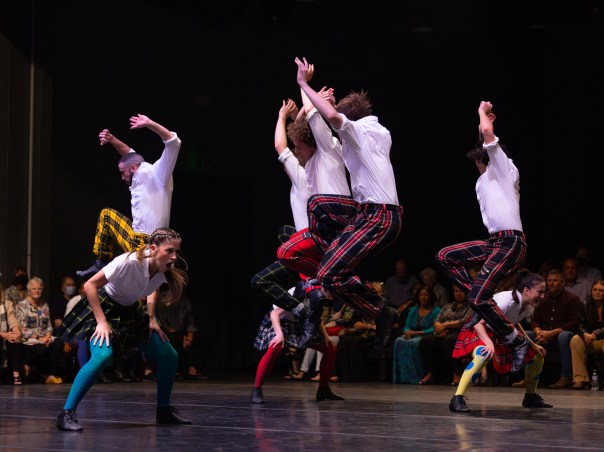
Loud woolen plaids are back in action – on the loose with louder goofball leggings. And the eternal question, pointedly asked, rings out again at The Patricia McBride & Jean-Pierre Bonnefoux Center for Dance: “Do you, do you, do you, do you wanna dance?”
Like Breaking Boundaries two seasons ago, Charlotte Ballet’s Boundless is a non-stop evening in three parts, showcasing three artforms. If you missed Boundaries in fall 2023, you should definitely repent by picking up tickets, heading out to 701 North Tryon, and checking out what all the shouting was about (through March 21).
On the other hand, if you’ve already tasted that Breaking Boundaries brew, you’ll find that most of the barrels have been refilled. The world premiere choreography this time around is Nicole Vaughan-Diaz’s On Three, after which you’ll leave the Center for Dance at intermission and decamp in the lobby, where four different instrumental duos will be entertaining during the 14 non-educational performances.
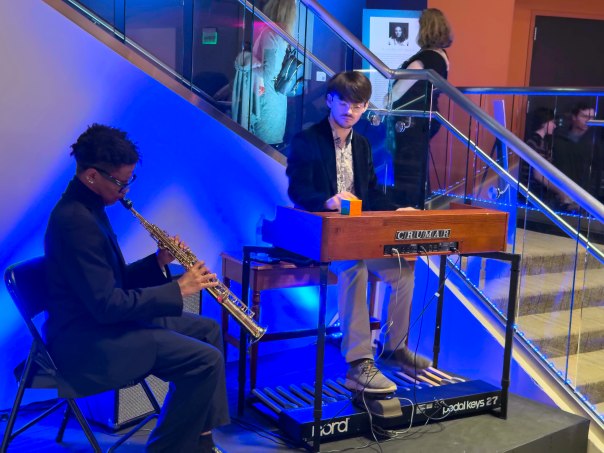
A staircase dramatizes the musicians, enclosing them as it winds upwards to an urbane, dimly lit balcony above. Scaling the wall with the stairs is a fine exhibit of action photos by Quinn Wharton, showcasing current members of the Charlotte Ballet troupe. Across from that display, a horizontal display of more Wharton photos on the eastern wall faces that diagonal rise. And there’s also a video installation by Tobin Del Cuore.
Completing the clubby feel of intermission, festive audience members line up for food and drink, so they can be toting a soda or a highball while viewing the exhibits or claiming one of the precious few cocktail tables downstairs as they nibble to the music and schmooze. On the night we went, it was Jonah Bechtler on keys and Noah Kibonge on soprano sax, pumping out jazz standards such as Bobby Timmons’ “Moanin’.”
As in 2023, the transition inside the studio for Ohad Naharin’s garishly colorful Kamuyot made all the charming diversions of the intermission pragmatic. The grandstand of seats facing the permanent studio space was folded back and collapsed into the wall behind where we had sat. Unassigned general-admission style seating was set up on each of the four sides of the performance space, two rows deep.
There’s only one hard-and-fast rule to the seating. Don’t sit in the seats reserved for the dancers.
If your first impulse is to sit in one of the four front rows, be aware that one or more of the 15 dancers will be asking you to join them on the floor. Cool with that? Great. You can even multiply your interactions with the dancers by sitting next to one of their reserved seats, for over the course of Kamuyot, multiple dancers settle into each of these spots.
Not so eager, shy, or on the fence? Row 2 figures to be your best bet. If your defenses are defeated, you can still catch a dancer’s attention and snag an invite. Or just hold hands for a moment of connection as I did.
Over the space of 28 months, my memories of Kamuyot had faded somewhat, so there were pleasurable reminders of buried treasure in my memory bank: the loud plaids, the Israeli choreographer’s affection for “The Theme from Hawaii Five-O,” his signature “gaga” dance moves, and my own experience of getting out there on the floor with the dancers. What couldn’t be forgotten were those broken boundaries.
So in a curious way, a divide reared up between those of us who vaguely or precisely knew what was coming and those who were seeing it for the first time. Simultaneously, I felt as if a barrier had fallen between me and those who had seen Kamuyot before. We found ourselves discussing that experience more readily.
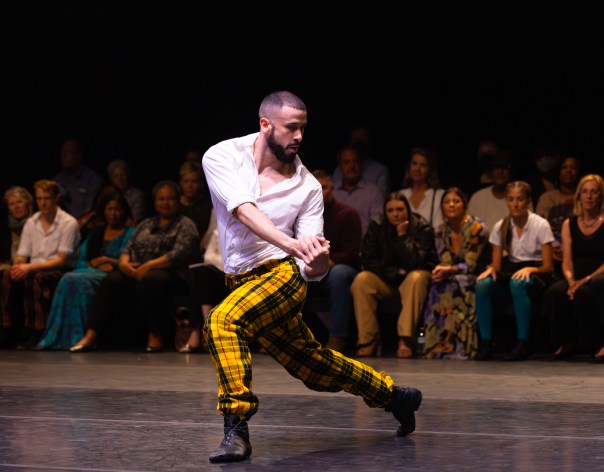
Resolved to be less of a participant this time, I found through this less visceral approach that Naharin’s structure emerged more boldly. The scheme is an evolution from solos and pairs to ensemble sections, from solitude and loneliness and antagonism to community. One female dancer writhes laboriously across the performing floor early in the piece, eventually drawing the attention of two men who soon engage in a one-sided shadowboxing bout.
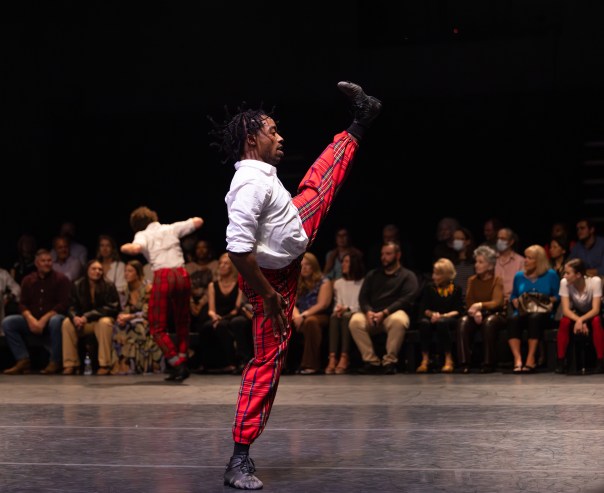
Even at the apex of this progression, when a single dancer would initiate a sequence, and he or she drew a crowd of imitators forming a fresh ensemble, you could count on a single outlier to carve her or his way through the heart of the group – usually exiting the hall without taking a seat. The hyperactive mass and the contemplative individual are repeatedly juxtaposed. Feel free to identify with either the celebratory or meditative aspect of Naharin’s spectacle – by diving in, holding back, or simply weighing these options.
Kudos to anyone who instantly grasps the meaning of Vaughan-Diaz’s deceptively simple title. On Three signifies the pact that two or more people make to synchronize their actions and begin at the same time. Bandleaders and chorus masters know the drill. Rock-scissors-paper-match competitors instinctively adopt it. Synchronicity, trust, and fair play are wrapped up in the ritual.
Yet that connection between intent and Vaughan-Diaz’s choreography remained opaque for me as her piece began. Entrances by the 10 dancers, circling a perpendicular setup of chairs, were markedly dilatory and unsynchronized, though there was some similarity in their pacing and dolefulness in designer Aaron Muhl’s dim lighting.
Flickers of intent began to spark once all the dancers were seated. One of the women, in a Kerri Martinsen costume a bit less drab than the others, sauntered over toward another chair where a guy sat. No hello, no eye contact, she just lay down in front of the guy, knees up. A triggering soon occurred after what my count of three would have been, and there was extended interaction and even some contact between the woman and the man.
None of it was particularly human, let alone intimate. When the man escorted the woman back to her seat and placed her in it, he seemed to have been humoring her. So the bigger surprise for me was when, moments later, the guy sidled over to the woman’s chair and assumed the same recumbent position she had modeled before. Something had happened between them, for they now reprised their relationship with a new dance episode in the same rudimentary and mechanical style as before.
Afterwards, the piece was largely pairs and chairs, different dancers coupling once the ensemble had removed, returned, or rearranged the chairs. The shape of the piece seemed to evolve from primal separateness toward ritual and trust as more of the dancing was done by more of the ensemble, but I’d doubt many in my audience perceived an arrival at the satisfying destination Vaughan-Diaz describes in her video:
“It’s the eye contact you make before being caught in a fall. It’s this agreement before you do something that cannot be done alone.”
Pretty disturbing, then, that Vaughan-Diaz imagines the “one, two, shoot” ritual of children playing odds-and-evens needs to be rediscovered by adults. Or that it’s in danger of being forgotten. Deliciously timely and dystopian for anyone seriously alarmed by our divisions.

 Art on My Sleeve