Reviews: Eureka Day at The Arts Factory and Vanya and Sonia and Masha and Spike at the Cain Center
By Perry Tannenbaum

Although conflict and chaos onstage oftentimes shock and alarm us, they can also be the springboards to comedy and satire. On balance, that is likely how you will experience the two new productions that opened last weekend, one at The Arts Factory on the JCSU campus and the other at the Cain Center up in Cornelius. On the heels of its Best of the Nest triumphs, Three Bone Theatre brought Jonathan Spector’s Eureka Day to the QC for its Metrolina premiere.
Higher degrees of carefully crafted chaos here. And degrees of relevance the playwright himself never dreamed of.
Adding to Three Bone’s winning momentum, Eureka Day won the 2025 Tony and Drama Desk Awards on Broadway for Best Revival of a Play. Critics agreed on the revival category because it had tiptoed into NYC 6 years earlier at a 65-seat black-box theatre after its 2018 world premiere in Berkeley, California. More, much more about Berkeley in a minute…

Leaning on some Tony Award mojo of its own, Davidson Community Players has brought Christopher Durang’s Vanya and Sonia and Masha and Spike to the Cain. Durang’s valedictory was a Tony and Drama Desk Award winner back in 2013 – and a smash for Actor’s Theatre of Charlotte and its quondam artistic director Chip Decker in 2014. Decker, we will see, is the bridge between DCP and ATC’s Stonewall Street days.
A far wider spectrum of conflicts here, sprinkled with stretches of wistful ennui, and peppered with a mighty eruption. Hold tight.
For all of its QC Nerve glory, Three Bone did not fill the Factory on West Trade Street for its champagne premiere last Thursday. A bit of a black eye, methought. But the effervescence of the Eureka Day School principal and his executive committee under the stage lights easily equaled the bubbly that awaited us after the show.
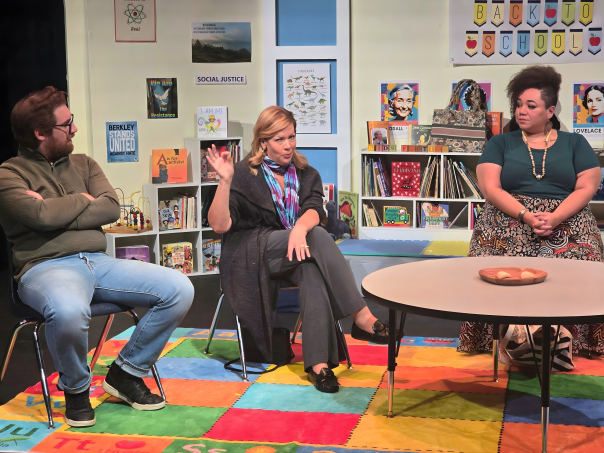
Living in perhaps the left-est part of the Left Coast, principal Don and his Berkeley committee cohorts, all parents of enrolled students, can be expected to “model” an especially welcoming brand of wokeness. Their conversations will be properly framed, non-judgmental, viewable through multitudinous lenses, devoid of racist stereotyping and gendered pronouns, with plenty of spitballing and so much to unpack at every turn. Feeling seen and not being othered are watchwords for their woke happiness.
As the 2018-2019 school year begins, the committee is meeting in the vacated elementary school’s library, blithely colored with shelves full of books and proudly decorated, even during the first Trump presidency, with trendy progressive slogans. We join them near the end, when the plate full of scones is almost gone. All five of these adults in this kiddie-flavored environment are too energetic and engagé to be afflicted with malaise, except for the placid Meiko, who is perpetually knitting.
Yet they’re deliberating on a question that would seem to lack urgency now that the new school year has begun. Should the dropdown menu where prospective parents indicate their nationalities be changed on the admission form – or is it OK?
On such weighty issues, the consensus decreed by the executive committee’s bylaws is easily attainable. But outside this quaint kiddie nook, where adults look comically oversized, a crisis is brewing in the homes of two committee members that will tear the committee apart, along with the progressive free-thinking community around it.
Consensus or not, Eli is the most important member of the group, since he is Eureka Day’s chief financial backer. He is also, we quickly learn, carrying on a lukewarm extramarital affair with Meiko, veiled by their children’s playdates if their respective spouses are not around.
The secrecy of this romantic liaison is discreetly maintained, but the consequences are about to break loose when a mumps outbreak hits the school. Neither of the playdate children has received an MMR vaccination: Eli’s son because he was on a slow vaccination schedule, and Meiko’s daughter because she’s a staunch anti-vaxxer.
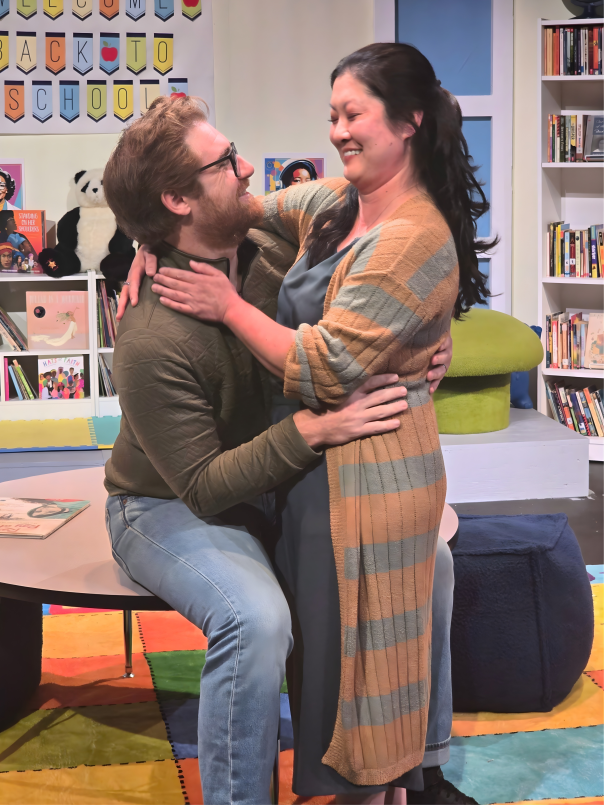
Meiko’s views align with those of board president Suzanne, while Eli’s align with newcomer Carina’s, this year’s revolving board member. The pathologically open-minded Don is childless, so he has no skin in the game when the committee reconvenes. A consensus trainwreck looms as the committee deliberates over whether to keep Eureka Day open and how. The pressure is on: a letter from the Alameda County Health Department goes out to all parents tonight.
Considering that the original Eureka Day premiered in Berkeley more than 18 months before the onset of COVID, Spector’s original script – deftly updated for its 2024 Broadway opening – was remarkably prescient. To vaxx or not to vaxx had not become a burning national debate during the 2017-2018 school year of the original script. That perspective is not altered in the 2024 revision, but what remains visionary is how principal Don and his committee decide to address their impasse.
Years before most of us had ever heard of ZOOM or attended an online meeting, Eli proposes a Community Activated Conversation livestream headquartered in the school library. As the committee huddles around a MacBook, we’ll notice that the “Welcome to Your 2018-19 School Year” sign has come down from the upstage wall, leaving a blank space for projecting the text messages from parents who have checked into the live chatline.

Eli and Don have envisioned all this as a wholesome Town Hall meeting where consensus will descend upon them all like a divine nimbus. Instead, some of the most hilarious chaos I’ve ever witnessed anywhere. Not only have Robert’s Rules been tossed into the nearest dumpster, but parents are not all compelled to remain on-task or on-topic. Dignity, decorum, restraint, self-censorship in Berkeley? Wrong address.
If you think we might have a problem tracking two media and two disjointed conversations at once – a problem compounded when two or three committee members are speaking at the same time – think about what director Tanya Bludsworth, lightboard operator Amanda Liles, and the cast have to deal with. On top of the intricately crafted chaos of Spector’s script (text balloon captions coupled with the committee’s dialogue through over 140 precisely placed footnotes), there’s an unpredictable downpour of audience reaction as the chaos intensifies.
Even without an audience, these are rough seas to navigate. Add us, and we had conditions that were impossible to simulate in rehearsals before opening night. Those of us who were there experienced – and participated in – something truly unique.
The unanticipated assault on the actors’ expectations didn’t seem to faze them at all. Although Spector appends special instructions in his script about how to present his amazing Scene 3, warning the production team in various ways against burdening the audience with sensory overload, when done right, the audience actually adds to the spontaneity of the performances we see.
If the actors can allow the surprises and shocks of the audience’s reactions to feed into the shocks and surprises they’re supposed to project at a Town Hall meeting where consensus has gone colossally wrong.
As moderator, mediator, Rumi fanatic, and deep breath/consensus advocate, Rob Addison, as the relentlessly conciliatory Don, draws the juiciest assignment as the hilarity peaks, totally losing control of his ideal modeling of community and redefining futility in his attempts to restore order and civility. Considering how pathologically woke and ecumenical this principal is, I’ll confess to harboring extreme schadenfreude when Addison’s sweet Utopia shattered.
Spector’s prime target remains consensus, and delightful to watch Addison in the crosshairs. But in a new episode added for the Broadway revival, we can see more emphatically that the Eureka Day principal has learned his lesson… and done his homework.
And whom would we rather see get her comeuppance than Donna Scott, Charlotte’s baddie diva as Suzanne? Yet it was likely Suzanne’s counterbalancing empathy, conscience, and vulnerability that drew Scott to this superbly nuanced role. Suzanne’s microaggressive bossiness and Don’s preternatural open-mindedness inspire the pushback that often brings the other committee members’ roles most vividly to life.
As Carina, Vanessa Robinson has the most uphill battle against Suzanne: newbie newcomer versus committee prez and Afro versus white. What juices up Robinson’s role, beside Carina’s zingers, is the opportunity for her to form a paradoxical intimacy with Scott, for Suzanne and Carina both misperceive each other. One of the supreme crowns of womanhood is their ability to apologize.

Notwithstanding her philosophical agreement with Suzanne, we see very early in Amy Wada’s rendition of Meiko that the board prez perpetually rubs her the wrong way. On the other hand, despite the wavering passion she feels for Eli, she is doubly in his debt. Righteous indignation and self-reproach obviously coexist at the heart of Berkeley life, and Wada has plenty of both to project. She seems to know how to knit, too.
After his luminous performance two years ago as Prior Walter in the QC Concerts production of Angels in America, you could rightly presume that Eli would be a piece of cake for Brandon Dawson. And it is. We get all the contours of Eli from Dawson, the conscientious benefactor, the adulterous lover, and the person who suffers most as a guilt-ridden father.
Eureka Day was a fairly lighthearted comedy in 2018. Recent history has helped it to gain considerable urgency, relevance, and weight.
In the long run, Durang’s Vanya and Sonia and Masha and Spike may turn out to be less of an evergreen than Eureka Day. Much of the comedy and impact mustered by the indolent Vanya depend on the contrasts between his elder Boomer generation; brought up on hula hoops, Howdy Doody, Snow White, and Davy Crockett; and millennialsbrought up on video games, cellphones, Avatar, and the Kardashians.
Vanya and his sister Sonia have basically tossed away their lives caring for their dearly departed professorial parents, who named them after Chekhov characters. Years and decades have passed them by, as they continue to vegetate and lapse into ever more laughable ennui.
Ironically, they replicate the chronic ills of the Good Doctor’s most famous tragicomedies, The Seagull, The Cherry Orchard, and Three Sisters. Will the blue heron appear on the pond today? There isn’t much excitement or suspense in the siblings’ daily lives, and they know it.

Thank heavens, there will be visitors, visitors as colorful as the siblings are drab. First to enter will be Cassandra, the family’s longtime soothsaying cleaning lady – and cook, if she’s in the mood. If you don’t know the Greek myth of Cassandra, Durang obligingly has Vanya explain it. The many prophecies and platitudes that Cassandra spouts seem to strike her by surprise in the daffy portrayal by Wandy Fernandez.
So even she can’t explain all she prophesies, chiefly “Beware of Hootie Pie.” He, she, or it is not listed in the cast. Nor can Cassandra pinpoint who must heed her warning.
In the middle of a languid reminiscence, Sonia suddenly remembers that her elder sister, Masha, is on her way. Unlike her homebound sibs, Masha has ventured out into the world and become a fabulous Hollywood success. Her career may be on the wane after being tethered to a wildly acclaimed action franchise, but her celebrity arrogance remains intact.
For those who remember the theatrical entrances designed to greet theatre legends with lusty ovations, this was one of them. Durang custom-tailored the role of Masha on Broadway for Sigourney Weaver, who was roundly snubbed by the Tony Award and Drama Desk critics despite her excellence.

Masha certainly doesn’t suffer the indignity of arriving alone. At her heels is Spike, her current boy-toy after five failed marriages, dispatched to retrieve Masha’s Snow White costume from the car.
At this point, it’s necessary to realize that we’re in Bucks County, Pennsylvania, down the road from the farmstead where Dorothy Parker had lived for about 20 years. An “extremely wealthy woman” has taken over the place and invited Masha to an exclusive costume party designed to acquaint her with the famous, literary, and important people in the area.
In her great benevolence, Masha has secured additional invitations for her interesting siblings and, of course, for Spike, who will lead Snow’s entourage as Prince Charming. The large garment bag that Spike has brought in – the man is ripped and, within minutes, stripped down to his tight undershorts – also contains Disney costumes ideally tailored for the future princess’s retinue: two of his best-remembered dwarves.
To Masha’s surprise, neither Vanya nor Sonia is flattered by the costumes provided by Hootie Pie. Aha! The prophecy! Meanwhile, Masha quickly has cause for further discontent. Near-naked Spike has been spotted down at the pond, dallying with a pretty woman who is decades closer to his age.
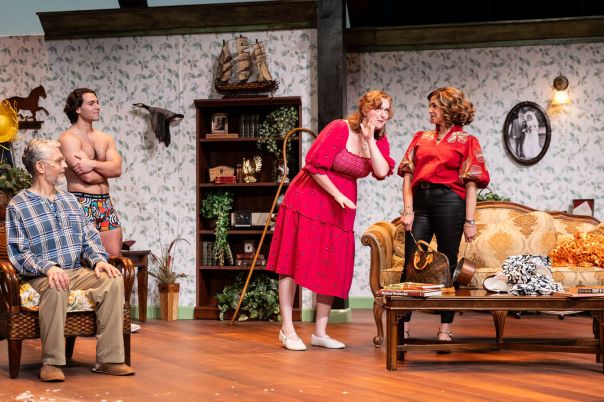
Nina, as forewarned by Cassandra, will pose a threat, but she turns out to be an aspiring actress who worships Masha, totally thrilled to meet her. How can they not bring her along to the costume party?
DCP director Caroline Bower gives Decker his second chance to design the Bucks County cottage, and he does not fritter away the opportunity to enlarge his concept for the wider, deeper Cain venue. This cottage, far more than the one on Stonewall Street, is worthy of neighboring Dorothy Parker’s acreage. It boasts a dimension usually overlooked in Charlotte set design: height.
Aside from the Old Barn on Queens Road, when was the last time you saw roof beams at a local theatre production in the QC?
The Davidson Community acting performances are also up to the high bar set by Theatre Charlotte, particularly William Reilly as Vanya. He absolutely blisters the climactic monologue when Spike proves inattentive to his new experimental play. Till then, Reilly is remarkably serene and stoical, gazing slightly upwards with the pleading look of a martyred saint.
If Vanya is wistfully regretting his unlived life, Valerie Thames as his younger adopted sister Sonia is loudly bemoaning and bewailing hers, more of a blatant riff on Chekhov’s suffering sisters. I’m not sure anyone has spoken more deliciously absurd lines since the days of Oscar Wilde. Without the slightest trace of self-awareness, Sonia declares that she has too much time to spare for reading.
At her exquisite worst, Thames has a spontaneous moaning contest with Masha, cleverly framed as an acting lesson in tribute to the celeb’s fading glory. It takes a lot of energy to compete with Masha’s self-absorption.

As the celebrated Masha Hardwick, Debra Allebach can’t share her siblings’ woeful regrets over their lost youths. Instead, she is desperately striving to regain hers via storybook or Hollywood tabloid romance with Spike. Yes, you can still have abundant energy in your fifties, blithely asserting you’re still in your early forties, and acting even younger.
But we can’t simulate actual youth. We’ve all seen some pretty grotesque facelifts that prove my point. That’s the agony Allebach must face up to. It’s rather sad when Vanya’s mighty monologue wakes her up. Until then, what a bitch!
Portraying – or is it modeling? – Spike, Vic Kuchmaner gets to prance around in the cloud where many of his generation reside, disregarding what’s happening around him to the extent of rarely logging in to real life. Reminds me so much of the self-proclaimed “teen idol” who portrayed Lloyd Weber’s Joseph at Central Piedmont ages ago.
Spurning Spike and latching onto Vanya as devotedly as to Masha, Nina is a sweet counterbalance to Spike and his charismatic superficiality. Emma Kitchin endows the nymph with a luminous simplicity that helps to clarify Durang’s deepest intentions. On the surface, it does ultimately appear that the playwright is siding with crotchety old Vanya in decrying the mindlessness of modernity and longing for the good old days with all their faults.
Kitchin’s enthusiastic attachment to Vanya and his work opens our eyes to another contrast that’s getting roasted: Hollywood at its worst matched against Broadway at its best.
Whether you head for The Arts Factory or Cain Center to get your comedy fix this weekend, you won’t go wrong.

 Art on My Sleeve