Review: Xuefei Yang at The Parr Center
By Perry Tannenbaum

It wasn’t until my third time around with the Shuman Public Relations press release that it hit me. A national solo tour by any classical guitarist – let alone a Chinese female guitarist – is a rather unique event. No other pre-publicity had registered on my radar, so my curiosity was doubly piqued. To my eagerness to determine whether Xuefei Yang would live up to the hype was added fresh worries.
What kind of audience do we have in Charlotte, NC, for classical guitar? Would people be able to find the Parr Center, the two-year-old venue that had only been used once before for classical music – by Opera Carolina over 18 months ago?
Timed to coincide with the release of her new Chapeau Satie album – itself chiming with the centennial of Erik Satie’s death – the Yang tour isn’t running on fumes. Yang is one of the first artists to be signed onto Apple’s Platoon label, another encouraging sign alongside lossless music files that Apple Music is committed to classical. Enough Yang videos are on YouTube to suggest that she is quite savvy about marketing.
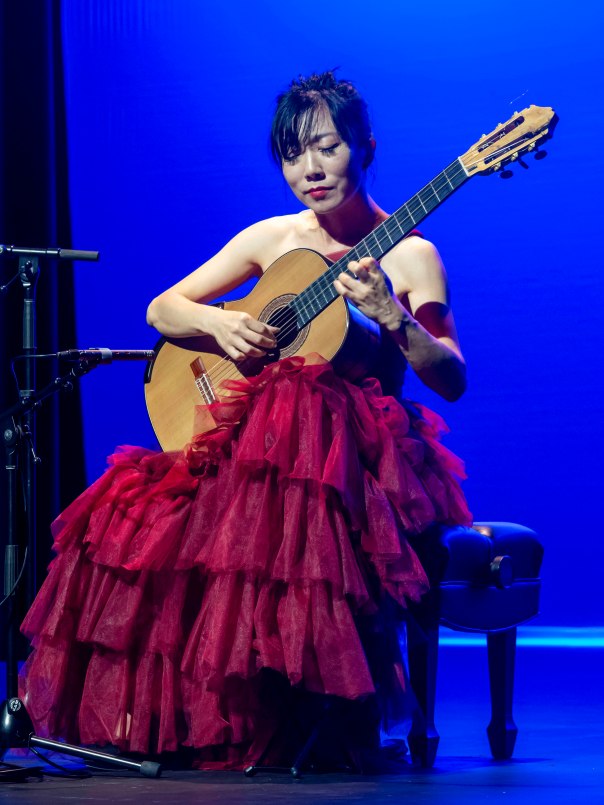
Her Parr concert quickly dispelled my fears of an empty house. Because of Yang’s impressive technique, her winsome rapport with the audience, and her wide-ranging repertoire, the evening was a buoyant mix of retro intimacy and decorum counterbalanced by an open-armed diversity and eclecticism: classical, jazz, tango, and Tin Pan Alley. Gleaned from four continents.
Aside from the finely calibrated sound, the deep Apple pockets behind Yang’s tour were out of sight. No printed programs were handed out at the entrance, and no QR codes lurked in the house. No poster-sized signage for selfies loomed in the lobby, and no merch was on sale. The prerecorded announcement introducing the guitarist was as slick and primetime as Yang’s best videos, yet efficiently brief.
With nobody else onstage to greet her, Yang walked in from the wings, acknowledged the enthusiasm of what turned out to be a good-sized audience, sat herself down on an adjustable piano bench, and positioned herself – and a rather fluffy red skirt – on her foot rest. Though the applause was robust, there were no jumpers, no double-time clappers, and no whoopers in the crowd to indicate the presence of rabid fans.
Six minutes later, things would be different. Yang opened fire with Isaac Albeniz’s Asturias (Leyenda), a piece that you never forget once you’ve heard it. Nor do you have to see it being played to appreciate its rapidly compounding difficulties. It begins with a flamenco-styled bassline, layers on a trilling treble, and peaks with repeated strums stomping as the third layer – the fiercer, the better – as the bass and treble keep going, seemingly uninterrupted.
Or at least the flow sounds steady, undeflected by the ferocity, in the John Williams recording of 1974, which made me fall in love with the piece. Gradually, the sublimity of the slow middle section etches itself into memory after repeated hearings, the more so as you appreciate how perfectly it circles back to the opening bassline, trills, and strums.
At the Parr Center, Yang played better than she had in either of her 2022 studio recordings, first on the Decca label and then on a rushed and misjudged retake on Warner. She set the land speed record for the Asturias on Warner but surrendered her grasp of the argument. Now she was just a tad slower than Williams in the bravura sections, still in a thrilling groove, and only marginally swifter in the malagueña middle, her lucidity abounding and connecting both sections, with sublime harmonics perfectly timed.
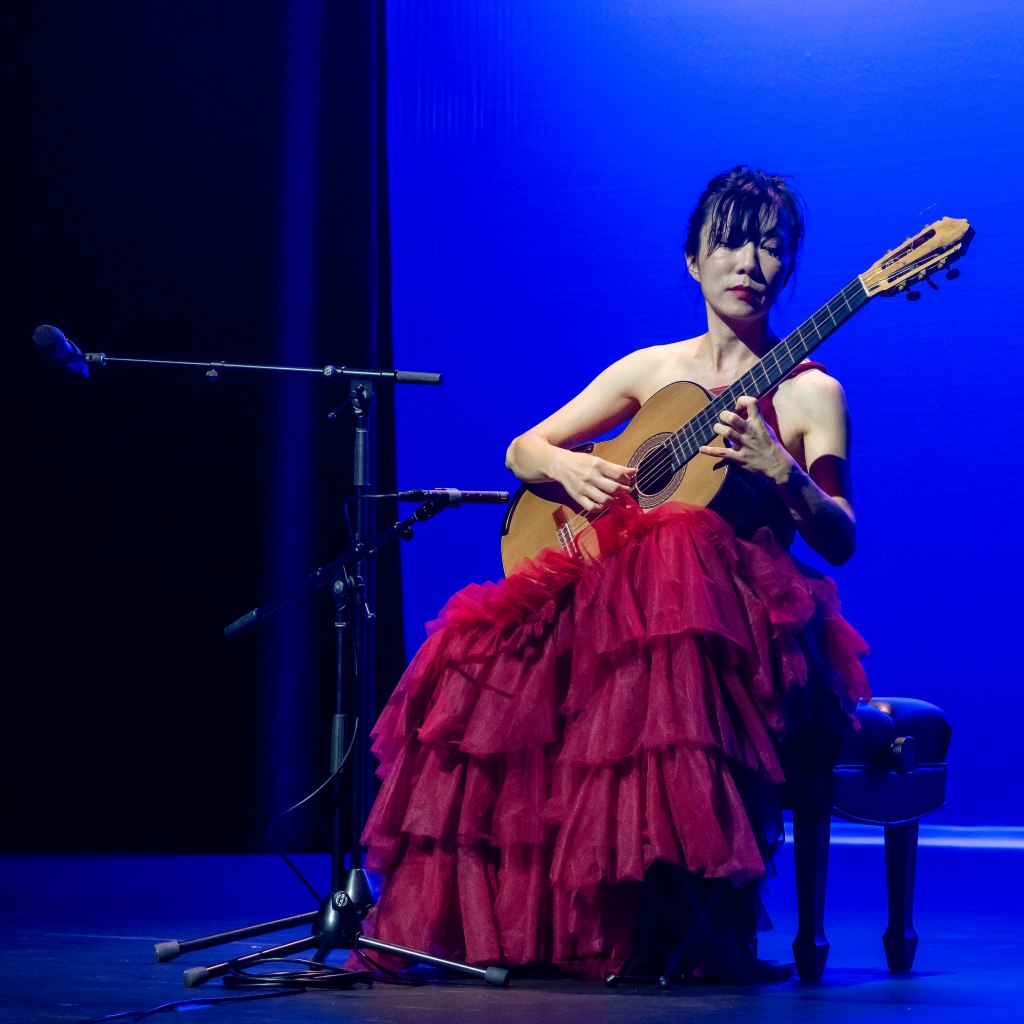
An audacious beginning, to be sure. Now there were whoops aplenty, a couple of them uncomfortably close to my ears. Yang stood up with a bigger smile, holding her beautiful guitar in her open hands in a way that surely plays well at the seven churches on the 15-city tour. But she didn’t begin speaking to us until she reset herself and swiveled a second microphone her way.
We had begun our four-continent journey in Spain, she told us, and would continue to Paris with a couple of pieces from the new album. Again, these were transcriptions of pieces originally composed for piano that showed two sides of Satie, the spare and contemplative Gnossienne No. 3 and the unexpectedly frisky “La Diva de l’Empire.” Prepare for a cakewalk, Yang told us.
Of course, the cakewalk was the more adventurous Satie setting, especially since Yang is contriving on tour to replace vocalist Héloïse Werner, who sings with her on the recorded track. She soloed with a beautiful lilt, especially jaunty and supple where she was replacing Werner’s vocal.
Onward to Asia, where we were given a Japanese treat, an excerpt from Ryuichi Sakamoto’s Merry Christmas, Mr. Lawrence film score, my first gratifying discovery of the evening. You can actually check out the final track on Yang’s 2023 X Culture release and see how her version improves upon the composer’s soundtrack album – sadder, moodier, and poignant. To my ears, the Parr Center performance was even better, adding dimensions of foreboding as the tempo quickened, heartbreak and disillusion as the performance climaxed, crowned by a beautifully delicate coda.

Those in the audience who knew Sakamoto’s original could more fully appreciate the extras that Yang had imaginatively lavished upon it. For me, Yang’s excellence as a composer did not become apparent until she unveiled her own Xinjiang Fantasy. The tempo changes and the trilling treble might tell us of Yang’s desire for more pieces like Asturias in the repertoire – and perhaps more room for improvisation. Compared to the version she recorded on the same Decca album where her Asturias first appeared, the Parr version was more thoughtful, contemplative, and impressionistic, all of the percussive embellishments banished.
Perhaps because of the scarcity of flights from China to South America, Yang stopped over in Mexico for a couple of pieces by Manuel Ponce before crossing the equator. “Scherzino Mexicano” was an adorable departure from the broodings that had preceded, and “Estrellita” was like a sentimental homecoming, played ardently with touches of the sublime and Yang’s bell-toned harmonics.
The rest of our stay in the New World was more casual, relaxed, and jazzy. Astor Piazzolla chipped in one of his multitudinous tangos, “La muerte del ángel,” and Luiz Bonfá welcomed us to Brazil with his famed “Manhã de Carnaval” from Black Orpheus. We lingered in Brazil, in bossa nova, and in Black Orpheus with Antônio Carlos Jobim’s “A felicidade” before arriving at last in the USA.
So you can’t name a single piece written in America for classical guitar, right? Yang to the rescue with three superb transcriptions of tunes by Erroll Garner, Jerome Kern, and Billy Strayhorn. Garner’s “Misty” was the most innovative of the three, most adventurous in its bravura variations on the midsection (or bridge) of the familiar melody. Strayhorn’s “Take the A Train” was probably the most popular selection of the evening, delivering Duke Ellington’s familiar keyboard intro transposed to guitar, along with some of the familiar big band riffs. Nor did “Smoke Gets in Your Eyes” disappoint.
These American arrangements may indicate a new direction for Yang in upcoming releases, since there are no studio parallels to be found on Spotify or Apple Music. It’s tempting to think that Yang is also at the vanguard of a new wave of national tours by solo classical artists. That Apple and its new Apple Platoon label are at work preserving and recording classical music in higher fidelity and promoting live performance is as amazing as it is encouraging.

 Art on My Sleeve