Review: Charlotte Ballet’s A Realm of Existence
By Perry Tannenbaum
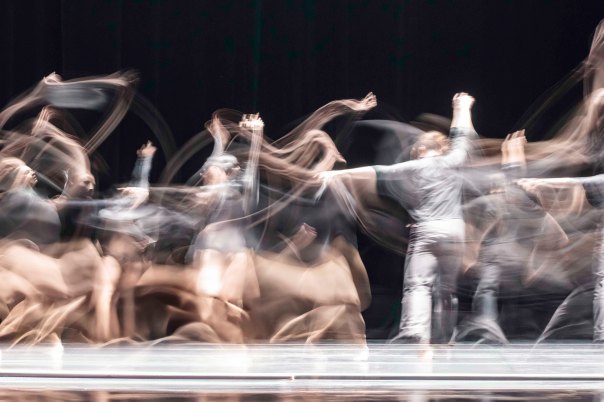
March 6, 2025, Charlotte, NC – Past and present eras of Charlotte Ballet intertwined at Knight Theater in their latest program, A Realm of Existence, named after none of the choreography below. Three of the four pieces were by artistic director Alejandro Cerrudo, including Dos y Dos y Dos, his first world premiere with the company since he was designated to lead it in 2022. After a break, Pacopepepluto lightened the mood with settings for three Dean Martin hits, and Cloudless cast an intimate, almost erotic aura before the second intermission. Hearkening back to the preceding Hope Muir stint as artistic director, nine dancers performed the surreal scenario of Johan Inger’s Walking Mad. It was the first piece performed at Knight Theater under Muir’s leadership in 2017, reprised there by Muir in 2019.

For a piece that emphasized pairs, Dos y Dos y Dos was strikingly touchless – and for that reason, perhaps most fascinating in its interstitial moments between the various couplings. The first ensemble reacted to one another in waves, like coils of a Slinky toy or a row of dominoes, creating the push-pull of gravity between them out of thin air. The intriguing style carried over into the pas de deux – not religiously since there was minimal contact – but wasn’t as unique for me in that idiom. While the variety of the ensembles grabbed me more, the variety of music for the couples – composed by Marek Hunhap, Jean Michel Blais, and Frederic Chopin – brought fresh vibes to their dreaminess.
Absent any props, scenery, or flashy costuming, Cerrudo placed strong emphases on form and flow in his new work. Lighting by Michael Korsch is important in this piece – but not expensive. Dim lighting has been almost a trademark of Cerrudo’s tenure, certainly CharBallet’s settled style in recent non-Nutcracker production photos. PR photos of A Realm of Existence couldn’t be anything other than dimly lit. But as Pacopepepluto quickly made clear, a dimly lit mood needn’t always chime with a Chopin Nocturne.
“Memories Are Made of This,” the first of Cerrudo’s three solo pieces (the “Paco” piece?), showcased a true gem of bad Dean Martin imitation by Joe Scalissi – or a treasure since neither Spotify nor Apple Music have a clue about Scalissi, Joe or otherwise. You could hardly imagine a better dance track for mocking Martin’s schmaltzy style, Cerrudo’s moves prodding Mouzon into projecting the antithesis of suavity.
Apparently, gems like Scalissi’s are very rare indeed, so Mario Gonzalez had to content himself with an authentic Martin cut, the exponentially schmaltzier and creepier “In the Chapel in the Moonlight,” so he drew more laughs than Mouzon’s antics anyhow. How did Cerrudo top himself after that for Rees Launer? With Dino’s most beloved – and outright silliest – hit, “That’s Amore,” complete with its original chart-topping chorus and accordions.
Packaging moon, stars, and an underfoot cloud, this was clearly the “Pluto” segment. There was so much intrinsic merriment in that track for Launer to build on with his discordantly spasmodic movements, and the choreographer mischievously brought back Gonzalez and Mouzon for comedic cameos as lagniappe. That really was amore, especially for the gals in the audience since the guys were hardly wearing a stitch.
Flipping the customary script, Cerrudo had objectified his men more than he would the women in Cloudless, Anna Owens, and Adriana Wagenveld on opening night. Branimira Ivanova’s costumes for this pas de deux were more for a dance studio than a runway. That enabled Owen and Wagenveld to build their chemistry, intimacy, and heat from scratch, a steeper climb without flashy lights and glam dresses. With the gentle music of Nils Frahm simmering in the background, there was actually a bit of tension for me, wondering how far the intimacy would go – and whether it would upset the giggling church ladies sitting behind us. The work out costuming helped to widen Cerrudo’s latitude.

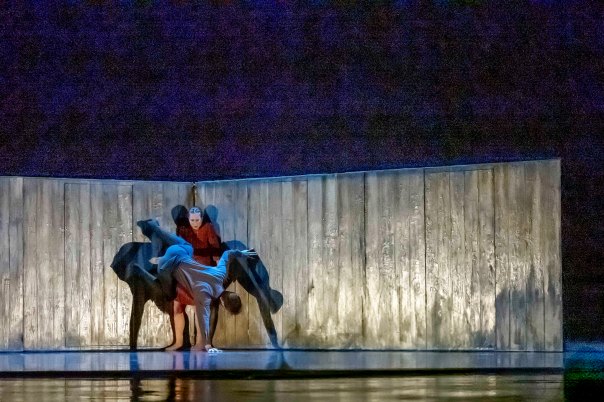
As for Walking Mad, I’ve written about it before, here and elsewhere. So I’m dispensing with yet another description of the piece and developing a theory about Inger’s intent – after noting those same church ladies’ surprise and delight in seeing it for the first time. No doubt the wooden wall, nearly as versatile as the dancers who play with it, is in permanent storage somewhere in town now that this crowd favorite has been performed three times. This wall plays such a big part in the action that what it is can quickly elude our consideration.
It’s a wall that separates the insiders partying behind it from the outsiders who can’t seem to forget their worries and merge with the mindless, monotonous fun. That’s fairly obvious when a crowd of partyers with conical hats spill out from the sides of the wall and briefly join the lonely, trembling folks on our side – especially since they’re almost always engulfed by the hypnotic repetitions of Ravel’s Bolero. But there’s also a night-and-day monotony to Inger’s scheme, for the first dancer we see, seeking to toss away his workday attire and join the festivities, is wearing a bowler hat.
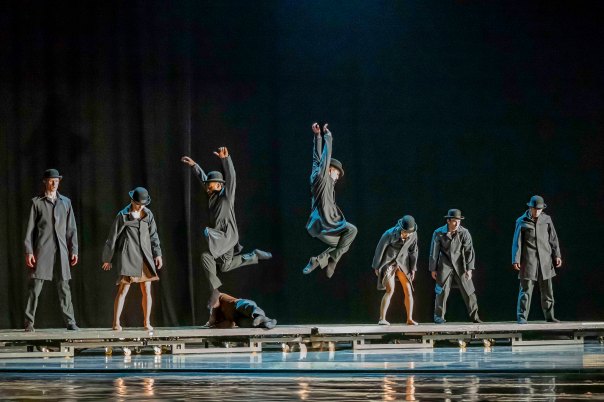
A group of male dancers will parade funereally across the stage later in the piece, all wearing similar Magritte bowler hats. It’s a broad hint that our days are as repetitious and monotonous as our nights, only more formal and mindful. That’s where the fears and trembling of the outsiders come from. Notwithstanding the surprised gasps and giggles from the crowd, this may not have been the best realm of existence.

 Art on My Sleeve