Monthly Archives: March 2025

Dimming the Lights, Cerrudo Delights With Three Dance Originals

Review: Charlotte Ballet’s A Realm of Existence

By Perry Tannenbaum
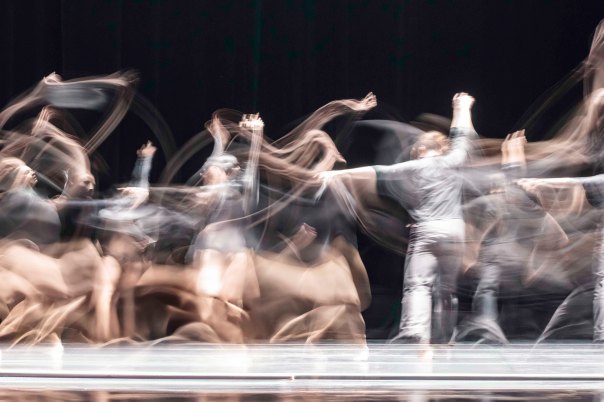
March 6, 2025, Charlotte, NC – Past and present eras of Charlotte Ballet intertwined at Knight Theater in their latest program, A Realm of Existence, named after none of the choreography below. Three of the four pieces were by artistic director Alejandro Cerrudo, including Dos y Dos y Dos, his first world premiere with the company since he was designated to lead it in 2022. After a break, Pacopepepluto lightened the mood with settings for three Dean Martin hits, and Cloudless cast an intimate, almost erotic aura before the second intermission. Hearkening back to the preceding Hope Muir stint as artistic director, nine dancers performed the surreal scenario of Johan Inger’s Walking Mad. It was the first piece performed at Knight Theater under Muir’s leadership in 2017, reprised there by Muir in 2019.

For a piece that emphasized pairs, Dos y Dos y Dos was strikingly touchless – and for that reason, perhaps most fascinating in its interstitial moments between the various couplings. The first ensemble reacted to one another in waves, like coils of a Slinky toy or a row of dominoes, creating the push-pull of gravity between them out of thin air. The intriguing style carried over into the pas de deux – not religiously since there was minimal contact – but wasn’t as unique for me in that idiom. While the variety of the ensembles grabbed me more, the variety of music for the couples – composed by Marek Hunhap, Jean Michel Blais, and Frederic Chopin – brought fresh vibes to their dreaminess.

Absent any props, scenery, or flashy costuming, Cerrudo placed strong emphases on form and flow in his new work. Lighting by Michael Korsch is important in this piece – but not expensive. Dim lighting has been almost a trademark of Cerrudo’s tenure, certainly CharBallet’s settled style in recent non-Nutcracker production photos. PR photos of A Realm of Existence couldn’t be anything other than dimly lit. But as Pacopepepluto quickly made clear, a dimly lit mood needn’t always chime with a Chopin Nocturne.
“Memories Are Made of This,” the first of Cerrudo’s three solo pieces (the “Paco” piece?), showcased a true gem of bad Dean Martin imitation by Joe Scalissi – or a treasure since neither Spotify nor Apple Music have a clue about Scalissi, Joe or otherwise. You could hardly imagine a better dance track for mocking Martin’s schmaltzy style, Cerrudo’s moves prodding Mouzon into projecting the antithesis of suavity.

Apparently, gems like Scalissi’s are very rare indeed, so Mario Gonzalez had to content himself with an authentic Martin cut, the exponentially schmaltzier and creepier “In the Chapel in the Moonlight,” so he drew more laughs than Mouzon’s antics anyhow. How did Cerrudo top himself after that for Rees Launer? With Dino’s most beloved – and outright silliest – hit, “That’s Amore,” complete with its original chart-topping chorus and accordions.

Packaging moon, stars, and an underfoot cloud, this was clearly the “Pluto” segment. There was so much intrinsic merriment in that track for Launer to build on with his discordantly spasmodic movements, and the choreographer mischievously brought back Gonzalez and Mouzon for comedic cameos as lagniappe. That really was amore, especially for the gals in the audience since the guys were hardly wearing a stitch.

Flipping the customary script, Cerrudo had objectified his men more than he would the women in Cloudless, Anna Owens, and Adriana Wagenveld on opening night. Branimira Ivanova’s costumes for this pas de deux were more for a dance studio than a runway. That enabled Owen and Wagenveld to build their chemistry, intimacy, and heat from scratch, a steeper climb without flashy lights and glam dresses. With the gentle music of Nils Frahm simmering in the background, there was actually a bit of tension for me, wondering how far the intimacy would go – and whether it would upset the giggling church ladies sitting behind us. The work out costuming helped to widen Cerrudo’s latitude.

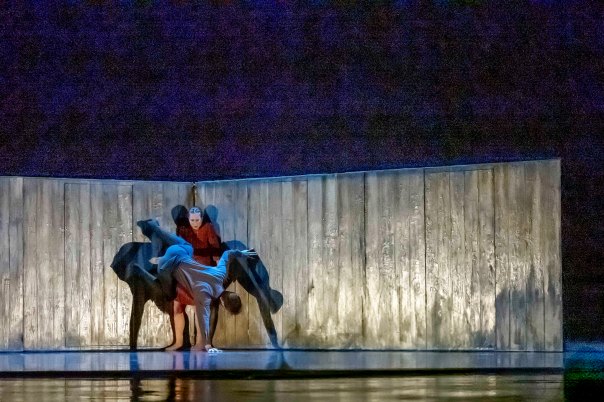
As for Walking Mad, I’ve written about it before, here and elsewhere. So I’m dispensing with yet another description of the piece and developing a theory about Inger’s intent – after noting those same church ladies’ surprise and delight in seeing it for the first time. No doubt the wooden wall, nearly as versatile as the dancers who play with it, is in permanent storage somewhere in town now that this crowd favorite has been performed three times. This wall plays such a big part in the action that what it is can quickly elude our consideration.

It’s a wall that separates the insiders partying behind it from the outsiders who can’t seem to forget their worries and merge with the mindless, monotonous fun. That’s fairly obvious when a crowd of partyers with conical hats spill out from the sides of the wall and briefly join the lonely, trembling folks on our side – especially since they’re almost always engulfed by the hypnotic repetitions of Ravel’s Bolero. But there’s also a night-and-day monotony to Inger’s scheme, for the first dancer we see, seeking to toss away his workday attire and join the festivities, is wearing a bowler hat.
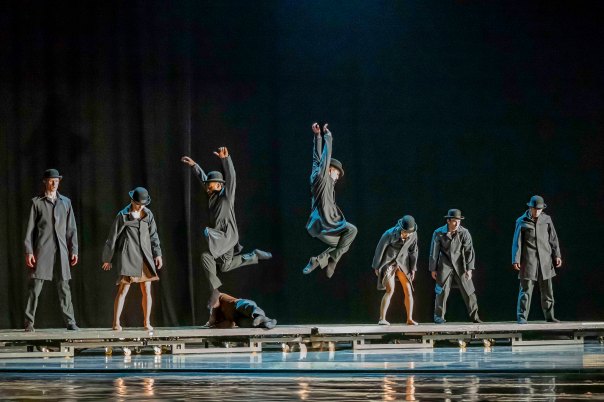
A group of male dancers will parade funereally across the stage later in the piece, all wearing similar Magritte bowler hats. It’s a broad hint that our days are as repetitious and monotonous as our nights, only more formal and mindful. That’s where the fears and trembling of the outsiders come from. Notwithstanding the surprised gasps and giggles from the crowd, this may not have been the best realm of existence.

Risen from the Dead, CAST’s Alabaster Is All About Artists in Crisis

Review: Alabaster at The Mint Museum

By Perry Tannenbaum

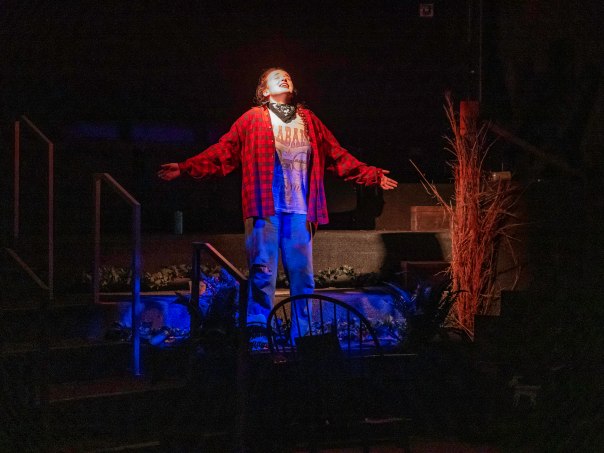
Google and Alexa will tell you if you ask: it’s a little bit more than a 17-mile drive from Bessemer to Alabaster, Alabama. Every source I’ve checked also confirms that Gip’s Place, the last backyard juke joint in America, was in Bessemer until its blues guitarist founder, Henry “Gip” Gipson, passed away in October 2019 at the age of 99. It’s useful to know that when we meet Weezy, the first character to speak at the Mint Museum – in the first Carolina Actors Studio Theatre production anywhere since its 2014 NoDa demise.

Weezy tells us that she lives at a small farm “right near” Gip’s Place in Alabaster.

True, we have ample reason to question Weezy’s veracity from the get-go, since she also introduces herself as a goat. Titling her comical drama Alabaster,playwright Audrey Cefaly could coyly blame her geographical inaccuracy on this cantankerous barnyard beast she created. But the choice, invoking the special malleability of a stone that has been reshaped by sculptors and artisans for millennia, is clearly an artist’s choice.

As we continue to follow the scrappy encounter between two artists in backwoods Alabama, one a celebrated photographer of celebrities and the other an unknown painter, we often find that Weezy – among other things – is Cefaly’s surrogate. In one meta moment you can look out for, Weezy even delivers a message from the playwright to one of our protagonists.

Mostly, Weezy serves as an irascible Jiminy Cricket for June, the one human survivor on the farm. When she isn’t offering up prompts and explanations channeled from Cefaly, she becomes June’s better self, the self that is wishing to break free of her self-imposed isolation and artistic obscurity. When sweet optimism sours into clear-eyed skepticism and cynicism, Weezy becomes the painter’s inner voice: June’s worst critic.

And sometimes, she’s a goat, caring for her ailing mama. Weezy is fluent in English and goat. Occasionally, she’s also clairvoyant.

Both Bessemer and Alabaster are prone to tornadoes. Cefaly’s tornado has radically reshaped June, demolishing her farm and turning the entire left side of her body into a relief map of scars, patches, pocks, and swirling melty skin. Playing the role of June, Zoe Matney has a l-o-o-o-o-ng pre-show routine, for she must spend much more time than usual backstage getting director/makeup designer Michael Simmons’ concept applied – front and back, from torso upwards – with help from assistant director/makeup artist Dee Abdullah.

Then she is onstage as the audience arrives, long before lights dim and Weezy enters.

If Weezy weren’t there, we must also remember, we wouldn’t have a reason to hear from June, though her first response to the goat’s prodding is no more than a well-chosen finger. Fortunately, we are quickly liberated from the confines of an inner dialogue by June’s distingué visitor, Alice.

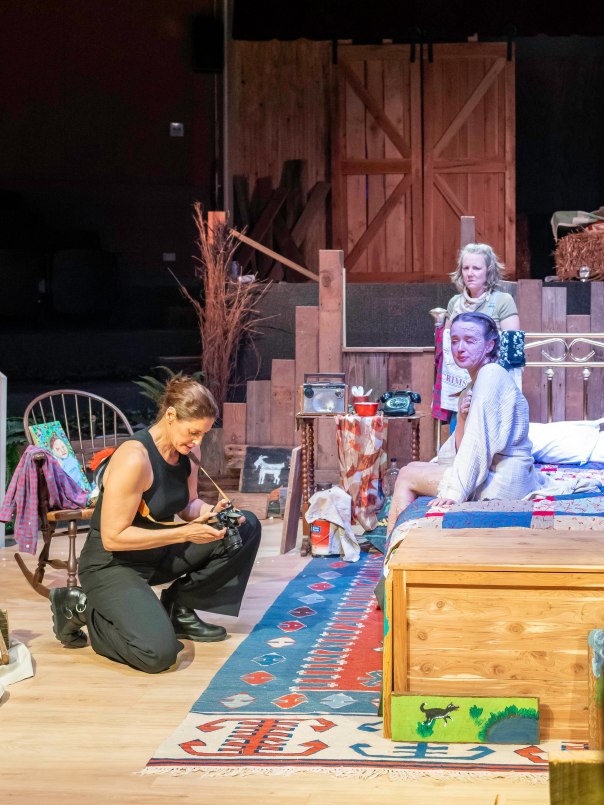
Acquainted, you can bet, with Annie Leibovitz and no further than a light meter’s distance from Demi Moore, Alice’s career has recent taken a hairpin turn to the scarred-women project she’s working on now. June is her seventh subject, and Alice works in multiple media. Trying to reach the traumatized inside of her subjects – all women – while finding the dignity and beauty mixed with the deformity outside, Alice documents them in video interviews and, when the time and light are right, by snapping coffee-table-quality portrait photos.

Are these scars a form of artwork?

A fresh aspect of artist’s choice comes into play with Cynthia Farbman Harris as Alice. Alabaster premiered in December 2019, just two months after Gip’s passing, in Fort Myers, Florida – the first stop in a “Rolling World Premiere” presented at 11 member companies of the National New Play Network, a rollout spanning from New Jersey to Oregon. The QC had a company in that Network, Actor’s Theatre of Charlotte, which had rolled with some of these co-op premieres before.

When asked about the switch away from glamor assignments, Alice deflects at first. She only gives herself away slightly when asking June about her “accident” – a word more apt for her own trauma – and when, egged on by June’s questioning, she scrolls back far enough among places she’s been before Alabaster to her rehab.

So it shouldn’t be too surprising to learn that Actor’s Theatre was scheduled to premiere Alabaster in the latter half of its 2022-23 season, just over two years ago. More of you will remember that Actor’s Theatre did not make it to the end of 2022, planting its gravestone among the most honored companies in Charlotte’s theatre cemetery before the halfway point of its 34th year.

For Harris, who auditioned for that abortive ATC production, it was a matter of not forgetting. She had worked with Simmons at CAST, with a variety of other stints at Moving Poets, Queen City Theatre, and Theatre Charlotte – including a pair of diva roles, Maria Callas in Master Class and Blanche DuBois in A Streetcar Named Desire. If the role of Alice stuck with her after ATC’s demise, there must have been plenty of meat on the bone.

With an eye toward reviving the edgy theatre vibe that reigned while ATC, CAST, and QC Theatre were all up and running, Cynthia and her husband, actor Michael Harris, have founded Actors Collaborative Theatre to help make it happen. The new ACT is an associate producer of Simmons’ rebirth, while Moving Poets and Charlotte Contemporary Theatre are among the companies listed in the digital playbill on CAST’s thank-you list.

If you know how long ago Harris starred as Blanche, then you know Alice is bit of a stretch, no matter how much she wanted it. We’re not just talking about the yoga scene. With Abdullah serving as intimacy director, June’s master bedroom becomes more than an artist’s studio. Scars and all, June brashly inquires whether Alice is gay, before we learn the photographer’s full backstory.

Somehow, Matney and Harris make their love-hate relationship work altogether naturally and spontaneously. It only becomes a little more cerebral than Cefaly imagined it. They lean into the age difference a little instead of pretending it doesn’t exist. But they do traverse the long, rugged terrain to the primal mode. The two artists debate whether their meeting is like The Bridges of Madison County or not. Yet they could also debate whether they are both hostile animals locked in cages of their own making – while the liberating keys are always in their hands.

Actually, they do talk about that.

Matney’s performance is every bit as stunning as Harris’s, if for no other reason than June is so moody and mercurial. Ambivalent about having her paintings exposed to outside world, June is living with desperate intensity in her present isolation, hoping for a sunnier future – she has invited Alice here, though she is wary – while repeatedly tortured by her past trauma.

Something as trivial as the beep of Alice’s camera can trigger flashbacks to the worst. Adding to the inner psychological circuitry are the stresses of fresh lightning and thunder – plus the partial nudity at the start of the photo session. Matney calibrates her various disturbances well when her hurting is raw, and she channels energy convincingly into compensatory actions when June is striving to appear calm and well-adjusted. She also leaves room for just the right amounts of flirtation and coquetry.

Kelly Mizell, who plays Weezy, can tell you how long ago Harris sashayed into Nawlins as Blanche, for she was an outstanding Stella Kowalski in that same Theatre Charlotte Streetcar way back when. Given the opening entrance, this talking goat decisively demonstrates that she can still command a stage before discreetly receding into the background, sometimes as a handy guide, sometimes as an annoyance, and sometimes as a mind-reader.

Mizell gets to show Weezy’s tender side caring for Bib, her mostly pallet-of-hay-ridden “Mmaaahaaaahaaaa… maaaaaah!” You can see Harris wanting to play Alice enough to partly bankroll and publicize a production, but with so much stage time and so little spotlight (or vocabulary) as this old goat, Debbie Swanson had to really want this Mama Bib role. She’s wonderful when her moment comes.

Otherwise, there are remarkably few signs that Simmons and the Harrises are doing all this on a shoestring. Lighting design by Dave Meeder easily ranks with the best we’ve seen at the Original Mint’s Van Every Auditorium on Randolph Road. Tim Baxter-Ferguson, another name we fondly associate with a bygone era, installs a marvelously rusticated twin-level set design that simultaneously gives off vibes of woodsiness, springtime color, and irreversible damage.

Sophie Carlick’s costumes don’t have to be lavish, but they enable June, Weezy, and Alice to radiate an outdoorsy aura. Cleverly enough, June’s bedroom outfit hides her preoccupation with painting as decisively as her splotched overalls proclaim it, but the goat costumes also strike a perfect note. So do the many artworks fashioned for June’s artistic oeuvre on barnwood, to be auctioned off when Alabaster completes its run.

Simmons’ sound design and special effects are on-point, but I wish they had impacted more: louder, with more lightning crackle and windy sweep. Nor was the ringtone on Alice’s cell as ugly as Cefaly intended. As a photographer, I had to chuckle at the sadly unprofessional equipment we were seeing, including a camera with an onboard flash. Yet I could empathize with Harris – and admire her all the more – when she had to keep that lame videocam running and the still camera showing snaps on its screen.

When Alice instructs June on how to use a smart phone, when she shows her how to trip the shutter, and how to review the photo portraits on the wee screen… Quiet moments like these resonate with us, because they are part of a bonding process, two healing processes intertwining. Two resurrections. Three if you count the rehab June and Alice join in on with those barnwood scraps.

Good reasons to smile as we left the Mint. Along with the resurrections of CAST and a vital drama Actor’s Theatre never got to present.

Lasers, Projections, and Artful Plumbing Bring New Vitality to “Become Ocean”

Review: Charlotte Symphony’s Become Ocean at Blume Studios

By Perry Tannenbaum

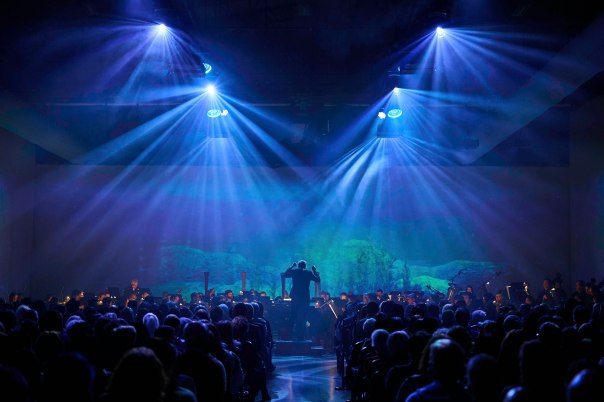
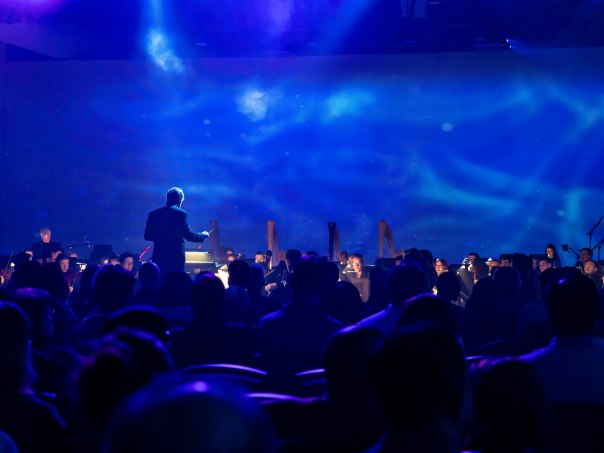
Animated bubbles rose from the pillars of four harps. Aquamarine waves flowed toward us and surrounded us. Revolving laser lights played upon silent infusions of smoke and mists, forming clouds and starbursts above.

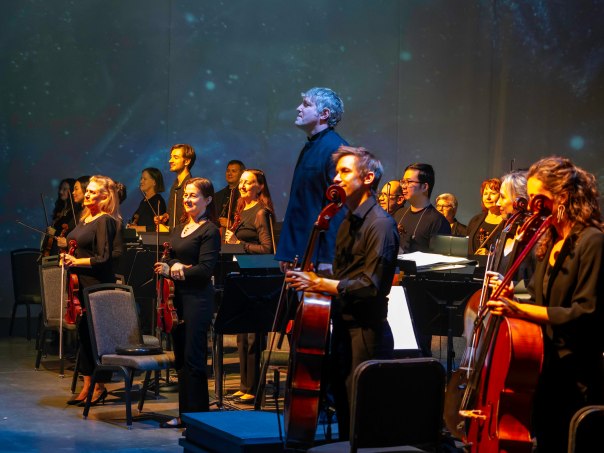
Become Ocean by John Luther Adams, conducted by Yaniv Dinur at the newly unveiled Blume Studios, was not a typical Charlotte Symphony program. It was an elaborately crafted experience. All of the orchestra and all of the audience were together in a vast shoebox, walled by white curtains punctuated only by exit doors. The only people elevated above the musicians were Dinur, haloed in a spotlight, and the phalanx of lighting and sound technicians at the rear of the hall.

Touring Broadway shows usually bring fewer board operators to the Belk Theater soundbooth. Creative directors Aaron Mccoy and Ian Robinson, projections designer Jeff Cason, and lighting designer/laserist Jay Huleatt were duly listed in Symphony’s digital program as members of the production team headed by co-producers Bree Stallings and Scott Freck.

Likely they took their cue – and its immersive drift – from Adams’ own words, written before the live 2013 premiere of the work by the Seattle Symphony, which commissioned the work. “We came from the ocean, and we’re going back to the ocean, right? We’re made up mostly of water, and life on earth first emerged from the seas. And with the melting of the polar ice caps and the rising sea levels, we may become ocean sooner than we imagine.”

For all of its gorgeous waveforms, colors, and lights, there was no mistaking the doomsday lifelessness of the massive projections. No fish or mammals inhabited these waters. No crawlies moved or glimmered on seawalls. The smallest bubbles might be imagined to suggest primal cellular life, and translucent forms taking shape in the deep could be seen as lazy jellyfish if you didn’t require intentionality. Plant forms occasionally appeared on the ocean floor, always motionless, never as fragile or temporal as grass.

Additional golden light gently flooded Dinur’s players, so when we reached the darkest ocean depths, we might see them as a hopeful golden glow, guiding us forward through the gloom. The feel of the Charlotte performance, notwithstanding all the electronics, was organic.

Unlike a “Symphony at the Movies” concert, conductor and orchestra didn’t calibrate their tempo with a soundtrack. On the contrary, the techs at the back of the hall were able to interweave their effects and projection episodes in sync with the musicians. The even, somewhat glacial pacing of Adams’ score certainly eased the synchronization to the point where it consistently felt seamless.

The composer’s scenario, if there is one, does not begin with a theatrical catastrophe or cosmic apocalypse. More like Debussy’s La Mer, the opening rises up gradually out of silence, evoking the infinite. Seated midway between the front and rear of the space along the right-side audience wall, where Symphony seated us in order to best hear the score, my wife Sue and I couldn’t really discern exactly when the music reached us after Dinur gave his downbeat.

It almost seemed to emerge – via double basses, contrabassoon, and maybe tuba – from the lower depths of human audibility, more like a hearing test than melodic music when first discernible. If we’d insisted on seats that offered a view of the musicians, the effect would not have been as mystifying. On this level playing field, with its wretched sightlines to the orchestra, we were prodded into looking upwards and around us.

Even with a conspicuous absence of violins in the initial murmurs and the emerging sound weave, the score was not devoid of sweetness. Waveforms layered onto the low subterranean drone surely emanated from the harps. Whatever Adams added to these rising and falling arpeggios from the marimbas, vibraphones, celesta, and bells only added an electronic roundness – and a dim metallic glow – to the harps’ liquid ostinato. The crystallization of all this unseen plucking of soft pounding became quite magical.

Without cataclysm or catastrophe, becoming ocean could be experienced in a variety of ways, subtly aided by the light show. There was the gradual seduction of immersion in the liquid deep when we surrendered to it, each one of us at a different moment. Perhaps we moved further toward an acclimation to Adams’ prompt – proclaimed out loud by the sound system, like an epigraph preceding the performance – that this is “where we came from.”

As the projections evolved from abstract auroras and drifting bubbles to more solid shapes – waves, undersea gorges, boulders, and petrified plants – evidence mounted that the production team’s concept took us far, far away from the pivotal moments of environmental catastrophe. By now, millions of years after birds, men, reptiles, amphibians, and fish had breathed their last gulps of oxygen, we had become ocean in the sense that we were the hopeful spirit of a potential rebirth of life.

The structures of the score and the complementary projections open the doors to other interpretations. We could puzzle out the meaning when brass became as prominent as the harp and percussion ensembles. We could decide – or not decide – whether the extended whistling from the woodwinds was ominous or a hopeful sign.

In the longer scheme of planetary transformation, a similar ambiguity hovers over the long cataclysmic build near the end of this sea odyssey that crests with timpani, bass drums, and a muted trumpet. While it’s tempting to assume that this peak, subsiding into a quietude with sounds that evoked the funereal tolling of a bell, was the sealing of our doom, my reading was more upbeat.

The sea-shaking impact, millions of years from today, could signify a distant collision with an extraterrestrial object or force that eventually brings life back. The tolling would then signal a restarting of time.

What became clearer during this Charlotte Symphony performance piloted by Dinur was that Adams’ Become Ocean still merits all of its accolades, aging well since it was awarded the Pulitzer Prize in 2014. The Stalling-Freck production team has collaborated beautifully with Symphony and its new Blume Studios facility. Their multi-media addition never trivializes this epic symphony. Not does it constrain the visceral takeaways we can experience with the music. On the contrary.

First-timers will need GPS guidance when they venture away from Uptown Charlotte to their first Blume Studios experience. Plenty of free parking rewards their pioneering spirit when they arrive.