Review: The Humans @ Armour Street Theatre
By Perry Tannenbaum

Thanksgiving in Chinatown, in the shadow of the fallen Twin Towers – Stephen Karam’s spooky, mystifying, and hilarious The Humans hands us a world teeming with paradox. For an afternoon in a creaky old two-story apartment, newly rented by Brigid Blake and her boyfriend Richard Saad, her family gathers to celebrate, the whole lot of them nursing open wounds – and their Alzheimer’s-stricken elder, “Momo” – trying to heal from recent setbacks.
First staged in the QC at Knight Theater in a 2018 touring production starring Richard Thomas as family patriarch Erik Blake, Davidson Community Players brings us a downsized reprise in the first locally-produced staging, with the venerable Hank West in the lead.
Haunted by his return to the vicinity of Ground Zero and by his recent misdeeds, tormented by a deadly mix of sleeplessness and nightmares, Erik vies with elder daughter Aimee for which of the Blakes is suffering the most. Since last Thanksgiving, Aimee has come down with ulcerative colitis and taken major hits to her love life and her career as a Philadelphia lawyer – with major surgery looming on the horizon.
Yet Erik fires a wicked one-liner at Brigid, whose gripe, like his wife Deirdre’s, barely hovers above the “suck it up” level compared with his own. “If you’re so miserable,” he asks the health food fanatic, “why are you trying to live forever?” Inside negativity, Karam can be equally trenchant and funny when Aimee philosophizes about her recent breakup: “Maybe loving someone long-term is more about deciding whether to go through life unhappy alone or unhappy with someone else.”
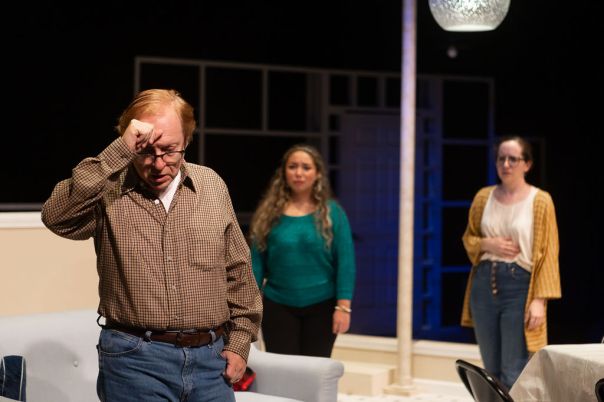
Only Deirdre and Erik have an agenda for the afternoon, subtly suggested in a couple of brief dialogues. We’re mostly watching Karam’s keen observations of family interactions – their bonds, their tensions, their little quirks, and their tectonic divides. These appear all the more chaotic because dialogue often overlaps and action is happening simultaneously upstairs and in the more commodious basement.
Knight Theater probably gave us an oversized impression of Brigid and Richard’s love nest, while DCP’s Armour Street can’t help look both height- and space-challenged. Remarkably, Evan Kinsley’s more cramped set design lessens the struggle of viewing multiple tracks of action and family intrigue. Yet Karam and director Glynnis O’Donoghue are still able to provide enough compelling distraction at a key moment to allow the aged Momo to disappear without our noticing.
Even without two-story height, Kinsley’s set has an alleyway leading to an elevator shaft to accommodate the wheelchair-bound Momo’s transit between the two floors. The slice of set that serves as the upstairs somehow has enough space for the front door, an entrance to a bathroom (Aimee’s frequent retreat), and the only window looking out on the city. When the apartment’s oddities need to impact, Kinsley’s set and Sarah Provencal’s sound design deliver.
The divides between the Blakes will be familiar to anyone who has grown up in a family of siblings. Although Brigid would never consider living in Philly, the geographical divide is as important here as the generational difference, for neither of the daughters would ever think of moving back to Scranton, PA – except to a summer home that Erik tells us can move towards construction once there’s a sewer system near their pristine plot.
Those anticipated PA pilgrimages will not bring either of the sibs back into the bosom of the holy church. Nor will it erase the fact that these country folks’ children are irremediably citified, one a lawyer and the other an aspiring composer. Safety, religious, and lifestyle concerns plague the homespun parents. Ahead of their Thanksgiving visit, Deirdre has sent a care package that includes a statue of the Virgin to protect Brigid’s new home. Meanwhile, Aimee can expect an email any time a lesbian commits suicide.

Karam provides plenty for the Blakes to discuss in their near and distant back histories, with a handful of stunning updates. If things get dull, he serves up a choice collection of singularly awkward moments that would instantly embed themselves in family lore ever after, lovingly and mockingly retold at holiday dinners and special celebrations.
There’s even a “pig smash” ritual unique to Blake Thanksgivings, a nice spotlight for Richard. Often the aspiring social worker serves as our ears in his role as outsider, giving the Blakes the chance to explain all that is long-known among themselves.
These moments reverberate warmly within us, but the most haunting vibes, from Erik’s dreams and experiences, touch us all, nonchalantly invoking 9/11 and Superstorm Sandy – specters of terrorism and climate change. Over and over, whether Deirdre wheels Momo around or Aimee summons an Uber with her cell, we hear an eerie, insistent whisper from the playwright emanating from his vivid, painstakingly detailed dream: this is how we live.
On Davidson’s compacted stage at Armour Street, the natural flow of The Humans, the lack of powerhouse confrontations that shake us to the core when we witness such American classics as August: Osage County, Who’s Afraid of Virginia Woolf? or The Little Foxes, reminds us of Chekhov’s more placid classics. Rich and funny and touching as all the action is, we will likely struggle to discern a solid plot until Erik’s big reveal.
Inexperienced theatergoers are therefore advised to ignore any FOMO anxieties they may be experiencing and surrender themselves to the many delights, laughs, shocks, and epiphanies that West and his castmates deliver.
On the page, Karam’s script doesn’t pop out at you with the color and verve that O’Donoghue gets from this ensemble. West actually comes onstage with a couple of key advantages over Richard Thomas. We more readily accept West as an ordinary janitor-turned-equipment-manager, and he can bring out a curmudgeonly edge to Erik that I’d never noticed before.
No less surprising is the bubbly, goofball likability that Breanna Suarez brings to Brigid, though she is often the family contrarian and party-pooper in the script. The vibrant energy she exudes somehow turns pure negativity into simple immaturity, emphasizing Brigid’s spoiled qualities. As our genial hostess, Suarez tunes in on Brigid’s side hustle as a bartender, so she’s the life of the party while subtly fueling the true plot, endearingly committing a faux pas for the ages along the way.

Portraying West’s wife for the first time since 2005, when they both earned best actor honors in Coyote Ugly, Anne Lambert makes the wait worthwhile. Although Citizen Trump famously descended his escalator in June 2015, between the time that The Humans opened Off-Broadway and when it reappeared on Broadway with a completely new cast and director, Deirdre likely struck the late-2015 Broadway crowd as a MAGA maniac.
Interestingly, Karam could have taken Hillary Clinton as his model if he had written his tragicomedy 20 years earlier, but Lambert still strikes me as a MAGA nutjob even if that couldn’t have been the playwright’s intent. The religious zeal, the paranoia, and the constant moralizing are almost non-stop, so thanks to Lambert’s implacable disapproval, Deirdre winds up ennobling Erik and humanizing her daughters – just by enduring her. Yet there is an unmistakable sincerity to this steely, troubled soul.
Deirdre’s relatively spurious sufferings also brighten Aimee’s halo. Her woes are certainly the most tangible, so Alyssa Whitting has the freedom to add some hard edges to her performance, aiming her best zingers at Brigid with an assortment of barbs for the rest of the fam. Ascending and descending DCP’s imaginary staircase for extended poops, Whitting makes a pungent impression when she’s with us. She’s the slick urban professional among the Blakes, getting better reception on her cell than Dad and handling all the key calls.

Preoccupied with the cooking, Ryan Miles as Richard is also frequently on-leave from the family flow, but he’s a fine audience surrogate when we need things explained. Without fuss or bravado, Miles keys into the fact that Richard is the most laid-back, financially secure person in the room – the one lifelong New Yorker – in between Brigid’s age and Erik’s, accentuating his unique perspective.
Momo’s lines are annoyingly repetitive and approximately 85% gibberish to my ear, meticulously transcribed by Karam word-by-nonsensical-word. So if Wandy Fernandez is accurately delivering Momo’s babblings as written without considerable improvisation, she has performed one the most prodigious feats of memory in the history of theatre. There is wonderful variety in her performance with a lovely little miracle in the middle, which of course gratifies Erik and Deirdre the most. Words or not, the woman can also throw a fit.
The cryptic ending of The Humans, where the thin thread of Karam’s plot crystallizes, was clearer to me the second time around. Along the way, it’s helpful to note the circular shape of the Blakes’ history, the dream Erik divulges stage by stage, and the explanation Richard offers. Erik’s worries, sadly enough, are suddenly more topical in the Carolinas than ever before. After Sandy, the fact that Chinatown was a Zone A flood zone was fearfully real. Now that Asheville is isolated, adrift from interstate highways until next year, we can legitimately wonder what zone is not a flood zone after all the climate damage humans have done.
Richard says it succinctly, recalling a comic book he loved as a kid: “horror stories for the monsters are all about humans.”

 Art on My Sleeve