Monthly Archives: March 2024

Normality Attacks a Serial Killer in Catch the Butcher

Review: Catch the Butcher with Post Mortem Players @ CATCh

By Perry Tannenbaum
Serial killers, wherever they prey on young defenseless women and girls, are universally detested, even by fellow criminals. Yet these monsters, vying with vampires in wickedness and cunning, surely have a captive audience that greatly outnumbers their victims. Identify one and he’s frontpage news, sure to draw breathless airtime on local and national TV. Invent one who is truly special and you may spawn a bestseller and even an Oscar winner.

Yes, the guilty pleasures of sopping up the gory conquests of killers at-large and thrilling in the hunt to stop and avenge their rampages are perverse addictions shared by millions. Our susceptibility to the lurid scent of butchery was more than enough license for playwright Adam Seidel to bring us Nancy, his sacrificial lamb in the grimly satirical Catch the Butcher.

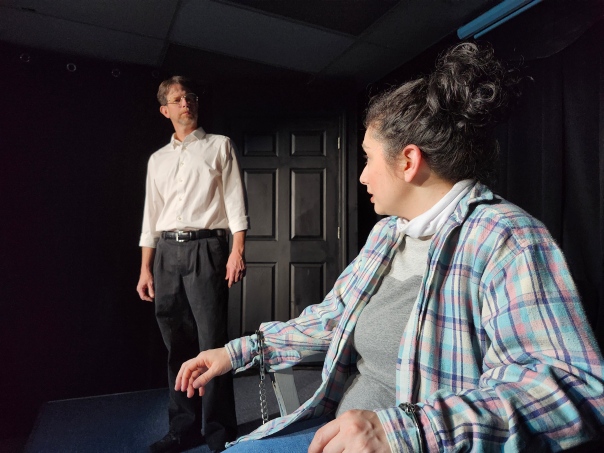
Nancy doubles down on the audience’s unspoken perversion: she wants to be abducted by “the butcher of Harbor Park.” Night after night, she sits alone on a park bench deep in the darkness of that dreaded landmark, fearing that she will be stalked and longing for it. As directed by Heather Wilson-Bowlby in the current Post Mortem Players production at CATCh, the company’s first sally into the QC, Nancy is almost advertising her yearning.

She’s reading The Stranger Beside Me, Ann Rule’s account of her friendship with serial killer Ted Bundy, a classic in the true crime genre. Heather-Bowlby’s mischievous touch, we will learn, is especially apt because the Harbor Park butcher dabbles a little in literature, dedicating a poem to each of his victims. Nancy’s fandom runs deep, admiring the fiend’s verse and feeling an unspoken kinship.

Parallel to this literary thread, the action of the early scenes is dark, silent, and animal until the Butcher pulls off his abduction. The silence of this lamb, as her killer circles ever more closely around her, is not merely evocative of a silent movie creepshow, begging for organ music in the background. We come to realize that it was also like a National Geographic documentary depicting a mating ritual in the wild.
Throughout Nancy’s bizarre captivity, Seidel has his fun juxtaposing the sophisticated with the primal and the drudgery of domesticity with our natural savagery – to shocking or comical effect. Numerous twists are in store as this butcher-victim pas-de-deux develops, including at least one complete flip-flop. And why not, seeing that Nancy and the butcher of Harbor Park were actually stalking each other?

If you don’t scan the QR code on Post Mortem’s flyer before the lights go down, gaining access to the full digital “Slaybill,” you won’t have any idea of where the silent opening scenes are happening, who we’re watching, or when the action takes place. That heightens our suspense and delays the onset of humor we’d expect at CATCh (Comedy Arts Theater of Charlotte). You’ll know most of the details if you’ve read the script beforehand, but Wilson-Bowlby flouts the playwright’s insistence that we’re in the present day, giving her star headphones instead of earbuds and a boombox instead of an iPhone.

We’re no further back than 1980, when The Stranger Beside Me was first published, but the copy that Jackie Obando Carter is clutching shows considerable wear and age. Costume designs by Carter were no more decisive to my eyes in designating the decade. More impressive were the design and execution of special effects that Carter and Hilary Powell collaborated on: one stabbing was particularly impressive since, at CATCh, my wife Sue and I were seated as close to the action as we would be watching a card trick.
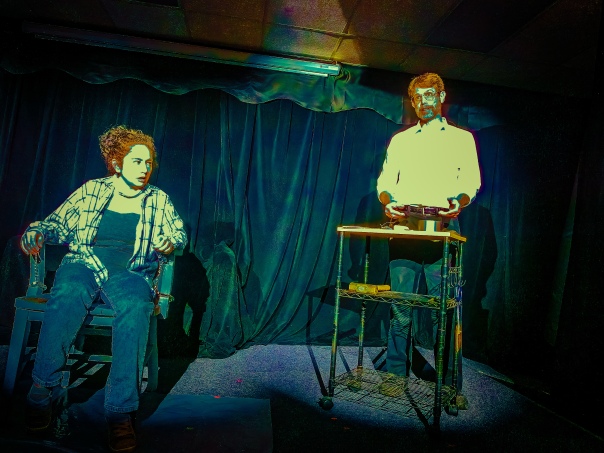
Carter’s chemistry with her abductor, Chuck Riordan as the Butcher, is deliciously volatile. The vibe is more spiced with sensuality on Carter’s end as Nancy tries to divert and charm Bill – revealing his name bares the first chink in the Butcher’s armor – as her survival instincts kick in. While Nancy is dazed and disoriented when she first awakens in the Butcher’s soundproofed dungeon, this is what she quested for during her previous vigils in the dark.

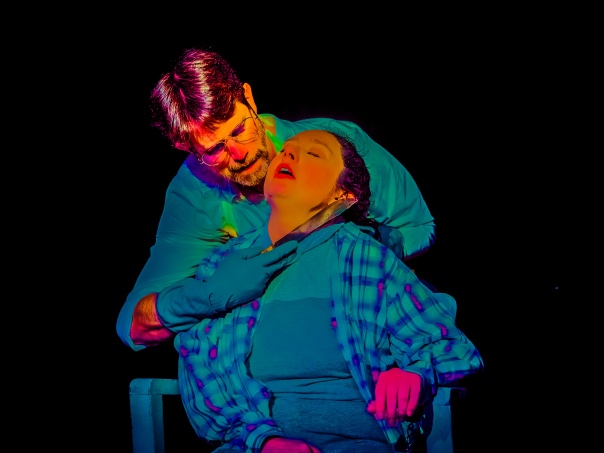
She is not like us. She needs prodding to scream her loudest and confirm Bill’s soundproofing. A knife at her throat as she sits helplessly handcuffed to a chair? Carter must calibrate the mortal terror that Nancy is experiencing with her fantasy fulfillment and delight. The more we realize how diligently Nancy has worked to be here, the more we appreciate the complexity of Carter’s performance.

Since she candidly lets out that the Butcher and his technique aren’t what she expected, Bill is also a bit disoriented as he realizes what he has stepped into. Being measured against the glamor and terror of Nancy’s dream serial killer begins to tilt his attitude toward defensiveness and appreciation. While maintaining his dominator role, he finds he must prove himself as a ruthless butcher and sustain the admiration his victim has professed toward his poetry.

Riordan, like Carter, is making his QC debut in a role that requires deft and sudden navigation. But he has significantly more leeway in how he portrays this monster as his vulnerabilities are exposed. He doesn’t get to be quite so sure of himself as the adventurous nothing-to-lose Nancy – deviations from glamor, savoir faire, and fearsome menace all redound in his favor as we see more beneath his façade. He’s an anti-villain, in a sense.

Riordon can thus roll with the moment and seem authentic so long as he doesn’t fumble his lines or visibly stumble in his actions. Especially in Bill’s domesticated scenes, Riordon can mute his paranoia and be altogether humdrum. There are key moments when Riordon is suddenly called upon to show a killer’s steel or a lover’s grace. He masters these with aplomb, and he’s strong on Bill’s telling trait: he wants to make his mark with his murders and his poetry, desperate for both notoriety and acclaim.

It would be heartless to give an even sketchy summary of how the story unfolds with Seidel’s unfailing logic. So let’s concentrate on a sequence that was pivotal for me.

To gain precious time, Nancy has convinced Bill that she wishes to hear the poem that was written about her. Bill not only picks up on the ploy, he notices that, compared with previous victims, Nancy isn’t as terrified when a knife is at her throat. She is not what he expected. He must consider the possibility that Nancy is a cop or an FBI agent, particularly after she escapes her handcuffs to use the toilet.

Fast forward a bit past some juicy action, one of them with French toast, and Bill has finished his new poem. We haven’t sampled the Butcher’s literary craft before, so we presumably know less about what we can expect than Nancy. “A Single Rose,” as Bill titles it, is recognizably dreadful – so dreadful that I initially suspected that the serial killer was laying a fiendish trap for our lady in distress, testing whether her esteem was worth having.

Asked for her reaction, Nancy comes back with an utterly hilarious, magnificently audacious response: “It’s not your best work.”

At this point, we had reached a realm of dark humor that was unfamiliar to me. In perfect style. From here, Seidel could take us wherever he wished – even upstairs, out of the Butcher’s dungeon, to a new household.

In the aftermath, we get to know the couple’s next-door neighbor, Joanne – a bubbling busybody portrayed by Jennifer Briere, yet another talented Post Mortem newcomer. She enters through the front door with a bundt cake, then a vase filled with freshly cut roses, seemingly well-acquainted with the welcoming-new-neighbors drill. Briere is especially precious when Joanne learns how Milwaukee, wherever that is, differs from Texas. You will see that all the audacity Nancy has shown us before is eclipsed the moment she dares to open the front door for Joanne, defying Bill’s stern commandment.

Reviews of Catching the Butcher sometimes cite Silence of the Lambs as an inspiration and inevitably Dexter, because the original Nancy in the 2015 Off-Broadway production, Lauren Luna Vélez, was a fixture in that series. If you’ll permit a more classical viewpoint, Seidel’s macabre comedy reminded me more of John Fowles’ The Collector, may favorite horror novel alongside Dracula. Bill is more of a scientist than Hannibal, less of a gourmand.
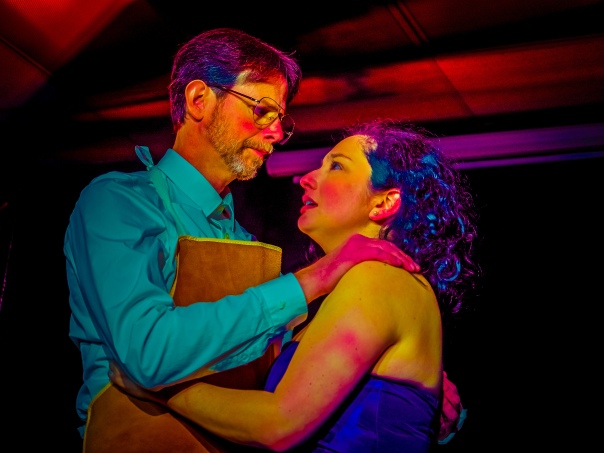
The household idyll we see blossoming after intermission, with its undercurrent of doom, took me back to prelapsarian Adam and Eve, with snoopy vivacious Joanne subtly installed as our Serpent. Wilson-Bowlby may have been feeling similar vibes as she staged the ending, giving it more of a wedding or honeymoon tang than Seidel could have imagined. Quite wonderful.

Kennedy’s Bridge Circle Meets Its Quota of Quips – and More

Review: The Thursday Bight Bridge Circle at Theatre Charlotte

By Perry Tannenbaum

Since 1987, the last time I watched a live performance at St. John’s Baptist Church, I haven’t cut a deck, played a hand, won a rubber, or even bid a single No Trump – I’ve even lost track of my copy of Charles H. Goren’s Point Count Bidding. But since that night when PlayWorks staged The Octette Bridge Club at St. John’s, I haven’t needed much knowledge about the game of bridge or its culture. My last brushes with the game were in Sunday columns I would read in the arts section when The Charlotte Observer was a traditional newspaper.

So it was a little concerning, when I sat down at Theatre Charlotte for the premiere of Ray Kennedy’s The Thursday Night Bridge Circle, that I found no less than four bridge teachers were credited in the playbill for their contributions. My concerns were thankfully unfounded. Visitors to the Queens Road barn will not be assailed with bridge terminology, the intricacies of bidding, or even extensive card play.

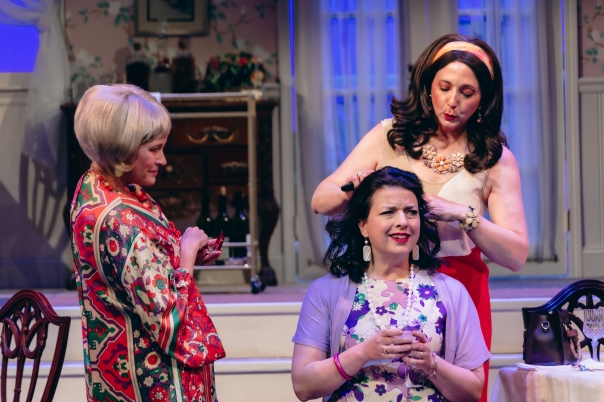
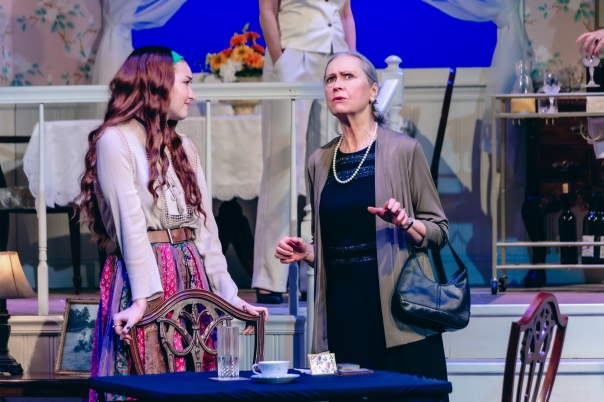
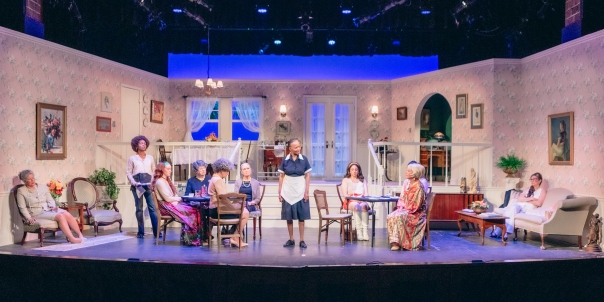
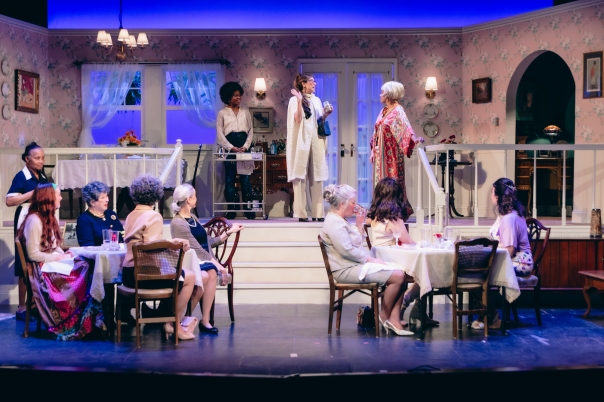
Louise Kennedy’s circle is a looser agglomerate than P.J. Barry’s octet, which was an unwavering group of eight sisters. And it’s only Louise’s circle tonight because hostess chores hopscotch from member to member on successive Thursdays. Nor are participants constant, we learn, as Louise welcomes us to her cheery, symmetrical, split-level living room – two tables flanked by two sofas – a luxe scenic design by Tim Parati that gives us peeps at the garden and the foyer.

Tonight, for example, Louise’s college co-ed daughter, Mary Carter Kennedy, is in town to play one of the hands, to be partnered with Louise’s mother-in-law, Mrs. Kennedy, who has earned a risqué reputation in LaGrange, North Carolina, as a liberal. Since one of the regulars can’t make it this week, dear Louise is bracing herself for the arrival of Miss Virginia, who will likely be roaring drunk as soon as she can guzzle sufficient booze. Excitement is ratcheted up further by a new player that only our host knows, Carmella, feared to be a judgmental Yankee – and to have a profession!

Imagine that!

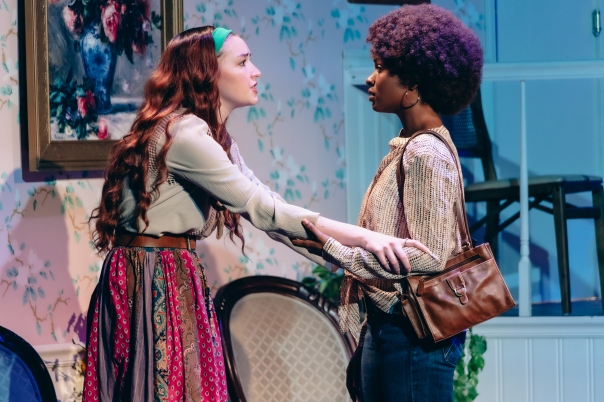
The two tables are filled out by Bootsie and Cluster, gals from Louise’s generation, and two more elders, Miss Caroline and the eternally disapproving Mrs. Coltrane, Louise’s mom. You can bet there will be plenty to rouse Mom’s umbrage, beginning with the fact that housemaid Margaret and her daughter Bernice will be mixing drinks, pouring beverages, and preparing the hors d’oeuvres. Mary Carter also has a truckload of disclosures that will disconcert her granny.

Hosting such an exhilarating event is so intricate, complex, and daunting that Louise – or anyone who hosts the circle – cannot be expected to participate in the cardplaying. The standard of perfection is too high for a hostess to divide her attention. Tables must be carefully set, partners thoughtfully chosen, and place cards placed exactly so at every chair.

Sadly, Carmella hasn’t chosen the best night for her first sampling of Southern hospitality – or the best year. It’s 1970, LBJ is midway through his second term and the backwater of LaGrange still has separate black and white schools, bathrooms, and post offices. “It’s always been that way,” Miss Caroline complacently declares, and none of the LaGrange ladies except the liberal Mrs. Kennedy seems to suspect that Margaret or Bernice might be discontented with the racist status quo.

Needless to say, Kennedy has concocted a comical time bomb that is primed to explode before our eyes. Desegregation has arrived and Louise’s mom and husband have decided to send their imperiled offspring to military school – a betrayal of Louise’s bestie, Bootsie, who was counting on her public-school solidarity. Nor will Mary Carter, an activist at school, take this well, while Carmella and Mrs. Kennedy will be reliably alarmed. Toss in a stray N-word from Virginia when she’s sufficiently lubricated and you may conclude that a polite evening of bridge has been scuttled.

Before his fictional kindred took the stage on opening night, the playwright Kennedy spoke to us about his autobiographical work and introduced us to the real-life Mary Carter, proudly sitting in the third row. So when Tonya Bludsworth entered as Louise, it was a bit like a continuation of the playwright’s monologue, except that the hostess was giddier with excitement and nervousness because she didn’t know how the evening would go.

Sketching each lady who would sit in each bridge chair, the intro was a bit draggy despite Bludsworth’s fretful charm, particularly since the playwright doubles down on his intros by granting Louise mystical foresight into who is arriving at her front door – tripling down when she greets them by name. Most people will be delighted with Kennedy’s style, which endows most of his characters with the ability to come up with a Southern-fried quip or a salty simile in nearly every sentence.

Almost by magic, Kennedy is able to differentiate between his ladies anyway, thanks to the big family squabble and the political, class, and age divides. Dennis Delamar’s stage direction is as handsome as Parati’s set, elegantly accessorized by “props team” Lea Harkins and Lois Marek. No doubt Delamar’s successes are facilitated by the presence of at least three more actor-directors in his cast, Corlis Hayes as Margaret, Paula Baldwin as Mrs. Kennedy, and Bludsworth as the fourth ace. Assistant director Dee Abdullah is no slouch, either, as a dramaturge.

Kennedy’s lapses into logorrhea may be the result of his not realizing the full power of his script, which bursts forth with terrific force on Queens Road, first when Hayes reacts to the bombshell dropped by Kathryn Stamas late in Act 1 as the soused Virginia (which Grace Ratledge as Mary Carter and Ashley Benjamin as Bernice refuse to let go) and then a stunner by Ann Dodd as Mrs. Coltrane when she is unexpectedly confronted deep in Act 2.

Costume designer Angeli Novio accepts the challenge of making the hotsy-totsy New York lawyer, Stephanie DiPaolo as Carmella, stand out among the local LaGrange fashionistas in her haute couture. DiPaolo does her Long Island accent lightly enough to maintain her stature as an evolved Yankee outsider, but instead of leaning more into her legal expertise and feminist superiority, the playwright lets her devolve into an excuse to more thoroughly introduce us to the natives.

No matter how charmingly Jenn Grabenstetter as Bootsie and Amy Pearre Dunn as Cluster expound on the origin of their Dixie nicknames, I just don’t care, even if it did incentivize them to audition. Let’s get to the juicy stuff quicker! And when we do get there, let Baldwin have more space to bemoan and bewail how her son could conspire with Mrs. Coltrane to send her dear grandson off to a boarding school. It’s a glaring plot point that needs to be addressed – and weren’t we in the middle of a war in 1970?

Regardless of how much more meat Kennedy could pile onto our plates (and how much candy he could discreetly remove), Hayes makes an enduring impression in her climactic monologue, deftly calibrated by the playwright not to become a tirade. Ginger Heath, anointed my first Best Actress many years ago, get surprisingly little to sink her teeth into here despite her imposing wig, but that only spotlights the exploits of the newbies all the more.

Benjamin absolutely commands the stage when she unexpectedly returns in Act 2 as Bernice, a bit of a surprise after her badly miked debut as Tinman last September. That leads to a rather memorable sequence of assertiveness, contrition, and reconciliation begun by Dodd in her QC debut as the formidable Mrs. Coltrane. I didn’t expect to weep after intermission, but I did, even while the quips kept landing.

The Full Cerrudo Experience Is a Hit in Come to Life

Review: Charlotte Ballet’s Come to Life at Knight Theater

By Perry Tannenbaum

March 7, 2024, Charlotte, NC – Midway through his second full season as artistic director, we can now say that Alejandro Cerrudo has stamped Charlotte Ballet as his company. The corps looks fresh, peopled with more newbies we’re getting to know than trusted heirlooms who have long since proven their mettle. The choreography on their current Come To Life program at Knight Theater – Cerrudo’s Little mortal jump, Jiří Kylián’s Petite Mort, and the world premiere of Penny Saunders’ Beat the Clock – is beguilingly adventurous. Wow factor? Check.

For those of you who remember the 1950s, yes, Beat the Clock exhumes the classic TV game show hosted by the preternaturally vacuous Bud Collyer and sponsored by Sylvania. So at first, it wasn’t at all apparent that Saunders was targeting gender roles in those ancient days. But while the jackpot money was still flying gloriously above the dancers portraying the announcer, the host, the contestants, and the amped audience, we were cinematically fade-dissolving into a different scene as the shower of bills hit the ground.

This was a panel discussion where three women discussed the provocative question of whether housewives could benefit from additional education. Though it’s a godsend for the choreography, the discussion got heated, which may frustrate a few feminists in the audience. What frustrated me, however, was that Saunders’ sound design wasn’t as clearly audible for the panelists as it was for the archival gameshow track.

As the panelists’ hubbub subsided at stage right, there were a few moments of split screen as Michael Korsch’s lighting intensified at stage left for a briefer husband-and-wife scene, where both of the marrieds ended up feeling ignored and unvalued. Is this why we won the war? Sometimes, it felt this way. This brief microcosm gave way to two concluding community scenes, the first spotlighting the women and the finale embracing the entire 14-person ensemble.

Kerri Martinsen’s costume design had something to say about conformity in the outfits sported by the gameshow contestants and audience, later giving way to assorted nondescript outfits. Similarly, Maurice Mouzon Jr. as the announcer and James Kopecky as the host wore uniform outfits – with glittery silver blazers, to hell with historical accuracy. Back then, the em in emcee stood emphatically for master of ceremonies, so I suspected that Saunders and Martinsen were double-underlining their point.

After the first intermission, the repertoire flipped from cinematic to theatrical, with costume designer Joke Visser adorning Kylián’s men with gilt-edged cavalier attire that fit tightly and, for his women, the stiffest possible dresses. Suffice it to say that you’ve probably never seen women move laterally across the stage as these ladies in black do. Nor can it be doubted that these ladies – or their dresses – are the little deaths implied by Kylián’s Petite Mort title. Scored with slow movements from Mozart’s 21st and 23rd Piano Concertos, Mort both celebrates and lovingly skewers classic elegance – with a beautiful set of pas de deuxs between the ensemble segments and a couple of breathtaking transitions that require some nifty undercover choreography of their own.

The most eye-catching pairings among the six couples, for me, were Kopecky and Samantha Riester along with Raven Barkley and Rees Launer. Your mileage may vary, especially if you’re witnessing Charlotte Ballet for the first time, and the six couples will change from performance to performance (only Reister and Kopecky are constants, and they will be swapping out dances and partners). Just try not to gag on the relentless grace and symmetry.

If Kylián’s piece was a wry and perfect gem, then Cerrudo’s Little mortal jump, premiered by Hubbard Street Dance back in 2012, impacted like a coolly calculated over-the-top extravaganza. Korsch italicized the spectacle with his lighting design, principally when he aimed his beams at the audience and when he illuminated rows of vanity bulbs on cue. Branimira Ivanova’s costumes arguably upstaged Korsch’s lighting and Cerrudo’s choreography, literally stopping the show and putting two of Charlotte Ballet’s dancers in suspended animation, pinned to the scenery. Well before that, it was apparent that Cerrudo’s scenic design – massive movable boxes about as high as a school locker – was an integral part of his choreography. The movements of these huge boxes made transitions between scenes a constant source of excitement and surprise.

Ten pieces on Cerrudo’s playlist, listed alphabetically rather than sequentially in the program booklet, add to the kaleidoscopic swirl of his scenario and the giddy, stagey energy of the dancers. So his magical moment of suspended animation stands all the more dramatically apart from the hectic electricity that bookends this utterly unique pas de deux. Cerrudo’s piece, longer than the others, fit in well with them, maybe even eclipsing them a little. More comfortable in his leading role, his welcoming remarks were confident, for his invitation to support CharBallet’s 2024-25 season would soon be buttressed with a stunning program. The buzz in the house seemed to indicate that Cerrudo is winning over fervent new fans in his audience and onstage. As one ticketholder summarized, leaving the elevator that descends into the nearby parking garage: “Holy cow.”

Small Sizing Yields Big Rewards in DCP’s Fun Home

Review: Fun Home at Armour Street Theater

By Perry Tannenbaum

Across the way from the Gershwin Theatre, where Wicked has been running for over 20 years, you can find my favorite Broadway theater, Circle in the Square. At the other end of an underpass that connects the two venues – and two or three flights of stairs underground – you and 800+ plus patrons (less than half the Gershwin’s capacity) can have a theater-in-the-round experience in a space that’s like a wee oval basketball court or a hockey rink.

I’ve seen seven different productions at this underground stadium since 1999, most unforgettably the world premiere of Tennessee Williams’ Not About Nightingales that year and the visionary waterworld of Mary Zimmerman’s Metamorphoses in 2003. Right now, two other Circle gems are playing in Metrolina revivals, Lombardi at the Lee Street Theater in Salisbury and five-time Tony Award winner Fun Home at the Armour Street Theater in Davidson.

A couple of admirable versions of Jeanine Tesori’s musical have already run in the QC, a Broadway tour at Knight Theater and an Actor’s Theatre reprise on the Queens U campus, so the current Davidson Community Players production, directed by Danielle Melendez, has big shoes to fill. What strikes me most positively about DCP’s effort, however, is how small it is. If you’re sitting in the front row, as my wife Sue and I were last Saturday evening, some of the action will be right next to you. Or behind you.

From that vantage point, DCP is better than even the 2019 Actor’s Theatre production at Queens’s Hadley Theater in replicating the intimacy of the Circle in the Square experience. Set designer Chip Decker, who stage directed the Hadley production during his years at the helm of ATC, retains his bright visual concept – a departure from the more funereal Broadway and touring versions – in depicting the Bechdel Funeral Home, allowing Alison Bechdel’s cartoons free play on the translucent windows of the parlor.

Often, they’re animated, with Bechdel’s words and drawings blooming before our eyes.

As we watch Lisa Kron’s adaptation of Bechdel’s graphic novel unfold, there’s a nice little studio perch set aside at stage right for the full-grown Alison to narrate. Sometimes as Alison, Kel Wright insinuates herself into the action, lurking in the main playing space, sketchbook in hand, as Small Allison and Middle Allison act out her vivid memories of growing up at a Pennsylvania funeral home and coming out as a lesbian at Oberlin College.

The bright visual concept tracks better with Kron’s book, because darkness only gradually seeps into the story. Alison’s dad, Bruce, seems like a bookish, excessively neat and proper mortician at first, mainly because he and his dutiful wife Helen conspire to hush up his big secrets. When Small Alison and her brothers sing “Come to the Fun Home,” a faux commercial jingle for the funeral home, the childish glee is as contagious as an early Jackson 5 hit or something fresh from little Donny Osmond and his backups.

Bruce may discourage these boisterous outbursts, but he cannot suppress them. Similarly, when Small Alison wants to go to her school party in jeans and sweater, Bruce can temporarily impose his will by shaming his daughter into wearing a dress. It’s only in retrospect that we and the full-grown Alison realize that Bruce was mostly protecting himself, shielding the truth of his own sexuality rather than upholding propriety.

Ironically, the fulcrum begins to shift for Middle Alison at Oberlin College, where she discovers her own gayness. This is jubilantly proclaimed in “Changing My Major (to Joan),” a song that equals the joy of “Fun Home” and surpasses it in exuberant sensual comedy. Tesori is at her best in these chamber sized songs with their pop flavorings and their Avenue Q spice. Even at her peak in Caroline, or Change and Kimberly Akimbo, Tesori’s other acclaimed shows, there’s a little bit of Sesame Street mischief going on.

Having coped with Bruce’s escapades for decades, Helen understandably freaks out when her daughter informs her that she has come out. Alison can only see her mom’s distress through a haze of misperception. Yet we always like Alison because she not only observes herself and her family with her sketchbook, she perseveres on her path and eventually, if still hesitantly, confronts her problems.

Despite Dad’s disdain, she continues to opt for cartooning instead of “serious” art, continues to wears jeans instead of dresses. Faced with Joan’s advances, Middle Alison retreats… temporarily. She seems to hibernate and marinate after writing home about her gay epiphany, processing Dad’s puzzling evasiveness and Mom’s distress, but she elects to bring Joan home with her when she returns from Ohio on winter break.

Darkness falls gradually, but it falls hard.

Mortician, English teacher, preservationist, and molester of underage boys – there’s a lot to unpack, even for adults in the audience, as we try to understand and judge Bruce in the context of his times. Coming off his outré antics in Vampire Lesbians of Sodom,Ashby Blakely is as varied, complex, and nuanced as we’ve ever seen him as Bruce. At times, he roars in his tyrannical moments, overpowering the small house. Like all the other players, he’s miked, but thanks to Kathryn Harding’s exemplary sound design, there’s never any distortion, clipping, or dropouts to mar the show or its music.

The one major sacrifice for theatergoing purists is the lack of a live orchestra at Armour Street. Nevertheless, Harding contrives a surround effect by channeling the prerecorded soundtrack and the amplified voices from the rear speakers. It was a pretty unique front-row experience for me, rather enjoyable.

After her exploits at Booth Playhouse as Norma Desmond in Sunset Boulevard, Alison Rhinehardt had already convinced me that she could overpower Armour without a mic. As Helen, she predictably knocks her showpiece, “Days and Days,” out of the park with diva aplomb. Until then, she’s rather wholesome and humdrum, accentuating Mom’s breakout.

Nor is there any perceptible cratering when we scrutinize the less familiar names in this cast. Recently unveiling her directing chops in the Queen City Concerts premiere of Local Singles,Wright brings an exacting intensity to Alison that always captures the drama, even when she sings. “Caption,” she keeps barking in Kron’s script, so her valuation of le mot juste always seems foremost as her castmates take care of the graphics.

As the Bechdel brothers, Aiden Honeycutt as John and Grayson Flowers as Christian help turn Small Allison’s “Fun Home” promo into an exhilarating panorama. Bailey Fischer takes flight almost from the first moment we see her as Small Alison – goodness, energy, and precocity personified until her last “Flying Away” moment. That energy is formidable when Ann Schnabel must take over as Middle Alison, especially in the intimidating context of a matriculating college freshman. In a sense, then, her “Changing My Major” is as much a rebirth as it is an affirmation.

It’s the needed embrace of the real world that will ultimately help her in coming to terms with the truth about Dad.

Criminal law is far more confident than my feelings in determining who the forbidden fruit is among the remaining cast. As the revelatory Joan, Sierra Key seems healthy enough, her seductiveness sufficiently muted for a Midwest coed. At school and visiting the funeral home, Key hits all the notes that emphasize Joan’s savoir-faire and discretion without pounding them. As the Bechdels’ handyman, Bart Copeland struts and preens enough to convince us that he’s also a consenting adult.

When he switches roles and becomes a former student that Bruce picks up on his nocturnal rambles, Copeland calls upon the naivete that made his star turn as Pippin so compelling last spring at Theatre Charlotte. Topped with a mop-top wig, you’ll see he’s also a perfect fit for Tesori’s retro pop music.

Doubling the Fun

Okay, so maybe you weren’t duly impressed that two shows are now running in Metrolina that premiered at the same Broadway theater. We can do better. Weirder. This coming weekend boasts two different shows set at a funeral parlor! Yes, as Fun Home continues for two more weekends up in Davidson, down here at Booth Playhouse, Charlotte Conservatory Theatre is bringing us the world premiere of Nan-Lynn Nelson’s Leaving Watermaine, directed by the playwright.

It opens on leap day this Thursday, at the tail-end of Black History Month, for a four-day run. By the end of Act 1, we’re greeted with a busy weave of plot threads involving undertaker Werly Mainlodge, his three daughters, and their beaus – both beloved or unwanted. Which of the three young ladies will be leaving first? Elopement or honeymoon? Will the Klan intervene on the eve of the planned departure?

Has there been a KKK lynching or a passionate murder? Or is the presumed victim still alive? Mystery, racism, colorism, and comedy peep into what seems like a tragedy, so you’ll need to stick around after intermission to learn how the dangling threads sort out. Nelson seemed to have it all calculated, incorporating her own musical soundtrack into her sound design.