Monthly Archives: February 2024

Dialing Up the Almighty in Memphis

Review: The Mountaintop at Theatre Charlotte

by Perry Tannenbaum
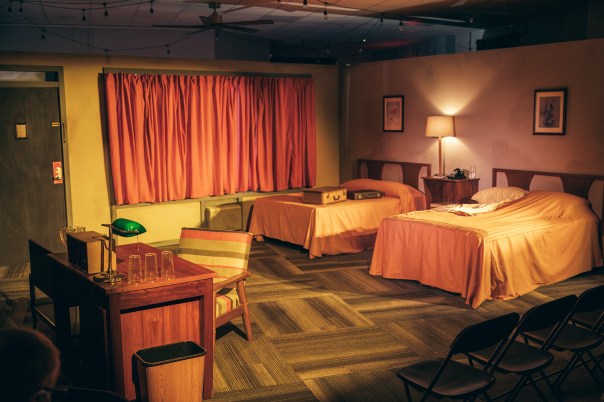
A stage with a particularly authentic – or imaginative – set design is a good start for a director who wishes to immerse you in the world of a play. Yet few productions surround you with the theatre experience, making you feel outside your own world and inside theirs. Sleep No More was dedicated to achieving this mission with a Macbeth makeover up in Manhattan’s Chelsea district at a spooky hotel, where I saw it in 2015. So was Then She Fell the following night in Brooklyn, where I was plunged into the imagination – and mental illness – of Lewis Carroll.

In Charlotte, such efforts have been comparatively infrequent, but not unknown: Chickspeare’s Fefu and Her Friends on Cullman Avenue in 2001, numerous “environmental” productions by Carolina Actor’s Studio Theatre (CAST) in their days on Clement Avenue, and Matt Cosper’s legendary Bohemian Grove of 2014 that was staged god-knows-where – you had to agree to be kidnapped in a van by The Machine at the Actor’s Theatre parking lot to attend.

They do make an impression, these hyper-immersive presentations.

Cut to the legendary Queens Road Barn for the latest Queen City experiment in environmental staging. Yes, that’s Theatre Charlotte – in Myers Park! – on the cutting edge with its new production of Katori Hall’s The Mountaintop. Directed by the ageless Corlis Hayes and designed by Chris Timmons – with a nine-person “Lobby Transformation” team – this is the first fully-staged drama my wife Sue and I have seen in the 501 Queens Road lobby since the spare and forlorn Waiting for GODot in 2007.

Together with invaluable help from David Gallo, set designer for the 2011 Broadway production, and props designer Brodie Jasch from Fayetteville’s Theatre Squared, Dr. Hayes and her production team aim to take us back to the Lorraine Motel in Memphis on the night of April 3, 1968. Rev. Martin Luther King, Jr., returns from the Mason Temple, where he has just delivered his eerily prophetic “I’ve Been to the Mountaintop” speech.

Every detail of the last room occupied by MLK has been replicated with meticulous authenticity – night tables and their contents, lamps, the chair and its fabric next to the window, the window curtains, the bed coverings – all the way down to the upside-down zero on the door to Room 306. With walls within walls, you must enter through this door to get your first view of the new theatre space in the lobby created for this production. Only the ceiling remains unaltered, with its fans and extinguished holiday lights. Explanations are appended in the digital program for those details which couldn’t be ascertained and those that would have conflicted with Hall’s script.

Since there is no intermission and all the usual concession outposts have been whisked away, they have thoughtfully made “Room Service” available to ticketholders via a QR code. In more ways than one, we are treated like kings at The Lorraine. Fun fact: the fateful motel was actually named after the hit 1928 song, “Sweet Lorraine,” popularized by jazz artists Teddy Wilson and Nat “King” Cole.

For all of Dr. Hayes’s reverent devotion to getting the look and feel of The Lorraine recreated as faithfully as she can, we soon see that it isn’t a shrine. Hayes is equally bent on getting to the heart of Hall’s pointedly irreverent drama. Hall provides ample time for solemnity and anguish at the end, but until then, she wants us to see the soon-to-be-martyred icon as a man, not a god, and not even as a holy man. The real Martin – or as God likes to call him, Michael – had his foibles, vices, and infidelities.

And notwithstanding the resounding valedictory declarations of the Memphis speech we’ve heard over and over – “So I’m happy, tonight. I’m not worried about anything. I’m not fearing any man” – Hall insists on reminding us that King did have worries and fears.

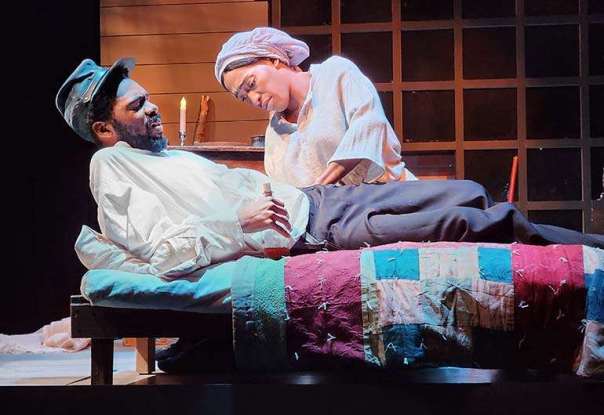
All obeisance to King’s saintly aura is swiftly discarded almost as soon as we see Justin Peoples taking on the role, before he walks through the audience to take a pee. Not only is he unkempt after his oratorical exertions and his walk through the rain, he has largely dropped his dignified public persona, at ease if not quite relaxed. Though he diligently examines his room’s rotary phone to make sure it isn’t bugged, we can hear that he has switched from formal to casual mode as soon as he speaks. It’s with an unmistakably Southern accent!

Immediately disarming. Neither the touring production by the famed Penumbra Theatre of Minneapolis that ran at Booth Playhouse in 2014, nor the homegrown Actor’s Theatre run of 2018 at Queens University, directed by April Jones, had quite the same spontaneous or undignified impact. The smallness of the lobby space at the Queens Road Barn certainly helps in establishing a closer intimacy with King and a sharper look at his vulnerabilities.

Maybe that folksy drawl would have been even more impactful if Peoples had held back on it until MLK had dialed room service after normal closing hours. The arrival of LeShea Stukes as the fetching Camae, a housemaid moonlighting as King’s waitress, would have been a good moment for Peoples to turn on the Southern charm. But for those of us who have seen The Mountaintop before, Stukes brings with her more than Camae’s sensual allure, more than her extra Pall Malls to satisfy King’s chain-smoking, and more than her working-class sass.
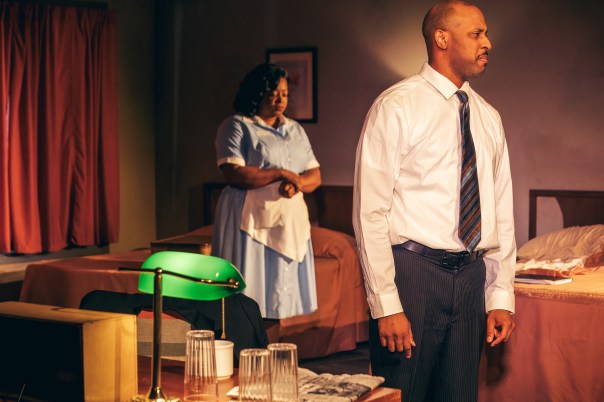
She now gives us solemn glances from behind King’s back, fully aware of the gravity of her true mission before she discloses it, morphing from pursued damsel to admonishing paramour to chum to messenger of God. None of these fresh wrinkles quite accounts for the marvelous voodoo or the juju that Hayes, Peoples, and Stukes have conjured up in creating the playful, poignant, and profound chemistry of this Camae and MLK.

Lighting designer Jennifer O’Kelly gently signals those moments when Camae might be contemplating why she’s there, foreshadowing the AV extravaganza that will accompany Stukes’ final mountaintop revelations. She will almost be speaking in tongues when we reach this visionary summit.
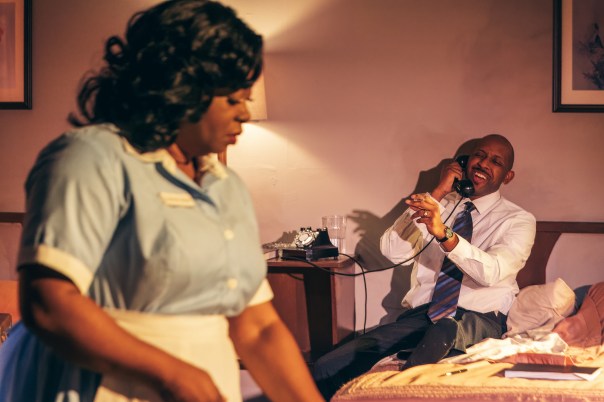
There’s little theology here, for when King dials up the Almighty, pleading his case for more time on this turbulent planet, she hangs up on him. Yet there just may be some deep dialectic in Hall’s scheme that narrows the gap that we might feel between God’s biblical judgment upon Moses at Mount Nebo and the judgment upon Martin in Memphis.

Moses was given a precise catalog of his greatest sins. Maybe in an afterlife he learned not to shatter any holy tablets or assault a boulder without God’s approval. But what was the great sin that deprived MLK of the Promised Land that awaited his people? The answer never comes explicitly in the play, but King’s sins – though relatively petty until we consider possible adultery – are graven in its marrow.

In an age when not a day goes by without yielding fresh images, outrages, and crimes committed by a lying orange buffoon, we might find ourselves shocked to be shoved towards such traditional moral moorings. Some of these values were written long ago in our marrow. Leading a people may still require adhering to a higher standard in God’s job description, not flouting the laws and proprieties that apply to everyone else.

Peoples and Stukes, with plenty of finely judged assistance, have found a way to make The Mountaintop more poignant, relatable, and human. Hall’s work becomes more touching, meaningful, and necessary each time I see it.

The Passion of Mary Cardwell Dawson Brings a Neglected Pioneer Back into the Spotlight

Review: The Passion of Mary Cardwell Dawson at the Parr Center

By Perry Tannenbaum

  February 15, 2024, Charlotte, NC – Commissioned by the Glimmerglass Festival and premiered there during the summer of 2021, The Passion of Mary Cardwell Dawson is a fascinating, informative, and inspiring hybrid. Part documentary, partly a new play by Sandra Seton with operatic arias composed by Carlos Simon, and partly an eye-opening “Building the Stage” exhibition, the new co-production by Opera Carolina and The Denyce Graves Foundation have found a perfect landing spot at the posh Parr Center on the CPCC campus.

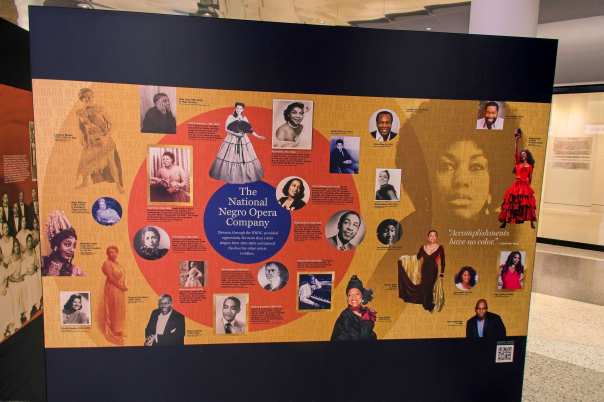
With numerous glitterati on hand from Charlotte’s African American community to celebrate opening night, Dawson, and Black History Month, the Parr Center lobby dazzled as never before. Just 15 minutes before the curtain was scheduled to rise, I encountered a roomful of beautiful people and formalwear; imposing billboard-sized exhibits of museum quality devoted to Dawson, the National Negro Opera Company she founded, and the luminaries of opera – and jazz – that she tutored; accessorized with video stretching from one entrance to the New Theater to the other. All the bells, whistles, and glamor you could want, with a live bass and alto sax duo playing Charlie Parker bebop in the background.

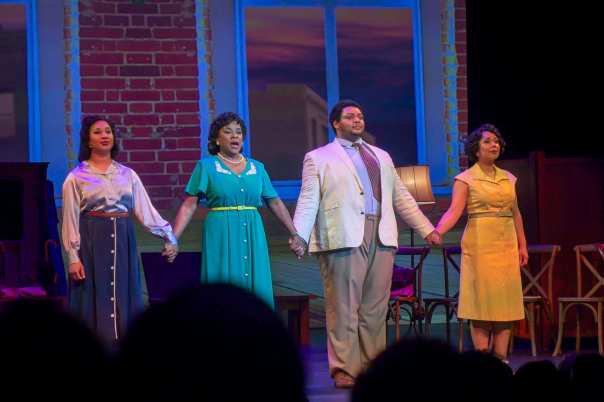
The production was certainly equal to the new hall. Accompanied solely at this point of its development by pianist Gregory Thompson, The Passion would seem smallish at Belk Theater with its cast of four and an orchestra of one. Unfortunately, the Seaton-Simon creation also struck me as too small for Dawson, its subject, and too small for Graves, its star. With a sympathetic director like Kimille Howard already on board, and Op Carolina’s set designer demonstrating fresh possibilities with his wonderful projections on the upstage wall, the avenues are certainly opened for a fuller exploration of Dawson’s talents and achievements.

Seaton places all of the action in Pittsburgh, mostly at the headquarters of Dawson’s company on Apple Street, in a studio upstairs from her husband Walter’s electric company. Her compressed timeline results in a format that wavers between masterclass and a professional rehearsal. On one side of the stage, Thompson presides at a Steinway, and at the other, we see three humble chairs that might be occupied by students in a Dawson masterclass. If the libretto were allowed to breathe a little, the curtain would rise on the three students we will see, either seated and ready to perform or engaged in conversation, giving Simon – composer-in-residence at the Kennedy Center in DC – a chance to begin penning some recitative, and giving Graves a grander entrance.

Alas, this is a rehearsal of Bizet’s Carmen on the day that the Negro Opera Company’s production is set to premiere on a floating outdoor stage by the shore of one of Pitt’s famed three rivers. This setup gets more improbable as the story unfolds, undercutting Dawson’s wisdom as a performing artist, an opera director, and a business person. Would an operatic director allow her performers to risk overtaxing their voices by rehearsing on the day they perform? Wouldn’t the entire cast be summoned to a last-minute rehearsal? Wouldn’t it be in full dress? Wouldn’t standard rep like Carmen be so far under the belts of professional-grade singers that their director wouldn’t feel compelled to instruct them on how to present Bizet’s music or penetrate to his protagonists’ cores?

By heightening her drama on the day of the opening, Seaton actually manages to be more unflattering to the Dawsons. A rainstorm is raging across Pittsburgh, threatening the cancellation of tonight’s outdoor performance and the ruination of Dawson’s company. Administrators at Spoleto Festival USA and ticketholders from around the globe would laugh out loud at the notion that a scheduled outdoor production would bring in national and international stars to Charleston without making contingency plans for bad weather beforehand. Not sound judgment for Dawson or her husband, who handled her company’s business end.

Of course, Seaton’s scheme makes it easier for The Passion to have legs, because the roles of Dawson’s singers – Isabelle as Micaela, Phoebe as Carmen, and Frank as Don José – only need to be versed in their presumably familiar Bizet music rather than having to learn anything written by Simon. Even so, Diana Thompson-Brewer as Isabella, Ladejia Tenille as Phoebe, and Johnnie Felder as Frank, are all forced to look and sound slightly amateurish at times during their lamentably brief moments in the spotlight. Howard helps them all out from her director’s chair, occasionally obliging Graves to be a bit fussier – and a lot more prudish – than Seaton may have imagined Dawson when she wrote the script.

I was most impressed by Felder in the tenor role, and wondered how much his superiority might have figured in Seaton’s concept or Howard’s casting. Most of Graves’ vocal coaching, after all, is reserved for the younger women onstage and the music she has excelled in all the way the Metropolitan Opera, Covent Garden, and the Vienna Staatsoper, to name a few – so it would be a pity not to hear Graves in this repertoire while we have her here and not perceive her superiority to Dawson’s protégées. The diva and the drama deserve that. Simon’s music, scant as it is, is also worthy of Graves. Those two arias, when Dawson is alone with her thoughts and later when her class/rehearsal is done, both have the qualities of the best arias sung at Spoleto’s production of Barber’s Vanessa last spring.

A fuller version of The Passion of Mary Cardwell Dawson would be a full-length opera with a fuller view of Dawson as a singer, teacher, and impresaria. Ideally, it would take us back to the North Carolina native’s childhood and the foundations of her love for music and opera, but we should at least cover the arc of Dawson’s founding of her company, a more substantial exploration of her teaching methods and philosophy, and a nicely drawn arc of her prize students’ development into professional opera singers that do full credit to Dawson and her pioneering company in their Carmen. A full opera company at the end – with a fuller orchestra – would bring the entire enterprise up to scale. Make no mistake, though, this handsome Opera Carolina production is an exciting coup for Charlotte and a compelling argument for Denyce Graves’ project to reach its fullest fruition.

The More Things Change, the More Confederates Shocks and Delights

Review: Confederates at The Arts Factory

By Perry Tannenbaum

Symmetry, parallelism, continuity, and evolution are intricately interwoven throughout Confederates, Dominique Morriseau’s comical and sometimes farcical drama of 2022. The Charlotte premiere, now at the Arts Factory, comes to us less than two years after its Off-Broadway premiere in a highly polished, smartly aware Three Bone Theatre production.

Morriseau’s symmetry isn’t subtle: it hits us straight in the eyes the first time we see Zachary Tarlton’s scenic design. Split down the middle, the Arts Factory stage gives two eras and two institutions equal play in an intimate black box format. One side evokes Civil War slavery on a Southern plantation, while the other half introduces us to contemporary academia.

We alternate between settings, starting with Sandra, a modern tenured Black professor, proclaiming her outrage and sense of violation in vivid terms – yet with the poise and sleekness of a contemporary college lecture accessorized with slides. From that peep into scandal in present-day academia, we flash back to the slave quarters of Sara as her brother Abner sneaks into her bedroom through a concealed trap door.

Sandra has been maliciously targeted by a student or teacher who pasted a demeaning old Civil War photo of a bare-breasted black wetnurse suckling a white baby – with Sandra’s face photoshopped to replace the original slave’s. Jumping to conclusions or instinctively making connections, we’re apt to immediately believe that Sara was that nurse. Abner has volunteered for the Union Army and has been wounded in battle, so as she sews up Abner’s wound, the subject of Sara’s nursing skills is inevitably addressed.

Sara’s skills and ambitions extend further. Dangerously. She has already learned how to read, breaking one terrible white taboo, and she wishes to nurse and fight for the Union alongside her brother – to learn how to fire a rifle right now. That’s a pill Abner can’t easily swallow.

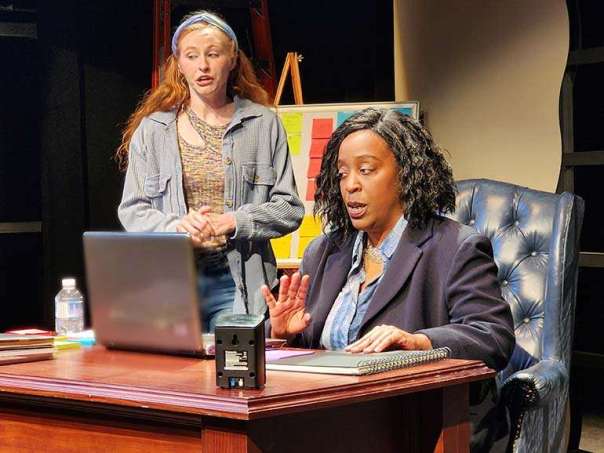
Otherwise, the two women have separate storylines until Morisseau split-screens them together at the end. Portraying Abner in his Three Bone debut, Daylen Jones is the first subordinate character to cross the invisible line between pre-Emancipation Dixie and the hope and refuge of modern-day academia. Shedding his rags and his Union blue greatcoat, Abner becomes the aggrieved Malik in today’s world. He’s obviously a gifted student, and his gripe with Professor Sandra is that she grades his papers more harshly because he’s Black, protecting her immunity from being charged with favoritism.

Seeing that there are only Black females on faculty – and no men – Malik feels doubly oppressed by bias in academe: racial bias compounded by gender bias. Notwithstanding her starchy professional manner, Sandra is more of a crusading sociologist than a sober judge. So she may indeed have fallen prey to the trope heaped upon oppressed races and genders that says, “If you wish to be treated as an equal, you need to be better.” Pragmatic? Sure. But for a gifted scholarship student seeking to maintain his A average, cold comfort.

We eventually see that there are four characters on each side of the time divide, three of whom repeatedly change costumes to play double roles. Before and after we can tally all this, director DonnaMarie and sound designer Tiffany Eck place two snippets from Nina Simone’s “Four Women” at strategic spots in their playlist, layering on extra meaning – and mythic aura – during scene changes.

If Jones can be labeled as two provocatively different militants as he roams back-and-forth from opposite sides of the stage, then Holli Armstrong (also on my radar for the first time) can be regarded as two variants of an imperfectly enlightened white racist. She is most exaggerated and hilarious on the Southern plantation as Missy Sue, the master’s daughter, when she comes back home as an undercover born-again Abolitionist. It is Morisseau as much as DonnaMarie who is prompting Armstrong to bring a Gone With the Wind air-headedness to Missy Sue – and a twisted lesbian desire for Sara – and she obliges with fiddle-dee-dee gusto.

She offers Sara a perk in exchange for executing a dangerous mission: if Sara will transcribe and transmit Master’s battleplans, she gets to live in the big house while Sue delivers Dad’s secret intelligence across enemy lines. Sure, that’s an appreciable upgrade for Sara, but she’ll still be a slave doing Missy Sue’s dirty work.

Armstrong discards Missy Sue’s pea-brained giddiness when she transitions to Candice, retaining her sycophant tendencies and much of her high energy as she haunts Professor Sandra’s office, working off her tuition debt and gathering gossip. Her true manipulativeness gradually emerges in successive office scenes, but Candice never becomes as juicy a role as Missy Sue is, for she somewhat downplays her suck-up moments with faculty.

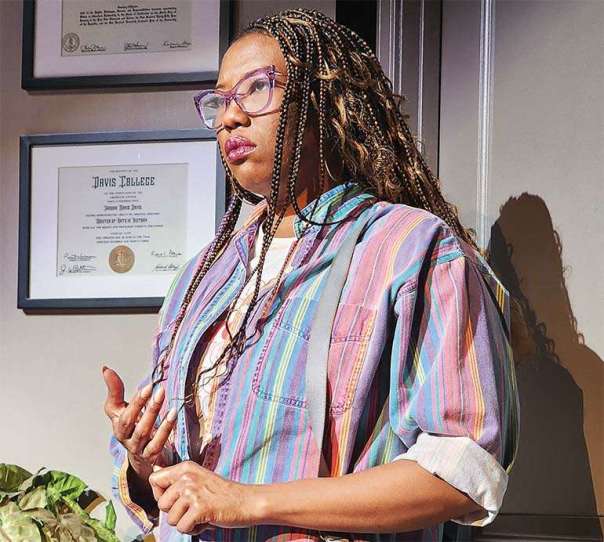
Last to appear onstage, Jess Johnson draws the most balanced – and delicious – of the dual-role combos. As the master’s Black mistress, the opportunistic Luanne effortlessly sniffs out that Sara’s access to the master’s office and desk are coming at a price the newcomer must pay, possibly beyond accepting Missy Sue’s sexual advances. On the academic side, Johnson gets the most radical of costume designer Chelsea Retalic’s backstage makeovers when she becomes Jade. Professor Jade is more stylish and popular than Sandra because she’s chummier with her students and would never dream of hamstringing the Black ones.

At both ends of the stage, Johnson gets to be a wily master of psychological warfare. Both Luanne and Jade want something vital from our protagonists. Luanne wants friendship from Sara and a path to freedom, but if Sara bars the way, she can work her charms on Abner. Needing Sandra’s endorsement, Jade doesn’t tiptoe around her differences with her superior, unleashing a torrent of scorn and chutzpah that took my breath away.

Indeed, Johnson unlocks Morisseau’s grimmest joke on her protagonists. Whether you’re at the bottom of the pecking order or at the top, you’re still the most oppressed person in the room. Times have changed, but not that much.

Sara is always being pulled at from multiple directions. Abner needs to be sewn back together, Missy Sue wants to recruit her as a spy, and Luanne wants her to plot an escape to freedom. Maybe that’s why the playwright stretched out Sara’s name to Sandra for the New Millennium! Our Professor is no less pressed upon, strongly urged to re-examine her grading philosophy, softly reassured that she is more admired than she really is, and arrogantly lobbied for tenure backing. Nobody seems to really care about the bare-breasted insult that was slapped on her office door.

Neither of these roles is fun-filled, but the challenges Sara and Sandra face allow them to grow in strength and stature before our eyes. Valerie Thames and Nonye Obichere are so fiery and authoritative in their separate roles that you can comfortably watch Confederates as two separate plays without constantly considering how meanings and brilliance bounce off the facets of the two gems. Not feeling compelled to track the finer points of Morisseau’s disquisition on racial or gender bias makes it all the easier for an audience to enjoy them.

Thames effortlessly takes on the self-assurance of an established TV guest whose knowledge and viewpoint are proven commodities, wearing Professor Sandra’s celebrity status with insouciant dignity. Just watch out when she bursts into flames! Maybe run for cover.

Although Sandra’s speeches frame the drama, Obichere gets to be a more physical presence as Sara – as nurse, spy, soldier, and lover – and she navigates a far wider character arc. Hers isn’t the funniest performance you’ll find this weekend at The Arts Factory. But it’s the most vivid, shocking, and memorable.

You may leave the theater convinced that both Sara and Sandra are depicted in that horribly racist slide. But it will mean more at the end than at the beginning. The magic of Morisseau and Photoshop are both at work.

Ensley and Schroeder Check All the Beautiful Boxes in Matthews

Review: Beautiful The Carol King Musical at Matthews Playhouse

By Perry Tannenbaum

When you think of singer/songwriter Carole King and Broadway musicals, there’s an instant disconnect: the humble simplicity of King’s Tapestry album cover clashing with the glitz and blare of the Great White Way. So a Broadway musical about King’s career is more of a stylistic stretch than a biomusical about most rock stars, pop stars, or jazz & blues divas. Everyone involved behind the scenes of the original 2014 production of Beautiful The Carol King Musical seemed keenly aware of the dichotomy, including director Marc Bruni, orchestrator/arranger Steve Sidwell, and scriptwriter Douglas McGrath.

Their idea of coping with the problem was by leaning into it. Not too subtly, they conspired to make the early stages of King’s career seem crass and commercial, as if she were trapped in the dog-eat-dog maw of the pop music industry. King and her writing partner, lyricist Gerry Goffin, write the songs while producer Don Kirshner finds the singers and the groups who will cut the singles – the likes of Bobby Vee, Little Eva, The Drifters, and The Shirelles. Yet somehow the hierarchy is flipped in the famed Brill Building in NYC.

Carole and Gerry are slaving for Kirshner, a genial industry mogul and taskmaster, and the couple’s best early music loses a lot of its luster when it’s farmed out, especially when “Up on the Roof” falls into the hands of The Drifters and “Will You Still Love Me Tomorrow?” is butchered by The Shirelles, thanks to excessively ornate Sidwell arrangements that would be more at home on Broadway or Vegas than Motown. These excesses helped Jessie Mueller to shine all the more brightly in the original cast – and for her sister, Abby Mueller, to shine equally when the touring version hit the QC in April 2016.

So a downsized production, like the one currently running at Matthews Playhouse, actually has the potential to be better than the Broadway and touring versions – with the right personnel and sufficient pizzazz. With Billy Ensley directing and Lindsey Schroeder leading a heavyweight cast, both those boxes are checked. The Broadway ensemble sheds two of its three keyboards nestling into Matthews, one its two guitars, and one of its percussionists. The slimming helps. No longer smothered by their orchestrations, Neil Sedaka’s “Oh! Carol,” Gene Vincent’s “Be Bop a Lula,” and Little Eva’s “Loco-Motion” sound more like rock music and less like mockeries.

Ensley targets the megahit by the King-Goffin duo’s friendly rivals, Barry Mann and Cynthia Weil, for his most farcical treatment. Not only is the arrangement of “You’ve Lost That Lovin’ Feelin’” garishly distorted, amped up from the swampy-echoey-churchy vibe of the original single, but the gulf between the bass and tenor voices of the Righteous Brothers is greatly emphasized, exaggerated, and comically exploited by Johnny Hohenstein and Zach Linick.

McGrath’s book is most affecting when it deals directly with King, though there’s bold poetic license in his voodoo, historically speaking. Pressured by Kirshner to come up with a new hit overnight for The Shirelles (in real life, they only had one hit record so far), King writes the music and goes to bed with Goffin. Perfect setup. Wouldn’t you like to wake up in the morning and find the handwritten lyrics for “Will You Still Love Me Tomorrow” perched on your piano – and be the first person on Earth to read and sing them?

No disrespect to the great Bobby Vee, but we’ve suddenly ascended more than a few notches above “Take Good Care of My Baby.” This moment still grabs me, but there are more moments like this after intermission, when “You’ve Got a Friend” and “A Natural Woman” are unveiled, that choke me up even more – as King breaks away from the Brill Building and starts to do her own thing. Schroeder replicates the sandy sound of Carole’s voice from the beginning, but as she transforms from a demo singer behind an upright piano to a chart-topping performer, watch out.

Schroeder can not only belt – she can tear your heart out.

McGrath’s dramatization heightens the magic most memorably when “You’ve Got a Friend” is reframed as a not-quite-farewell song, when King embarks for her solo career in LA with Kirshner’s blessing, and both Barry and Cynthia gather round the old upright with her to sing this newborn masterpiece. The song didn’t really come out until her second album, but who’s counting, right?

Nick Southwick as Barry and Sophie Lanser as Cynthia (get that woman a more reliable mic!) deliver polished performances all evening long, but they also grow more gravitas after intermission. Lanser sheds the frivolity of a “Happy Days Are Here Again” parody and “He’s Sure the Boy I Love” and joins Southwick – previously mired in the silliness of “Who Put the Bomp” and the wrong-key version of “You’ve Lost That Lovin’ Feelin’ – in a heartfelt “Walking in the Rain” duet.

Then if you haven’t started weeping with Schroeder’s “It’s Too Late,” you’re at the mercy of “You’ve Got a Friend” when Lanser and Southwick join in on the quivering-lip goodbyes. After playing Kirshner with avuncular savvy throughout King’s formative years, Ryan Dunn sprinkles some welcome laughter into this maudlin scene with a (purposely) bad attempt at vocalizing.

I’d forgotten that Carole had Aretha’s 1967 hit in her hip pocket when she cut Tapestry out on the Left Coast in 1971, so I found myself suddenly suppressing sobs when “A Natural Woman” began. Here it felt very right that Sidwell’s arrangement brought added vocalists and brass to beef up the simplicity of King’s version – and freed Schroeder to narrow the gap between Carole and the Queen of Soul with some fervent belting.

Marty Wolff’s simple two-story set design, with four wide strips of stained-glass paneling running vertically upstage in front of the eight-piece band led by Ellen Robison from the keyboard, needs only JP Woodey’s lighting to give it a rockin’ modernistic zing. Lisa Blanton’s choreography is devout doo-wop, most praiseworthy for how well the groups stay in sync, and Chelsea Retalic likely cranked out between 75 and 100 costumes for this large cast – all of them, from the sleekest to the grungiest, on point.

And the wigs! The only misfire here, among dozens of triumphant coifs – several for Schroeder – was the oceanic profusion of waves that perched on Joe McCourt’s head as Gerry Goffin, making him virtually unrecognizable. McCourt, a musical mainstay in the QC since his debut in 2008 as the lead in Godspell, has suavity to spare to spare and, in contrast with Southwick’s quirky neuroses as Barry, gets a nice and bumpy character curve as the only troubled soul we see.

This image has an empty alt attribute; its file name is beautiful24-139.jpg

As for the Afro-American doo-woppers… my, oh my! By bringing Nehemiah Lawson aboard to take over “Some Kind of Wonderful” from Schroeder and McCourt and then to bring him back again and again to sing “Up on the Roof” and “On Broadway,” the latter one of Weil & Mann’s best, Ensley and Robison signal that they have no plans of dissing The Drifters. Meanwhile, two lead singers are embedded among Ensley’s Shirelles. As Janelle Woods, the Shirelle who denigrates “Will You Still Love Me” as “too country” before fronting the breakthrough single (first Billboard #1 for an African-American girls’ group), Brianna Mayo gets a chance to show that her acting chops are as strong as her singing skills.

Shortly afterwards, Raven Monroe emerges from the backup Shirelles to become Little Eva and ignite “The Loco-Motion.” Until then, she moonlights as King’s babysitter during the leading lady’s brief marriage to the restless Goffin.

There’s a formulaic circle to McGrath’s storytelling that’s not at all displeasing, starting and ending with King as a star behind a grand piano singing a song from Tapestry. We flash back to her youth in Brooklyn and eventually touch down at Carnegie Hall, surely a kind of Jerusalem for a humble Jewish girl. Alongside her at the beginning and at the end is Carol Weiner as Genie Klein, King’s mother. Both were abandoned by her no-good father, steeled by adversity. Along the way to Carnegie, Weiner peeps in with a couple of overprotective warnings, a few salty quips, and a proud Mama’s lie.

If McGrath can embellish a good story, why shouldn’t she