Review: Company at Belk Theater
By Perry Tannenbaum

Fifty years can begin to date and dismantle the most meticulously crafted Broadway musical, let alone one originally stitched together from five unrelated sketches by George Furth in 1970. The gilded thread that made COMPANY shine – enough for Furth to win the 1971 Tony Award – was to be found in Stephen Sondheim’s gorgeous music, wedded to his preternaturally insightful lyrics.
Over and over, the cavalcade of wondrous Sondheim’s songs to be found in the opening act alone – including “Sorry-Grateful,” “You Could Drive a Person Crazy,” “Have I Got a Gal for You,” “Another Hundred People,” and “Getting Married Today,” – have been covered by three generations of the best singers in the business. As for the end of Act 2, the one-two punch of “The Ladies Who Lunch” and “Being Alive,” two sharply contrasted gems, is arguably the best eleventh-hour combo ever seen on a Broadway stage. Affirmation upstages disillusionment – if it can. No extravagant staging required.
But the book of COMPANY has been a perennial liability. On the one hand, it circles modernistically around a single point in time, Bobby’s 35th birthday, and becomes a study of marriage as he seeks to determine whether he wishes to take the plunge or if he’s ready for it. Trouble is, Furth’s story is superficial. Sitcom deep. We get to the end of Bobby’s spiritual journey without any time having elapsed, without any scene impacting profoundly, and without being sure any scene ever really happened outside of Bobby’s head, dreaming or drunk.
Maybe the best way to treat this problem was the 2006 revival starring Raúl Esparza, which nearly dropped the pretenses of scenery and ordinary storytelling completely as the entire cast played multiple instruments throughout the evening. That production of COMPANY, directed by John Doyle, was more about the performers and the music. Yet the communal togetherness of Bobby’s circle and their marital intimacies were somehow deeply enhanced by their playing as well as singing together.
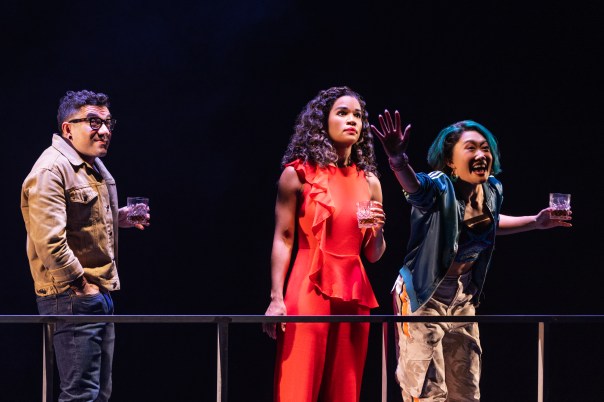
Directing the newest Broadway revival, now on tour at Belk Theater, Marianne Elliott took a bold new tack: diversifying Bobby’s circle, switching genders, and even remaking one of the couples as gay. Bobbie, nee Robert/Bobby, is now emphatically female, portrayed by Britney Coleman – a peripheral cast member in the Broadway production who also understudied Katrina Lenk in the lead role. Opposite the legendary Patti LuPone.
It all plays rather well, though the superficiality of Furth’s book is probably enhanced rather than diminished. The couples that entertain Bobbie are three notches zanier now in Elliott’s hands, so her friends are no longer drole or slightly poignant. They’re more energetic and eccentric. While Bobbie is wondering whether to plunge into the kinds of couplings her friends are modeling, you might be wondering why Bobbie doesn’t shed the whole bunch. Then ditch the boyfriends. None of the three “Have I Got a Guy for You” admirers stands out as a shining knight who might joyously sweep her away.
Coleman’s role, thin enough for a hero to start with, seems to retain her as an observer, but with the zaniness and eccentricity around her amplified, she also comes off as a bit of a level-headed intruder. Less connected to her more diverse circle. Observing the shenanigans, I guiltily felt more distanced as well. Elliott’s update can be a little off-putting.

Most awkward for Coleman are the two scenes that should be the climaxes in her drama. The showstopping “Marry Me a Little” was added by Sondheim at the end of Act 1 to help us see an arc in Furth’s story, as Bobby sang to a woman who had chickened out of marriage on her wedding day – a partial proposal offered as consolation to the would-be bride that becomes a little epiphany for our hero. Coleman belts it now to a balking gay man, a proposal that can’t even be taken as partial.
The situation is even worse when Bobbie confronts Joanne, in the climactic “Ladies Who Lunch” scene. There was some suspense for me on opening night as that scene approached. How would Elliott restage Joanne’s offer? Sadly, the original had more sting.
So what Elliott does best is freshening the 53-year-old musical, making this Sondheim masterwork seem more like a portrait of life today in New York. In a jolly fashion, Bunny Christie’s scenic design literally belittles the Big Apple’s pretensions, cramping Bobbie into a living room so small that there’s barely enough room for her to squeeze around the wee dinner table. Crouched down with their assorted gifts, waiting to spring their surprise birthday greetings as Bobbie enters, the cheery circle of friends is like a molten mass with barely enough room to breathe.
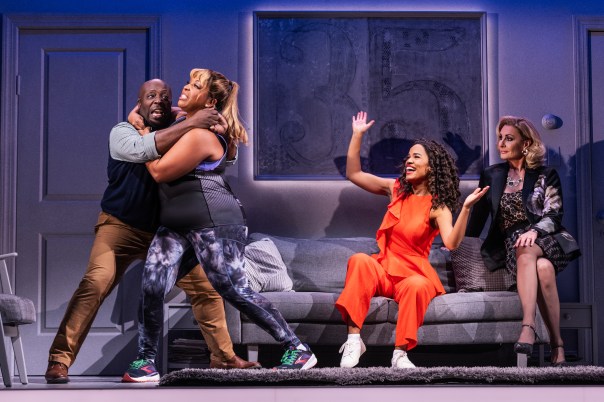
Other apartments we see are similarly drab and confined. On the first of Bobbie’s excursions, she visits Kathryn Allison as Sarah, on a strict regimen of exercise and dieting, and James Earl Jones II as her husband Harry, nervously on the wagon. As the couple’s verbal jabs at their mate’s failures at abstinence hit home, escalating into physical martial arts combat, the mid-lifers have nowhere to safely collapse when they’re exhausted other than their couch – on top of their hapless guest.
The scene is a fertile launching pad for “The Little Things You Do Together,” triggered by Judy McLane as Joanne before other couples incongruously intrude – from multiple doors, including Bobby’s little apartment, attached to her hosts’ like adjoining hotel rooms. Of course, Jones II has a marvelous voice as he triggers “Sorry-Grateful,” incongruously joined by two other husbands as the scene fade-dissolves, but his range is higher and his timbre mellower that you might expect. Allison is a very zestful and complementary comedienne onstage, likely unapologetically anti-diet in the real world.
Despite the somewhat clunky aftermath – and Coleman’s inability to be on hand anymore as the couple’s best man – Matt Rodin as Jamie (nee Amy) and Ali Louis Bourzgui as Paul, still on the precipice of marriage, are the most charming and hilarious of all the couples. It doesn’t hurt that Christie’s scenic design reaches one of its zeniths with the couple’s cheery kitchen. Christie’s most radiant Act 1 costume design is reserved for Emma Stratton as The Priest, making her most surreal entrances into “Getting Married Today” through the French doors of the fridge.

A faulty electrical cord sabotaged opening night at Belk Theater, pausing the action twice before intermission so that circuits could be checked and restored. Blumenthal Performing Arts prez Tom Gabbard not only apologized to the crowd but staged an impromptu Q&A with two of the stars, McLane and Tyler Hardwick, who played PJ, the grungiest of Bobby’s frustrated admirers. Soon to excel in “Another Hundred People,” Hardwick charmingly refused to disclose his favorite moment in the show.
Thankfully, everything was shipshape for Act 2. This Charlotte audience stayed with it.
McLane acknowledged that she was following in the footsteps of megastars as Joanne, including the likes of Elaine Stritch, Lynn Redgrave, and LuPone. She wasn’t at all self-effacing as she answered, and she grandly met the challenge of her biggest moment, delivering “The Ladies Who Lunch” with a lounging crescendo of decadence. Draped in another smashing, glittering getup from Christie, McLane personified New York vogue in all its Fifth Avenue complacency. That in turn laid down the gauntlet to Coleman, who belted “Being Alive” out of the park.
Then, on her fourth or fifth attempt, she finally blew out Bobbie’s birthday candles.


 Art on My Sleeve