Monthly Archives: October 2023

Goodbye Tokenism, Charlotte Symphony Is Embracing True Diversity – NOW

By Perry Tannenbaum

October 20, 2023, Charlotte, NC – Face it: in the wake of #MeToo, #BlackLivesMatter, and COVID-19, we’ve entered a complex cultural transition. Charlotte Symphony, never the most daring nor the most timid of orchestras in their programming, serves as a useful barometer. Their current program, with works by Emilie Mayer and William Grant Still, is even more impressively diverse – judging strictly by the playing times of these pieces – than their season opener, spotlighting the music of Valerie Coleman and The Butterfly Lovers Violin Concerto by two modern Chinese composers, Chen Gang and He Zhanhao.

But in 2023, these are not yet household names, or even widely known among Symphony subscribers. Accordingly, the season opening concert was titled “Beethoven’s Eroica Symphony No. 3” and the current offering is billed as “Chopin’s Piano Concerto No. 2,” pragmatically restoring balance and marketability. We haven’t reached the Promised Land in claiming our full musical heritage, but we’re definitely beginning to cross the Jordan.

As recently as 12 years ago, when I purchased The Gramophone Classical Music Guide for the last time, there was no mention of Mayer (1812-1883) in that doorstop nor in the Penguin Guide, The Oxford Dictionary of Music, or The NPR Listener’s Encyclopedia of Classical Music – all upstanding residents on my bookshelves. Indeed, the earliest recording of Mayer’s work that can found on Spotify, Apple, or Amazon was released in 2000, and the earliest that can be streamed came out in 2010, seven years before the first recording completely devoted to her compositions – pretty remarkable for a 19th century German composer who wrote eight symphonies, six of which have now been recorded. We had a nice taste of Mayer’s handiwork in her Faust Overture with resident conductor Christopher James Lees on the Knight Theater podium.
Recorded twice in the past two years and topmost among suggestions when I type the composer’s name in a Google search, the work has unmistakable gravitas, build, and power, welling up in the strings and releasing from its somber Adagio opening with a tattoo from the timpani that shifts us more lightheartedly into an Allegro colored by the wind section and easing into waltz tempo. Of the two name-brand pieces lurking in the program, Chopin’s Concerto and Antonín Dvořák’s The Noonday Witch, the Faust pairs best with Dvořák and his storytelling. Mayer’s work became more volatile and episodic past the halfway mark, a palpable struggle between good and evil as sturm and drang sections alternated with milder retorts from the winds, which gradually more assertive, with more sinew, before the antagonists merged majestically in the climax. Lees’ tempos and dynamics could have been more restless and spasmodic, but none of the walloping power was lost.

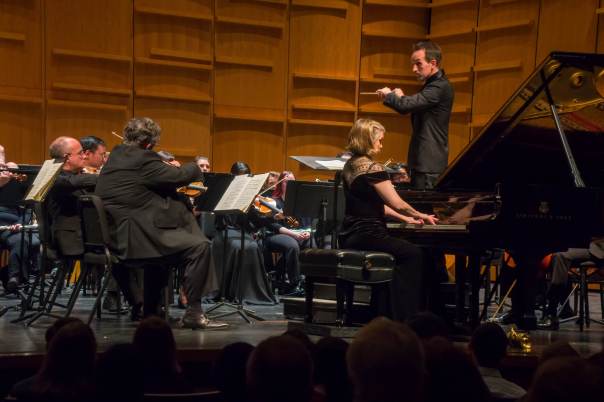
My last sightings of pianist Orli Shaham were at Spirit Square in 2002 at the Brightstar Music Festival, so I had no live experience of her full voltage beyond her exploits in a Brahms Piano Quintet, a Prokofiev flute sonata, and a Poulenc trio. Any doubts that Shaham and Symphony had the muscle and finesse needed for an optimum Chopin 2 vanished by the time the pianist finished her first kaleidoscopic turn in the opening Maestoso, after a spirited orchestral intro. Shaham’s delicacy, already convincingly established in this epic opening, became even more ethereal – and personal – in the sublime larghetto that followed. Neither Shaham nor Symphony was as captivating as the winsome 1999 recording by Christian Zacharias, where both the pianist and the Lausanne Chamber Orchestra honed in on the lilt of the waltzing rhythms that are so emblematic in Chopin’s work. But there are plenty of other flavors to Chopin, as the many master recordings of this concerto readily attest, and Shaham merely chose a different journey, rousing enough to trigger an ovation that demanded an encore.

When Lees picked up a microphone after intermission, it was to summarize the story of Polednice, the Czech poem by Karel Jaromír Erben, for the maestro maintained that Dvořák’s The Noonday Witch – one of four tone poems set to Erben’s ballads – followed the story bar-by-bar. Whether or not Lees’ claim can be verified, the piece offered Erica Cice, in her first outing as Symphony’s acting principal oboist, a swift opportunity to shine just 13 days after her predecessor, Hollis Ulaky, made her farewell appearance in the Eroica.

Here the oboe represented the misbehaving boy who was threatened with a visit from the fearsome by his frustrated mom in repeated attempts to quiet him – until she loses it and issues her fatal summons. Enter Allen Rosenfeld with his bass clarinet as the wicked visitor, who surprises and alarms both mother and son with her arrival. Much orchestral tumult ensues as the witch implacably chases her prey – until the tubular bells chime 12 times and the witch disappears at noon. Ah, but the story isn’t quite finished, with more orchestral turbulence on the horizon.

With a brief paragraph in the Oxford Dictionary and a more respectful entry in the NPR Encyclopedia, we can’t tout Still (1895-1978) as newly-discovered. As Lees hinted in his intro, however, the “Dean of African-American Composers” has been unconscionably neglected. The appearance of work in the clean-up spot on Symphony’s program, mighty orchestral works by brand-name Europeans usually dwell, may be unprecedented. With all of Symphony’s artistry and enthusiasm behind it, Still’s “Afro-American” Symphony No. 1 proved worthy of its esteemed position on the bill, even after Shaham dazzled us. In the bluesy opening movement of this 1930 work, “Longing,” you may actually catch a violinist or two smiling as she plays. You might have the same reaction. The middle movements, “Sorrow” and “Humor” retain a residue of ethnic flavoring, but here it’s less a part of the mix with traditional orchestral writing all-American strike-up-the-band jubilation. The sheer majesty of the closing “Aspiration” movement took me by surprise, for I’d never heard it before in live performance. America is very much carved into this closing, encompassing the swagger of our cities, the grandeur of our mountains, the serenity of our prairies, and maybe a few echoes of Native Americans we took it all from.

Second-Hand “Funny Girl” Still Delights

Review: Funny Girl at Belk Theater

By Perry Tannenbaum

For nearly 60 years, Funny Girl has been a Broadway musical in desperate need of fixing. With songs by Jule Styne and Bob Merrill like “People” and “Don’t Rain on My Parade,” there was enough musical merit for the show to stay afloat for a little while. Isobel Lennart’s book was the lead weight that threatened to capsize the 1964 score. Attempting to tell two stories, Fanny Brice’s rise to showbiz fame and her doomed romance with Nick Arnstein, Lennart botched them both.

Luckily, director Garson Kanin and production supervisor Jerome Robbins found an already-blossoming Barbra Streisand for their lead. All the show’s problems were magically solved: with Streisand’s talent and charisma, the weakly-scripted musical now had strong legs. Strong enough for there to be a Hollywood version four years later, where Lennart could sharpen her storytelling, drop some of the original Styne songs, call for a couple of new ones – including a title tune – and commandeer a couple of songs that Fanny Brice actually sang.

What a concept! Can you imagine a bio-musical written nowadays that wouldn’t package the hits that made Frankie Valli, The Temptations, Janis Joplin, Elvis, Carole King, The Supremes, or Michael Jackson famous?

So the 2022 Broadway revival of Funny Girl, now touring at Belk Theater, was really, really retro. Not only did it drop the two signature Brice songs added to the movie adaptation, “My Man” and “I’d Rather Be Blue Over You,” it also continued to shun Brice’s beloved “Second-Hand Rose,” a vaudeville hit that Streisand herself had been performing for over 50 years.

Now the eminent Harvey Fierstein was summoned to serve as a script doctor, but not to huge effect. There’s a new frame to the storyline that makes bookends of “Who Are You Now?” the song that only came late in Act 2 when Funny Girl premiered – and vanished from the 1968 film, replaced by the more affecting “My Man.”

So after all these decades when the most obvious void in Funny Girl could have been amply patched up and fixed, the show is now a curious relic, an updated replay of the vehicle that catapulted Streisand to superstardom rather than anything like an authentic homage to the fellow Brooklynite who rose to national fame and celebrity a generation earlier.

Was the goal in 2022 for Beanie Feldstein and, subsequently, Lea Michele to portray Fanny Brice? Or was the assignment to embody a youthful Barbra Streisand? Judging by the electrifying opening night performance by Katerina, I’d say director Michael Mayer’s compass is primarily pointed at Barbs, not Brice.

Even if the book still strays from the biography, we find that Brice, vaudeville, and the Ziegfeld Follies still dominate the ambiance. David Zinn’s set design, reminiscent of the old-timey Gentleman’s Guide to Murder, frames the action in an extra RKO proscenium, and Susan Hilferty’s costume designs remain devoutly old-school, whether she’s dressing Ziegfeld’s elegant chorines or she’s slumming with the kibitzers who schmooze and play poker in front of their Brooklyn tenements.

While McCrimmon belts every tune her larynx touches out of the park – and knows enough from Jewish to give her Fanny a slightly yiddishe ta’am – she doesn’t arrive with the name recognition of her Broadway counterparts. So the tour not only comes to us equipped with McCrimmon’s considerable verve and talent, we’re also favored with the presence of Melissa Manchester as Fanny’s mom, Rose Brice, a role that was juicy enough for Kay Medford to earn Tony Award and Oscar nominations back in the ‘60s.

Manchester’s poise, dignity, and zest help speed the early scenes off the runway even though we’re often grounded in Brooklyn – and the flight of “Who Taught Her Everything She Knows?” with tapdancing Eddie Ryan, formerly in Act 1, is now delayed until Act 2. Adorned with the tap choreography of Spoleto Festival favorite Ayodele Casel, Izaiah Montaque Harris as Eddie is a ray of sunshine every time the spotlight shines on him.

The other men are all top-notch. First heard as a disembodied voice of God at Fanny’s big audition, Walter Coppage’s awesome authority as Florenz Ziegfeld gradually melts upon further acquaintance to a stern, supportive, empathetic, and avuncular confidante. He remains a formidable and pragmatic Ziegfeld, one who will not partner with Arnstein in his latest get-rich scheme.

Stephen Mark Lucas has that Sky Masterson swagger about him as Nick, wicked enough to gamble and swindle for his livelihood but principled enough never to sponge off Fanny – until he does. Lucas doesn’t dance with the same robust confidence he sings with, but he executes a comical levitating move in his seduction scene with such suave insouciance that we forgive him.

Cranky, impish, and Irish, David Foley Jr. consistently delights as Tom Keeney, the two-bit revue entrepreneur who reluctantly recognizes Fanny’s talent before Ziegfeld whisks her away. Back in the neighborhood, Eileen T’Kaye and Christine Bunuan are Rose’s card-playing cronies, Mrs. Strakosh and Mrs. Meeker, T’Kaye freer to indulge in scene-stealing mischief.

Lighting designer Kevin Adams plays around with all the incandescent bulbs studding Zinn’s proscenium when music director Elaine Davidson and her 13-piece band (including seven locals) reach the climactic “Don’t Rain on My Parade” during the overture. That gives us a foreshadowing of the extravaganza awaiting us when McCrimmon will get her teeth into this scorching anthem to bring down the first act curtain. Milder eruptions accompanied “I’m the Greatest Star” with McCrimmon and Manchester and then “I Want to Be Seen With You,” the first love duet – itself a preamble to the more delicious “You Are Woman, I Am Man.”

Though the sound system wasn’t tweaked to the same perfection as MJ The Musical two weeks ago, there were no annoying glitches after one mic conked out early in Act 1. Audience enthusiasm was nearly as crazy, particularly when McCrimmon belted out her breathtaking “People.” Powerful, with plenty left in the tank.

Those footlights never did seem to come into play, but that’s showbiz. Second-hand or not, Blumenthal Performing Arts’ 2023-24 Broadway Lights Series is on a winning streak, with a pre-Broadway premiere of The Wiz waiting in the wings.

Cerrudo Is Boldly Breaking Boundaries – at the CharBallet Studio and in the Lobby

Review: Breaking Boundaries at McBride-Bonnefoux Center for Dance

By Perry Tannenbaum

With a lineup that has repeatedly included Fall Works, Spring Works, Innovative Works, and Nutcracker over recent seasons, it isn’t too harsh to say that Charlotte Ballet’s programming could stand a refresh – or at the very least, a more dynamic approach to its marketing. They’ve been pouring mostly new wine into those old bottles in recent years, bit an aroma of predictability was beginning to seep in.

Now in his second year as artistic director – and fielding the first full season he has chosen himself – Alejandro Cerrudo is starting to shake things up. “Works” must not have been working, for Cerrudo has banished all three from CharBallet’s 2023-24 lineup.

Starting out the season at the McBride-Bonnefoux Center for Dance instead of waiting until winter, Cerrudo is setting the tone with Breaking Boundaries, running through October 28. It’s more than a name change: Cerrudo is innovating how the Center’s studio and lobby spaces are used. Partnering with Middle C Jazz and the Charlotte Art League, he’s also extending intermission and making it a more integral part of the experience. Afterwards, assigned seating goes away.

For that reason and others, the world premiere of Mthuthuthzeli November’s From Africa With Love is actually the more conventional choreography now on display at the McBride-Bonnefoux. That is not at all to discount or belittle the beauty, deep emotional resonance, and cohesiveness of November’s artistry, including his costume design and musical composition.

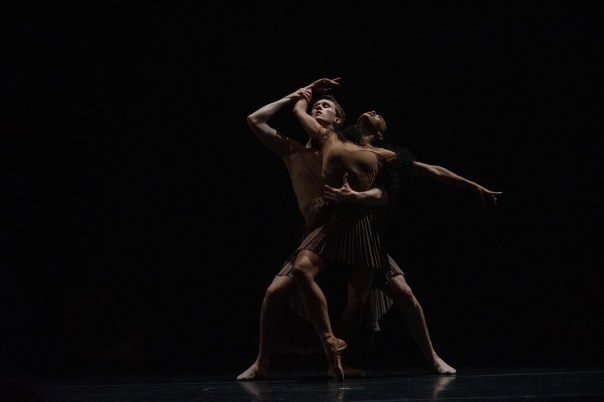
Nor should you think that less of an assault on boundaries implies none. What we might expect From Africa are eye-popping colors, primitive revelry, jungle cats, or savannah beasts, syncopated with intensive drumming. What inspires the South African-born choreographer and costume designer instead are mauve-colored ostriches from his native land that CharBallet’s dancers’ grace will have you associating with flamingoes. First the women dance quietly into the intimately-lit studio space with their matching mauve skirts and leotards, almost floating across the floor.

Mildly surprising, the men join in shortly afterwards wearing similar outfits, their skirts destined to serve as their plumage in the final tableau. Initially, they are different from the women but the same, whether we view them as human or animal. November pointedly freezes the ensemble for a moment or two in a formation without symmetry or geometry, so we behold their randomness, diversity, and harmony like a vast meadow teeming with life, peacefully grazing, somehow safe from predators. Lighting design by Aaron Muhl adds mystery and magic.

A couple of tracks, “Ibuyile l’Africa (Africa Is Back)” and “Qhawe (Hero),” from South African cellist Abel Selaocoe’s debut Where Is Home album, animate most of the movement and define its range once the full ensemble gathers. There is ethereal solemnity when the tempos are halting; while singing, exultation, and defiant guttural exhortation drive the quickened choreography over a pulsating drumbeat and handclaps. Seamlessly, our attention narrows to a single couple, Evelyn Robinson, more consistently at the center, and Luke Csordas, who will lift his partner several times but remain the only dancer who briefly leaps into the air. Three other duos rotate during the 15-performance run.

Earthbound, with a seething impulse to soar, From Africa With Love is haunting. It’s impossible for me to be sure whether November views its lively yet fragile beauty as emerging or fading.

You will need to abandon your seat – and the McBride-Bonnefoux studio – during intermission. You will also be asked to change your seat when you return and give some thought to the question of whether you wish to sit in the front row. My wife Sue, the tender-hearted Tannenbaum, was concerned that the elderly and disabled who normally populate the front row would be displaced, forced to climb stairs to reach the rows behind them.

My faith in Charlotte Ballet was not shaken. Or to put it another way, I was not at all worried. After intermission, my faith was vindicated. Not only were there greatly expanded opportunities to grab a front-row seat, the other natural option, to return to our original seats, was eliminated. They were gone.

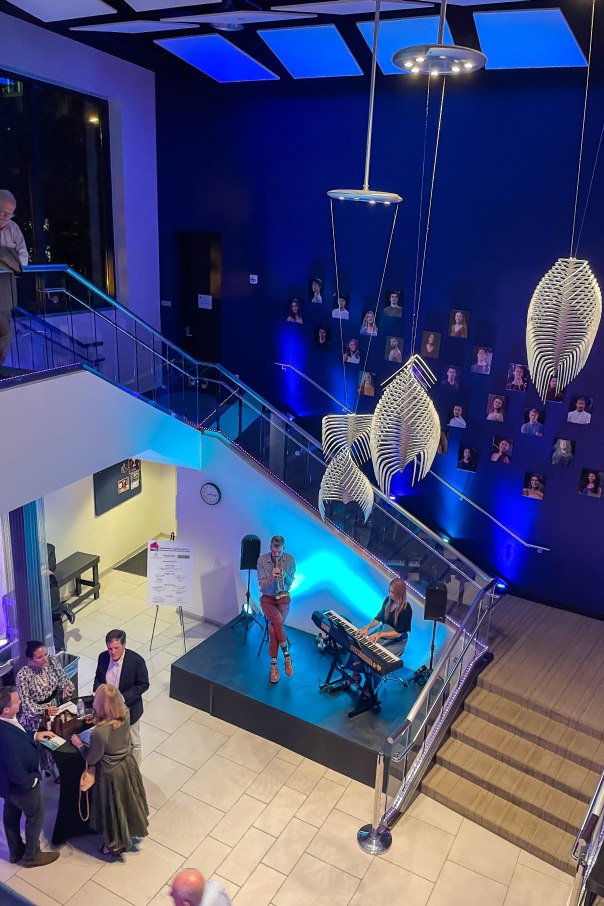
While this exciting transformation was happening behind closed doors, Patt and Sara, alias trumpeter Matt Postle and keyboardist Jess Borgnis, nestled into the Center for Dance lobby in front of the stylish staircase, framed by rows of purple lights as they played. Past the headshots of the CharBallet dancers, at the top of the staircase, we could look down at the cool jazz duo from the balcony or appreciate the artworks mounted on the walls behind us.

Sadly, my heartlessness extends beyond the elderly and physically challenged to the artists representing the Art League and the jazz duo. Other than enjoying the art and the music or noting that all was quite good, I observed an intermission of my own from reviewing and whipped out an iPhone to help me document the stylish ambiance. No other local company even strives to match the hospitality at the McBride-Bonnefoux, and only the Music @ St. Alban’s series up in Davidson seems to have stumbled upon similar possibilities of desserts and extra entertainment for all their patrons.

Yet the fullest impact of Breaking Boundaries was undoubtedly reserved for after intermission. The grandstand where our seats had been was now collapsed into the rear wall. Instead of one front row facing the studio performing space, there were now four rows of benches boxing it in. We made a beeline for a bench with a back rest, noticing along the way that there were spaces marked “Reserved”: our first hint.

It wasn’t long before the 15 dancers performing Ohad Naharin’s Kamuyot, dressed in loud woolen plaid skirts and slacks, settled into those designated spaces. By this time, the reason for the front-row caution was clear enough. If you don’t mind being invited to join the dancers on the floor – or you don’t mind turning down such an invitation – you’re OK. Otherwise, second row. Those who experienced second-row remorse could remedy their plight with a little extra exertion when the time came, capturing a dancer’s attention and an invite.

Even translated from the Hebrew as “Quantities,” Naharin’s title didn’t offer much of a clue to what might follow. There were no song titles in the program, but the list of 22 composers and artists, ranging from John Tavener and L. V. Beethoven to Lou Reed and The Ventures, broadly hinted at a bumpy ride. Indeed, the delight of unpredictability was sustained throughout the piece as single dancers or couples from all four sides of the stage took their turns on the floor and returned to their places. From the randomness of the order of dancers seizing the spotlight and yielding it, a certain inevitability set in if we were noticing who hadn’t yet risen and performed.

From then on Kamuyot was more of an ensemble piece. Distilled from previous works, Naharin aimed this work specifically at young audiences and, logically enough, created it for The Young Ensemble of the company he founded in Tel Aviv, Batsheva. The work has been staged across Israel in school gymnasiums, so the work aligns more closely with the studio space than most of the choreography we have previously seen staged at the McBride-Bonnefoux. On the other hand, staging the work at night in front of an adult audience alters Naharin’s calculus and the whole atmosphere of the dance.

Instead of encouraging kids to get involved with dance and experience its joys, Kamuyot now stretches out its hands to adults and old-timers to bridge the gap between themselves and their youth. With a soundtrack that ranges from the opening bars of Beethoven’s Kreutzer Sonata to The Ventures’ “Theme Song from Hawaii Five-O,” Naharin’s lively, kaleidoscopic work encourages traffic in both directions, for nothing is dumbed-down for his intended family audiences, ages 6 and up.

When dancers stand silently in front of you, or when they beckon you to join them on the floor, you know exactly what Cerrudo meant when he named this rousing season-opening program Breaking Boundaries. I would rate my own performance, when I answered the dancers’ calls, as rather wretched – but I surrendered my objectivity and the ability to even view the entire spectacle as soon as I entered it. What I gained in exchange for those losses was the full flavor of the experience.

I invite you to try it, and to bring a child along with you.

“MJ”: About as Close to Jax as We Can Get

Review: MJ The Musical at Belk Theater

By Perry Tannenbaum

Whether it was his skin, his sunglasses, his surgeries, or his sleepovers, Michael Jackson always gave his fans – and his detractors – plenty to think about aside from his music and his iconic videos. Even if you tried to maintain ignorance or indifference, there were just too many of him to ignore. He seemed to be everywhere, all the time, always visibly troubled and in flux. The loudest soft-spoken person we’ve known: the most grandiose hermit, progressively weirder and more deformed as the years went by.

So in condensing the King of Pop’s life and art into the 150-minute MJ The Musical, without plunging into inconvenient truths that might revoke her “Special Arrangement with the Estate of Michael Jackson,” script writer Lynn Nottage had to look very, very carefully for a place where she could begin – and a place where she could discreetly and dramatically end. A two-time Pulitzer Prize winner (Ruined and Sweat), Nottage knows her way around the theater, so she chooses wisely and safely.

Approaching its 700th performance in its current Broadway run after premiering in late 2021, the touring version has been spreading the moonwalk, the cocked hat, and the glove across our land since the beginning of August. Rounding into its second week at Belk Theater, there’s no question whether this production is a crowdpleaser. Whether or not Nottage has made storytelling mistakes or sugarcoated the facts of Jackson’s life, there’s more than enough hot smokin’ talent onstage to incinerate such nitpicking concerns in white-hot flames.

We begin in an LA rehearsal hall, where Michael, his backups, his line dancers, his handlers, and a small band are gearing for their upcoming Dangerous tour in 1992, following up MJ’s latest smash album and trying to live up to expectations created by his past glories – Off the Wall, Bad, and, greatest of all, Thriller. Ultimately, after much discussion and consternation about how MJ can uniquely open his stage show, Nottage spirals slightly ahead to the opening moments of the Dangerous tour for our ending.

By this time, there’s more than ample inventory from the Jackson 5, the Jacksons, and MJ’s solo album catalog to fuel a four-hour musical – with additional detours into the Isley Brothers, James Brown, Olatunji, and Richard Rodgers – if Broadway producers had thought those were in vogue. There’s also enough weird MJ and cosmetically altered MJ swirling around in people’s minds for media to assail the King of Pop with troubling questions and pry into his past 25+ years as boy wonder and superstar to find out what makes him tick.

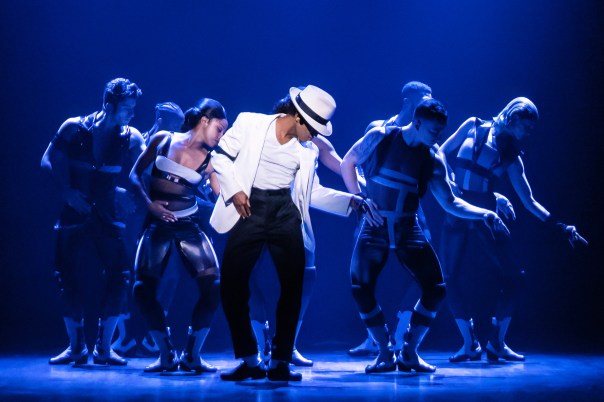
As soon as Roman Banks struts into this artsy loft, he begins flipping those legitimate questions into annoyances, for we can see that the silky moves are all there before he’s halfway through performing “Beat It,” meshed with a vocal that transcends impersonation. Musicians onstage are fortified by a dozen more lurking in the orchestra, adding heft to the opening number, and the dancers are Fosse sleek and Broadway tight. This is what came to see.

So we can empathize with MJ when Rachel and Alejandro, a TV reporter and her cameraman, walk into the busy room, hoping to get an in-depth interview and a behind-the-scenes scoop. Speaking with that preternatural softness of a singer saving his voice for his next performance, MJ yields to the eager cubs – but only on the condition that they keep it strictly about the music. Banks manages to suffuse that softness with a winsome sweetness.

Nottage doesn’t lavish much of her MacArthur genius into Alejandro, enabling Da’Von Moody to pour a smidge of his own personality into a generic, slightly geeky fanboy. There’s a modicum of humor because Rachel, not MJ, is his boss. Here Nottage gives us some texture, bringing us an opportunistic fan-tagonist in Rachel – pushing back over and over against MJ’s restrictions, pesky, persistent, and sometimes annoying. Stepping into this crucial role on press night last Friday from deep in the list of Swing players, Ayla Stackhouse added a touch of wicked allure to Rachel.

A wisp of seduction was in the air. As a result, Banks’ continued softness and firmness may have gained fresh strength. Yet when MJ kept saying no, he seemed to be veering toward maybe.

This sensation, that we were meeting the real MJ in person as Banks shuttled between guarded and candid moments, can be partially credited to the tech crew now at the Belk. MJ often speaks the gospel of detail and perfection, but this crew fulfills it. Over the last couple of Broadway Lights seasons, I’ve become so accustomed and resigned to the sound not being right on opening night at the Belk before Act 2, if at all, that I’ve lately tolerated the problem without comment.

Maybe that’s why Press Night for this two-week run was put on hold for two performances. On ordinary opening nights, you could expect Belk’s audio crew to turn MJ’s softspoken dialogue into the sound of microwaving popcorn. This time, everything was dialed in perfectly for the critics. Moments when I might be holding my breath, bracing for sonic gremlins to afflict MJ, were simply breathtaking.

All night long, the show maneuvered deftly, revealing subtle new merits. Timeshifts between the ‘90s rehearsal loft and the eye-popping ‘60s charm of the Jackson 5, juxtaposed with the abusive Jackson household and Michael’s taskmaster dad, could become somewhat disorienting as the retrospective took off. Part of what Nottage and director/choreographer Christopher Wheeldon are trying to accomplish is steering the narrative smoothly between songs in the Jackson catalog without the storytelling stalling and landing us at a gimmicky concert.

By the time we get our bearings in Act 2, about 23-25 hits into the 40-song list of musical numbers, we realize that anybody portraying MJ is pumping out too much energy onstage, singing and dancing, for him not to be whisked off to the wings for some rest. Giving Banks some breathers is also part of the navigation calculus. No less than three Michaels were onstage between 8:00 and 10:45 at the Belk, Banks as MJ, newcomer Jacobi Kai as Middle Michael, and Josiah Benson as Little Michael, timesharing the role on tour with Ethan Joseph.

If Banks amazed me, getting every signature move and vocal intonation of MJ, moonwalking through everyday life, Benson as the Afro-coiffed Little Michael left me gob-smacked. Maybe the Jackson Estate’s worries were misdirected: who knew that the roles of MJ and Little Michael could be cast so successfully, both on Broadway and on tour simultaneously? Little Michael’s timbre had always seemed to come from a once-in-a lifetime voice since that “ABC” moment when I first heard it. Not anymore.

What could have set MJ apart from the performers portraying him at various stages of development were his songwriting gifts and inspirations, never really explored in Nottage’s book. Likely, that would have rendered the show more intimate and even more Michael-centric. We get a fairly broad tapestry instead, including glimpses of singers Jackie Wilson and James Brown, along with the ballroom grace of Fred Astaire.

The supporting cast is very fine. Devin Bowles and swing-understudy Rajané Katurah were worthiest of mention as Little Michael’s parents, Joseph and Katherine, fleshing out their marital discords. Both make good on the vocal solos carved out for them. Bowles time travels as much as Banks, portraying MJ’s stage manager, Rob, throughout the contentious rehearsal scenes. Dancers, even when supposedly driven in rehearsals to smooth out imperfections, are exemplary, living up to Wheeldon’s strict demands. Is MJ pushing his dancers too hard to reach perfection – because Dad pushed him so relentlessly? We don’t miss the emotional turmoil lurking inside this connection.

Nottage is sufficiently fascinated by the intricacies of putting a show together that she not only reveals the micro levels of drilling the synchronicity of dance routines and sweating details. She also has Michael, Rachel, Rob, and Dave – MJ’s on-edge beancounter, excellently portrayed by Matt Loehr – discussing the larger concerns, namely the architecture, pacing, and budgeting of a show.

That helps us to swallow all the action in the drab rehearsal loft before the delayed gratification of seeing the all-out “Thriller” extravaganza deep into Act 2. A whole show of such MTV-like spectacles would have cost zillions, too mind-boggling to pack onto the biggest moving van known to man. An armada of trucks and set builders would need to be deployed for a full evening of such fantastical wonder.

In many ways, Nottage and Wheeldon deliver as much as we can expect of Michael Jackson’s life and artistry onstage without surrendering the rights to the music. I’d like to think that Nottage, dealing with the Jackson Estate’s constraints, saw herself as resembling her own persistent Rachel character during the process, pushing the envelope further and further, inch by inch, as far as it could be stretched. Perhaps her Pulitzer pedigree helped Nottage to make more territorial gains and bring us closer to the real MJ than The Estate was truly comfortable with when her work began.

Master Chorale Excites and Excels With Superior Renditions of Dett & Bernstein

Review: Dett & Bernstein at the Cain and Gambrell Centers

By Perry Tannenbaum

September 28 and 30, 2023, Cornelius and Charlotte, NC – Historically, a collaboration between Charlotte Symphony and the Charlotte Master Chorale is far from a groundbreaking event, since the two organizations had been joined for a while before breaking apart when Symphony absorbed the original Oratorio Singers of Charlotte after many years of proud collaboration. But when the rebranded Master Chorale not only partners with Symphony but also with two additional choirs, the Queens University Chamber Singers and The University Chorale of UNC Charlotte, something special must be brewing. Bring in five guest solo vocalists and expectations rise to Mahlerian proportions. That wasn’t the kind of extravaganza that the longtime collaborators had in mind, however, when they conceived their Dett & Bernstein program and reached out so dramatically.

Less intimidating, the event at Gambrell Center, on the Queens University campus, was a welcoming epic of diversity and inclusivity. For all the ensembles never gathered grandly together in symphony-of-a-thousand fashion. R. Nathaniel Dett rightfully headlined the bill, for The Ordering of Moses (1937) is more than double the length of Leonard Bernstein’s Chichester Psalms (1965) and armed with more vocal soloists and instrumental artillery. In something of a tune-up for the Gambrell event, the Master Chorale and Symphony had performed both of the headliner pieces at the new Cain Center in Cornelius two nights earlier. Neither of the University ensembles made the trip up I-77 to Cornelius, but tenor Jason Dungee, who would sing the title role in Dett’s oratorio, is also director of UNCC Chorale, so a couple of his prize students mysteriously appeared as two of the four adult solo singers in Chichester Psalms, obviously smuggled onto the tour bus.

Losing out on seeing the full University choirs, missing the opportunity to hear the gems by Adolphus Hailstork and Margaret Bonds that kicked off the Saturday program at Gambrell, the Cain Center still had the honor of hosting the North Carolina premiere of The Ordering of Moses. Commissioned by the May Festival Chorus, who premiered the piece in Cincinnati, the piece triumphed in front of the festival audience, but its live national NBC radio broadcast was abruptly snatched from the airwaves about 40 minutes into the performance, clearly a craven cave-in to a few racist listeners. Righting this wrong, if not the subsequent neglect of Dett’s oratorio, Moses was revived by the Cincinnati May Festival in 2014 and given a Carnegie Hall premiere a few days afterward – adorned with a live broadcast by WQXR that was not aborted.

As the Bridge recording of that concert demonstrated, the revival conducted by James Conlon was well-deserved. Hearing the live performance with Chorale artistic director Kenney Potter conducting the Charlotte Symphony was a very different experience from the sonorous broadcast version on the Bridge label, longtime champions of American composers. From the start, the work of Symphony’s assistant principal cellist Allison Drenkow stood out more boldly in relief, yielding a better grasp of how Dett structured his piece, for there are cello solos strewn throughout the piece, acting as friendly bookmarks, that she gorgeously performed with gossamer tone. Nor were the vocal soloists less than the equals of their Carnegie Hall counterparts, mezzo Sarah Brauer bringing wondrous elan to The Voice of Israel, soprano Anne O’Byrne fortifying Miriam in her biblical song and in duets with brother Moses with her fervor, and bass-baritone Marques Jerrell Ruff thundering The Word and afterward The Voice of God – with rumbling timpani quaking the earth around him.

In his introductory remarks during a pre-show segment, Dr. Marques L.A. Garrett had us looking out for the core of Dett’s music, the two themes of “Go Down, Moses.” The famous refrain theme peeps in behind a veil of different melodies, most notably the keening “When Israel was in Egypt land” theme before the full chorus breaks forth – after a vocal trio from Brauer, O’Byrne, and Ruff followed by a swirl of cellos and a bassoon – with the fortissimo command, further developed with fugal filigree. Yes, Ruff’s Voice of God is a tough act to follow, but who knew that Dungee, rising from his seat with the aid of a cane, had such a piercing, rafter-cracking tenor voice to answer the Almighty’s call? The dialogue between God and Moses was a thrilling highlight, enough for me to justify attending the second North Carolina performance as well as the first.

Fresh rewards awaited me at the Gambrell that lived up to my expectations. The Master Chorale is a large chorus, too large to share the Cain Center stage with Symphony, so they doubly split on both sides of the audience on two levels of the building. Gambrell Center has a more commodious hall and stage, but only one side level for deploying the choristers, so the Master Chorale waited to make their appearance while the two University choirs gathered on opposite sides of the audience, spilling onto short flights of stairs the led up from the orchestra to the sloped exit aisles. To our right, Dundee led the UNC Charlotte ensemble in two songs by Hailstork (b. 1941). Crucifixion or not, “My Lord, What a Moanin’” had a grace and energy worthy of a program finale or an encore. The hushed and reverent “Blessed Is the Man” was written as a gift specially for Dungee, who chose Hailstork as the subject of his doctoral dissertation, and the tenor’s fondness for the piece suffused his choir’s performance.

Not to be outdone by her UNC Charlotte colleague, soprano Sequina DuBose has had a song cycle written by Maria Thompson Corley for her recent Blurred Lines: 21st Century Hybrid Vocal Works recording on the Albany label, reviewed at this site earlier this year. You could say she crossed the line when she appeared as a guest soloist with the Queens U Chamber Singers in excerpts from Credo by Margaret Bonds (1913-1972) – if there were a rivalry between the two schools rather than hospitality and fellowship. Set to a prose poem by W. E. B. Du Bois, the posthumous Credo was premiered by Zubin Mehta and the LA Symphony shortly after Bonds’ death but not recorded until earlier this year on a magnificent Avie Records release by the Dessoff Choirs and Orchestra.

Presented at Gambrell with a spare piano accompaniment, the performance was admirable for its promptness, but it gave only a hint of the work’s full grandeur when heard unabridged with a full orchestra behind it. At Gambrell, pianist Brenda Fernandez provided all the accompaniment. The complete work, now that it has conquered with a brief foretaste, should be on top of Charlotte Symphony’s short list of new and newly-discovered pieces to be programmed at their Uptown venues.

Nor was DuBose to be outdone in her rendition of the second song in the six-song suite, “Especially Do I Believe in the Negro Race.” If you’ve heard her luminous performance of “Summertime” in two extended runs of Porgy and Bess in Charlotte, most recently with Opera Carolina back in January, or her Elvira in Don Giovanni, you won’t be surprised to learn that the smoothness of her tone and the clarity of her diction far eclipse what you might hear on Spotify in the world premiere recording.

Recordings do have an influence on repertoire selection, which may be why I’ve never heard Charlotte Symphony perform Chichester Psalms before – and why I haven’t heard a performance of Bernstein’s paean to peace in the Queen City since 2009, when Carolina Voices’ Festival Singers brought a slimmed-down version of the work to Temple Beth El for a Yom HaShoah commemoration, accompanied by piano, percussion, and harp. Marin Alsop’s version of the work on Naxos with the Bournemouth Symphony and Chorus is only slightly less wretched than Bernstein’s own version on DGG with the Israel Philharmonic and the Vienna Boys Choir.

Both of their engineering teams failed them miserably in the pivotal middle movement, where Bernstein juxtaposes the incandescent Psalm 23, “The Lord Is My Shepherd,” sung by a boy soprano, with the angry Psalm 2, sung by the Master Chorale in a sudden crescendo. The Hebrew text is probably most familiar to us via the powerful aria in Handel’s Messiah,“Why do the nations rage so furiously together, and why do the people imagine a vain thing?”

To replicate the dynamic range so easily rendered at the Cain and Gambrell Centers, you’ll need to turn your volume knob to the one or two o’clock position to make out the boy soprano faintly in the outer sections of this movement – and hurriedly turn back to the 11 o’clock position for the midsection to avoid waking your wife and neighbors when the full chorus unleashes their fury. Even sitting at the front end of these halls, I never felt assaulted by the fortissimos: acoustic balances and clarity were always tight. It was a joy to hear Calvin Potter singing the soprano part so clearly, stealing nervous glances at his dad on the podium as he awaited his cues. The boy was nearly perfection on the Hebrew until his unfortunate gaffe in the final line, mispronouncing the penultimate word at both performances.

Immediate consolation gushed forth after the Potter lad departed, for the final Chichester section, set to the warm and placid Psalm 131 with a sprinkling of 133, is preceded by a gorgeous orchestral lament that brought out Symphony’s best playing of the night. The transition between these last two Psalms was also treasurable, a lovely cello quartet. A wonderful vocal quartet – including those two UNC Charlotte imports – led into the final sublime fadeout, dominated by the women’s treble. Again: the last minute of Chichester Psalms was divine in live performance, but turn your hi-fi volume past 12 o’clock at home.

“Yankee Tavern” Still Implodes With 9/11 Speculations

Review: Yankee Tavern at DCP’s Armour Street Theatre

By Perry Tannenbaum

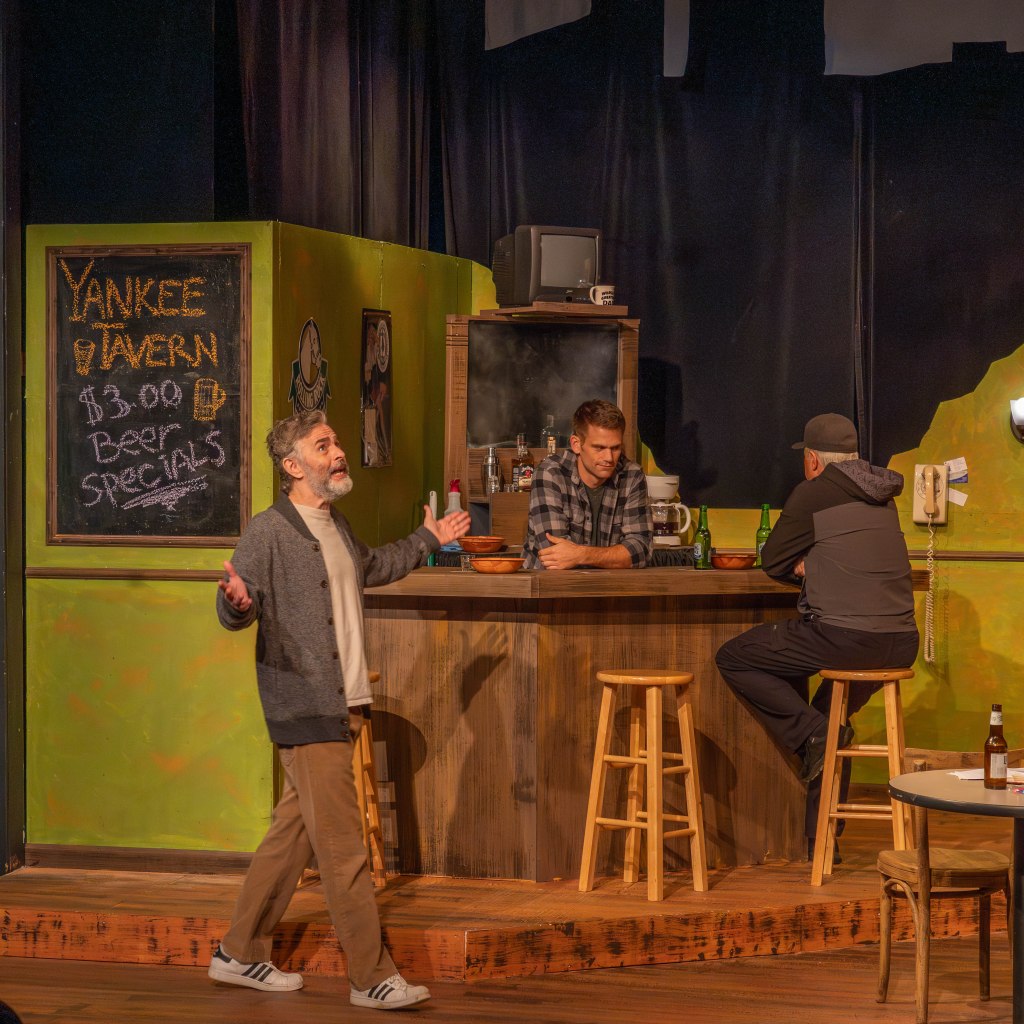
Over the years, Steven Dietz has favored Charlotte with plenty of spookiness and suspense. We’ve seen his most acclaimed works in fine local productions, including God’s Country, Lonely Planet, and the oddball Becky’s New Car. On a couple of occasions, we’ve been singled out for some of the earliest transitions of Dietz’s scripts from page to stage. Most recently – and spectacularly – Children’s Theatre and Actor’s Theatre of Charlotte teamed up to commission a pair of upstairs/downstairs spookfests from Dietz, The Ghost of Splinter Cove and The Great Beyond.

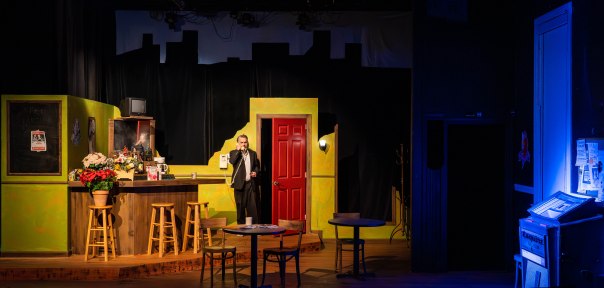
Since 2009, when Actor’s Theatre presented Yankee Tavern as part of the New Play Network’s nationwide “rolling world premiere,” we really haven’t experienced how Dietz uses his surreal, supernatural, and conspiratorial toolkit to address daily American life. The current revival, directed by Matt Webster at Davidson Community Players, also gives us the opportunity to see how well Dietz’s wild theorizing still holds up three election cycles – and three US Presidents – later.

If anything, the suspense seems to work better now, since Webster’s cast, in their pedigree and their natural inclinations, comes across as less cerebral, readier to go with the flow of an action yarn liberally sprinkled with spycraft plus a pinch of the inexplicable. Confronted with two actors, Matt Cosper and Tom Scott, who might plausibly place the roles of Hamlet and Lear on their bucket lists, as Dietz’s protagonists, I can see in retrospect that I may have resisted following on the suspenseful path that Adam and Ray were designed to take us.

t’s easier to be ambivalent about Matt Stevens as Adam, the seemingly wholesome owner of the Yankee Tavern, and Bill Reilly as Ray, the crazed-or-visionary vagrant who lives in the empty hotel above the bar. Together, they take us down a rabbit hole of coincidences, suppositions, and conspiracy theories that might account for America’s total defenselessness on the morning of September 11, 2001, when airliners crashed into the Twin Towers in Lower Manhattan and both skyscrapers stunningly collapsed.

Two amazingly perfect demolitions of two fully-occupied, high-profile landmarks, presumably built to last and zealously guarded – within the space of 46 minutes. You didn’t need to be close to Ground Zero to be struck with shock and wonder.

But the closer you were to the World Trade Center or people who perished there, and the more narrowly you yourself escaped, the more you could be expected to obsess over the mountains of evidence, facts, theories, legends, and numerologies that were left to explore or were mysteriously obliterated along with the rubble. Ray, the raffish vagrant, seems to have gone overboard, a fountain of conspiratorial spew that points in multiple directions here and abroad, adding to his confusion and ours instead of clearing the fog.

Adam and his fiancée, Janet, seem to mischievously indulge Ray’s weird futility, voicing their skepticism to get the freeloader to be more passionate about his disorganized beliefs – and perhaps prodding him to spout new bullshit they haven’t heard before. The badinage gets out of hand when Janet carelessly reveals that Adam has collected Ray’s voluminous ravings into book form for his master’s thesis. Outraged by this betrayal, Ray has some secrets of his own to reveal about his betrayer.

Reilly renders Ray with such eccentric looniness that anything he says draws skepticism, beginning with his nocturnal conversations with the ghosts who haunt the boarded-up hotel rooms above, including Adam’s dad. Are these symptoms of madness or sources of insight? There are some compromising secrets that Adam is hiding from Janet. How damning these secrets are depends on how truthful you think he is in explaining his ongoing relationship with his ex-professor.

At first, Cordelia Hogan strikes us as a bit irritating as Janet with her persistent suspicions and distrust, so we tend to empathize with Stevens and his protestations of innocence as Adam. Things slowly change when the lights come up on a new scene with a quiet stranger seated at the bar, mostly facing away from us. He’s sitting with two bottles of Rolling Rock Beer perched on the bar, subtly evoking the Twin Towers, but he’ll refuse to drink one of them – leaving it full in memory of a friend that he never saw after the Towers’ collapse.

In his quiet way, Palmer is as obsessed with the mysteries of September 11 as Ray, but he has been more relentless and has roamed further, driven by the unsolved death of his close bud. When Steve Schreur breaks his silence as Palmer with a startling confession of wrongdoing at the colossal Twin Towers crime scene, a monologue that transforms his demeanor from a humble cop on the beat to a crusading zealot, the net of mystery and conspiracy widens to include Adam, his ghostly dad, and Yankee Tavern as focal points.

This may be Palmer’s first stop at the crumbling sports bar, but it isn’t his first sighting of Adam – and he also seems very well-informed about the ex-professor and her machinations. He definitely has his suspicions. Now we will reassess the mild-mannered Stevens and maybe see him as craftier, more secretive, and spy-like. You may also start wondering at this point whose side Palmer and Adam are on in this geopolitical tapestry, and you may believe there really could be a deal breaker on the horizon for Adam and Janet’s engagement.

At this point, we’re also caught up in the psychology of straining toward belief based on the devilish wisps of evidence and inference and eye-witness testimony that Dietz has doled out. The playwright, Webster, and his cast have all done their work well; the design team have created and sustained the playwright’s lazily surreal atmosphere; so the intended coupling will likely occur. Our speculations about Adam and Palmer will likely sprout fresh speculations about 9/11.

We’re built that way, which is precisely Dietz’s point, whatever the truth of history might be if it is ever untangled.

Problem is, Dietz couldn’t factor in 2016 or 2020. A US President who had lost the popular vote might conceivably orchestrate a catastrophe to rally the dubious electorate behind him. Could be worth the trouble for W. Until the Orange Marvel came along, who knew that a sitting US President could simply squat down on a toilet seat and remediate the situation by merely proclaiming, with two posable thumbs and a Twitter account, that he had actually won the lost election by a landslide?

Of course, that grim update won’t prevent the flareup of confusion and speculation we will feel when Dietz springs his ending. It’s a brutal reminder that the hotel above the action isn’t the only place that is haunted. Yankee Tavern is also spooked and so are we. Maybe more than ever before by the incurable virus of conspiracy theory.

CP’s Connor Series Signs Off With Two Powerhouse Piano Quintets

By Perry Tannenbaum

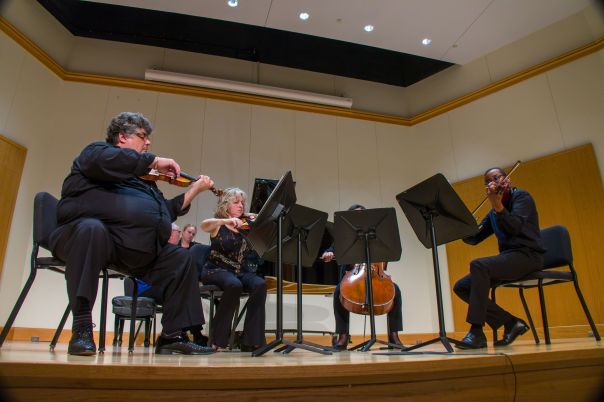
September 17, 2023, Charlotte, NC – Even before the Connor Chamber Music series began six years ago at Tate Hall, Catherine and Wilton Connor were among the strongest advocates of chamber music in the Metrolina area. They had previously helped to give the St. Peter’s Chamber Music series extra reach beyond Uptown church by hosting Living Room Concerts in their Myers Park home. Furthermore, they had opened their doors to violinist Rosemary Furniss and her chamber trio when her husband, Christopher Warren-Green, was the Charlotte Symphony’s music director.

So it was bittersweet to hear Mr. Connor announce that the latest concert on the Central Piedmont Community College campus, showcasing piano quintets by Béla Bartók and Antonín Dvořák, would be their last. Connor hastened to console us, hyping the recent and future concerts of Chamber Music for All, led by Charlotte Symphony concertmaster Calin Lupanu. And in fact, the program we were soon to hear had already been performed a week earlier at the Lancaster Cultural Arts Center, the climactic event of the inaugural Historic Lancaster Music Festival. Future CM4A concerts are already scheduled there, at Sedgefield United Methodist Church, and at the Steinway Piano Gallery.

Not nearly as renowned, recorded, or as frequently performed as his six string quartets, Bartók’s Piano Quintet in C Major is one of the composer’s earliest works, written in 1903-4, a mere 17 years after Dvořák’s quintet was premiered and 35 years before his own final string quartet. Often in its outer movements, the opening Andante and the concluding Poco Vivace, the music has an anthemic openness that you might expect from a 19th-century piece written in the shadows of Liszt, Strauss, and Brahms, before Bartók leaned more toward folk music and modernistic experimentation.

At the keyboard, Phillip Bush resisted the temptation of steering the joyousness of the piano part into stentorian jubilation, resulting in more ensemble cohesiveness and more contemplative edge. Lupanu could stay more within himself to match Bush’s fire without ever flattening the peaks and valleys of the volatile music where Bartók abruptly changed tempos and dynamics. Marcus Pyle, who had inched onto our radar earlier this year as a preview speaker for Opera Carolina’s production of Porgy and Bess, impressed almost instantly on viola with his lush tone and sleek double-bowing.

The inner movements, a Vivace-Scherzando followed by an Adagio, are more forward-looking. The Scherzando did not lack for quirkiness, but Bush could have been more provocative and eccentric in the second movement. With cellist Marlene Ballena and second violinist Monica Boboc making valuable contributions, the quartet sounds were dominant in the Adagio, though the 2019 Alpha Classics recording, captured live at the Lockenhaus Chamber Festival, dares to be more raucous and astringent. When Lupanu’s quintet surrendered more fully to the closing Vivace, they delivered more of its fire and madness.

Competition among recordings of the Dvořák Piano Quintet No. 2 in A Major not only increases exponentially compared with the sparse field of Bartók recordings, so does the name recognition of the pianists, violinists, and string quartets who have entered the fray. On the other hand, the musicians onstage at Tate Hall must have had so many more opportunities to glean master classes from this immense discography – and likely more opportunities to rehearse and perform this perennial favorite before bringing it to CPCC. The electricity and sound quality of live performance, the familiarity of the audience with the piece – particularly when it settled into the dreamy Dumka movement after the rousing Allegro opener – brought the Connor concert experience into gratifyingly close alignment with the best CDs available.

Bush played with confident élan, pliant and at ease navigating the tempo shifts of the opening movement, charming and lyrical in the gorgeously pianistic Andante passages that make the Dumka so memorable, and unbridled with the onset of the folksy interludes. Lupanu also played with loose and spontaneous abandon, slashing boldly with his bow at the quick tempos and delicately caressing the strings in the lovely soft passages. Ballena shone most with her cello as she introduced the first theme of the Allegro, and Pyle was equally convincing introducing the second. Everybody seemed to be having a jolly time as the sober ending of the Dumka gave way to the penultimate Scherzo. Lupanu and Bush mischievously frolicked on the left side of the Tate stage, answered to humorous effect by Ballena and Pyle with their suave mellowness.

Boboc had her most memorable spot in the Allegro Finale when we jumped away from the spirited interplay between Bush and Lupanu into a fugal section where Ballena and Pyle also got a taste. There were also harmonious sections that reminded me of the uniqueness of Dvořák’s string quartets. Yet it was Bush who was most dominant at the concert’s climax, trilling and ding-a-linging merrily before he ramped up the speed and intensity toward the very end. Obviously relishing the encounter, Lupanu matched him note for note as they raced to the precipice.