Monthly Archives: September 2023

Follow the Yellow Brick Road to the Queens Road Barn

Review: The Wizard of Oz at Theatre Charlotte

By Perry Tannenbaum

With her rustic picnic basket, her toy dog Toto, her beribboned pigtails, and her iconic gingham dress, the 1939 movie version of L. Frank Baum’s imperishable heroine, Kansas-born Dorothy Gale, was designed to closely echo the Dorothy found on the pages of Baum’s 1900 novel. She was conceived in the lineage of Little Red Riding Hood and Lewis Carroll’s Alice as a little girl – credulous, easily surprised or disappointed.

Judy Garland was 16 years old when she began shooting The Wizard of Oz at MGM Studios. Her sub-5-foot stature bridged some of the age gap, but director Victor Fleming and the MGM braintrust didn’t stop there, trussing Garland up to hide her curves. All of this subterfuge (some would call it barbarity) was logical only because Hollywood, suspicious of fantasy and children’s fiction, wanted to reassure us that Oz, The Wizard, the Witches, the Winkies, and the ruby slippers were all nothing more than a little girl’s dream.
Noel Langley’s screenplay, revised chiefly by Florence Ryerson and Edgar Allan Woolf, went to extraordinary lengths to frame Dorothy’s adventures as a dream. The celluloid version supplied the Scarecrow, the Tin Man, the Cowardly Lion, Glinda, the Wicked Witch, and The Wizard with Kansas counterparts she will transform into Ozians. Baum never created a Miss Gulch or a Professor Marvel. In fact, when he adapted The Wonderful Wizard of Oz for the stage in 1902, Baum actually expelled Toto and the Wicked Witch from his cast – and did not permit the Lion to speak.

Langley obviously hasn’t gotten enough credit for his contributions to Oz mythology. The whole preamble to the cyclone and Oz is his, along with the wholesome welcome home to Kansas that crowds the screen with patronizing adults. Aunt Em is the only person who greets Dorothy in the book, where the ending is dispatched in less than 75 words. Dorothy finds a new farmhouse that Uncle Henry has built to replace the old one that killed the Wicked Witch of the East. No question in Baum’s mind: Dorothy has been away to a real place in real time.

When John Kane adapted The Wizard of Oz for the Royal Shakespeare Company in 1987, he went with Langley’s version of the story. Not only were the songs by Harold Arlen and the lyrics by Edgar “Yip” Harburg brought along for the ride, so was “The Jitterbug,” an Arlen-Harburg song that didn’t make the film’s final cut. If anything, Kane’s additions to the screenplay served to underscore the idea that Oz was a dream, dropping more key words and phrases that linked the magical land to Kansas. Auntie Em and Uncle Henry were added to the roster of Kansans who change costumes and join Dorothy in Oz.

That’s the version we have now as Theatre Charlotte kicks off its 96th season with a rousing trek down the familiar Yellow Brick Road. After her TC debut in 2022 at Camp North End during the company’s vagabond season, Allison Modafferi Brewster directs for the first time at the Queens Road barn. Leaning heavily on projection designs by Alison Nicole Fuehrer to navigate the geographies of Kansas and Oz, Modafferi and her cast of 40 (plus nine “Ruby” Munchkins who timeshare with the “Emerald Cast” that performed on opening night) heartily buy into the notion that Oz is a dreamland.

But in choosing Winthrop University senior Cameron Vipperman as the lead, Modafferri and costume designer Rachel Engstrom are pushing back against the idea that Dorothy must be a child. Or, to cite the range prescribed for auditions in 2006, when Central Piedmont presented this Wizard as their first summer extravaganza at the newly-built Halton Theater, between the ages of 14 and 17.

Gone are the ribbons, the pigtails, and the gingham dress, though Vipperman’s do does sport a couple of fairly subtle weaves. Nor does this energetic production go along with the notion that Miss Gulch and the Wicked Witch of the West must be gnarly old crones. Wielding her broomstick in a rather gladiatorial black outfit, Mary Lynn Bain was quite the action figure as the Wicked One. No corny cone hat for her!

Unless you’ve scouted productions down at Winthrop and Matthews Playhouse, neither of these antagonists will be a familiar name. Casting is no less adventurous for Dorothy’s Yellow Brick pickups. As the Scarecrow, Devon Ovall comes to the Queens Road barn by way of Northwest School of the Arts. Ashley Benjamin, the first female Tin Man we’ve ever seen in Charlotte, seems to be freshly arrived from Georgia in her digital bio. Only Kyle J. Britt can boast previous Queen City exploits prior to his present turn as the Cowardly Lion, having appeared at the barn in last year’s Christmas Carol as the Ghost of Christmas Present.

Noticeably younger than any Oz supplicants you’ll ever see again in an adult production – so close to Dorothy’s age that they seem to be her pals and never her protectors – this youthful trio is remarkably appealing. Ovall flops around and collapses with infectious glee as Scarecrow. Aided by strategic sound effects, Benjamin brought plenty of creaky stiffness to the Tin Man, but she often needed stronger miking.

Rachel Engstrom’s costume designs for these two weirdos are masterworks of simplicity, but her greatest triumph may be her Lion, little more than a wig gone wild and a couple of fringed sleeves. This is sufficient armament for Britt to make delicious meals of both his Cowardly highlights, blustering his “top-to-bottomous” bravado with gusto and regally rolling his r’s on “King of the Forest” – with an extra-chesty baritone.
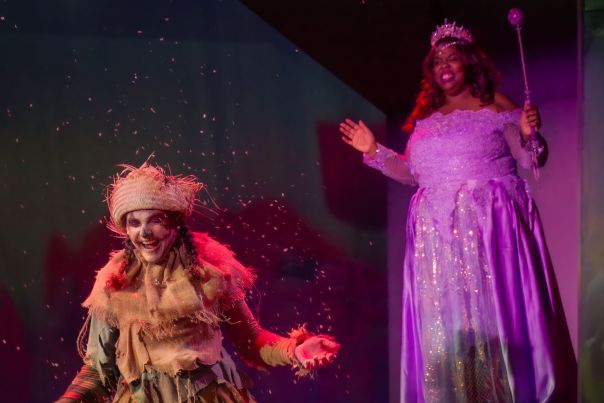
Modafferri’s infusions of diversity and gender switching don’t stop with Benjamin. Brandie Hill brings a righteous gospel flavor to Aunt Em and especially to Glinda the Good, while D. Laverne Woods brings out the gypsy in Professor Marvel and the sass in the Wizard. Darren Spencer as Uncle Henry is a softer, more indulgent contrast to Aunt Em’s law-abiding rigor, making him the obvious choice to play the softy old Guard at Oz’s palace.

Mostly at the service of Fuehrer’s projection designs, set designer Chris Timmons’ neutral-toned slabs don’t quite allow the colors to pop until we first espy the poppy field and Emerald City beyond. The cityscape lingered a few seconds too long as we transitioned from Oz to the wicked West, my first inkling that there was more than one projector in play. The more concerning miscue on opening night was the stage crew’s failure to secure the flight of stairs leading up to the platform where the Wicked Witch makes her immortal “What a world!” exit.

Poor Bain took a nasty little tumble trying to get up there, nearly breaking her neck before she had a chance to melt, prompting Vipperman to be very careful when she climbed up after her. The wonderful reversal was still effective.

That climactic scene cannot be withheld from an adoring public, so Timmons had to choose between the complexities of using a trapdoor in the middle of his stage or building a platform. The latter solution is likely simpler, but its hazards were frightfully exposed last Friday. No doubt all the furniture moving and fastening will go better this week as the run resumes.

Technically, the Theatre Charlotte version of The Wizard is nowhere near as dazzling as the CP version of 2006, when the Witches, the Wizard, Dorothy, the Scarecrow, Miss Gulch, and a cow all flew, and Glinda floated gloriously in a bubble. Such lavishness is probably the main reason why CP shitcanned its Summer Theater programming this season – after four decades of serving as the best launching pad for emerging professional talent that Charlotte has ever seen.

Musically, the lack of a live orchestra dulls the brilliance of Herbert Stothart’s scoring, but music director Matt Primm and his talented cast rescue things nicely. After a shaky start, when Vipperman was too studiously on the beat, “Over the Rainbow” came to full bloom. Surrounded by the loosey-goosey shenanigans of Ovall and Britt, she blossomed even more in Oz. Pepper Alpern as Toto remained a wild card. Nobody knew what the mutt would do next, behaving, barking, or otherwise stealing focus.

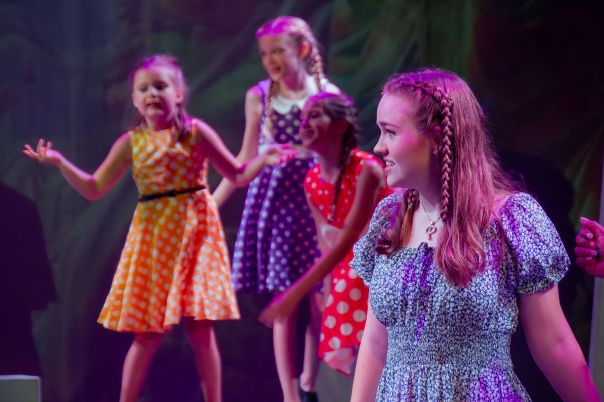
Engstrom and choreographer Vanessa Zabari held a deck full of winning cards to counteract this earthbound production’s lack of aerial aces. Dance numbers greatly enlivened the arrivals in Oz and the Emerald City when a bevy of Munchkins, a Youth Ensemble, and an Adult Ensemble strutted their stuff, captained by Aidan Conway. Punctuating the action at key moments with assorted tumbles, somersaults, and splits, Conway was also a pro-grade soloist when he wasn’t fronting the ensembles.

Thanks to Engstrom, Emerald City was a sea of multitudinous greens, and the changes of dresses for the adorable Munchkins were more than enough to convince me anew that Oz truly is a merry old land. But for the next two months, I’d be quite content if I didn’t see another damn polka dot.

“A Soldier’s Play Recalls” the Brink of a New Era

Review: A Soldier’s Play at The Gettys Center

By Perry Tannenbaum

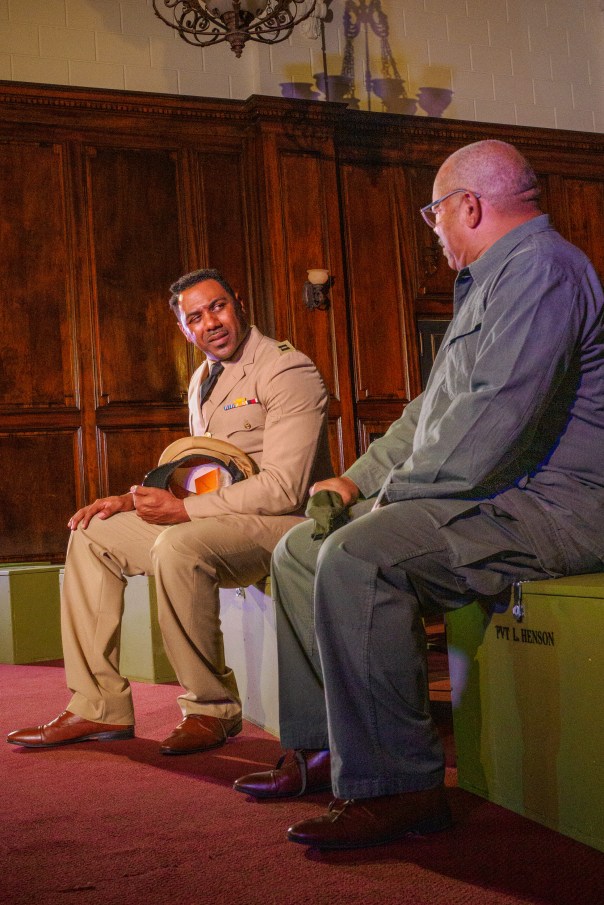
KKK, segregation, and Jim Crow are all in the air as Charles Fuller’s A Soldier’s Play unfolds in 1944 at Fort Neal, a fictitious army base in Louisiana. Yet there are beacons of hope, personified by the Black privates, the corporals, and the busted sergeant we see in a humble barracks. Broadway Lights subscribers saw a deluxe revival of the 1982 Pulitzer Prize winner at Knight Theater back in January, and the current Free Reign Theater reprise down in Rock Hill – not Rural Hill, that was Free Reign’s HQ last summer – only reaffirms the script’s stature as a classic.

Fuller captures these Black military men on the brink. Any day now, these eager recruits are hoping to be deployed across the Atlantic, where they can prove themselves on the battlefield fighting the Nazis. On the home front, we learn that this platoon of baseball players, culled from the Negro Leagues, has a chance to play the New York Yankees if their team can maintain its undefeated record through the rest of the season.

Not a far-fetched dream! Just three seasons into the future, Jackie Robinson will make his breakthrough MLB debut with the Brooklyn Dodgers, win Rookie of the Year honors, pop champagne with his white teammates as he celebrates his first National League pennant, and become the first Black athlete to play in the World Series – against the New York Yankees.

Fuller accurately fine tunes his soldiers’ aspirations, but he drops a bombshell into this Deep South outpost that is equally shocking to the Black scrubs and the white officers on base. When the ballclub’s manager, Tech Sergeant Vernon C. Waters, is murdered in the middle of the night, presumably by local racists, the feds in DC send Captain Richard Davenport to investigate.

DC or not DC, Davenport is a Black lawyer. How is he going to be able to point a finger at a gang of KKK knights, dragons, or wizards and proclaim “Arrest these men!” within the borders of Louisiana? It’s as if a DC thinktank had come up with the surest way for Waters’ murderers not to be prosecuted for their crime.

Nobody on base has ever seen a Black man like this before. Captain Charles Taylor, Waters’ former commanding officer, admits his discomfort in accepting Davenport as an equal. He’s also a bit flustered by the stranger’s cool and orders him to remove those glasses, forgetting that Davenport outranks him. Adams enjoys his teaching moment with a nice nonchalance as Tim Huffman seethes, finely calibrating Taylor’s redneck tendencies with his West Point pedigree.

Whether or not they can sense the Robinson breakthrough on the horizon – or grasp the MLK dream 19 years before he proclaims it – the Black ballplaying soldiers also show that there’s a learning curve for them in dealing with Davenport’s intelligence, competence, professionalism, and objectivity. Flustered, flummoxed, or wary, the corporals and privates quickly show that they are no less thrown by this Davenport phenomenon than Taylor.

And of course, they share Taylor’s skepticism about Davenport’s ability to charge a KKK-grade racist with any crime in Louisiana and make it stick.

Everybody, then, is taken aback as Davenport ignores race altogether, seeking to interrogate both Black soldiers and white officers in search of the facts, and allowing those facts – rather than easy presumptions – to lead him to the truth. Only the busted sergeant, Andrew Roberts as Private James Wilkie, seems to realize that Davenport is seeking evidence to form his opinion of who the murderer or murderers might be rather simply bolstering the opinion he already had.

Davenport is paying attention when Wilkie upsets the KKK hypothesis with a telling observation that Fuller cleverly assigns to the one man at Fort Neal who has lost his stripes. Roberts gives us a messy mix of servility and seething resentment as Wilkie’s complex layers unfold. It was Waters, after all, who busted Wilkie, so the former sergeant will become a prime suspect in the instant that the Klan is cleared of suspicion.

Not only does Wilkie open the door to new possibilities of viewing Waters’ murder, he also opens a window into the deep tensions that lurk beneath the graceful, flawless façade of the invincible team. In flashbacks triggered by Davenport’s ongoing interrogations, we soon see that Waters’ mix of servility and resentment was far more toxic than his subordinate’s. An unforgettable debasement of a Black man at the hands of white officers that Waters witnessed in France during World War I ignited a lifelong secret crusade against the “Geechies” that he despises, Southerners whom he sees as tarnishing the image of his race and hampering their progress.

It is an absolute mania, and even the best player on the team, Private CJ Memphis, does not escape Waters’ lethal prejudice. The chin-to-chin confrontation between Justin Peoples as Waters and Dominic Weaver as Memphis, modeled after the Claggart-Budd climax in Herman Melville’s Billy Budd, Foretopman, is more electric than any of the Davenport-Taylor faceoffs. In the sequel to the Waters-Memphis climax in the barracks, a jailhouse stunner where Waters berates and gloats over his latest victim, Memphis achieves a tragic stature when Weaver proceeds to channel Billy Budd’s Christ-like attributes.

Under Dr. Corlis Hayes’s beautifully judged direction, the deep Billy Budd conflict regains its dominance over the Davenport-Taylor sparring. The touring production, unlike the previous New York productions and the 1984 film adaptation, tilted our attention away from Waters toward Broadway star Norm Lewis, who took over the Davenport role on the road. Yet we still see quite vividly that the new man on base is the future.

Shining more light upon Waters’ diabolical obsession, Hayes and Peoples let us see that, in some ways, A Soldier’s Play is like a Perry Mason mystery. So many soldiers on his team detest Waters that almost every one is a legitimate suspect. Davenport’s main weapon is cross-examination – in Captain Taylor’s office, his own hastily-outfitted domain, or in front of the soldiers’ bunk beds and foot lockers.

Weaver’s performance as CJ, like a genial Willie Mays with a guitar, further focuses on the enormity of Waters’ crime. Memphis isn’t the only player who has tangled with his racist tech sergeant. PFC Melvin Peterson, a Northerner like Waters, is more offended than anyone by the sergeant’s bigotry, and Devin Clark, who shone so brightly as Brutus in Free Reign’s Julius Caesar last year, is more than up to capturing Peterson’s rage, which leads to a fight with Waters. His antagonism lingers on, flaring up again when CJ is baited by Waters and jailed.

Suspects abound, in the barracks and among the white officers. As Lieutenant Byrd, David Hensley’s defiance and antagonism toward Davenport, when he has the effrontery to question him, nicely contrasts with Hugh Loomis’s subdued pragmatism as Captain Wilcox, who realizes that his pal’s hot-headedness may have already landed them both in hot water. Hayes also has a welcome urge to expand the light and relaxed interludes Fuller built into his play, importing blues singer Big Mary from Fuller’s screen adaption, and offering Shar Marlin a chance to give us a sassy respite from the all-male action with her cameo. Nice touch.

Having seen numerous Jackie Robinson biopics and dramas over the years, we can see some pragmatism in Waters’ disciplined philosophy to the extent that it mirrors the template that the future Hall of Fame second baseman fit into when he made his debut on the big MLB stage – supplemented by some pointed advice. Waters keeps his feelings bottled up in the company of superior officers, eradicates rusticity and superstition from his actions and speech, maintains a sober low profile, and waits patiently for these quiet concessions to win him favor and advance his career.

There’s a constant tension between that approach and the tacks taken by Memphis and Peterson. Memphis likes being liked, displaying his talents, being himself, and letting his natural gifts take him where they may. Even if he does lack education and polish, Memphis is respectful, outgoing, and good, though we have to factor in the large portions of female adoration he attracts. Clark gets to be more pugnacious and far more fiercely intelligent, despising bigotry in any form, even if it comes from Waters, a superior whose orders he should obey. He will stand up strong for his beliefs at all times, even if it means taking a licking.

But the real deal, Jackie-wise, is Davenport. Adams amalgamates all the best of Waters’ calculated patience and Peterson’s egalitarian principles, with the ability to turn on some of CJ’s natural charm. Before the soldiers have shipped off to Europe, eager to prove themselves in World War II’s European theatre, Davenport is a fully-evolved marvel that people in Louisiana readily recognize and value. As we saw in the spit-and-polish version presented at Knight Theater, Adams also chafes a little at the relentless saluting and military barking that comes from Hayes’s drilling, aided by two military consultants who keep all the soldiers coming to attention.

After much seasoning and resourceful survival, Davenport arrives fully polished, ready for primetime and postwar America. He may not have the fire of Malcolm X or the towering eloquence of MLK, but we can imagine Davenport as a worthy ally for either of those pathfinders.