Staggering our ability to comprehend, with a death toll of a million people over the space of just 100 days, the Rwandan genocide of 1994 isn’t the easiest subject to deal with, either for those who lost loved ones in the slaughter or for the international community that looked away. Co-creators Gakire Katese Odile, who speaks to us, and Ross Manson, who also directs, both know that the carnage cannot be minimized or undone.
Collaborating on The Book of Life, which premiered at the Edinburgh International Festival last September, Odile and Ross don’t even point fingers at those who sowed the deadly discord with toxic misinformation. Instead, their mission is one of healing for the survivors of the catastrophe and building concrete new hopes to replace the ruins. Staged at Festival Hall (formerly Memminger Auditorium) in its US premiere, The Book of Life is undoubtedly one of the most extraordinary events at Spoleto Festival USA this year, a genial ceremony of storytelling, music, dance, AV projections, and communal empathy.
We all received little pencils and pieces of paper as we entered the hall, so it was no mystery that we would participate. Odile, better known as Kiki, tells us something curious in the early moments about her encounters with both survivors and perpetrators: all of them speak of “we” in addressing their experiences instead of “I,” the more logical first-person.
To break through that defensive emotional distancing, Kiki asked them all to write personal letters to the dearest relatives they lost or, in the case of the perpetrators, the people they killed. Kiki’s collection of these letters, some of which she reads to us, are her Book of Life. Since each of these recalls a different story, it is easy enough for Kiki to weave other elements into the fabric of her show.
One recurring thread is an origin folktale where a leopard calls together the entire animal world and asks them all how they can steal away a piece of the sun from the other side of creation to light up their world of darkness. In succeeding episodes, a mole rat, a vulture, and a wee spider volunteer to be the leopard’s stealthy envoys, tunneling through to the other world, chipping off a piece of sun that won’t be missed, and bringing it back intact to spread the light.
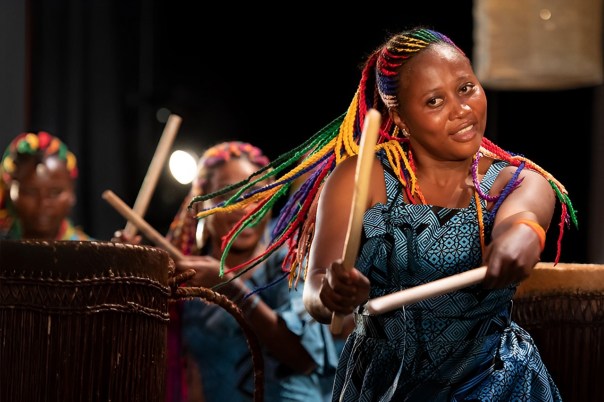
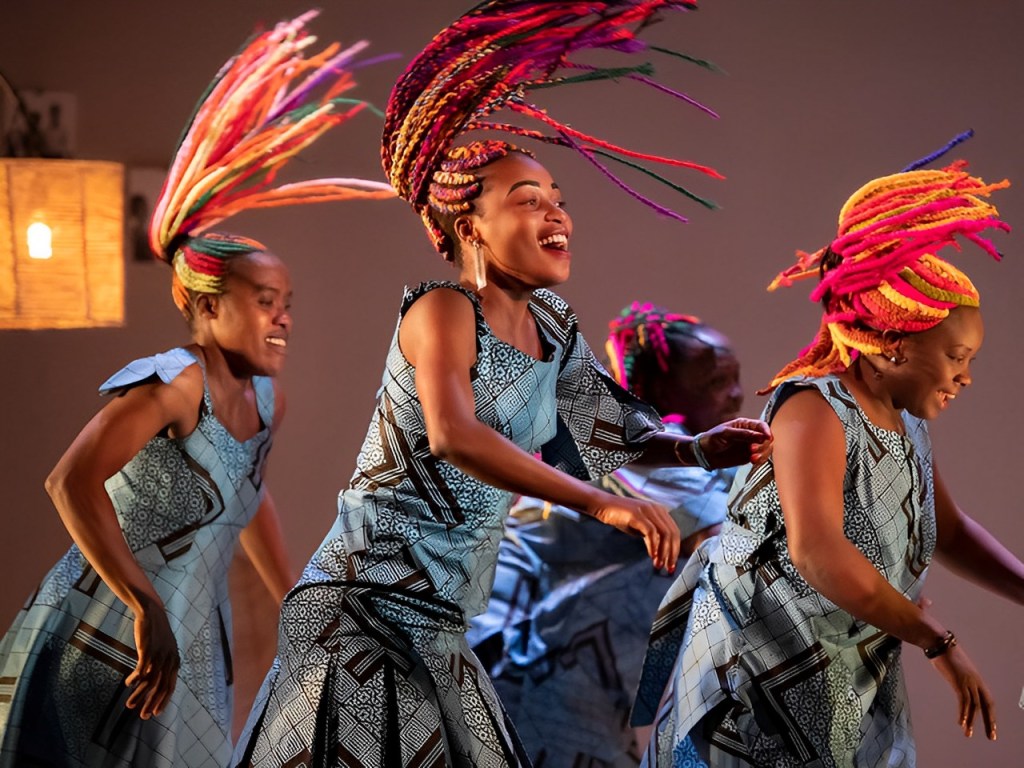
Spread across the stage, four women in amazing multicolored braids on each side of Kiki, are a group of live light-givers, the inspirational Ingoma Nshya (“New Drum” or “New Power” if you don’t speak Kinyarwandan): The Women Drummers of Rwanda. In the wake of the 1994 genocide, a grassroots movement incorporating all of Kiki’s constructive and conciliatory impulses founded the first Rawandan women’s drum circle in centuries – overturning a taboo against women even touching a drum or approaching a drummer.
The group’s name proves to be rather modest, for the women not only pound complex arrangements by Mutangana Mediatrice on their large conga drums, they sing impressively – as soloists or as a chorus – and they also dance, swinging their multicolored braids as part of the choreography or in pure joy. Translations of the songs are projected upstage, where we also see animations that accompany the testimonial letters and the animal fable.
Altogether, I thought that Kiki didn’t read nearly enough letters from The Book to counterbalance all of her charming diversions. Perhaps the most pleasing of these was hearing of her initiative to employ more women in Rwanda, an ice cream shop called Sweet Dreams, staffed entirely by women.
Most intriguing was Kiki’s unique exercise in sharing, when she asked everyone to draw a picture of one of our grandfathers with our pencils and papers. Not at all standoffish, Kiki herself came out into the hall to collect our handiwork, a nice touch. Then she gathered the entire drumming ensemble around her onstage to pick a winner that was shared with all of us, blown up on the projection screen.
The sharing continued as Kiki showed us a sheaf of past winners, one by one. After the show, trays of today’s drawings would be available in the lobby, and Kiki encouraged us to pick up one of these grandfathers as a keepsake on the way out. It was a fine way of underscoring a key point: images and memories of loved ones we have lost are still in our hearts and minds, shareable if we make the effort.
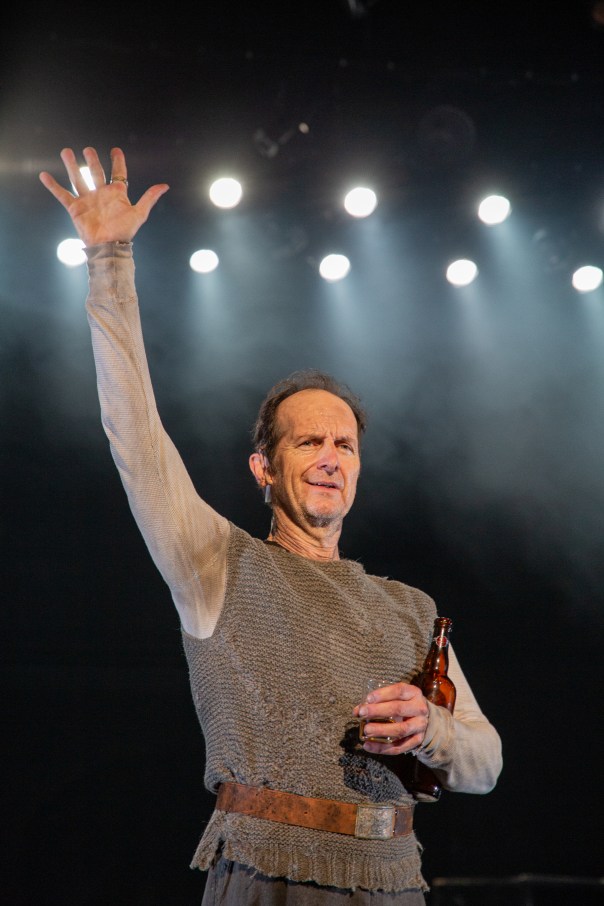
Writer-director Lisa Peterson and writer-actor Denis O’ Hare have chosen well in naming their adaptation of Homer’s epic AN ILIAD. For this Iliad is to be understood as one of many possibilities: one of many ways of retelling the blind poet’s colorful account of the Trojan War, which itself codifies many ancient oral transmissions by the Greek bard, and sadly, one of many wars that can be lamented, bewailed, and memorialized in this way.
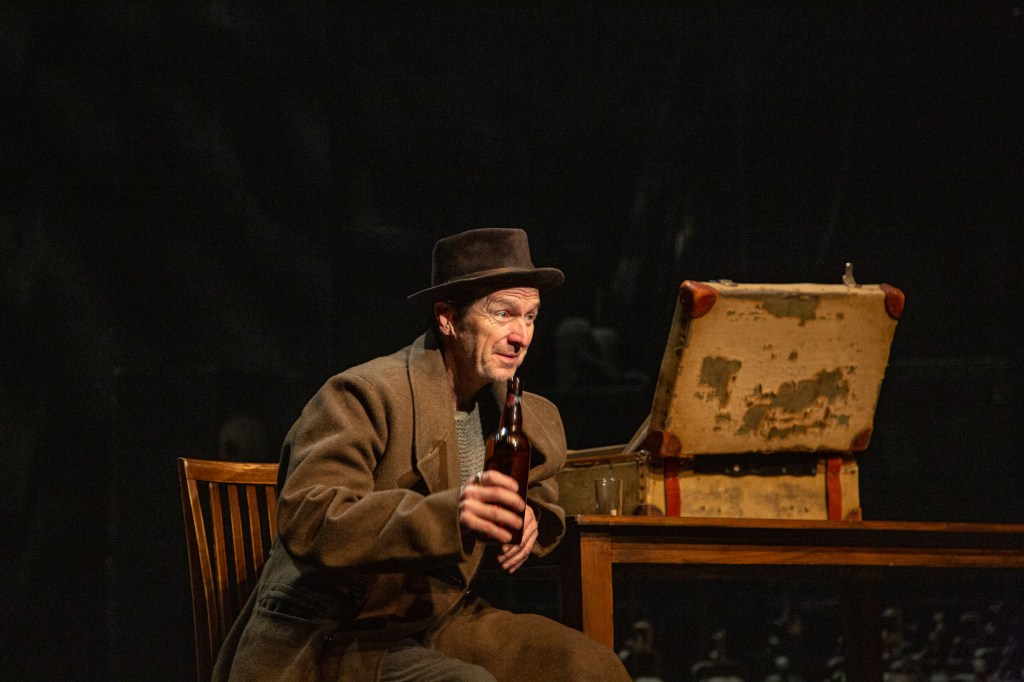
There’s a noticeable world-weariness in O’Hare’s demeanor as he enters for his Spoleto Festival USA debut, turns off a downstage ghostlight, and moves it to the wings at the antique Dock Street Theatre as he settles into the storytelling. Clearly in his eyes, it isn’t a story that does credit to mankind.
We quickly learn that Achilles and Hector will be the chief protagonists and adversaries in this distillation. Mercilessly, Peterson and O’Hare zero in on chief Greek personalities, just as Homer did, but with a more concentrated focus on their pettiness and hypocrisy. The war was begun when Hector’s brother, Paris, eloped with the beauteous Helen of Troy, stealing her from King Menelaus of Sparta.
King Agamemnon of Argos, brother of Menelaus, declares war on Troy to avenge his brother’s disgrace, and launches the fabled thousand ships to bring Helen back. O’Hare actually dips into the Robert Fagles translation of Homer to enumerate the kingdoms and the exact numbers of their ships that have sailed the seas with armed soldiers just to settle this domestic squabble.
Yet when we first see O’Hare portraying Agamemnon, nine long years into the 20-year war, the Argive king is refusing to give back a woman he shouldn’t have, despite the fact that the gods have already punished him for his insolence by decimating the entire Greek army with plague. When the Greek general finally relents, he does so by taking Achilles’ woman, Briseis (spoils of a previous war!), in exchange. Achilles’ isn’t pleased at all, but his counter to this indignity is more sullen and tranquil: the greatest champion of the Greeks sits in his tent, refusing to fight.
O’Hare is so focused on the pettiness and selfishness of Achilles that he ignores the impact and implications of his sitdown strike: by sulking on the sidelines, Achilles does as much – if not more – to turn the tide of the war than the deaths of thousands in the plague. That’s how colossally great this warrior so often proves to be in Homer’s telling.
But despite O’Hare’s anti-heroic sentiments, there is no stinting when he arrives at the wrath of Achilles, the Myrmidon king, after Hector has slain his beloved Patroclus. Nor should there be, since “Goddess, sing the rage of Peleus’ son Achilles” is the opening plea from Homer to his Muse in Fagles’ translation – and every other – clearly the Bard’s central subject.
There’s a huge payoff for dwelling on Achilles’ rage and his barbaric exultation after he has avenged Patroclus’s killing. The fury of it resonates through the Homeric catalogue that O’Hare inserts into his narrative, a catalogue of wars that have raged around the world since the Trojan War that parallels the Homer’s catalogue of ships that sailed on Troy.
Ultimately, Achilles’ fury and his fearsome rampage are a towering eruption of his hurt pride and the bitterness of his compounded losses. Agamemnon surely hasn’t appeased him, and his best friend Patroclus found no way to end his sulking. Yet when he spirals out of control, still furious after wreaking his revenge, it is the grieving King Priam, Hector’s aged father, who finally calms Achilles down and returns him to civility.
O’Hare crafts his storytelling, referencing our pandemic sufferings and the war in Ukraine along the way, in a manner that augments the dignity and poignancy of Priam’s supplications – making us understand how deeply the old king must reach to stir Achilles’ humanity and steer him back toward reason.
The magic of this moment is in the commonality of the grief that Achilles and Priam can share. It is a grief that men have perpetrated and suffered forever. We shake our heads sadly over how devastatingly hurtful and heartbreaking it all is – and how utterly senseless and stupid.
With so many theatre, dance, opera, jazz, orchestral, choral, and chamber music events to choose from – more than 300 artists from around the world, streaming in and out of Charleston over 17 days (May 26 through June 11 this year) – planning a dip into Spoleto Festival USA is always a challenge. Even Spoleto’s general director, Mena Mark Hanna, struggles to prescribe a strategy, as hesitant as a loving mother of 39 children to pick favorites.
“My suggestion for a first-time participant,” he says, sidestepping, “would be to see two things you like and feel comfortable about seeing, maybe that’s Nickel Creek (May 31-June 1) and Kishi Bashi (June 3), and two things that are really pushing the envelope for you. So maybe that’s Dada Masilo (June 1-4) and Only an Octave Apart (June 7-11).”
Nicely said. Only you can easily take in the first three events Hanna has named within three days, but you’ll need another four days before you can see singer-songwriter phenom Justin Vivian Bond and their monster opera-meets-cabaret-meets-pop collaboration with countertenor sensation Anthony Roth Costanzo. If you happened to see the recent Carol Burnett tribute on TV, the cat is out of the bag as far as what that will sound like, if you remember the “Only an Octave Apart” duet with opera diva Beverly Sills – recreated for Carol by Bernadette Peters and Kristin Chenowith.
What it will look like can be savored in the Spoleto brochure.
The giddy Bond-Costanzo hybrid is one of the key reasons that my wife Sue and I are lingering in Charleston through June 9. Equally decisive is the chance to see jazz legends Henry Threadgill (June 6) and Abdullah Ibrahim (June 8), the Spoleto Festival USA Chorus singing Thomas Tallis’ Spem in alium (June 7-8),and Jonathon Heyward conducting Hector Berlioz’s Symphonie Fantastique (June 9).
One other irresistible lure: the opportunity to see Maestra Mei-Ann Chen conduct Antonín Dvořák’s New World Symphony(June 7), along with works by Florence Price and Michael Abels – less than four months after her scintillating debut with the Charlotte Symphony.
Abels, you may recall, teamed with Rhiannon Giddens last year in composing Omar, the new opera that premiered at Spoleto – after an epic gestation that spanned the pandemic – and won the Pulitzer Prize for Music earlier this month. It was a proud moment for Spoleto, for Charleston, and for the Carolinas. For Hanna, it was an extra special serendipity to help shepherd that work to completion.
“I mean, it’s kind of incredible,” he explains, “to be someone who comes from Egyptian parentage, speaks Arabic, grew up sort of fascinated by opera and stage work and spent their career in opera and was a boy soprano – to then have this opportunity to bring to life the words of an enslaved African in Charleston, South Carolina. And those words are Arabic!”
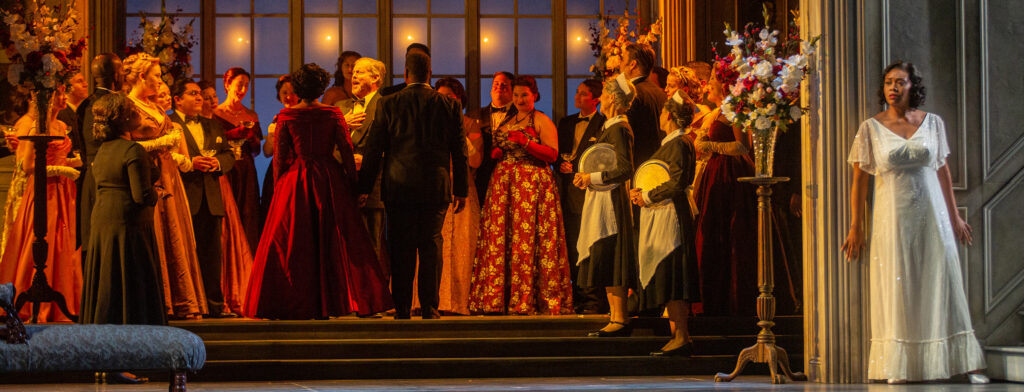
We may discern additional serendipity in the programming of this year’s opera, Samuel Barber and Gian Carlo Menotti’s Vanessa (May 27-June 10), which garnered the Pulitzer in 1958. Revived at Spoleto in 1978, the second year of the festival – with festival founder Menotti stage directing – the production was videotaped by PBS and syndicated nationwide on Great Performances, a huge boost for the infant fest. That revival also sparked a critical revival of Barber’s work.
Omar was the centerpiece of a concerted pushback at Spoleto last year against the Islamophobia of the MAGA zealots who had dominated the headlines while the new opera was taking shape. Vanessa is part of what Hanna sees as a subtler undercurrent in this year’s lineup, more about #MeToo, Black Lives Matter, and the repeal of Roe v. Wade.
“I want there to be a kind of cohesiveness without necessarily us being able to see what the theme is,” Hanna reveals. “If there is something that unifies a lot of these pieces, it’s about understanding that we are telling stories from our past, some of them the most ancient stories that we have in our intellectual heritage. We are looking at these stories with a different sense that takes on the reverberations of today’s social discourse.”
Among other works this season at Spoleto that Hanna places in his ring of relevance are An Iliad (May 26-June 3), a one-man retelling of Homer’s epic featuring Denis O’Hare; Igor Stravinsky’s The Rite of Spring (June 5), as an orchestral concert and the inspiration for Masilo’s The Sacrifice; Helen Pickett’s new adaptation of Arthur Miller’s The Crucible for Scottish Ballet (June 2-4); and A Poet’s Love (May 26-30), a reinterpretation of Robert Schumann’s Dichterliebe song cycle by tenor/pianist Jamez McCorkle, who played the title role in Omar last year – with stagecraft, shadow puppetry, and projections by Miwa Matreyek.
“Going back to the Trojan War, An Iliad is as much about war and plague then as it can be today with the reverberations of Ukraine and the pandemic,” says Hanna. “Vanessa, is reinterpreted here through the lens of a remarkable female director, Rodula Gaitanou. The cast is just killer: You have Nicole Heaston as the lead with Zoe Reams and Edward Graves and Malcolm McKenzie and Rosalind Plowright, just a world class cast at the very, very top. And it’s also really cool to see these roles, which are traditionally sung by Caucasian people, being sung by people of color.”
Aside from the recurring motif of reclusion, so vividly resonant for all of us since our collective pandemic experience, Hanna points to a key turning point in the opera. Menotti left it mysterious and ambiguous in his libretto at a key point when Vanessa’s niece, Erika, either has a miscarriage or – more likely – an abortion.
For Hanna, that brings up an important question: “What does that mean now when we are looking at a renewed political assault on female autonomy? So these stories take on new messaging, new reverberation in 2023. And we need to retell these stories with the new lens of today.”
Especially in the Carolinas.
Long accompanied by a more grassroots and American-flavored satellite, the Piccolo Spoleto Festival, Menotti’s international arts orgy has taken a long, long time to shed its elitist mantle. Now it is moving forcefully in that inclusive direction with a new Pay What You Will program, offering tickets to about 20 performances for as low as $5 – thanks to an anonymous donor who is liberating about $50,000 of ticket inventory.
Hanna brought this exciting concept to the unnamed donor, hasn’t talked to him or her or them – yet – about sponsoring the program in future years, but he is pledging to continue it regardless.
“What art can do is endow you with a new experience, a transformational experience that you did not have before you took your seat,” he says. “It can help create an understanding of another side that is normally seen by one perspective as socially disparate, as highly politicized, as a discourse that’s just way too far away. Art can break down that barrier through the magic and enchantment of performance. To me, having those artists onstage, representative of a demographic we wish to serve, only takes us so far. We also have to lower the barrier of entry so that we can actually serve that demographic.”
Kishi Bashi not only continues Spoleto’s well-established outreach to Asian culture, he also typifies the more hybrid, genre-busting artists that Hanna wants to include at future festivals.
“We want to try to find these artists that are like pivot artists, who occupy these interstitial spaces between dance and theater and classical music and jazz and folk music,” Hanna declares. “And Kishi Bashi is one of those. He plays the violin on stage. He has all of these violinists on stage with him, but it’s this kind of strange, hallucinatory, intoxicating music that’s like somehow trance music and Japanese folk music, but using sort of Western classical instruments. Yet it’s very much in an indie rock tradition as well.”
Other wild hybrids include Leyla McCalla (May 26), the former Carolina Chocolate Drops cellist who blends Creole, Cajun, and American jazz and folk influences; Australian physical theatre company Gravity & Other Myths (June 7-11), mixing intimate confessions with acrobatics; Alisa Amador (June 7), synthesizing rock, jazz, Latin and alt folk; and the festival finale, Tank and the Bangas (June 11), hyphenating jazz, hip-hop, soul, and rock. Pushing the envelope in that direction is exciting for Hanna, and he promises more of the same for the ’24, ’25, and ’26 festivals.
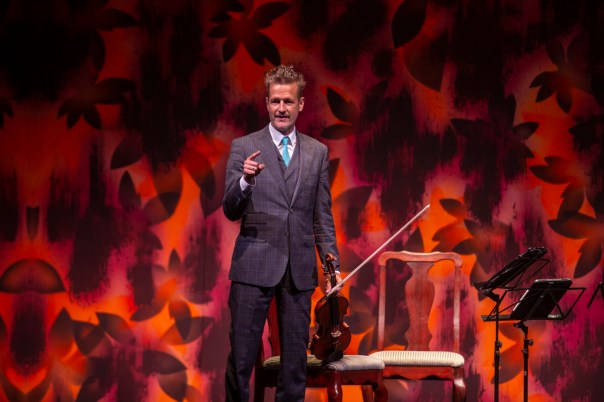
Until the Pulitzer win, the year had been pretty rough on Hanna, losing Geoff Nuttall, the personable host of the lunchtime Chamber Music Series at Dock Street Theatre. Nuttall was the artist who convinced Hanna to come to Spoleto. At the tender age of 56, Nuttall had become the elder of Spoleto’s artistic leadership when he died, beloved for his style, wit, demonstrative fiddling, and his passionate advocacy of the music. Especially Papa Haydn.
The special Celebrating Geoff Nuttall (May 26) concert will gather his close friends and colleagues for a memorial tribute at Charleston Gaillard Center, including violinist Livia Sohn, cellist Alisa Weilerstein, countertenor Anthony Roth Costanzo, tenor Paul Groves, pianist Stephen Prutsman, and surviving members of the St. Lawrence Quartet. The occasion will be enhanced by the Spoleto Festival USA Orchestra and Atlanta Symphony’s Robert Spano – plus other guests soon to be announced.
Hosting chores for the lunchtime 2023 Chamber Music series, spread over the full festival, 11 different programs presented three times each (16 performances at 11:00am, 17 at 1:00pm) will be divvied among vocalists and instrumentalists who perform at the Dock. It was totally inappropriate, in Hanna’s eyes to replace Nuttall onstage this year, but he will begin to consider the charismatic violinist’s successor during the festival and into the summer. Hanna assured me that the player-to-be-named later will be a performer who participates in the musicmaking.
Continuing on the trail blazed by Amistad (2008), Porgy and Bess (2016) and Omar, Hanna wants to place renewed emphasis on the Port City and its African connection. It must run deeper than seeing Vanessa delivered by people of color.
“Charleston was the port of entry for the Middle Passage,” Hanna reminds us. “And Charleston has at its core an incredibly rich Gullah-Geechee-West African-American tradition that is part of the reason this is such a special, beautiful place to live in with its baleful history. So I think that you see that this year, you see that with Gakire Katese and The Book of Life (June 1-4), you see that with Dada Masilo and The Sacrifice, you see that with Abdullah Ibrahim and Ekaya.”
Resonating with the brutalities of Ukraine, Ethiopia, and Syria on three different continents, the US Premiere of Odile Gakire Katese’s The Book of Life may be the sleeper of this year’s festival, crafted from collected letters by survivors and perpetrators of Rwanda’s 1994 genocide and performed by Katese, better known as Kiki. “After the unthinkable, a path forward,” the festival brochure proclaims. The finding-of-hope theme will be underscored by music created by Ingoma Nshya, Rwanda’s first-ever female drumming ensemble, founded by Katese.
“Kiki is engaging with how a country tries to reconcile with its recent, terrifically horrific past of the Rwandan genocide as someone who grew up Rwandan in exile. You see that in the work of Abdallah Ibrahim, who was really one of the great musicians of the anti-apartheid movement, who composed an anthem for the anti-apartheid movement, was in a kind of exile between Europe and North America in the 80s. And then when he finally came back to South Africa for Nelson Mandela’s inauguration, Nelson Mandela called him our Mozart, South Africa’s Mozart.”
Marvelous to relate, you can hear more of South Africa’s Mozart this year at Spoleto Festival USA than Vienna’s Wolfgang Amadeus – or Germany’s Ludwig von Beethoven. That’s how eclectic and adventurous this amazing multidisciplinary festival has become.







 Art on My Sleeve