Monthly Archives: March 2023

CSO and the JCSU Concert Choir Lift Every Spirit at Brayboy

Review: Johnson C. Smith University and Charlotte Symphony

By Perry Tannenbaum

2023~CSO at JCSU-35

March 21, 2023, Charlotte, NC – You might have thought that a symphony orchestra performing in a college gymnasium would prove to be an odd coupling. Sure, there can be satisfying concerts staged at coliseums where a city’s basketball team plays, but those are usually performed by rockstars, pop icons, and the occasional Cirque du Soleil troupe when every note is processed electronically. My curiosity was certainly piqued when Charlotte Symphony Orchestra announced that its “In Concert with Johnson C. Smith University” program would be happening on campus at the Brayboy Gymnasium. Led by resident conductor Christopher James Lees, Symphony would be joined on the court – the hardwood covered with bright blue tarpaulin – by the JCSU Concert Choir, led by soprano Shawn-Allyce White and accompanied by pianist Frank Williams.2023~CSO at JCSU-13

A hookup between Symphony and JCSU at a more established concert venue should have seemed inevitable as long ago as 2015, when the leadership of Spoleto Festival USA visited the campus to announce that the Concert Choir would be participating in the high-profile production of Porgy and Bess the following year, celebrating the festival’s 40th anniversary. Yet when Lees picked up a microphone to greet the crowd, he reminded us that Symphony hadn’t been on campus for 13 years – indicating that this was his first time on campus and implying that CSO’s last musical director, Christopher Warren-Green, had never gotten around to the inevitable before his tenure ended. Were the optics or the acoustics the obstacles that had forestalled a return visit? Or was the idea simply slept on after Opera Carolina enlisted the men of the Concert Choir for their production of Cyrano in 2017, followed by the full choir’s appearance in I Dream in 2018?

Any questions about the Brayboy’s acoustics were swiftly dispelled. The sound from Lees’ microphone was crisp and present, nothing like the muffled sound from a faraway galaxy that emanates from PA systems at some basketball arenas or outdoor stadiums. As the brass heralded the assault of Franz von Suppé’s “Overture from Light Cavalry,” the sound remained bright and forward for all sections of the orchestra, not at all like an echoey gymnasium. French hornist Robert Rydel and principal flutist Victor Wang stood out sharply from the ensemble in their little cameos.

Rather than the controlled gallop and fury of Karajan’s recording with the Berlin Philharmonic, Lees seemed to favor the frantic onrush of Paul Paray’s recording with the Detroit Symphony, which shaves more than a minute off the Berliners’ 7:38 timing. The strings could show off their fast fingering as well as their lush tone, and when the familiar big tune surfaced, four percussionists sprang into action to make the cavalry charge more thrilling. Maybe more impressive – and surely boding well for the 14-member Concert Choir standing by for their pieces – was the syrupy sweetness of principal clarinetist Taylor Marino’s eloquence during a lull between two of the Cavalry dust storms.2023~CSO at JCSU-23
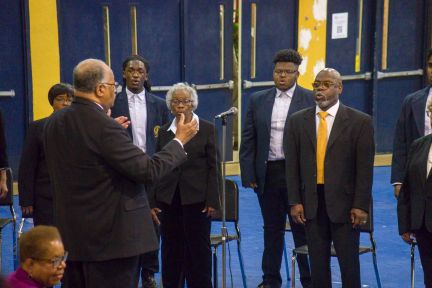
Fortified by two floor-standing mikes, the Concert Choir, eight women and six men on this occasion, were as stirring and powerful as ever at Brayboy, opening with William Henry Smith’s acapella arrangement of the traditional “Walk Together, Children.” Mostly tinted with treble and infused with jubilation, the main takeaway from the Choir’s performance wasn’t the urging of walking together but the excitement of “a great camp meeting in the Promised Land.” Richard Smallwood’s “Trust Me” was statelier, more equally weighted between the men and the women, never deteriorating into the sluggishness or singsong repetitiveness of other performances I’ve heard. The pause midway was particularly dramatic, daring to linger in silence long enough for the first smatterings of applause to break out before returning with thunder.

In between these two righteous chorales, Lees slipped in Jessica Meyer’s Slow Burn, reminding us in his intro that the composer was a violist and to be on the lookout for principal CSO violist Benjam2023~CSO at JCSU-07in Geller’s pivotal solo – but somehow neglecting to mention that the 2018 composition was written for a burlesque dancer. The piece was wonderfully apt when Symphony first performed it in early 2021, when wind players weren’t yet allowed back in concert halls due to pandemic restrictions, and the worldliness of this all-strings piece was a fine fit at the Brayboy. Bluesy strings did all of the sensual slitherings, while a pair of double basses provided percussion via pizzicatos, hand slaps, and vigorous thwacks of the bow on the necks of the instruments, accentuating Meyer’s jazzier passages. Most alluring was Geller’s suggestive glissando triggering the key swell of the strings that most vividly evoked Meyer’s title. Nor did Geller’s subsequent solo disappoint.

The two orchestral pieces that followed were more like what we expect from a city’s Symphony, but a pleasant surprise lurked in the first of these, a work dating back to the days of Haydn and Mozart, the Symphony No. 2 by Joseph Bologne, Chevalier de Saint-Georges. A champion swordsman, military leader, and political revolutionary, Saint-Georges was the son of a French planter and an African slave who would be called “The Black Mozart” because of his varied musical output, including orchestral works and operas. Saint-Georges played a key role in commissioning Haydn’s Paris Symphonies and may have mentored the younger Mozart. The outer movements, Allegro and then Presto, reminded me instantly of Mozart’s symphonic pieces, while the inner Andante brought Papa Haydn to mind. Violins dominated throughout, subtly backed by French horn and oboe in the opening movement, then by pizzicatos from the lower strings in the finale.

Some Slavic coloring had peeped into the Cavalry overture, but the performance of Antonín Dvořák’s Slavonic Dance No. 8 was the pure essence, a percussion orgy driving the main theme and the high woodwinds taking the spotlight. Anything less would have been anticlimactic in the wake of Dr. White’s stirring vocal on the Hall Johnson arrangement of “Ride on, King Jesus,” accompanied by Williams at the keyboard and crowned with a flurry of vocal fireworks. White was only slightly less impressive after the Dvořák, taking the lead vocal on the Moses Hogan arrangement of “Ev’ry Time I Feel the Spirit,” backed by the full choir with Williams conducting.

Lees stated the obvious when he declared that we were all waiting to see Charlotte Symphony and JCSU Concert Choir perform together. Would we get the Gershwin brothers or the Johnson brothers? Nothing less than the “National Black Anthem” would do at this point of the evening. While there are many YouTube examples of Dr. Roland Carter’s arrangement of “Lift Every Voice and Sing,” none on my radar sport more than a piano and an organ for their instrumentation. So Charlotte Symphony may have broken some new ground here with its uncredited orchestration.

The effect was electrifying as the entire audience rose to their feet to honor the anthem. In Carter’s arrangement, there are instrumental sections before each of the three stanzas where James Weldon Johnson’s lyrics are set to J. Rosamond Johnson’s music. Each of these interludes affording sufficient space where an orchestra can shine while providing an orchestrator with engaging new melodic material. Of course, you also want the orchestra to actively support the choir each time it enters, so the new CSO orchestration added a dimension that has always been missing in the YouTube versions. Together, Charlotte Symphony and the Johnson C. Smith Concert lifted the impact of “Lift Every Voice.”2023~CSO at JCSU-29

We weren’t quite done even now. Lees had hedged a bit in announcing that a surprise awaited us, probably remembering as he spoke that the JCSU Drumline, alias the Funk Phi MOB, was already mentioned in the digital program. But before they brought on the rhythm and the funk, we were all invited to participate in a lighter CSO-JCSU hookup. After a brief rehearsal of the seven-note melody, we all joined in on cue for vocal sections of Daniel Bernard Roumain’s La, La, La, La. Needless to say, the lyrics were not a challenge.

2023~CSO at JCSU-32

Amid this glee, Funk Phi MOB came marching in with their purely collegiate pandemonium, carrying me back to long-ago Saturday afternoons at the University of Iowa, the University of Oregon, and Williams-Brice Stadium where my shivers were alleviated or intensified by the fortunes of my hometown college football teams. This drumline was a bit more up-to-date than the drum corps I remember stationing themselves at midfield. Beside the customary bass drums and snare drums, a couple of these percussionists were outfitted with some sort of Yamaha hybrid, five or six flat shiny surfaces arrayed like a cross between timpani and a xylophone. If you’ve experienced how a stadium rocks during halftime, you can imagine the gymnasium version, peaking at a sensible 94dB according to my Apple Watch.

Topping off this mighty2023~CSO at JCSU-38mayhem, a drum major arrived with all his spirited, ceremonial, and high-stepping antics. Thanks for being here had been expressed long before this all-American climax, so without further adieus, the drum major could end the concert by leading the Drumline, Dr. White, and Lees out of the hall. When my wife Sue and I managed to navigate from our seats through the exiting audience and folks still milling on the court – conversing, posing for photos, and taking selfies – we emerged from the Brayboy Gymnasium and found that a drum party was still going on outside the entrance. Fortunately, I had brought my camera. Sue wouldn’t let me proceed to the parking lot until I took a few shots.

Misery Loves the Queens Road Barn

Review: Misery at Theatre Charlotte

2023~Misery-1

Fame can be unsettling, painful. It can be dangerous, corrupting, or toxic. But it was Stephen King who had the marvelous idea, with Misery, that fame could also be a gripping horror story – and in case anybody had forgotten, immensely lucrative. The 1990 film, adapted for the screen by William Goldman and directed by Rob Reiner, snagged a few awards for lead actress Kathy Bates as Annie Wilkes, bestselling author Paul Sheldon’s #1 fan. Goldman also crafted the 2012 stage adaptation that opened on Broadway in late 2015, starring Laurie Metcalf opposite Bruce Willis.

That’s the version playing now at Theatre Charlotte. Metrolina has seen previous incarnations of Misery, by Rock Hill Community and Off-Tryon Theatre, but those adaptations were by British screenwriter Simon Moore. So this Willis-Metcalf vehicle, directed by former Theatre Charlotte executive director Ron Law, qualifies as a local premiere.

The main attraction of the Moore version, retained by Goldman, is that it turned the restrictions of a live stage presentation to our advantage, stripping away the outside world almost entirely and making the story more claustrophobic – no pig, no media, no fretful literary agent, and just one law enforcement agent. It’s very much like a first-person narrative by an immobilized writer who wakes up unexpectedly inside a torture chamber.

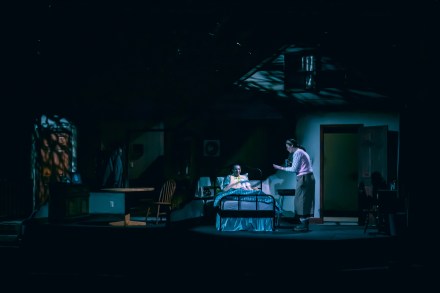
Chris Timmons builds a silhouetted two-story set that meshes well with his drab, gloomy, lightning-streaked lighting design, while Christy Edney Lancaster layers on plenty of thunderclaps in her sound design along with pop song recordings that sound like they originated on 78 rpm shellac (quite possibly the same Liberace cuts heard in the movie). It’s very creepy at the old Queens Road barn when lights dim out and our attention becomes centered on the light shining from Annie’s upstairs bedroom, framed by lightning flashes.

2023~Misery-3We seem to be in a macabre fairytale forest or wilderness, snowbound outside of Silver Creek, Colorado. Sheldon has been severely injured in a car crash, Annie has extricated him from his wrecked Mustang, and she has somehow carried him up from a deep ravine in a heavy snowstorm and brought him home, where she is nursing him back into shape with splints, pills, intravenous fluids, and injections. As Sheldon’s #1 fan, Annie must have obtained King’s permission to stalk her idol through the storm, making this whole yarn possible.

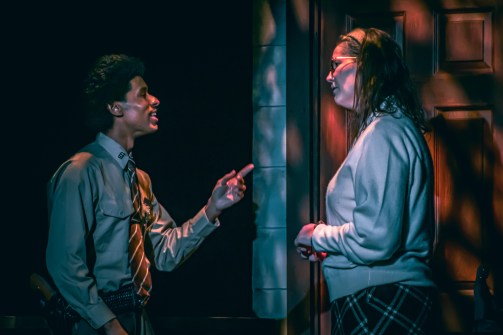
She is a nurse by trade, we quickly see, evidence of IV treatments still lingering in the bedroom Annie has selflessly devoted to Paul’s care. Yet as I observed in my review of the 2002 Off-Tryon production, this Annie is to nursing what Typhoid Annie was to food preparation. Whether she intends from very beginning to keep Paul on the premises as a companion to her pet pig, Misery, may be open to debate, but there are revelations that topple Annie’s already-shaky equilibrium.

Paul has decided that Misery’s Child, the newest installment in his popular Misery series, soon to arrive at bookstores everywhere, will be his last. The new manuscript in his briefcase, just finished at his nearby Colorado retreat, will be a total departure from those where Misery Chastain was his beloved protagonist, the woman who Annie credits for saving her life. Now that she has saved his life, she’s sees herself as entitled to disproportional payback from her captive. Autographing his new book for her will not be nearly enough.

She rips out the phone, fully cutting Paul off from the outside world and further plunging us into a nebulous bygone era. Devout enough to be outraged by the foul language in Paul’s manuscript, Annie can discard morality in the blink of an eye when it comes to granting her idol’s freedom. Anyone who has seen the film will vividly remember that violence is in her toolbag.

2023~Misery-2

Of course, sudden explosions can always blow Paul’s cunningest escape plans to smithereens in seconds, but the finest aspect of King’s plotcraft is the cerebral battle between the imaginative author and his fanatical, adulating nurse. Avidly following his books, scrapbooking multitudes of magazine articles about him, and maybe picking up inside dope about him from nearby locals in and around the Silver Creek Lodge, Annie is a formidable adversary. She controls his food and his medicine – and as Paul’s #1 fan, she compounds her advantage by knowing so much about him.

Paul must first recover health and mobility. Then he must watch and study his keeper closely if he hopes to prevail. Rescue is tantalizingly close each time Buster, the local sheriff, drops by. But Paul isn’t aware of the initial visits as his disappearance continues to be investigated. On your way home after the thrilling climactic scenes – or maybe days later – you may begin to surmise how Paul subtly aided the inquiry.

Not all of Paul’s stratagems work in this chess game, and the retributions Annie wields on her idol can be shocking. Even more shocking onstage, perhaps, because we never get a full peep at Annie’s scrapbook and her backstory. It’s got to be tricky role for Becca Worthington to pull off live, especially since she comes off as a little more rustic than Bates and a tad meeker. The range is broader without the Hollywood coquetry, and Worthington pitches her performance more darkly when Annie veers out of control, in keeping with the gloomy lighting scheme, where sunshine and snowbanks have no place.

Costume designer Sophie Carlick also darkens our portrait of Annie, discarding the crucifix necklaces and the prim nurse-like outfits, such as Julie Andrews might wear strumming a guitar in a meadow, in favor of more rugged clothes she can credibly wear indoors and out: boots, knit socks, and dumpy cardigans. Sadly enough, when Paul asks Annie to celebrate Misery’s rebirth with a romantic dinner, Worthington doesn’t have the time, in a no-intermission production, to elaborately glam herself up for the occasion.

2023~Misery-4

Timothy Hager has fewer rooms to navigate here as Sheldon than James Caan did in the movie, stealing contraband pills and a kitchen knife from the same room where his candlelight dinner scheme goes awry. Nor must he somehow emerge from a cellar – a fourth indoor location! – where he has been dumped because there is none. Yet Hager certainly manipulates his wheelchair with all the apparent difficulty of a newbie recovering from a separated shoulder, giving us the impression of an epic exploit. Without the benefit of closeup shots, he also makes sure that Paul’s fears are visible far beyond his eyes.

Effortlessly, Hager often radiates a shambling clumsiness in his attempts at hoodwinking Annie, a fallibility Caan hardly hinted at, endearing himself to us a bit pitiably in the darkness of this snakepit. Most importantly, Hager has a firm grip on the climactic typewriter scene where he precisely executes some truly nifty fight choreography.

2023~Misery-5

Transitioning to stage, Goldman most radically altered the role is Sheriff Buster, who only visited the Wilkes cottage once in Goldman’s screenplay. Law widens the discrepancies, casting Roman Lawrence as the lawman in an auspicious Charlotte debut. Buster is no less easygoing now, but he is conspicuously younger and less snoopy, no longer visible in scenes at the office with his wife, up in the sky in a helicopter, at the crash scene, at the lodge where Paul finishes his books, in a library researching, or at the general store. Lawrence is the closest thing in this show to sunshine, arriving each time without apparent urgency or suspicion. That sharpens the drama in the denouement.

Production levels have been a bit eye-opening in the first two shows at the Queens Road barn this year, a place we’ve never before compared with Children’s Theatre of Charlotte in terms of technical prowess. With Misery, Hollywood has arrived in Charlotte at the service of thrillers. Prep for King’s famed hobbling scene was impeccable, eliciting audible gasps from the audience, but that was mere prelude. Both blood splatters in the closing scenes were absolutely spectacular, worlds beyond what community theatre delivered in my day when we taped blood capsules to ourselves backstage and hoped for the best.

These more sophisticated spectacles were likely a collaboration between Timmons and all three of the players, possibly Carlick as well, and perhaps triggered by sound cues. Or Bluetooth! The difficulty of the tech was best demonstrated at a key moment when it went wrong – Play-That-Goes-Wrong wrong. A wastebasket began smoking before Hager could toss a kitchen match into it. Presumably unnerved, Hager then tossed a key manuscript page toward the basket instead of slam dunking it to be sure. He missed!

On a movie set, these screw-ups would become a hilarious outtake. But onstage, instead of cracking up, Hager and Worthington covered up. Good thing they did, for the next cluster of fight choreography and SFX followed immediately, the most challenging moment of all. It was perfect.

Monteverdi Validated at Myers Park With Venetian Vespers

Review: Venetian Vespers with Bach Akademie Charlotte

 By Perry Tannenbaum

2023~Venetian Vespers-03

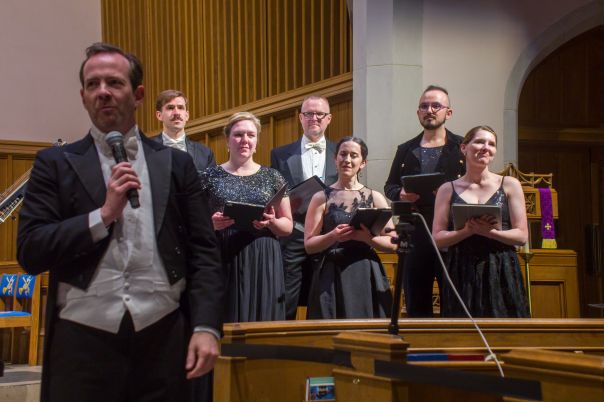
March 4, 2023, Charlotte, NC – You might gasp audibly upon learning that The Oxford Dictionary of Music proclaims that Claudio “Monteverdi’s place in the history of Renaissance music can justly be compared to Shakespeare’s in literature.” That high regard was echoed stateside by Ted Libbey in The NPR Listener’s Encyclopedia of Classical Music: “To paraphrase his contemporary Shakespeare, he bestrode the musical world like a colossus.” Yet many at the Myers Park Presbyterian Church; where Bach Akademie Charlotte presented their latest concert, Venetian Vespers conducted by Scott Allen Jarrett; were probably witnessing a live performance of Monteverdi’s music for the first time. Others had likely never heard Monteverdi anywhere but in church and/or on recordings in their entire lives.

As far as I can tell, the Renaissance colossus has never had a hearing at Belk Theater or Knight Theater in Charlotte. I’m fairly certain that my first live encounter with Monteverdi was at Spoleto Festival USA in 1991, when L’Incoronazione di Poppea was presented at Dock Street Theatre. Before then, my revelations had happened at local libraries in Columbia and Charlotte, where I could borrow and fall in love with vinyl recordings of Monteverdi’s Madrigals (there are nine books of them) followed by my discovery of L’Orfeo, the first masterpiece in opera history.

In keeping with the tone of the venues where Bach Akademie usually performs – and the liturgical spirit of their marquee composer – Jarrett, with a small chorus of six voices and an instrumental quintet, focused on two major sacred works that bookended Monteverdi’s career, his Vespro della Beata Vergine (1610) and his Selva morale e spiritual (1641). Sensing a general unfamiliarity with Monteverdi’s music and his importance, Jarrett spoke at length on both, stressing the cultural eminence of Venice at the peak of the Renaissance and Monteverdi’s towering influence over how composers would write for voice after he upended traditional practice by prioritizing text over music.

The texts that Bach Akademie performed were mostly scriptural and liturgical Latin, but Jarrett and his musicians also dipped into the “moral madrigals” found in the Selva collection, with Italian texts written by Francesco Petrarch and Angelo Grillo. In fact, Jarrett’s selections were admirably proportional to the original collections: we had twice as many excerpts from the Selva as we heard from the Vespro, and the Italian songs gave us a balanced representation of the larger collection, which on complete recordings is just over twice the size of the 1610 Vespers.

2023~Venetian Vespers-17

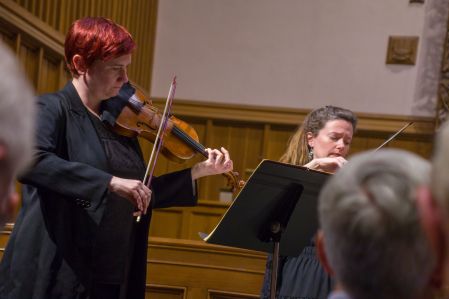
We began and ended the concert with full ensemble pieces from the Selva, starting with “Laudate Dominum” (second version). Sopranos Margaret Carpenter Haigh and Arwen Myers blithely chimed the opening exhortation – “let us praise” – over and over, interspersed with full choral and instrumental passages, along with a couple of merry exchanges between tenors Nick Karageorgiou and i. Four of the six Selva selections were originally for accompaniment by two violins, slots ably filled by two mainstays of Boston’s exemplary Handel and Haydn Society, concertmaster Aisslinn Nosky and Fiona Hughes.

2023~Venetian Vespers-32

Replacing the four trombones in the score as well as playing their own parts, Nosky and Hughes figured more prominently in the “Gloria” that followed Jarrett’s impressive disquisition. This larger-scaled composition also offered more opportunity for the vocalists to shine, the tenors declaiming the title word most often before the sopranos dominated with their filigree on the recurring “Domine.” Thanks to Jarrett’s intro, we were also on the lookout for the heavenly harmony lavished on the stately “peace on earth” passage, enriched by Edmund Milly’s bass-baritone, cellist Guy Fishman, and organist Nicolas Haigh.

2023~Venetian Vespers-13

Accompanied solely by Deborah Fox on theorbo, Myers and Margaret Haigh gave us a marvelous first sampling of the Vespro, “Pulchra es,” set to two amorous verses from the Song of Solomon, delicately straddling the borderline between chastity and seduction as they sang from opposite sides of the chancel. Both sopranos rejoined the male vocalists as we returned to the Selva with “Laudate pueri” (first version). The men harmonized sweetly to launch this setting of Psalm 113 before the sopranos quickened the tempo and lifted the music to joy and jubilation.

I wondered how Jarrett and Bach Akademie planned to handle “Duo Seraphim,” the next Vespro selection, since it was written for three tenors, according to the program booklet, and the conductor deployed Karageorgiou and Wilson to opposite ends of the stage. Akademie’s artistic director must have also anticipated some suspense in the room, for it wasn’t until halfway through the piece that the third tenor walked to his place upstage, behind organist Nicolas Haigh – Milly, the bass! While Milly’s tessitura didn’t need to reach quite as high as the two other tenors’, he did quite well, actually sounding louder than his comrades on a few notes. Of course, there’s another way of construing the drama of Jarrett’s staging. At the exact point where the text departed momentarily from its familiar Isaiah 6 refrain, and the heavenly witnesses to the seraphs’ “Holy, holy, holy” call were cataloged as “the Father, the Word, and the Holy Spirit,” Milly took his spot upstage before the three were said to be one.

Composed while Monteverdi was still in service to the Duke of Mantua, the “Dixit Dominus” for six voices and instruments seemed to be specially crafted for the acoustics of the Venetian Basilica of San Marco where he would later serve as the chapel maestro. John Eliot Gardner’s recording of the complete Vespro at San Marco with the English Baroque Soloists in 1986 implicitly made that point, and Jarrett, both in his introductory remarks and with the ensemble’s performance, made that point explicitly at Myers Park Presbyterian.

2023~Venetian Vespers-31

Although she didn’t get much of the vocal spotlight, alto Laura Atkinson picked up a microphone to preface the remaining three Selva selections. Both of the poems that followed, written by Monteverdi for the other five voices, proved worthy of the pulpit, as their translated titles indicated: Petrarch’s “O blind ones! What use is all your toiling?” and Grillo’s “This life is a flash of lightning.” Reminding us that this was Bach Akademie and that the Charlotte Bach Festival is slated for its return on June 10-17 (if interim managing director Garrett Murphy’s fundraising goal is met), Jarrett and company gave us a small-scale preview of the plenty to come with Johann’s “Sanctus in D.” Not the swiftest version you’ll ever hear, but light, lively, and irresistible.

“Beatus vir” (first version), set to Psalm 112, was an apt finale to this Venetian Vespers concert, carrying forward the festive mood of the penultimate Bach with invigorating vocal counterpoint – Monteverdi writing here for six exactly voices at last – and providing Nosky and Hughes, as the two violinists also prescribed by the score, with their best opportunities to shine. But it wasn’t until the music slowed down, where the Psalmist spoke on the steadfastness of a god-fearing man in the face of evil tidings, that the finale became truly grand. The sheer massiveness of the sound summoned up the church to mix its harmonies, reminding us that we were in a house of worship.