Daily Archives: May 24, 2021

Branford Marsalis Helps Bring Charlotte Symphony and Subscribers Back Together at Last

Review:  Branford Marsalis Plays Ibert

By Perry Tannenbaum

2021~Branford Plays Ibert-04.jpg

More than 15 months had elapsed since my wife Sue and I had sat together at Belk Theater and enjoyed a Charlotte Symphony concert – exactly 15 months since we had seen Gabriella Martinez with the orchestra on Valentine’s Day at Knight Theater. Needless to say, much had changed since our last night out in Uptown Charlotte. Until we turned off the I-287 innerbelt onto College Street, we had no idea what a solemn concrete canyon the Center City has become – because the explosion of new buildings, high-rises, penthouses, and parking garages has hit us while foot traffic on a Friday night remains nearly extinct. Fortunately, we had allowed for extra travel time as we made our way to the landmark “Branford Marsalis Plays Ibert” concert, for the capricious Saturday night traffic was as heavy as usual, doubling our surprise when we left I-77. There wasn’t a Hornets basketball game scheduled that night, so we were among the first to enter the BankAmerica parking garage, with hundreds of spaces to choose from.

Thwarted by travel restrictions that kept him on the other side of the Atlantic, Christopher Warren-Green was unable to preside over our auspicious reunion, so resident conductor Christopher James Lees was called into action, acquitting himself quite brilliantly. Attendance for the concert was capped at 500, about 24% of capacity, and our tickets had been channeled to the Apple Wallet app on my iPhone, which the usher firing his QR scanner gun was able to wield better than I. We were so eager to enter the hall and see the CSO again that I forgot to get an exit parking stub in the lobby, but there was no crowd lined up for them after the concert when I did remember. Masking was still in effect for everyone except wind players, so it was helpful to find staff at their customary posts in the lobby – at the ticket booths and at the entry to the grand tier – so we could recognize and happily greet one another.

Marsalis, the Grammy Award-winning saxophonist, would be playing Erwin Schulhoff’s Hot-Sonate in addition to Jacques Ibert’s Concertino da camera, so there was plenty to bone up on in our seats before the lights went down. Sadly, there were no program booklets to assist our preparations, only the sort of glossy 5”x8” cards subscribers will remember from the pre-pandemic KnightSounds series. An informational email from the ticket office had popped into my inbox that afternoon, which contained a link to a PDF version of a 24-page program booklet. If you’re among the lucky 500 attending the sold-out concerts, you’re covered.

2021~Branford Plays Ibert-01

Filled out by Béla Bartók’s Romanian Folk Dances and Gershwin’s Lullaby for string orchestra, the program was an adventurous delight from start to finish – about an hour in length, as promised in that handy email, without an intermission. Bartók was particularly shortchanged by the abbreviated program handouts, for the names and tempos of his six Folk Dances couldn’t fit on the same card with all the movements Marsalis would be playing. Even if the Bartók movements had been listed they would hardly be indicative of what we would see and hear. Until the penultimate “Poargă românească (Romanian Polka): Allegro,” the dances weren’t at all festive. The “Brâul (Sash Dance): Allegro” was rather poignant, despite its nimble pace, and the “Pê-loc (Stamping Dance): Andante” was actually bleak. Even the gorgeous “Buciumeana (Hornpipe Dance): Moderato” had a forlorn fiddler-on-the-roof sadness to it. Otherwise, what was surprising was the extent that all these arrangements by Arthur Willner were miniature violin concertos, here featuring concertmaster Calin Ovidiu Lupanu, who was especially impressive high up in the treble of the “Stamping Dance.”

A nice array of winds and brass – including principals Victor Wang on flute, French hornist Byron Johns, and trumpeter Alex Wilborn – joined the strings onstage as Marsalis made his first appearance. Beginning with “quarter note = 66,” the movement markings in Schulhoff’s concerto for alto saxophone were deceptively fussy and clinical, for the heat of the Hot-Sonate came from jazz, just emerging from its raucous childhood when this suite was composed in 1930. Originally written for sax and piano, the arrangement by Harry Kinross White is most beguiling in its bluesy third movement, where the horns added an astringent accompaniment. Quaintly described by the composer “lamentuoso ma molto grottesco (plaintive, but very grotesque),” this “quarter note = 80” movement delivered the deepest jazz flavor, and I could easily imagine Johnny Hodges, on leave from Duke Ellington’s Orchestra, playing its premiere. Unfortunately, Schulhoff’s idea of the grotesque was no more edgy than his grasp of the alto saxophone’s capabilities. Despite the undeniable appeal of the music, Marsalis wasn’t really tested by the demands of Hot-Sonate.

Gershwin’s Lullaby, not jazzy at all, was a perfect palate cleanser between the two Marsalis stints. The strings wafted a tropical lightness that had a “Catch a Falling Star” lilt and laziness. Little showcases were set aside for the string section leaders, most notably Lupanu and cellist Alan Black, and the piece ended deliciously in bubbly geniality, with rounds of delicate pizzicatos. Absent during the Gershwin, horns and winds reasserted themselves forcefully in the Concertino da camera, originally scored by Ibert for 12 instruments, including the soloist, with only five string players. Marsalis was noticeably more tasked now, from the opening Allegro con moto movement onwards: more speed, more range, more complexity, and more technique were required from him, while the vibrant accompaniment offered more distractions. There’s actually some percussion from the strings amid this opening movement, but I was so focused on Marsalis and his unmasked accompanists that I didn’t notice which string players were tapping their bows.

2021~Branford Plays Ibert-09

An achingly lovely, oboe-like lament by Marsalis began the Larghetto section, with the strings gradually creeping in ever-so-stealthily behind him. Extra strings, 22 in all, were a definite asset here as the music swelled. Wang’s flute and Wilborn’s trumpet had the most impact behind Marsalis as we cheerfully swung into the concluding Animato. Though often labeled as separate movements on CDs (including Branford’s recording with the Orpheus Chamber Orchestra in 2000), this concluding Larghetto-Animato was in itself like a three-movement concerto, for Marsalis drew a second cadenza between orchestral bursts that was far more demanding than anything he had played so far, nearly requiring circular breathing to execute its cascading, fleet-fingered runs. The audience was keenly attuned to the saxophonist’s virtuosity, for they gave him a lusty standing ovation when he was done, a judicious upgrade from the warm applause showered on the Schulhoff.

A wonderful evening, all in all, and a giant step back to normality.

Chang and Yang Offer a Rousing Ladies’ Night Before Mother’s Day

Review: Celebration of Amy Beach and Florence Price

By Perry Tannenbaum

2021~Beach and Price-03

Surely there couldn’t be a more natural concept than having two women instrumentalists sharing a concert stage and playing works by two female composers on Mother’s Day weekend. Or we can certainly hope that view will continue to prevail when we are past COVID-19, now that #MeToo has swept the nation, now that Black Lives Matter is opening the way to reconsidering African-American composers, and now that Trumpism is on the wane. Right now, I think we must admit, this oh-so-natural concept, brought to life on the UNC Department of Music’s YouTube channel by pianist Clara Yang and violinist Sunmi Chang, still felt rather refreshing and innovative. The duo showcased two pieces by Amy Beach, one of them excerpted from her epic Violin Sonata, plus a welcome reclamation from Florence Price, the African-American composer’s Fantasie No. 1 in G Minor.

2021~Beach and Price-31

The 30-minute stream was impeccably recorded at two locations with an imaginative video mix layered on in post-production. Just to disabuse us of the notion that all this wizardry was happening live – and maybe to add some glam – the ladies changed costumes between each of the pieces. Nor was there much of a letup before the evening’s encore, William Bolcom’s “Graceful Ghost Rag.” It was rather charming, in fact, to see Chang going casual and sporting a tee shirt, ponytail, and jeans to underscore the bluesy informality of this segment, while the video mixers had some fun of their own, tossing in some funky effects, including a foray into artsy black-and-white.

2021~Beach and Price-21

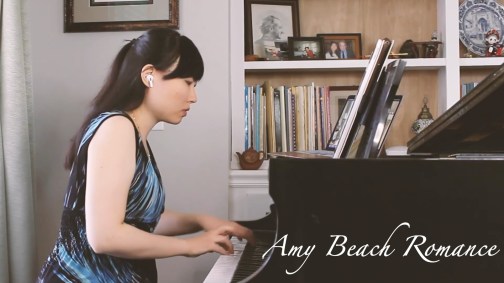
Compared with traditional chamber music programs staged in concert halls – or even those convened in the parlors of wealthy patrons – this offering had the claustrophobic TikTok feel we have grown familiar with during the pandemic. No view of Yang included all of her piano, and as the more mobile Chang moved from an austere bare wall for the Sonata to a furnished room for the Romance, her visible stage was barely as wide as her mantelpiece, slightly expanded after Chang introduced us to Price. Viewers will be able to see the earbuds sprouting from the ladies’ ears as they performed, but whether they were in any proximity with each other for their “remote collaborations” remains cloaked in mystery. Both of the Beach pieces began with piano intros, so synchronization was relatively easy to achieve. Price’s Fantasie, however, required instant alignment between the musicians, visually cued, which may be why there was a wee tablet (or a very large cellphone) perched next to Yang’s score on her piano.

2021~Beach and Price-13

Introducing Beach and her works, Yang readily admitted that the logistics of these collaborations had been challenging, but there was no strain evident as she played the lyrical intro to the Allegro moderato opening movement. Although the distributor of these UNC webcasts is YouTube and not Sony, the sonic quality when Chang layered on in the treble was on a par with any of the half dozen studio recordings you can readily hunt down on Spotify, possibly eclipsed only by the Chandos recording with Tasmin Little teaming with pianist John Lenehan. The challenges facing UNC’s duo inhibited the kind of fluid synergy captured by Chandos, but Yang triggered plenty turbulence and drama from Chang, and the video editing underscores the dialogue between the two musicians in the refrain that partitions Beach’s structure.

Actually, there was marvelous ebb and flow as the repeated refrains dominated by Yang gave way to more and more turbulence each time the focus switched back to Chang’s violin. Perhaps the more obvious choice for sampling the grandeur of Beach’s Violin Sonata would have been the concluding Allegro con fuoco with its rousing final rush, but the opening movement is lengthier, and the women ably advocated the ethereal virtue of the Allegro moderato’s serene final bars. I’d gladly listen to this duo in a performance of the full Sonata, especially if it were boosted by the electricity of a live concert with all of us in the same hall.

2021~Beach and Price-16

While the changes in attire and location for Chang chimed well with the more luxuriant lyricism of Beach’s Romance, this piece also plunged into turbulence in response to Yang’s eloquence at the keyboard. Beautiful ebb-and-flow was evident once again in the duo’s sculpting of this piece, both Chang and Yang tethering their crescendos and decrescendos to the intensity or tenderness of the moment, ending with a more soaring sublimity than we had heard in the Sonata. Apparently, multiple takes went into this segment of the video. How else can we explain a fade-dissolve from pianist Yang to… pianist Yang? Yet the audio seemed to flow seamlessly, a feat not quite replicated at the outset of Price’s Fantasie, after Chang gave us an impressive spoken intro and an even more impressive cadenza.

Was that merely an awkward fade after the duo veered into an outburst of folksy merriment – or was that an edit? While the web reliably confirms Price’s 1933 crowd-pleaser and the cover page of the sheet music, there is no confirmation that this piece has ever had a studio recording. All three of the YouTube listings have been logged in since last March, the majority by masked musicians, so when Chang told us in her intro that the piece was new to the duo, she was speaking for the rest of us. Total number of views has yet to reach four thousand, and only Dawn Posey’s recording with pianist Jack Kurutz (618 views) is truly a worthy rival to the new Chang-Yang offering in sound quality and artistry. As Chang rightly observed, Fantasy No. 1 in G Minor is a beautiful mix of classical tradition and African-American folk heritage, and we can see that the criminal neglect of this composer is only now beginning to be rectified. There’s obviously a long way to go as the piddling YouTube roster of videos attests, for a black violinist or pianist has yet to check in with this piece.

2021~Beach and Price-29

That would also be a natural concept. In the meanwhile, kudos to the ladies for their inclusiveness in holding a place open for Bolcom’s piece in signing off, a courtesy that I’ve never seen extended by male performers to a female composer. “Graceful Ghost” appears in numerous forms, including for solo piano, four-hands piano, and string quartet. Chang’s genial performance, wresting dominance from the piano, hasn’t been equaled yet by any that I’ve auditioned on Spotify. There are 35, so I’m not done. I’d resist the lure of Gil Shaham’s star quality if you’re interested in samples of this work, for he perversely ignores Bolcom’s injunction against letting the moderate tempo drag, giving us a singularly lugubrious and listless “Ghost.” Chang’s bouncy take was far more preferable, a very enjoyable way to end a concert that left me wishing for much, much more.