Monthly Archives: February 2020

Cherokee Nation Claims Territory Next to “Appalachian Spring”

Review: Appalachian Spring

By Perry Tannenbaum

2020~Symphony Si Otsedoha-11

When you think of an All-American concert at Belk Theater performed by the Charlotte Symphony, composers like Samuel Barber or Aaron Copland figure to be in the mix. Sure enough, Copland’s Appalachian Spring is the marquee attraction at the latest Symphony concert led by maestro Christopher Warren-Green, preceded by Barber’s equally familiar Adagio for Strings. What came between these works by a Pennsylvania blue-blood and a Brooklyn-born Jew was really surprising, enlightening, and inspiring – and frankly stole the show.

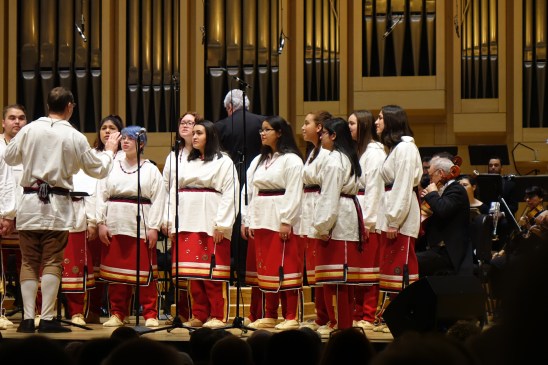
That work was by a composer most of us had never heard of, William Brittelle, titled Si Otsedoha in a language most of us don’t know. Commissioned by the North Carolina Symphony in 2017 and premiered the following year in Raleigh, the new piece tripled the Appalachian aspect of the concert, for the Boston-born Brittelle was raised in Newton, NC, the county seat of Catawba County. Appropriately enough, the featured performers of Si Otsedoha were the Cherokee Chamber Singers of Cherokee High School, led by Michael Yanette.

With English and Cherokee text by the Singers, the piece is divided into five sections, including a “Still Here Overture.” It’s forceful stuff from the beginning, with each of the Singers stepping forward to recount a segment of Native American or Cherokee history. The history goes back many millennia before the so-called “discovery” of the New World, and after each section – even after the sufferings, indignities, and betrayals inflicted by white European occupiers – the whole ensemble proclaims, “But we’re still here!” with an edge of affirmation and defiance. Special rancor is reserved for President Andrew Jackson.

2020~Symphony Si Otsedoha-05

These young men and women are telling us things. Though they mention the infamous “Trail of Tears,” they’re not complaining or asking for pity. In the softer second section, “Phoenix Rising,” we hear of the young people’s yearnings, sung in English and Cherokee, keyed by a recurring phrase, “When I look to the sky.” In the next section, we begin to notice the composer, the orchestra, soprano soloist Catherine Brookman and Yanette more; for it is here, with the women answering the men, that the Singers really begin to sing. Brittelle’s music leavens the message of “When Money Becomes Religion,” arguably containing the orneriest statements in the piece. The section on the Keystone Pipeline in North Dakota, in particular, aren’t intended to salve the sensibilities of Evangelicals or Republicans.

Adorned with silvery percussion and gossamer harp strings, “Walls of Glass” is the most soothing and ethereal section of the piece, where the lyricism of the composer and the harmony of the ensemble shine most brilliantly. The finale, “Si Otsedoha,” circles back to the “We’re still here” message of the opening section, but the Cherokee version is spoken with far less defiance than the earlier English preamble. Gradually the music, the singing, and the chanting grow insistent, then exclamatory and celebratory – with a little bit of a militant edge. The next time Native Americans wish to protest construction of a new pipeline that violates existing treaties, Si Otsedoha (first word is pronounced “she”) would be a stirring, powerful statement to fire up demonstrations.
2020~Symphony Si Otsedoha-08

Though Barber’s Adagio has been programmed at least twice since I heard Jacomo Rafael Bairos conduct it at Knight Theater in 2011, I had never seen what Warren-Green would do with it. Nobody who loves this affecting work will be disappointed. The cellos, violins, and even the violas get opportunities to stand apart during this eight-minute warhorse, and all three perform precisely and sensitively. Watching the performance is a treat – and after navigating the unexpected Uptown detours to find a feasible pathway to the Belk, which seemed to confound Google Maps as much as me, I can heartily credit the players for soothing my frazzled nerves.

Copland’s Appalachian Spring was more of a surprise than the Barber, last performed here in October 2015. After a moribund rendition of the score in 1993, which I consistently cite as among the most wretched Symphony performances I’ve ever witnessed, the orchestra conquered Copland’s iconic ballet suite the next two times I heard it in 2009 and 2015. For the current concert, Warren-Green expands his conquest, restoring music from the original Martha Graham ballet, which Copland called “Ballet for Martha” before Graham discerned spring in the music and took the eventual title from Hart Crane’s The Bridge.

Chamber and orchestral versions that flowed from the 1944 ballet abbreviated the score. Neither of the recordings in my collection break down the piece, but those conducted by Bernstein, Mehta, and Copland are among those you can find on Spotify. Of these, only Mehta’s begins to describe the ballet scenario with any of the detail that you’ll find so helpfully reproduced in Symphony’s program booklet. I suspect the absence or abbreviation of Section 4, “The revivalist and his flock,” was one of the things made that lamentable 1993 version so lifeless.

The “Calm and flowing” Section 7 of the piece, memorable for all its voicings of the “Simple Gifts” Shaker melody – by the violas, the cellos, and (most memorably) the clarinet – seemed to come with more off-road excursions by piano, brass, and percussion before the unforgettable orchestral explosion that Charlotte Symphony plays so grandly together. It may be a less cohesive Spring than Copland conceived in his suite, but after hearing the same-old-same-old so many times, I found it fresher and even more satisfying.

Robbins Hatches an Immigrant Experience

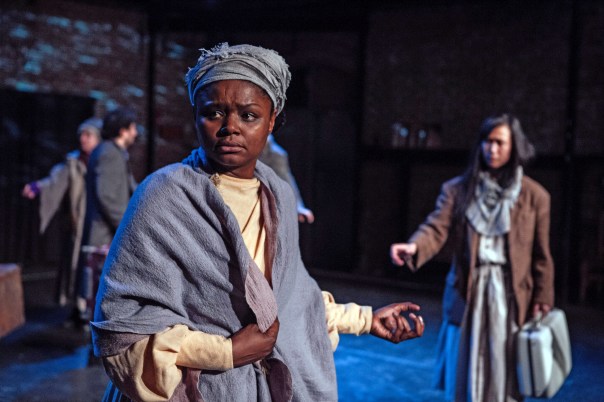
Quonta Beasley, Stephanie Lee, photo by Ashley Randall_Edit_1

Review: The New Colossus

By Perry Tannenbaum

If you are one of those knuckleheads who oppose illegal and legal immigration – “good” folks who scoff at the notion of allowing terrorists onto our sacred soil under the flimsy guise of political asylum – you won’t need to watch The New Colossus for long before concluding that this is not the show for you. On the other hand, if you were expecting Tim Robbins and his co-writers, The Actors’ Gang Ensemble, to bring a play to Knight Theater – or a suite of touching immigrant narratives – you might hang in there considerably longer before deciding that maybe you should have passed on this show as well.

For despite the assurances of the playbill that we would be watching scenes and stories, The New Colossus was not a play on the opening night of its national tour. Actors in the Ensemble, representing refugees from 12 different countries – including the US Confederate States – speak 12 different languages in portraying their own ancestors.

But not that often. In his director’s notes, Robbins clarifies his intentions, describing Colossus as a movement piece, a “calling up of ancestors.” Here and there, we see supertitles as each of the 12 refugees voices the perils in his or her birthplace – Iran, Turkey, Malaysia, Germany, Vietnam, Mexico, Finland, Hungary, Yugoslavia, Russia, Austria, and Louisiana – driving them to find liberty and new lives in America.

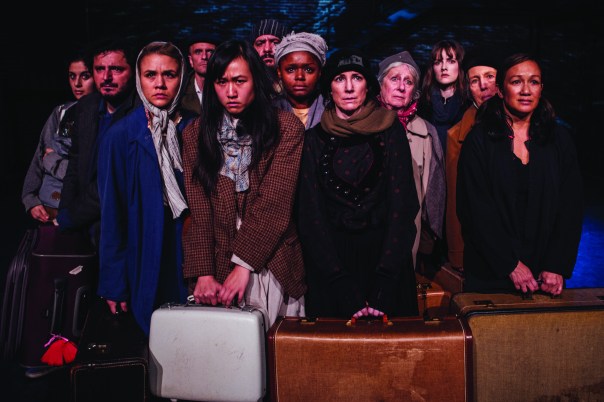
The cast of The New Colossus, photo by Ashley Randall

More often, we see them as a raggedy group, toting valises that contain everything they own, then fleeing from pursuers, squatting by a stream to quench their thirsts, helping each other to dig a tunnel with their hands, freezing in the cold, urgently struggling to build a fire, basking in the heat and light once they’ve succeeded, scurrying for cover when they believe their pursuers might see them, standing at a border wall where they’re not allowed to cross, and desperately hailing passersby who might assist their journeys to freedom. It’s fair to say that these wordless actions and movements are at least two-thirds of the 90-minute piece that Robbins and Ensemble “wrote.”

No doubt about it, Actor’s Gang delivers an immigrant experience. There were moments during these diverse and harrowing pilgrimages to our shores that were heart-rending – moments when I couldn’t help thinking about people fleeing today from wartime atrocities in Syria or murderous drug gangs in Guatamala. What has become of governments here and in Europe that close their borders to such desperate refugees? What has become of those peoples who demand, with the force of their votes, such absolute callousness from their governments and elected leaders?

Around the 14th time, or maybe the 27th time, these immigrants circled the Knight stage; grunting, panting, and sometimes muttering phrases in their native tongues; I couldn’t help feeling that my liberal tolerance was being stretched past its breaking point, even if the Ensemble was credibly simulating the tedium of their forefathers’ and foremothers’ exhausting treks toward freedom. Robbins not only co-wrote The New Colossus, he directed it. Sitting at rehearsals or announcing his reactions afterwards, he should have had the sense to say, “We can definitely cut some of that action.”

Music by cellist Mikala Schmitz and percussionist David Robbins alleviates the tedium, while projections by technical director Josh Keh open up fresh possibilities. Those possibilities surfaced during the post-show powwow that Robbins emceed from the stage. By a show of hands, our opening night audience revealed how many descended from indigenous Native Americans, how many of us were immigrants, sons and daughters of immigrants, grandsons and granddaughters of immigrants, etc., all the way back to the Mayflower.

The indigenous folk were also prompted to give us their names and tribes, immigrants gave their countries of origin and dates of arrival, while sons and daughters of immigrants gave the names, dates, and countries of origin of family members who first set foot here. When all these names, tribes, countries of origin and dates had been called out, Robbins asked for volunteers in the audience to share their special immigration stories.

At times, the speakers became emotional, and again, this was no place for anti-immigration, America-is-closed knuckleheads. But this wasn’t necessarily the end of Robbins’ show, even after the add-on segment. If they wished, people who had shared their stories could come backstage afterwards and retell their tales with a camera rolling. Robbins even invited the shyer folk who hadn’t ventured to share their stories with the entire Knight crowd to come backstage and open up in a more intimate setting.

So I can only hope that Robbins is conceiving The Colossus as something more than a play, a movement piece, or a simulated immigration experience. I hope he really sees it as a dynamic project and that, someday soon, the stories he is filming will nestle in among the images projected behind his performers – filling in their silences and preventing the images already chosen from overstaying their welcome.

None of the actors gets to dominate the stage for very long amid the hurly-burly of fleeing their motherlands, so it probably shouldn’t surprise anyone that performers representing familiar stories resonated most with me, namely Quonta Shannell Beasley as the emancipated Sadie Duncan from Louisiana and Jeanette Rothschild as her grandmother Yetta Rothschild, escaped from Germany. It also helped that the stories of Stephanie Lee as Ly My Dung from Vietnam and Paulette Zubata as her mother Gabriela Mia Garcia from Mexico also arrived somewhat pre-warmed.

Zirko Petkovic and Pierre Adeli, photo by Ashley Randall

Influenced by my own ancestry, I had a special fondness for the performers who delivered the most Eastern European flavor, Zivko Petkovic as his Yugoslavian grandfather, Mirko Petkovic, and Dora Kiss as Hungarian grandmother Aranka Markus. Of course, Emma Lazarus, the Jewish American poet who gave the Statue of Liberty her voice when she wrote her “New Colossus” sonnet, had a soft spot in her heart for Eastern Europe. Small wonder, then, that Petkovic and Kiss strongly evoked for me the immigrants famously described by Lady Liberty in the Lazarus poem:

“Keep, ancient lands, your storied pomp!” cries she

With silent lips. “Give me your tired, your poor,

Your huddled masses yearning to breathe free,

The wretched refuse of your teeming shore.

Send these, the homeless, tempest-tossed to me;

I lift my lamp beside the golden door!”

Sobering reminders when even our courts are okaying the concept of income requirements for aspiring citizens – and the idea of rejecting other countries’ rejects has become White House policy. Hopefully, Robbins’ new piece will blossom into a project that will be heeded.