Review: Duda Lucena Quartet
By Perry Tannenbaum
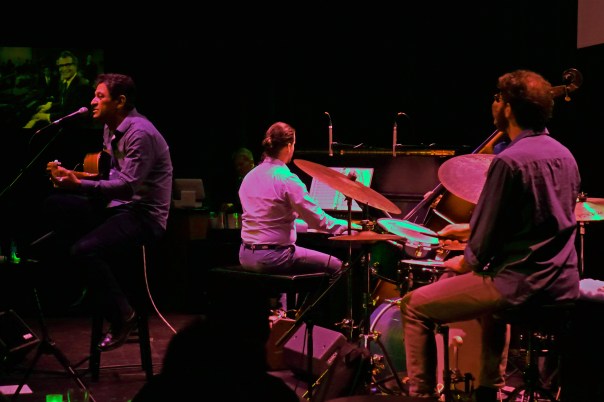
From the schedule at his website, you get the idea that Brazilian-born singer/guitarist/composer Duda Lucena and his quartet record only rarely and play most of their gigs in two posh spots in Charleston, his adopted hometown. Listening to the Duda Lucena Quartet at the Stage Door Theater earlier this week, the latest installment in The Jazz Room’s Premiere Thursdays series, I had to think that a lot folks are missing out. The 80-minute “Music of Brazil” set included a wide assortment of Braziliana by Antonio Carlos Jobim, Caetano Veloso, Djavan, and Lucena himself – and it could be accurately judged by the title of the Quartet’s one non-Brazilian excursion, the Gershwin Brothers’ “’S Wonderful.”
Lucena’s voice certainly brought back memories of João Gilberto, the vocalist who teamed with saxophonist Stan Getz back in the ‘60s to launch the bossa nova boom in the US with the music of Jobim; and memories of the later Renato Braz, who has headlined on multiple occasions in Charleston at Spoleto Festival USA. With a gifted rhythm section at his command, however, Lucena wasn’t always tethered to the dreamy, “Quiet Nights” concept of Brazil’s intoxicating rhythms. Not only would bassist Kevin Hamilton draw plenty of solo space, so would drummer Ron Wiltrout. At the piano, Gerald Gregory didn’t simply demonstrate his fluency with the tangy single-note stylings of Jobim and Count Basie, he occasionally showed us that he had absorbed the denser textures of Chick Corea and McCoy Tyner. No less surprising, the Lucena Quartet was emboldened to accelerate beyond quiet-city-streets speed limits on uptempo tunes.
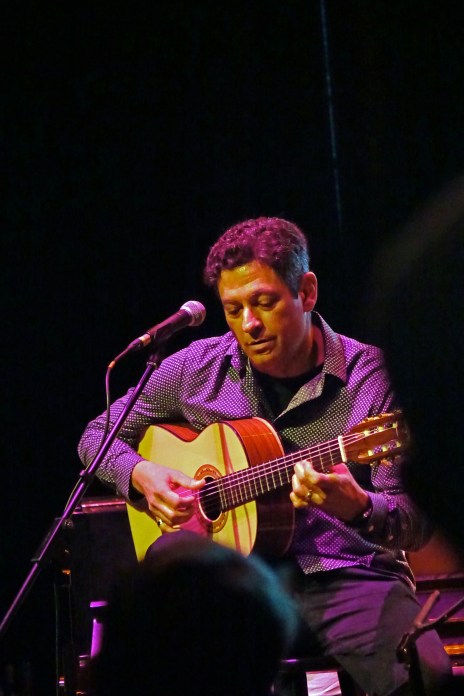
Instantly quashing any suspicion that he was leading a Jobim or bossa nova cover band, Lucena began with two of his own compositions. Purely instrumental, Lucena didn’t stray far from his melody in “Spider Waltz,” keeping his guitar virtuosity and his vocal skills momentarily under wraps, but Gregory and Hamilton didn’t hesitate to show us what they could do, good omens both. “Just for Now,” with lyrics by Heather Rice, was a more impressive Duda display. After Gregory’s intro, Luceno sang with a rich vibrato-less tone more reminiscent of Braz than Gilberto and followed with his first guitar solo, festooned with grace notes and charming sliding glisses that assured us he could play. Gregory was even tangier than he had been previously in his solo, and Luceno embellished his concluding vocal with a sprinkle of Brazilian scat, more modest, concise, and percussive than Louis Armstrong’s American style.
With Veloso’s “Coração Vagabundo,” it was time for the Quartet to cut loose. Not only did the speed of the performance leave recorded versions by Veloso, Gilberto, and Karrin Allyson far behind, it unleashed a the denser side of Gregory’s pianism in a solo that again surpassed what we had heard before. More heretical yet, Gregory’s exploits were followed by the first explosions from Wiltrout at the drums. Maybe it’s useful at this point to mention that Jazz Room concerts not only include a cabaret-style bar and a fair amount of chichi cocktail tables near the stage, they also flash continuous slideshows on a large-screen monitor behind the performers. During the “Brazil” concert, we didn’t merely see the obligatory sunsets in Rio’s shores, we saw Corcovado and the coast spectacularly lit up at night, majestic night-time aerials that revealed an illuminated ring of sea water lapping the beach, and a bevy of photos highlighting the colors, the spectacle, and the glitzy sensuality of Rio-Carnival. In that context, the uptempo brashness of “Vagabundo” fit well.
Jobim fanatics, though put on hold, would not be disappointed. Lucena had four of the Brazilian pianist’s compositions slated for the middle of his set list, punctuated by another Lucena original, “Festa dos Passarinhos” (Party of Little Birds), which quietly featured Wiltrout briefly accompanying Hamilton’s fine solo with hands on drums instead of sticks or brushes. “Água De Beber” had all the scat trimmings of Astrud Gilberto’s version without João’s discreet backup vocals, spiced with solos from Gregory and Hamilton; “Insensatez” drew again upon Hamilton’s resourcefulness, with another nice Lucena solo; so it looked like we would be cruising through Jobim without any radical surprises or fresh wrinkles. That suddenly changed when the Quartet lit into “Só Danço Samba,” the only planned cover from the landmark 1964 Getz/Gilberto album. Suddenly, two Brazilian dancers in full glittery Carnival regalia emerged from the Stage Door wings, flanking the stage and shimmying with gusto. Although Lucena had planned this treat – or at least had been alerted beforehand – there might be some question about whether this spot had been rehearsed, for the two lovelies were not complemented with satisfactory lighting that would have enhanced their glitter.

Another Jobim fave followed this lively spectacle, his contagious “One Note Samba,” but when it came time for Gregory to solo, he absolutely blew away the presumption that he would play in the Jobim one-note style, tearing up the keyboard with a knuckle-busting barrage. The vibe grew quieter for the next three songs – but not at all moribund. In Veloso’s “Trilhos Urbanos,” Lucena unveiled some sweet whistling each time he finished singing the melody; and on his original “Hammock,” the leader showed off his instrumental skills most extensively with an appropriately relaxing intro and, after some fine work by Gregory and Hamilton, truly luscious tone in his concluding solo. “’S Wonderful” was a nice planned surprise, for we hadn’t heard Lucena singing English in a while – or anything from Tin Pan Alley – but the next surprise came from one of the cocktail tables up front with a request that Lucena return to Jobim and his megahit, “The Girl from Ipanema.” The Quartet took on this impromptu addition with gusto rather than humility or fidelity. Lucena played freely with Jobim’s rhythms, pushed the tempo a bit, and interpolated his own suggestive exclamations where lyricist Vinicius de Moraes merely provided a simple “Ah!” Gregory, Hamilton, and the guitarist also obliged with some gorgeous soloing.
The concluding Djavan section took us to a sunnier, more contemporary region of Brazilian music, one that reminded me of my beloved Gilberto Gil albums dating back to the ‘70s. But we did not arrive in that sunshine immediately, for the Lucena Quartet’s take on Djavan’s “Sina” was more than a little bit funky and R&B-flavored with the most blazing solos of the evening from Gregory and Hamilton between two righteous Lucena vocals. “Maçã Do Rosto,” with more soloing from the pianist and the bassist, was like a calming inhalation before the rousing finale, Djavan’s “Aquele Um.” The Brazilian dancers emerged from the wings, and it was Carnival all over again. But this time, perhaps aware of the poor lighting in the corners of the Stage Door Theater, Lucena invited the two glittering dancers to join him onstage where they could truly shimmy and shine. Their previous glitter was now full-fledged dazzle. I’m afraid I was too distracted by the dancing to track all who soloed here – and I’m not at all sorry!



 Art on My Sleeve