Daily Archives: April 3, 2019

Facing Your Fears in a Haunted Basement

Review: The Ghost of Splinter Cove

By  Perry Tannenbaum

DSC07820

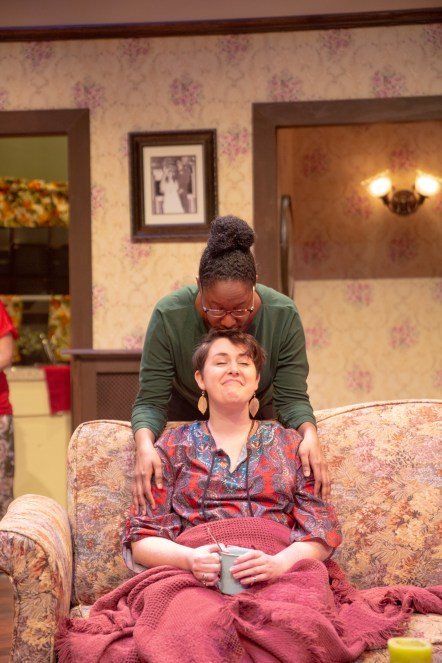
There’s a glint of magic as the adventure begins in Children’s Theatre of Charlotte’s production of The Ghost of Splinter Cove that you’ll only appreciate if you’ve already seen playwright Steven Dietz’s companion piece, The Great Beyond, in the world premiere Actor’s Theatre production at Queens University. What’s going down? Make that who, for Nate Banks and his sister Cora, on their first night at their late grandfather’s house, have been sent downstairs into the basement to spend the night.

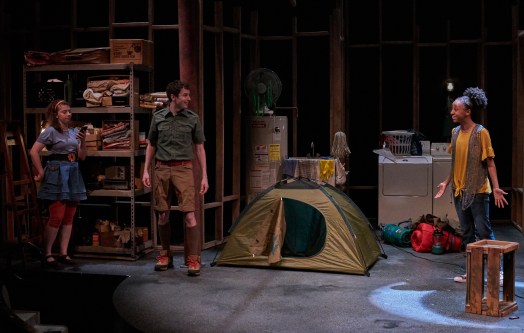
Yet their parents are far from callous. With the camping gear that their dad bought Nate for his birthday, they will break in his new tent – with a dome! – while their parents get their “adult time” upstairs. Nor has Rex, their dad, been lazy. To liven up their adventure, and to make up for canceling an outdoor expedition, Dad has downloaded a nifty smartphone app that will help simulate a true wilderness experience. Rex has troubled to hook the app up to loudspeakers, lights, and even a fan, so a starry night and stormy weather are both on the horizon after sundown.

But wait, there’s a holdup during the setup. Sydney, the daughter of Aunt Emily’s partner, Rene, asks Nate if he has chosen the destination for their wilderness adventure. Nate is dumbfounded until Sydney explains that she has the latest version of the same wilderness-simulating app, and it offers that cool option. Nate will need to take the time to download the update.
DSC07694

Now here’s where the magic happens. Once the Sim-Camp app is downloaded to Sydney’s phone and all the necessary Bluetooth connections are made, the most advanced Deep Wilderness option it presents – past the “Peppermint” and “Sunset Trail” baby options – is Splinter Cove. None of the kids has ever heard of the place, but if you’ve already seen what unfolds upstairs in Great Beyond, you will not have forgotten how important Splinter Cove is in the family history. It’s the place where Dad wants to bury Granddad’s ashes, for one thing.

Pure coincidence? “Hey, it’s selected already,” Nate observes as soon as he sees the most advanced options. When we hear him saying “Splinter Cove” for the first time, it triggers the loudspeakers.

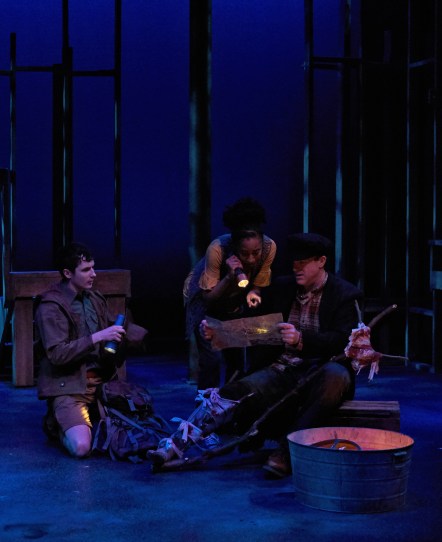
Long before this, however, a foreboding sense of dread hovers over the overnight adventure. There’s a fourth person in the basement, J, that both Nate and Cora imagine they can see. This imaginary friend doesn’t look anything like what the siblings imagine, he’s always in a different spot from where they point, and he’d rather talk to us than either of them.
DSC07874

There’s a comical aspect to the kids’ misperceptions, of course, but J is not the clownish comedian that Nate imagines. So who and what is he? Why has he been in the kids’ lives for as long as they can remember, and what are his intentions now?

Finding out will be part of the adventure, to be sure, and you can bet that Dietz has built plenty of suspense into the action leading up to that revelation. Among the works I’ve seen over the past 32 years of covering Children’s Theatre productions, only The Wizard of Oz, The Hobbit, and The Lion, the Witch and the Wardrobe were scarier, which makes Splinter Cove the scariest original children’s play I’ve ever read or seen.

It could be scarier at the Wells Fargo Playhouse if director Courtney Sale had put the pedal to the metal on all the jolts of surprise and terror that Dietz has sprinkled into his exemplary script. And it could be more spectacular if all the technical capabilities of ImaginOn’s larger theater, the McColl Family Theater, were marshaled to the cause.

While I felt Sale had been too cautious about crossing the fright threshold, my mom wondered if this show might be too intense for 8-year-olds after viewing Cove with me. So this is far from a punchless production, though our friend Carol opined that she also was disappointed in the fright factor after seeing Great Beyond earlier in the week.

Dietz’s craftsmanship certainly shines through, all the more brightly if you see both plays in this unprecedented Second Story Project. You don’t simply have adults upstairs and kids downstairs. Dietz makes sure we see a family at both ends of the staircase, with traits that align across the generations.

Like her mom, who resists the idea of holding a séance upstairs, Cora is anything but gung-ho about the camping trip, letting out a stream of sarcasm that parallels Mom’s resistance. Nate not only embraces his dad’s camping idea, he expands upon his resourcefulness, adding a campfire and a moon to the experience.

You’ll readily recognize moments that must occur in both plays, when Rex calls down from the top of the stairs and the kids respond, but I’ve discovered another one that isn’t so obvious. When Sydney asks the time, Nate responds, “Dad would say: ‘Straight-up six o’clock’” – while Dad is saying those exact words to Aunt Emily.

There are amusing misalignments as well. Cora is contemptuous of the prospect of joining hands and saying something enthusiastic before embarking on their wilderness adventure, yet her mom, Monica, does a little pinky-square ceremony with Rene, Sydney’s mom, shortly after they meet for the first time. Upstairs, with Rene presiding, they will dim the lights and light candles for a spooky séance, so it’s apt – if not particularly healthy – that her daughter is afraid of the dark.

Telling you what happens on the Splinter Cove camping adventure would be spewing spoilers for two Dietz dramas at once. It’s more prudent to point out that the playwright follows a tried-and-true storytelling formula by having Sydney face and overcome her fear in the heat of her adventure. Following the Wizard of Oz template, Dietz does this in triplicate, for Nate is afraid of deep water despite his swimming lessons and, again like her mom, Cora has serious trust issues.

Sale’s all-adult cast is marvelous, even if she doesn’t allow them to be as frightening as they could be. Chester Shepherd, whose electrifying high-strung performance in The Curious Incident of the Dog in the Night-Time will be long remembered, is hamstrung as Nate by Sale’s trepidations, scurrying around in terror as if he were doing one of the comical minor roles in Disney’s The Lion King. Notwithstanding how excellently it is done, that shtick dampens a moment when the fear factor should be dialed way up. You always believe Shepherd is a child, though, and his eagerness for the adventure fuels momentum from the start. Thrown by the adventure into the deep water, his terror is more human but still homogenized.

DSC07819

Carman Myrick seems to enjoy freer rein conveying Cora’s doubts and fears, for Dietz is demonstrating in both of his plays how much more readily we believe when our heroes face strong and nasty skepticism. Cora is the heavy, no doubt, but only intermittently like her mom, and I loved how thoroughly the magic of “Splinter Cove” worked on Myrick from the first time it was said out loud. On a relatively spare Anita Tripathi set design, Myrick makes her climactic climb and discovery compelling, and her achievement of trust becomes a dramatic watershed moment in more ways than one.

Coming off her stint, just last month at ImaginOn, as the pesky would-be girlfriend in Bob Marley’s Three Little Birds, Kayla Simone Ferguson doesn’t get to be cute or obnoxious this time around. The physical resemblance between Ferguson and Tania Kelly, the actor playing Sydney’s mom, is pronounced, but the personality parallels aren’t as obvious as the Banks kids’ with their parents. You could say that Rene is the spiritual guide and her daughter is the phone app guru, but the more lasting kinship is their calm and impartiality reacting to the sibling squabbles going on upstairs and downstairs.

Ferguson understands that she’s to be the sounding board for Nate and Cora to tell her (and us) all the important things they already know about each other. Meeting strangers in a strange house – “Wait – I’m spending the night?” – gives her license to be a little forlorn and pathetic. Most importantly perhaps, in confessing her fear of the dark, Sydney brings the squabbling sibs together in sympathy and starts the conversation going about each one’s greatest fear. Facing and overcoming these are the core of the adventure from a classic theatre-for-young-audiences perspective.

Bemused detachment typifies J as he slinks unseen among the children, along with a light sprinkling of menace – a bit heavier when he steals a smartphone from one of the kids’ backpacks. Sooooo shrewd of Sale to cast Arjun Pande in this intriguing role. He doesn’t immediately tell us he’s an adult, but with his low voice, he contrasts with Shepherd, whose sound and energy mark him as a kid. Pande also towers over all his castmates, so even those 8-year-olds in the audience who are braving this thriller will likely realize he’s the adult in the basement before he actually lets on.

If Pande isn’t quite as sardonic as he could be ridiculing the siblings’ basic misperceptions, he has the strong quiet confidence of an enigma waiting to be discovered, presciently knowing that this is the night when he will be. It’s a magical, magisterial role that Pande inhabits almost nonchalantly. Quiet confidence is more than justified, for even after everyone has vanished, J will remain a dizzying enigma.

One last wonder is how Dietz packs so much into the 53 minutes of Splinter Cove, only slightly slowed down by the two mind-blowing set changes. For that matter, what Dietz packs into less than 80 minutes in The Great Beyond is an equal marvel. Perhaps one day, a single theatre company will produce both Beyond and Cove on the same stage on the same night, and perhaps that’s what Dietz had in mind when he put the finishing touches on his Second Story Project.

Maybe then Dietz will decide which play should be seen first! He wrote Splinter Cove first, but my vote goes to seeing it last. And last it definitely will.

A Séance With 200% Certainty

Review: The Great Beyond

By:  Perry Tannenbaum

Great Beyond 4

When you walk into Hadley Theater on the Queens University campus for the world premiere of Steven Dietz’s The Great Beyond, you’ll be treated to a rare “don’t-think-about-elephants” experience. Even if you haven’t read the prepublicity around town, seen the spots on local TV and the web, or thoroughly perused your playbill, your emissary from Actor’s Theatre of Charlotte, artistic director Chip Decker, will call your attention to the elephant in the hall. While Dietz’s spooky new drama can stand on its own, it was written with an interconnected companion piece, The Ghost of Splinter Cove, that is now premiering at ImaginOn in a taut 53-minute Children’s Theatre of Charlotte production.

So once you’ve heard that, can you really be satisfied seeing The Great Beyond without going to see Dietz’s companion piece? Probably not.

If you’ve somehow failed to pay attention to the prepublicity, the playbill, and the curtain speech, all of them telling you that the action of Splinter Cove is happening downstairs in the basement of the same house at the same time in the same family as the action we’re seeing upstairs, the parents upstairs will remind you frequently enough of the strange adventure their kids are having below.

More than that, thanks to Evan Kinsley’s scenic design, which offers us a smidge of the home’s exterior, we get glimpses of the basement action through translucent windows that peep above ground. So it isn’t just a matter of Rex, the dad, opening the door to the basement and checking up on how his kids are doing – with prerecorded replies. No, no, no. Beginning with camping gear that he bought for his son Nate’s birthday, Rex has sent them on a wilderness adventure, with a smartphone app hooked up to the home’s electronics simulating the sounds, the natural lights, and the weather of the great outdoors.

At unexpected moments, then, the handiwork of lighting designer Hallie Gray and sound designer Rob Witmer captures our attention – and whets the curiosity of the three women who have gathered with Rex for an adventure of their own. The historic collaboration between two theatre companies is called “The Second Story Project,” but it’s at Queens U that we see why.

GreatBeyond3

Dietz has said that The Great Beyond is a reunion play, and it certainly follows a template we’ve seen before, bringing far-flung and estranged kinfolk together, comically or dramatically uncomfortable with each other, after a death in the family. Here Rex has brought his two kids to the home of his former father-in-law, where his distraught ex, Monica, served as caretaker during Tobias’ last difficult days. Relations between Rex and Monica seem cordial enough, though she isn’t a big fan of his elaborate camping scheme for their children – since it brings unpleasant family history to mind.

It’s also obvious that Rex retains a genuine affection for Tobias, whom he calls The Captain like everybody else in the family. The real family strife will rev up when Monica’s wayward younger sister Emily arrives. Or actually, it begins before, because the rigid and judgmental Monica has labelled Emily as a chronic latecomer – on the basis of one past incident – so hostilities can begin as soon as Emily arrives. On time, of course.

Not that Emily is flawless. A recovering alcoholic who now limits herself to one full glass of wine at the same time every day, Emily has made Dad’s home the last stop on an epic apology tour, launched five years ago when she achieved sobriety, spanning 23 states and two foreign countries. A straight arrow and a black sheep, the bread-and-butter combatants of countless theatre clashes are poised to have it out! But unlike Sordid Lives or Appropriate, two of the funeral-triggered plays we’ve seen before in Charlotte, the dead Tobias will also be invited to the reunion.

GreatBeyond4

You see, Emily is bringing her bisexual partner Rene to this sad reunion, hoping to summon up the spirit of Tobias at a séance later in the evening. It’s Tobias, not Monica, that Emily has really earmarked for receiving her last apology, and she thinks that Rene, a spiritual medium, can make contact and make it happen.

As if the friction between Monica and Emily weren’t torrid enough already! Now they need the scornful, skeptical, and sarcastic Monica to complete the circle around the séance table. Outnumbered three to one in this tussle – and somewhat pre-empted by Dietz’s two play titles – you can guess how Monica’s opposition to the séance turns out. As for whether Tobias shows up, I can safely defer to Dietz himself, who was present at the post-performance powwow on opening night. He told us that one of chief pleasures he found in telling this story came in conveying his 100% positive conviction that the supernatural visitations at séances are absolutely bogus and his 100% certainty that those visitations are absolutely real.

Whatever you may think of the action around the table, you can’t deny that Dietz has made intensive efforts to sustain our ambivalence, giving us numerous reasons to believe that the house Tobias built with his own hands is in the grip of the supernatural – countered by an equal number of escape routes to disbelief. But to his credit, Dietz leaves us with a giddy sense of confusion rather than a rational set of alternatives as we attempt to arrive at the truth now – and the truth about the tragedy that has haunted the family for nearly 40 years – teasing us out of thought.

That giddy confusion will be compounded when you factor the climax of Splinter Cove into your calculations. If you go to Hadley with somebody – whether an adult or a child – you can expect that conversation on your way home will be peppered with lively clarifications and disputes.

Decker certainly holds up his end of Actor’s Theatre’s historic collaboration with Children’s Theatre. Rather than missing core elements of the script that I’d seen when I read it (a fundamental reason I customarily avoid reading scripts I’m scheduled to review unless I’m planning to interview a playwright before seeing the production), Decker and his superb cast managed to bring Dietz’s drama more intensely to life and reveal the power – and comedy – of a couple of moments that I’d overlooked. Didn’t hurt that Dietz was here in Charlotte, tweaking both of his scripts during the process.

Great Beyond 2

All of these roles are beautifully rounded, so it wasn’t surprising to see the keen relish that the players took in them. It would be hard to overpraise Tonya Bludsworth’s work as Monica, the meanie who has worked so devotedly and so selfishly to be The Captain’s favorite. Bludsworth brings out the humor and the sharpness of Monica’s mocking sarcasm, turns it off when she realizes she’s wrong, has moments of self-awareness, and is delightful in so many different ways during the séance she has so grudgingly agreed to. There’s a bit of swagger to her, for all of her starchiness.

Robin Tynes-Miller mixes Emily’s feelings of resentment and remorse to perfection and turns them up high. Her wrenching efforts toward reformation make Bludsworth’s cynicism and rejection all the meaner. Tynes also hones in on just how thin-skinned and childish Emily remains as the younger sib, allowing Bludsworth the delight of intentionally provoking her, elevating Monica’s wickedness at times to villainy. For all her weakness, it is Emily who powers the story forward when her determination is steeled, yet Tynes makes her lapses likable, so we’re still rooting for her when Rene and Rex must rally behind her cause.

Dietz has Rene doing a lot of the heavy lifting when it comes to coaxing Monica to the table – and an even greater share of the calming and reassuring that Emily needs when her frustrations with her recalcitrant sister get the better of her. Tania Kelly does it all with a confident authority, belying Monica’s presumptions of what a medium should be. Not a dreamcatcher earring in sight, and no Whoopi Goldberg kookiness.

As patient and sure as she is at the séance table, unruffled by Monica’s taunts, Rene also takes it upon herself – without any desperate urgency – to rectify Monica’s obsolete assessment of Emily’s character. Rene is the mother of Sydney, the third child downstairs at play with Nate and Cora, and Kelly dials in the right amount of parental concern and trust in Rex. Most of all, when the doors and windows are unlocked, the candles lit, and the incantations begin, Kelly makes us believe that Rene is in earnest and something amazing could happen.

Rex is the glue that binds Dietz’s plays most firmly together, and Scott Tynes-Miller beautifully captures his strength, his self-deprecation, and his insouciance. For the most part, Rex’s role is as a peacemaker in the siblings’ brawls, the steadying force that Monica realizes she was foolish to discard. Miller not only gets the last of the play’s four monologues, addressed directly to us, he also demonstrates to closest bond to Tobias, briefly recalling how The Captain taught him to be a man. Turns out to be a surprisingly important plot point. There’s a nice through-line that Miller finds in Rex, for he has a firm and quiet purposefulness, and like Emily, arrives with a mission. That turns out to be yet another way that he binds Dietz’s magical plays together.

There’s much more to the story of The Great Beyond than I’ve disclosed here – with surprises stirred in that are calculated to startle and astound. Much of this story is expanded upon and illuminated in The Ghost of Splinter Cove. So your intuition to see the companion piece will not lead you astray.

Jewish Playwriting Contest Dramatically Involves Charlotte Audience in Selecting a New Play for a New York Production

Review: The Jewish Plays Project

By:  Perry Tannenbaum

The Jewish Plays Project, currently in its ninth season, seeks to recognize and develop new plays that freshly address contemporary Jewish life. In their annual Jewish Playwriting Contest, plays that peddle stock Jewish humor or deal directly with the Shoah are graciously discouraged. Like other playwriting contests, it solicits scripts that haven’t received professional productions and welcomes playwrights of all ethnicities. Of course, an expert panel is part of the selection process, but unlike the Pulitzers, the Tonys, or the Steinberg Awards, the JPP panel only screens the hundreds of entries and winnows them down to a group of finalists.

Cunningly, JPP invites theatre communities around the country to engage with the scripts, winnow them down to a Top 3, perform the Top 3 publicly in abbreviated staged readings, and have the live audience vote for their winner. In the 2019 cycle, Charlotte is the first of seven cities to complete its participation in the process, so the ultimate winner won’t be announced until after the Palo Alto readings on May 1 – moving on to a full production in New York this September.

The seven finalist scripts were emailed to us back in November, and I can proudly say that our reading panel in Charlotte had the most listed members, edging out Houston and New York, sharing the honor for the most populous panel with Chicago. Our panelists met at the Levine Jewish Center for a dinner powwow during the last week in January. After spirited discussions of each script, we wound up choosing In Every Generation by Ali Viterbi, The Shabbos Goy by Cary Gitter, and Dox Modern Middle by Megan Pope for the public event at Gorelick Hall, the J’s theater facility.

Last year’s national winner, Summer Night with Unicorn by David Rush, had been produced by the Levine Cultural Arts department’s JStage at the Gorelick in November, so there were people in the audience – and onstage – who had experienced last year’s playoffs and/or seen its fruit. This was the third year that Charlotte had participated in the annual contest, my second year of participating on the community panel, and my first time at the competitive readings. I was a bit taken aback by the robust turnout. Word has gotten around.

Unlike the staged reading festivals presented in the past by Actor’s Theatre of Charlotte and the defunct Charlotte Rep, the Levine’s Jewish Playwriting Contest maintained its professionalism without stuffiness or excessive formality. If you were an actor, you weren’t warned against the impropriety of wearing a color or dressing for your part, but you did lay your script on a lectern as you performed. If you bought a ticket, you could grab a free nosh at the back of the hall and schmooze with your fellow cognoscenti before David Winitsky, the founder and director of JPP, moved up front to issue welcomes and thanks. Then he explained the JPP and the Contest before testing the technology that would be used for the individual playwright intros and the voting. Directing all three entries, he also read the stage directions during the readings.

Old schoolers could vote on paper ballots as God intended, or if you had a smart phone, you could text your vote to a prescribed number. My first two test votes, before and after the first play reading, were for macaroons and Bernie (who lost to Midge). While writing this review, I texted “LEAVE” to the number we had been given and received an answer, my first real assurance that my votes had counted. So the technology worked, the format for the evening had been exhilarating, and theoretically, my vote may have been decisive. Yet I did not drive home feeling that the format had been completely fair.

Gitter’s The Shabbos Goy led off the readings, probably the easiest of the three to summarize. Seth, a divorced Orthodox Jew, has a crisis of faith because he has fallen in love with Angie, an Italian-American art gallery curator who recently moved into an apartment down the hall. Not knowing she had moved in, Seth had knocked on her door, thinking he would call on his Shabbos goy to do something for him that Orthodox Jews are forbidden to do on the Sabbath – like turning on a lamp or an oven. Angie readily agrees to help this nerdy knish maker. He’s such an unlikely candidate for her affections that, when he asks her out, she doesn’t immediately grasp what he’s doing, by which time he’s apologizing.

Seth’s sister Rachel, his partner in the Lower East Side knish store, is more devoutly opposed to her brother’s wishes – she’s not Jewish! – but Sophia, Angie’s folksy grandmother, has an open mind. In the scenes excerpted for the reading, Seth (Jordan Ellis) told Angie (Karina Caporino) about his spiritual crisis. His confession went better than Fitzwilliam Darcy’s, acting as an aphrodisiac. Afterwards, Angie had a couple of heart-to-hearts with Sophia (Jackie Fishman) and Rachel (Susan Cherin Gundersheim).


If the allusion strikes home, you’ll already know that Viterbi’s In Every Generation has something to do with Passover. Not only is the Passover seder the instrument of fulfilling the biblical commandment of telling your children about the exodus from slavery in Egypt, it is the gateway for fulfilling man’s obligation “to see himself as if he personally went out of Egypt.” Viterbi divides her play into four parts, a very apt number for Passover, and links three generations of a family across three seders, beginning with 2018 in LA, then flashing back 65 years to 1953, and then zipping forward to 2048. After three seders with this family, Viterbi thinks we’re ready to visualize her family in 1416 BCE after leaving Egypt, celebrating Passover and yearning for the Promised Land.

In the first excerpted scene, we saw all three generations gathered at the 2018 seder. Drawing most of our attention were two squabbling siblings, Yael Katz (Caporino) and her adopted Chinese older sister, Devorah (Vivian Howell Tong), who is studying to be a rabbi. It is she, therefore, who expounded on the number four in the Passover Haggadah. Their mom, Valeria (Stephanie DiPaolo), tried to keep order, but her difficulties were compounded by her octogenarian parents, Davide Levi (David Catenazzo), who coukd no longer speak due to ALS, and Paola (Fishman), who kept lapsing into Italian. Our second excerpt took us to 1953, shortly after Davide and Paola had immigrated to America. Davide could talk at that seder – smoothly enough to convince Paola that Passover might be a great time to start their squabbling unborn family.

Reduced to a bare-bones 20-minute sampling, In Every Generation had to shed its last two parts – and the English subtitles that are supposed to help us understand Paola’s Italian when she arrived in LA back in 1953. Shabbos Goy suffered to a lesser extent from Winitsky’s radical abridgement, losing one of its characters, a dashing young artist whose work Angie would love to display at her gallery. Young and sexy Blake, Angie’s arrogant quarry, expected to combine business with pleasure. Pope’s Dox Modern Middle was perhaps the most disadvantaged by Winitsky’s excerpting. It would have been helpful, for starters, if the playwright, the director, or the reading had explained what the title meant.

Amid some healing chanting and a spectral appearance of Fathermother, representing her parents and her Orthodox Jewish heritage, the excerpt began with 17-year-old Raphaela (Arella Flur) arriving in Israel. She was greeted by her Aunt Caroline (DiPaolo), a longtime Israeli who knew more about Raphaela than the girl thought. Caroline already knew, for instance, that her upfront 16-year-old neighbor Gil (Rixey Terry) would be the perfect companion to show Raphaela around – because he is gay, she is lesbian, and that’s why she was sent away from Brooklyn by her “Dox” parents. In later excerpts, we learned that there’s an LGBTQ nightclub in Jerusalem that will welcome both Gil and Raphaela, with queerness to burn. A quartet of glittery queens emerged from the audience, voguing and preening. More seriously, the club’s bartender, Pop Tart Girl, took an interest in Raphi, evoking memories of Ani (Caporino in both roles), her previous paramour back in Brooklyn.

When the votes were tallied, Winitsky announced that The Shabbos Goy had been our audience favorite. Audience members who have become attached to Seth and Angie, rooting for their romance, can go to JewishPlaysProject.org and see how Gitter’s romantic comedy is doing in the standings. With the two points that Shabbos Goy earned at the Charlotte playoffs, it is now tied with In Every Generation for first place. Next in the standings, trailing the leaders by two points, is Dox Modern Middle. As exciting as the contest was, I’d be more comfortable if the readings were extended to 40-45 minutes each. Lacking that, audiences should get a full summary of each contestant. That’s what I’m voting for.