Daily Archives: November 4, 2018

Like Panoramic Pease, “Music of the Night” Was Fun While It Lasted

Review:  The Music of the Night: An Andrew Lloyd Webber Revue

By Perry Tannenbaum
If you’ve never heard of Andrew Lloyd Webber – or you’re aching to become reacquainted – don’t blame Blumenthal Performing Arts, Charlotte Symphony, or CPCC. Three times in last nine years, Blumenthal’s Broadway Lights series has brought us touring versions of Phantom of the Opera with visits from Evita, Joseph and the Amazing Technicolor Dreamcoat, and School of Rock sprinkled in-between. CP brought us one of the first local productions of Phantom anywhere in 2015 and has kept enthusiasms stoked for Lord Lloyd with productions of Joseph and Jesus Christ Superstar over the past decade and Evita earlier this year.

Denial and deprivation have become harder to sustain in recent months. Broadway Lights brought Love Never Dies, Webber’s sequel to Phantom, to Belk Theater in early September, and both Charlotte Symphony and CP piled on with Andrew Lloyd sequels in late October. Symphony’s “Music of Andrew Lloyd Webber and More” opened last Thursday and encored the following evening, but the melodies of CP’s The Music of the Night: An Andrew Lloyd Webber Revue linger on after opening on the same night.

The current revue marks a farewell to panoramic Pease Auditorium, which is slated to be demolished along with the school’s library in early 2019. As you might expect, the fondness of the farewell comes from numerous actors and artists who have kept the theatre tradition thriving at Pease, regathering at ground zero where the CP program started in 1972.

At the helm, directing and choreographing, is Ron Chisholm, whose local pedigree goes back to 1990. Susan Roberts Knowlson, Patrick Ratchford, Lisa Smith Bradley, and Kevin Harris qualify as distinguished veterans handpicked for this 13-member cast, while Ryan Deal and Lucia Stetson have the creds to be labelled the new establishment. Watch out for a few of the others, though. There were stars on the ascendant in my telescope.

With a running time of less than 73 minutes, nobody onstage gets a truly full workout except the musicians led by the versatile Lucia Stetson, who has acted, directed, and conducted both musicals and operas over the years at CP. Why such a miserly songlist with so many singers onstage and so many songs to choose from? With a decent bouquet of your fave CP singers on hand to deliver, it would have nice to claim that you’d be hearing all your fave Andrew Lloyd Webber songs.
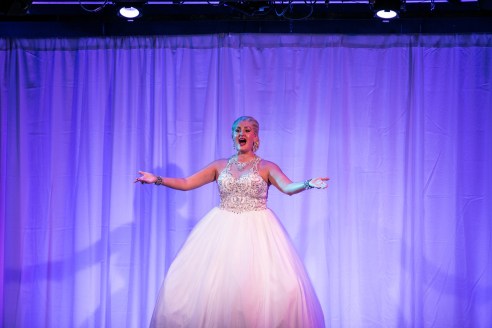
There are 20 songs, or there would have been if one hadn’t been skipped last Saturday. Most generously represented are Evita and Phantom of the Opera – not surprising when you consider that Lucia Stetson and Ryan Deal, who starred in the title roles at CP, are on hand to handle their reprises. This they do with panache, for Chisholm knows where to place his chips when he ponders his staging. Stetson is festively dressed by costume designer Ramsey Lyric for the brash “Buenos Aires” and backed with enough vocalists to evoke a carnivale – and she really is dressed to the nines when she does Evita’s anthemic “Don’t Cry for Me, Argentina.”

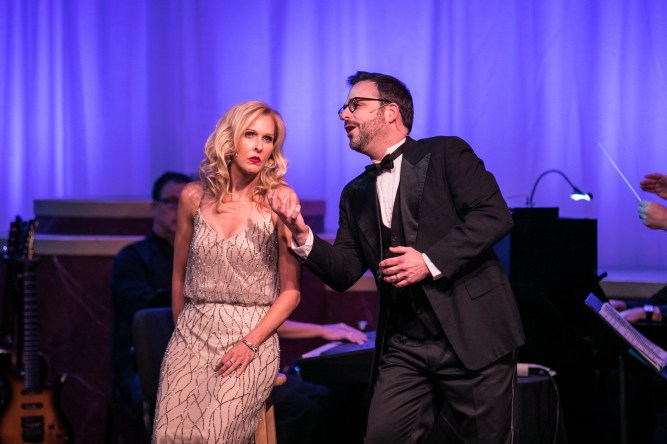
As the ghoulish, predatory Phantom, Deal can only fully come into his own when paired with his prey – the more beautiful, the better. Deal breathes heavily enough to be truly sinister in singing “Music of the Night,” but he’s most commanding when he torments Knowlson in the title song. Squat as Pease is, scenic designer James Duke does provide twin staircases flanking his final Pease set. The one at stage left is definitely an asset when Deal makes his dominant melodramatic exit. “Sing!” he bellows as Knowlson sustains high notes we haven’t heard from her in years. I’m guessing that’s the rest of the ensemble forming an offstage chorus for this duet, intensifying its power.

Taking up the Raoul role, Ratchford struck up the more consoling duet with Knowlson, “All I Ask of You.” All that chemistry was still there, no doubt kindling widespread nostalgia among those in the audience who remember the multiple times Knowlson and Ratchford shared top billing at CP in the past. With the entire ensemble singing “Masquerade” and Knowlson soloing on “Wishing You Were Here,” you will gather that Chisholm & Company’s Music of the Night is wringing maximum mileage from Phantom.

Even before the selections already cited, Brittany Currie Harrington and Traven Harrington were a more age-appropriate Christine and Raoul in “Think of Me.” Traven’s voice is the mellower at his low end, but Brittany was sensational at her uppermost in an unforeseen cadenza at the end of their duet. Each of the Harringtons logged an additional solo before the revue was done, Brittany reprising the title song from Love Never Dies and Traven taking us way back to the title song of Starlight Express.

Do you remember There’s A Light at the End of the Tunnel from that same rollerskating musical? Me neither, but Kevin Harris – perhaps signaling that he’ll be back for Showboat next summer? – reminds us how righteously rousing it is in bringing us to intermission, with backup support that matches the liveliness of “Buenos Aires.” Of the remaining cast members, I most fancied Ron T. Diaz and Emily Witte, both of whom I wished were better showcased.

Witte was saddled with the lackluster “Another Suitcase” from Evita before being obliged to timeshare “I Don’t Know How to Love Him” from Jesus Christ Superstar with Sarah Henkel and Karen Christensen. Diaz continues the Superstar momentum into the final bows, getting a better split on that title song, with J. Michael Beech sharing the spotlight and everybody in celebratory form backing up.

Lisa Smith Bradley bore the burden of beginning the evening with “Memory” from Cats, a song that I loathe from a show I despise. As we moved onward – and inevitably upward – I could be thankful that this irritation had been immediately disposed of. But I remain peeved at the evening’s brevity and the songs from other shows that remained AWOL. If we could dip into Joseph for Ratchford’s Elvis-like “Song of the King” and Harris’s “Close Every Door to Me,” surely there could be space for more than the peeps we had into Song & Dance and Whistle Down the Wind.

Maybe it’s okay to skip past The Woman in White, Aspects of Love, and Tell Me on a Sunday, but surely we must sample the Tony Award-winning Sunset Boulevard and Sir Andrew’s triumphant comeback, School of Rock, which wowed this town back in January. A couple of songs from each of those hits would expand the running time past the 90-minute threshold – and sound more like a respectable survey of this composer’s work.

“The Philadelphia Story” Bides Its Time Before Detonating

Review:  The Philadelphia Story

By Perry Tannenbaum

One of the wonderful things about Philip Barry’s The Philadelphia Story is that, yes, it really is about class distinctions and peculiarities, but the playwright remains ambivalent and tolerant of them all. Beneath their upper or lower crust exteriors, all of these Philadelphians – young and old – are recognizably human. You rarely see so many fully-fleshed characters onstage in the course of a single evening. I wouldn’t be terribly surprised to see a premier professional company repeatedly reviving this witty, effervescent comedy, but it’s absolutely astounding that Theatre Charlotte, our community theatre, has revived Philadelphia Story twice in the new millennium, now and back in 2000.

Both productions showed the pitfalls. The cast needs to be nine deep, alert to the amount of polish and roughness Barry expects of them, and aware of the energies and pacing required at each point of Barry’s intricate plot. The story revolves around “virgin goddess” socialite Tracy Lord – as you might expect, since Katharine Hepburn, the original Tra on Broadway and on celluloid, matched the 25% investment that the playwright plowed into the original production. Tracy is sensibly engaged to the cold and ambitious George Kittredge, impetuously divorced from the dapper C.K. Dexter Haven, and estranged from her father, whose indiscretions have brought the Lords unwanted publicity.

While Tracy is resolving these relationships, her brother is focused on suppressing a magazine exposé that will be published about their wayward father, dangling the prospect of exclusive access to the wedding as an enticing alternative for the publisher. The reporter and the photographer assigned to the Kittredge-Lord nuptials, Mike Conner and Liz Imbrie, bring another level of complications to the scene. She’s been secretly carrying a torch for him for years, but when spirits rise and champagne flows on the night before the wedding, Mike finds that he has fallen – hard – for Tracy, a prelude to their both enjoying an illicit, drunken midnight dip together in the Lords’ swimming pool.

While Barry is at work on how the wedding, the magazine story, and multiple alienated affections – past and present – will ultimately resolve, director Tonya Bludsworth and her cast must deal with all of the reactions and repercussions along the way. Making all of this bubbly complexity even harder for Bludsworth and Theatre Charlotte to achieve is the relative lack of enthusiasm for the project. Turnout for auditions was likely as tepid as audience turnout. Compared with opening night for Peter and the Starcatcher in September, there were conspicuously more empty seats at the back of the house – and a bit less confidence onstage.

Ten of the 14 cast members are new to Theatre Charlotte, including most of the key characters. We started off strong back in 2000 with a Tracy who had the look, the patrician manner, and sometimes even the sound of Hepburn, but that newcomer’s imperial highness never became sufficiently ruffled when the plot thickened. In Bella Belitto, we have another newcomer as Tracy, and on opening night, her serene highness was conspicuously lacking in the early going and – like others onstage – she was often underpowered and inaudible.

Without that serene aura and grace, the splintering of Tracy’s goddess élan isn’t as poignant as it should be in Belitto’s account of her re-education. Yet when she’s assailed by complications, catastrophes, and intensifying adoration, she faces it all very convincingly, her spirits and energies rising. Waking up on the climactic morning after, her decibel level also crescendos spontaneously. We feel that she is learning her lesson and actually benefiting from the indiscretions that brought on her fall – and that the lesson runs deep to her core. Her epiphany detonated effectively for me.

A lot of that depends on Nick de la Canal radiating a rakish upper-crust urbanity as Dexter with enough of that crust trimmed away to make room for tolerance and forgiveness – the two key qualities Tracy needs to acquire. De la Canal’s insouciance also contrasts nicely with the stuffiness that Will Millwood brings to George Kittredge. Barry doesn’t completely hide his disdain for George’s commercial outsider status, so Millwood makes a prudent choice in stressing his judgmental bent.

Dexter also comes off finer than Mike Conner, but by a significantly smaller margin. Here the nuanced class distinctions are no less telling. Christopher Long reminds us that Mike starts out fairly judgmental himself before Tracy bewitches him, but we indulge his pre-judgments more readily in the same spirit that we’re inclined to forgive his boyish, impulsive trespasses. Our best verdict on him vis-à-vis George is much like Barry’s: he’s more deserving, in spite of his depressed finances, of being called a gentleman.

What gives The Philadelphia Story its screwball slant is that everybody up onstage and down in the audience seems to know who the best fit for Tracy is – except for the goddess herself. This includes her mischievous younger sister, Dinah, who attempts some telephone matchmaking. Helena Dryer makes little sis pesky and likable in the right proportions. She’ll be an utter triumph once she makes herself consistently intelligible.

Tracy’s mom isn’t the most pivotal role here, though Margaret does point the way for her daughter in forgiving her husband’s infidelity. What makes Heather Place’s debut so auspicious as Margaret Lord is her clear bubbly delivery and her effortless projection of warmth and class, richly portending her reconciliation with the dashing, slightly over-the-hill Seth Lord. Victor Sayegh is mildly and earnestly supplicating toward Margaret and his disapproving daughter, as befits a Philadelphia patriarch, another cue for Tracy to accept people’s imperfections, including her own.

Sayegh and Place draw two of Chelsea Retalic’s most stylish costume designs in evoking high society elegance, but it’s an uphill battle to project prosperity amid Josh Webb’s drab and dour set design. Two Ionian columns fail to provide uplift, and there’s no longer a visible hint of the swimming pool in the wings. Portraying the eccentric Uncle Willie in a delightful debut, Dan Kirsch gets my nod as the plutocrat most at home in this down-market mansion, lovable for all his pomposity.

Fresh from his crossdressing exploits in Starcatcher, Johnny Hohenstein is mostly responsible, as Tracy’s scheming brother Sandy, for the PR intrigue that lurks beneath the romantic comedy. Good luck following – or caring about – all the Act 2 twists in that sector of the plot. For that reason, Anna Royal as Liz turns out to be more important for me. Ultimately, she’s modeling the patience, forbearance, and forgiveness toward Mike that Tra should have toward Dex. Royal gives Liz just enough edge to update her and elevate above the cliché she must have been in 1939 when THE PHILADELPHIA STORY first hit Broadway.

Here she isn’t just a working-class woman who knows her place, meekly deserving Tracy’s discards. Wielding her Contax camera, she’s Mike’s professional partner, biding her time for a natural upgrade.