Daily Archives: August 29, 2018

Pride Rock Remains Strong in “Rafiki Tour” of “The Lion King”

Review:  THE LION KING

By Perry Tannenbaum

Among the multitude of musicals they have brought to Broadway, Disney proclaims The Lion King as the world’s #1 musical, not just theirs. Very likely, more people around the globe have seen the show than any other Broadway musical in history. Yet as the megahit reaches its 21st Broadway birthday, the key question we ask each other about it is evolving. As generations grow up and older, we’re less inclined to ask each other if we’ve seen The Lion King. Now in its fourth Charlotte run at Belk Theater, we’re apt to ask each other how many times we’ve seen the tour or, more nostalgically, “Do you remember your first time?”

With all the massing of puppetry for its curtain-raising “Circle of Life,” Lion King wasn’t built to start on time. It’s a bit like a Carowinds ride that doesn’t begin until seatbelts are fastened or doors are locked. Of all beginnings, you don’t want to miss this beginning.

A significant part of why I keep coming back is to be wowed by that opening, of course, but that wow factor diminishes a tad during the five-year intervals between tours. Watching newbies respond to the legendary puppet parade is what keeps the experience fresh for me. My wife Sue has ceded her usual seat for the last two iterations, giving me the opportunity to be up-close when a granddaughter and a great-grandmother took it all in for the first time.

In aisle seats.

Come to think of it, I don’t remember anybody arriving late on press night or taking a seat after the great procession. When a show becomes a family heirloom, as LION KING undoubtedly has, somebody in each group must know the score – and the necessity of arriving before lockdown.
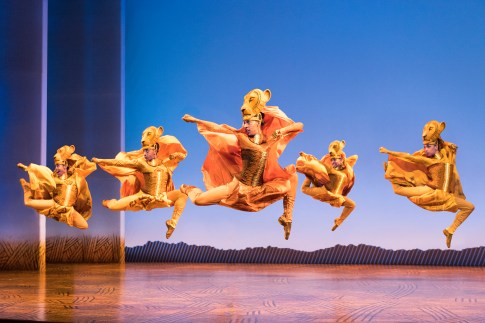
The magic of the puppets, particularly the tall giraffes and the gargantuan elephant, has often been cited as triggering the unique theatricality of director/designer Julie Taymor’s inspired adaptation. But since this company has been designated the “Rafiki Tour,” it’s fitting to direct our attention toward the shaman who greets us and summons the animals to Pride Rock. Not only has Rafiki been favored with a gender switch from the 1994 animated Disney original, she has also discreetly shed her baboon origins. From the outset, we get the message that this unparalleled ceremony is humans paying homage to the animal kingdom – and life itself – in the most respectful and beautiful ways we can devise.

On top of that, there’s percussion, singing, and later even birds in the upper levels of the hall, a cathedral effect. The spectacle envelopes us and uplifts us. Of course you’d want to come back!

Elements of the story echo biblical and Shakespearean motifs that resonate deep within us. What we also treasure about Lion King is how it manages to celebrate both liberty and responsibility as Simba, the future Lion King, matures – always maintaining a firm grasp on which of those values is most important. Delaying justice until Simba gets his priorities sorted out makes it all the more satisfying when he ascends to his rightful throne. Yet the long arc of his drama is punctuated with low, low comedy along the way.

Mukulisiwe Goba as Rafiki and Mark Campbell as Simba’s usurping uncle, King Scar, have traveled long and far on multiple tours of this show, very much a part of its fabric. Crying out her “Nants’ Ingonyama” chant to the kingdom, Goba seems to be as much the soul of Taymor’s Africa as the ginormous sun that rises over the savannah or the iconic baobab tree than spans it. Campbell’s tigerish costume looks weathered from its epic journeying, equally emblematic of Scar’s wickedness and old age. He also wields a cane, adding a dimension of Richard III decrepitude to his seniority and immorality. The 2013 Scar labored with that same limitation – so I can’t continue to overlook the clumsiness of the climactic fight choreography. Clean it up, Diz, especially the last reversal.

Nick Cordileone as the chattery meerkat Timon and Ben Lipitz as the stinky warthog Pumbaa repeat their 2013 stints at Belk Theater, so the comedy in the carefree tropics has never been better. Back at Pride Rock and at the Elephant Graveyard, Greg Jackson is the model of punctilious British servility – and timidity – as Zazu, a high-pitched hornbill with a hilarious puppet.
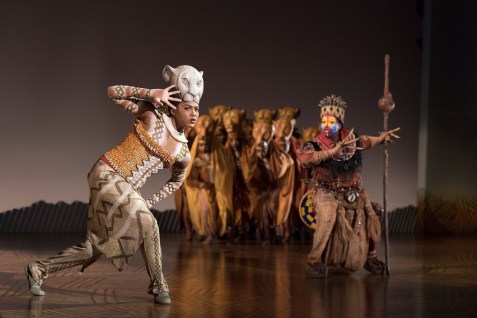
Nia Holloway returns as Nala, Simba’s destined queen, as lithe and graceful in her movements as ever. Chemistry between her and the new adult Simba, Jared Dixon, isn’t as torrid as it was five years ago. Holloway is more regal and commanding than before, while Dixon is more naïve, exuberant, and happy-go-lucky than his predecessor. It’s as if the mystic grace of Holloway’s cat movements rubs off on Dixon, imparting the gravitas that he has lacked. Goba also intercedes magically in her most dramatic moment as Rafiki.

Only in his afterlife does King Mufasa succeed with his wayward son, and Gerald Ramsey has exactly the right combination of regal strength, fatherly forbearance, and tragic stoicism. Young Simba, who lingers onstage throughout the first act, is the sort of role that could launch a future Michael Jackson. Two youngsters on the cusp of adolescence rotate in the role on tour, keeping with the Broadway practice. Charlotte native Ramon Reed certainly didn’t disappoint on press night, with ebullience to burn. Understandable, since he’s also listed in the current Broadway cast at ibdb.com.

Straddling Broadway, Black Panther and Black Diamond

Preview: Eclipsed

By Perry Tannenbaum

Few writers who have brought a script to the Broadway stage have also had a major acting role in a major Hollywood film. Mae West, Orson Welles, Sam Shepard, Mel Brooks, Maya Angelou, and Woody Allen have legit claims. Perhaps the stealthiest addition to this very short list happened this summer when Danai Gurira emerged in the Marvel universe as Okoye, the spear-wielding generalissimo of Wakanda in The Black Panther. You’ll look long and far for a review that reminds us that Gurira’s Eclipsed not only came to Broadway in 2016, it scooped up six Tony Award nominations, including one for Best Play.

Of course, the record was set straight when Panther became a megahit and Gurira, already a star of The Walking Dead series on AMC, rose even higher in the firmament. Feature stories about Gurira consistently cited Eclipsed among her accomplishments. Additional light reflected back on Eclipsed from Lupita Nyong’o, the glam spy of Panther. Nyong’o was nominated for a Tony as the leading lady in Gurira’s play after her Oscar-winning performance in 12 Years a Slave.

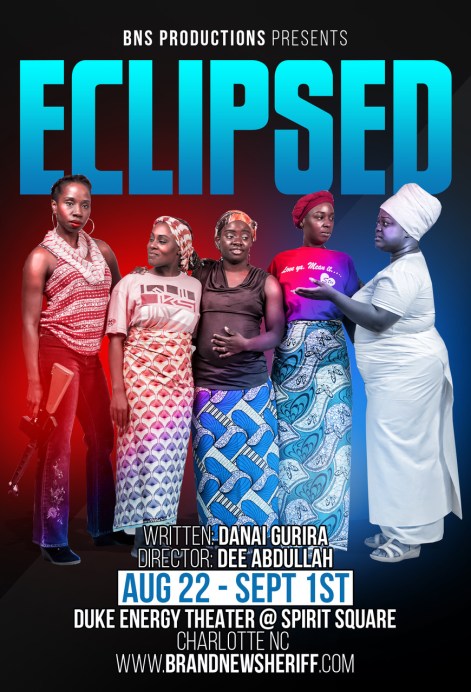
Gurira’s rare achievement is definitely drawing the spotlight now that Eclipsed is making its rounds among regional theatres. Bringing Eclipsed to Spirit Square this week, Brand New Sheriff Productions certainly isn’t ignoring the playwright’s Walking Dead and Panther connections as it spreads the word.

You won’t find any zombies at Duke Energy Theater, but connections between Black Panther and Eclipsed are substantial. Both dramas are set in Africa. While Wakanda is a fantastical high-tech kingdom in Marvel geography, Gurira’s Liberia is quite real – but no less dramatic. After spending a good chunk of her childhood in Zimbabwe, Gujira returned to the continent on a grant from the prestigious Theatre Communications Group in 2007 and interviewed more than 30 women who had been victimized by Liberia’s civil war.

Among these women – some of whom were serially raped, others whose daughters had been kidnapped and turned into sex slaves – Gujira took four of their names for her characters. Three are wives of the unseen Commanding Officer, a brutal rebel leader against president Charles Taylor, and the other is a peace activist seeking to bring the war to an end.

The fifth woman, at the heart of this drama, is unnamed. “The Girl” is CO’s most recent captive, and two of his wives, Helena and Bessie, are hoping to shield her from him.

Yes, Eclipsed was the first play to hit Broadway with an all-black female cast. Just don’t get the idea that Gujira’s script is all about victimhood and peacemaking. CO’s other wife, Maima, is a freedom fighter with the Liberian rebels, and she returns from the battlefield with some serious weaponry strapped to her shoulder.

Maima is not only an action figure vaguely akin to Okoye in Black Panther, she’s modeled after Col. Black Diamond, a female Liberian freedom fighter. Guijira saw a picture of the warrior in a New York Times feature in 2003, the year that the Second Liberian Civil War ended. Black Diamond was the inspiration for Gujira’s mission to Liberia – and for Eclipsed. The way Maima sees it, men aren’t going to rape you if you’re toting an AK-47.

That’s where actress Tracie Frank comes in. A self-confessed blerd, she knew about Marvel and Black Panther long before she knew about Eclipsed, and she knew Gujira as Okoye before she realized that the film’s action hero was also playwright. She has done major roles around town in A Trip to Bountiful and the title role of Caroline, or Change. But nothing like Wife #2, Maima.

“Truthfully, I didn’t even see myself in that role when it did come along,” Frank admits. “As I read the script to prep for the audition, I decided to read for the two ‘motherly’ roles. I remember absently thinking, ‘wow, whoever plays Maima will have to be tough!’”

Director Dee Abdullah thought differently, handing Maima’s lines to Frank after her first reading.

“I was surprised,” Frank recalls, “but I went out and read her again – not as an impartial observer, but as a version of myself… and I knew it was right. I guess I feel like Wife #2 chose me.”

Well, so did Abdullah after a hiatus from directing of five full years. A co-founder of Carolina Actors Studio Theatre with Ed Gilweit, Abdullah was no longer at the core of CAST when the company folded in 2014, but she was devastated by the loss. Corlis Hayes shoved a life raft towards her when she directed August Wilson’s Jitney for BNS last summer, asking Abdullah to design the costumes.

That gig positioned her for Eclipsed. Another BNS blerd, Abdullah has been on board as a Black Panther fan before the film but only slightly acquainted with Eclipsed because of the Nyong’o connection. After researching the story, she knew this was the project to get her back into directing.

“As you might remember,” Abdullah says, “I am not one to shy away from difficult subject matter. This play gave me all the complications a human spirit could endure and still survive. It is about women and their courage to survive under the worst circumstances that life could hand them. It is also based on real stories of the Liberian civil wars, which made it more compelling for me.”

Away from the scene for five years, Abdullah had grown out of touch with the local talent that would show up for auditions. Three of her five choices – Toni Oliver as Helena, Racquel Ena Mae Nadhiri as Bessie, and Gbale Allen as The Girl – are new to the Charlotte scene. Aside from Frank, Ruby Edwards as Rita, the peace negotiator, will be the only familiar face.

“All of the women had a special quality about them that make me want to look at them on stage,” Abdullah recalls. “Tracie has a power that came across much more grounded than the others. Her character makes a choice that takes her on a much more difficult journey than the other women – I needed someone who could convey that energy while staying grounded in truth. The Girl is the only character that goes through a transformation during the course of the play. Gbale gave the innocence as well as the confident toughness that this character needed to pull this role.”

Getting the roles was just the beginning of this ensemble’s journey. Casting by Abdullah was done four months in advance, with rehearsals beginning in late April, so the performers could research the culture, learn the civil war history, bond with one another and learn a Liberian accent. Oh yeah, there’s also some footage online of Frank and Allen wielding their firearms.

“Dee has been quite unique,” Frank affirms, “and I can’t imagine anyone else directing this play. She’s intuitive and observant – she sees what’s under the surface – and that’s vital in a story like this one.”

Abdullah is pleased with the dedication her cast has put into their work, and Frank believes the results will show.

“There’s a natural rhythm to our interactions,” she explains, “one that comes from knowing each other, caring for each other, being annoyed by one another! We’ve formed a sisterhood that won’t end when the [show] closes on September 1st. We’ve learned and experienced so much over this spring and summer. It has been unforgettable.”