Review: Evita
By Perry Tannenbaum
There isn’t a superabundance of melody in Evita, but when composer Andrew Lloyd Webber’s supply begins to run low, he deftly puts his few song lines, riffs, and strands of recitative into a spin cycle, zigzagging through Spanish, Latin, and jazz idioms. Or he might shift tempos for a reprise, shift the context for a song’s reprise that gives it new meaning, or simply drop in a replay.
More conspicuous is the lack of action complementing Tim Rice’s lyrics for a musical purporting to bring us the life and legend of Eva Perón, Argentina’s first lady during the presidency of Juan Perón. Much of this story is told through the cynical-yet-captivated eyes of fellow Argentinian Ché Guevara, beginning his narrative at Evita’s phenomenal state funeral. What Ché attempts to explain is how an obscure commoner from the boonies could become so beloved and venerated in the space of 33 years.
Less dramatic muscle, bone, and spectacle were baked into this 1976 opus than the sturdier Phantom of the Opera, which would be minted 10 years later. In previous Charlotte productions by Queen City Theatre Company (2010) and Theatre Charlotte (2003), small-scale design concepts reminded us that Evita is closer in Sir Andrew’s chronological development to the episodic Joseph and the Technicolor Dreamcoat than his signature guignol. After all, only four major characters create the whole Argentine tapestry.
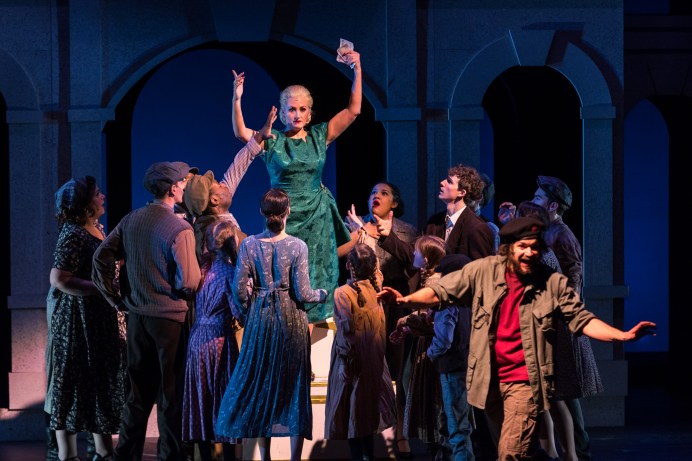
CPCC Theatre shoves Evita toward grandiosity at spacious Halton Theater, largely through the design wizardry of Robert Croghan. There is classic splendor to the iconic balcony scene at the Casa Rosada, and when Peronistas demonstrate in the streets for a “New Argentina,” Croghan drapes his set design with massive flags and banners scribbled with slogans that drop down from the Halton’s high flyloft.
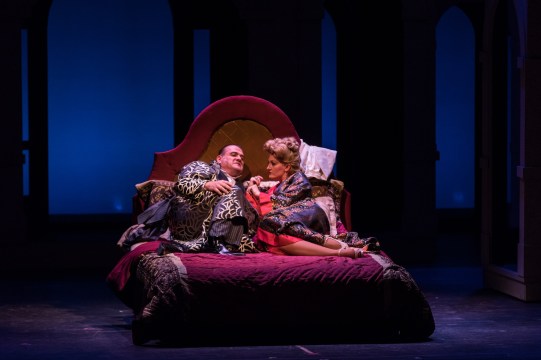
Plenty of Croghan’s costume designs are of the peasant variety, but when it comes time for Evita to be dressed to the nines – or for the strongman Perón to luxuriate in the opulence of his bedroom – we can see what South American excess and corruption look like. Actors and audiences love this musical beyond its deserts, so director Tom Hollis could be expected to find a fine Evita to glitter in this excellent Halton setting. In Lucia Stetson, he has struck gold.
Or should we say silver, since that’s what Argentina is known and named for?
Along with her wardrobe, Stetson becomes more and more refined as she exploits one man after another in her climb to the top. The sassy arriviste of “Buenos Aires – Big Apple” turns imperious as Evita supplants Perón’s previous mistress, but we don’t see the first rays of sublimity until after intermission when she appears on the balcony of the presidential palace – aglow in Jeff Child’ lighting design – and sings the iconic “Don’t Cry for Me, Argentina.” Stetson does majestic even better than she does sass.
From that moment on, it’s up for grabs whether Evita is a saintly benefactor of the poor, Argentina’s beauteous ambassador to the world, or a corrupt, self-indulgent template for Imelda Marcos. Not only is there a tension between Che’s cynical jabs and the Peróns’ official line, there’s also an inscrutable quality to Stetson’s performance that blossoms naturally out of her majesty. Crowning that regality is Stetson’s star-quality singing, which makes everything believable – Evita’s vanity, her savvy, her belief in her own beneficence, and her physical frailty.

Sadly, Stetson was the only singer onstage at the Halton last Saturday night who was consistently intelligible. Whether it was their diction, their mics, or settings at the Halton’s notorious soundboard, Ron T. Diaz as Che and Robert Nipper as Perón struggled to be understood. Diaz started off well enough in the opening funeral scene, but when the orchestra grew loud behind him, the words and the narrative thread got lost, though Diaz’s voice and Che’s gadfly intensity still pierced through. He restores the rock intonations that Ricky Martin rejected in the most recent Broadway revival of 2012, and I recognized them like an old frenemy in all their original gusto.
Thuggish, conceited, and physically imposing, Nipper helps the “I’d Be Surprisingly Good for You” duet to sizzle with restrained sensuality and menace, as good a Perón as I’ve ever seen, with a robusto voice. If they’d fix the audio, his performance would likely join Stetson’s in the not-to-be-missed stratosphere.
Joel King as the crooner Magaldi, Evita’s small-town ticket to Buenos Aires, and Leana Guzman as Perón’s Mistress both satisfy in their respectively comical and pathetic cameos, and music director Drina Keen leads a fine 13-piece band in the pit. We don’t quite hear the volcanic eruption at the end of the symphonic “Don’t Cry for Me, Argentina” that would give us the lift of a true coronation, but the ensemble is sleek in the Latin-flavored sections of the score, and drummer Kyle Merck makes the military interludes a delight.
At the café where Evita enchants Magaldi and when Evita begins to move to the same music with Perón, choreographer Ron Chisholm makes the company and his principals look good. When the choruses of aristocrats and army soldiers join in berating “Perón’s Latest Flame,” one of numerous spots where we might perceive a disconnect between the music and the intended mood, Chisholm goes with the comical flow. So Argentina’s military struts like a regimented bunch of banana republic bumpkins.
Hardly a minute later, Perón considers running away from these buffoons to Paraguay. Guess he didn’t see them the same way. In that crucial moment, Evita becomes Lady Macbeth to keep him on track.



 Art on My Sleeve