
Review: American Idiot
By Perry Tannenbaum
Young love and the ills of the world are so frequently the focus of rock musicals that we sometimes feel little need to decipher the words that jangle together with the actions and emotions we’re seeing onstage. This week is a particularly rockin’ and raucous week in Charlotte, with the 20-year revival tour of Rent and the new Actor’s Theatre of Charlotte production of American Idiot opening on consecutive nights.
The original premiere of the Jonathan Larson musical and the 2004 Green Day album were separated by a mere eight years. While the young adult angst lived on, the world had completely changed: the old preoccupations with AIDS and AZT were supplanted by post-9/11 disillusionment and a scattershot scorn for suburbia, corporate America, the war-mongering George W, and the powerlessness of teens to change any of it.
Actor’s Theatre certainly knows powerlessness. Scheduled to open their new location on Freedom Drive last October, they had to be content to offer tours of their production-ready facility. Governmental regulations, foot-dragging and red tape have pushed back the opening to a still undetermined date in 2018. For a second consecutive show, Actor’s Theatre is relying on the kindness of Queens University and their Hadley Theatre, a facility they share with Myers Park Traditional School. Once you get past the decorous entrance and the antiseptic hallway, the black box venue actually possesses much of the off-Broadway feel we’ve come to expect from this company.
At the core of this production are a stage director, music director, choreographer, and a couple of lead actors who have figured prominently in past Actor’s Theatre productions at their demolished former home on Stonewall Street. They may be taking their exile from a permanent home personally, now that it’s prolonged to nearly 18 months, with an understandable urge to scream. Producing artistic director Chip Decker didn’t appear to be worried about reining any of them in, especially music director Ryan Stamey and choreographer Tod A. Kubo.
Stamey stands behind a keyboard at the edge of the stage, looking up at a six-piece band perched above the middle of the stage, occasionally leaning into a microphone and joining the vocalists. There’s a cellist embedded in the sextet whom I never heard. Likewise, the tropical strains of steel guitar, so clearly soothing in the background of the Broadway cast album on “Give Me Novacaine,” has been almost completely sandpapered away by Stamey’s heavy-metal approach.
The storyline, not exactly robust on the Grammy Award-winning concept album, has been somewhat bolstered by lead singer Billie Joe Armstrong and stage director Michael Mayer in their book. Instead of a single Jesus of Suburbia, the musical has three. We have the original Johnny, who escapes the burbs only to encounter his hipster, heroin-shooting alter ego, St. Jimmy, and the possible love of his life, Whatsername.

At a neighborhood 7-Eleven, Johnny meets two other chums who have been crucified by suburbia – and turned into American Idiots – Will and Tunny. Only one of those two will use the bus tickets Johnny has purchased for the trio’s glorious breakaway. Will’s girlfriend, Heather, shows up and places his hand on her belly, obviating the need of saying to him that she’s pregnant. Apparently, punk rockers aren’t very articulate, for Tunny doesn’t do much of anything in the big city, mostly lying face down on a bed until lured by a US Army commercial to go off and fight in an unspecified foreign war.
With two more self-pitying saviors and two additional girlfriends worked into the story – Tunny eventually finds The Extraordinary Girl – Armstrong added more Green Day music to his score, conveniently taken from 21st Century Breakdown, the follow-up album to American Idiot. Their decibel level tamped down to barely bearable, the band is so face-meltingly loud that you have to admire the singers’ will to prevail. Decker doles out the most expressive and outré action to Johnny and St. Jimmy, keying electrifying performances from Matt Carlson and Jeremy DeCarlos respectively.
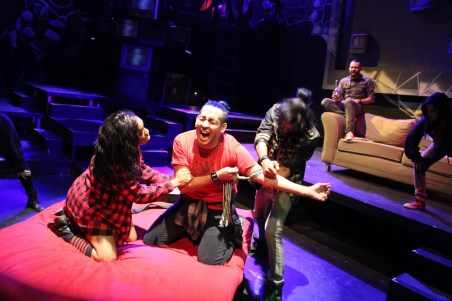
From his defiant and rebellious posturing in suburbia, Carlson became pure decadence in the city, simulating casual sex, shooting dope, and reeling around in a stupor as he sang. To contrast with this charismatic dissipation, DeCarlos had to take extreme measures to strike us as Johnny’s inner Beelzebub. There has always been a physical resemblance between DeCarlos and Jimi Hendrix, and I had to suspect that St. Jimmy would be the role to set it loose. Costume designer Carrie Cranford audaciously joined in the conspiracy, supplying a flamboyant jacket that evokes the Hussar military jacket Hendrix sported back in the late ‘60s. There wasn’t a headband or a Mexican bandit’s sombrero in the outfit, but the outrageous hairdo more than compensated, so puffed and straightened that I didn’t notice the thin dangling braids at first.
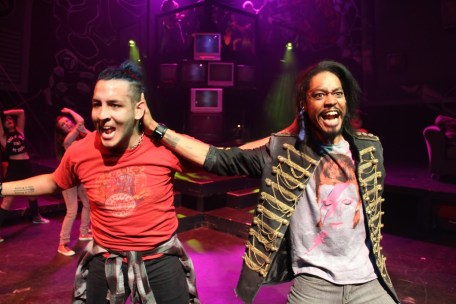
Coupled with this look were spell-casting gesticulations that went beyond the Wicked Witch of the West and World Wide Wrestling in their shamelessness, and I’ve never heard DeCarlos sing with such ferocity before, though there are also seductive and manic moments for St. Jimmy. Where exactly in this charismatic performance the ministrations of Kubo’s choreography began was difficult for me to divine, but the choreographer should definitely get a large proportion of the credit for making this American Idiot such an immersive, visceral experience. Like Actor’s Theatre general manager Martin Kettling told us in his curtain speech, the ensemble frequently used the platform looming above the stage as a jungle gym, often joining the musicians at the top. Over and over, I saw daring dance moves that must have come after Kubo hopefully asked, “Can you try this?” in rehearsals.

Some of the most arresting action came from the women, differentiating the Charlotte American Idiot from the Broadway edition, where hard rock seemed to be the exclusive playpen of macho sexist louts. Nonye Obichere was particularly stunning as Whatsername, all Johnny could handle and more, singing and dancing with a dominatrix edge. As Heather, Lizzie Medlin was more bitchy and Gothic, upstaging Steven Buchanan, who was mostly confined to the vicinity of a sofa once Will grudgingly chose domesticity as his direction in life.
Grant Zavitkovsky was underpowered, undermiked, and largely unintelligible as Tunny in the early going, but those problems thankfully vanished by the time he enlisted. While the budgetary concessions Decker made in his set design worked well, the technical economies he adopted meant that Tunny’s wartime travails were far less catastrophic. No matter how well Grant Zavitkovskyperformed the role, The Extraordinary Girl couldn’t be nearly as extraordinary in her devotion.
There’s a self-critical bent in Armstrong’s leading men that is totally at odds with the striving, sentimental nobility and martyrdom of the Rent heroes and heroines. Lyrical and melodic takeaways from American Idiot aren’t as vivid or memorable as those you might find in the sassy “Out Tonight” or the anthemic “What You Own” that Larson crafted for his glorified squatters. I didn’t find myself nearly as much on the side of Armstrong’s troubled American Idiots, but I did feel they should be listened to. Even if I hadn’t known how passionately Carlson and DeCarlos felt about this music, I would have heard it in their voices and seen it in their actions.



 Art on My Sleeve